- Understanding homophones
- Different types of homophones
- Elevating your English level with homophones
- -ail/-ale
- -ed endings
- -air/-are and related endings
- -ai and other endings
- Other “a” and “e” homophones
- -ear/-are or -ere
- -ea/-ee
- Other -ea homonyms
- -ew
- -ite/-ight
- -ou/-ow or -oe
- -oa and other endings
- -on/-un or -one
- Other -e homonyms
- C and s sounds
- Silent letters
- Numbers
- Other “y” and “u” homophones
- Contractions
- Wrapping up: Homophones are just one small part of English
- Frequently Asked Questions
- What are homophones?
- How do homophones differ from homographs and homonyms?
- Why is understanding homophones important?
- Can you provide examples of common homophones?
- How can mastering homophones improve my English skills?
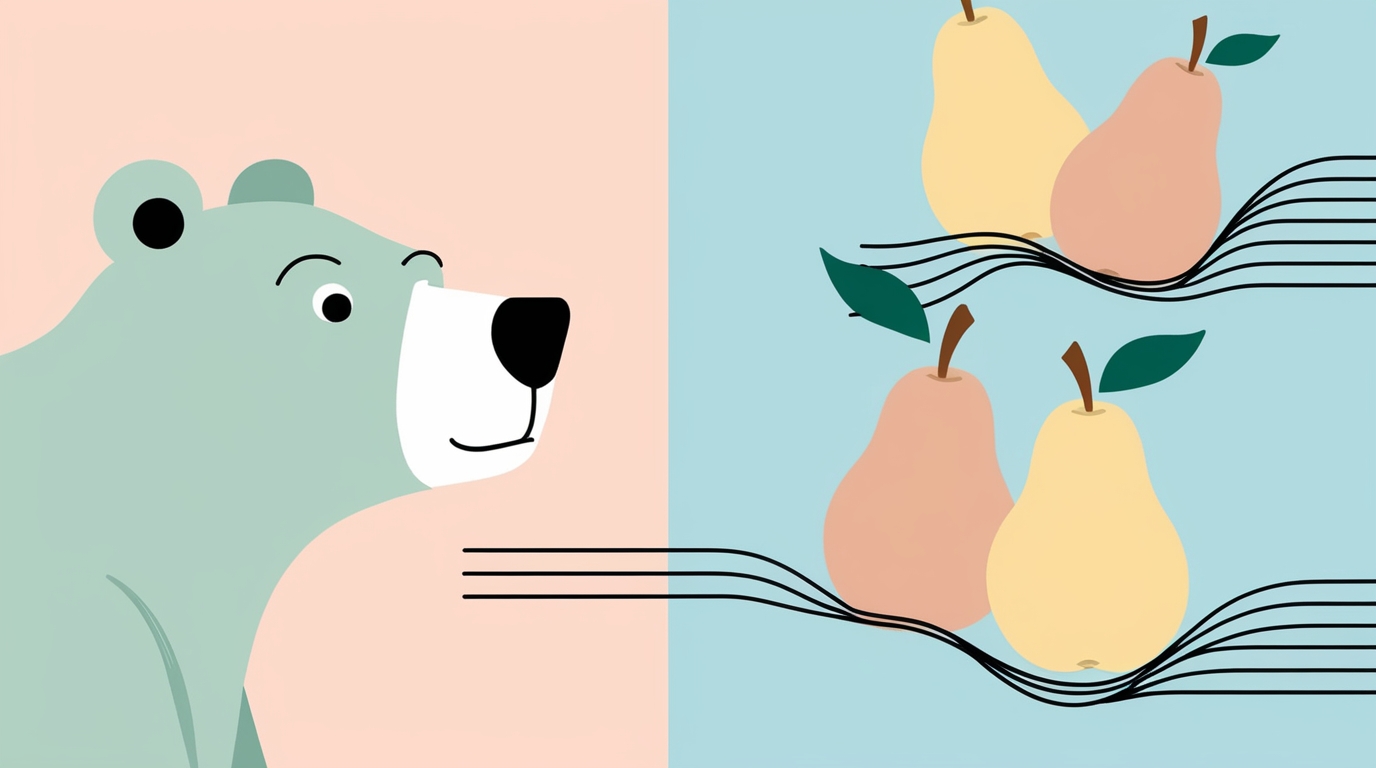
If you hear someone say that a bare bear with a pair of pears just sold a sail, it might sound puzzling at first. But what they really mean is that a naked bear made some cash by selling a section of his boat while also holding two pieces of fruit.
Homophones, words that sound alike but have different meanings, can be tricky yet fascinating. They offer a unique opportunity to explore the subtle intricacies of the English language. By mastering homophones, you’ll enhance your ability to engage in complex discussions, enjoy humor, and deepen your overall understanding of English.
In this article, we will explore the fascinating world of homophones, highlighting their distinctions from homographs and homonyms. We’ll also discuss why understanding homophones matters and share an extensive list of over 100 homophone pairs. Get ready to impress your friends the next time someone mentions the “hair of a hare”!
Understanding homophones
The term “homophone” is derived from Greek, where “homo” means “same” and “phone” translates to “sound.” This makes it clear that homophones are words that share the same pronunciation yet differ in meaning and spelling.
English is filled with homophones that often trip people up. Take the words “to,” “too,” and “two,” for instance. Although they sound identical, each serves a distinct purpose in grammar. “To” is a preposition that signifies direction, “too” is an adverb that means also, and “two” represents the number. For example, you can say, “I’m going to the store,” but not “I’m going two the store.” Similarly, you might enjoy “two cups of coffee,” but not “too cups of coffee.” Understanding these differences can sharpen your writing and communication!
A common source of confusion in English is the pair of words “its” and “it’s.” Even native speakers sometimes struggle to differentiate between them. “Its” indicates possession, as in “the car and its tires,” while “it’s” is a contraction for “it is.” For example, it’s not safe to drive a car without its tires properly attached. Understanding this distinction can help improve your writing clarity!
The words “your” and “you’re” may sound alike, but they serve different grammatical purposes. “Your” is a possessive adjective, while “you’re” is a contraction of “you are.” For instance, if someone says, “You’re more than your achievements,” they’re playing with these homophones. Understanding the difference can enhance your communication skills!
Different types of homophones
Homophones are just one fascinating aspect of the English language; they have a counterpart known as homographs. The term “graph” typically relates to writing—take “autograph,” for instance, which means signing one’s own name. This helps us grasp that homographs are words that share the same spelling but possess different meanings and sometimes even different pronunciations.
Homonyms are a fascinating category of homophones that consist of words that sound alike but are spelled differently and possess distinct meanings. For instance, consider the pairs “be” and “bee,” or “bough” and “bow.” There are even three-way homonyms, like “cite,” “site,” and “sight,” which all sound identical yet have their own unique definitions. These intriguing word sets highlight the playful complexity of the English language!
Elevating your English level with homophones
Mastering homophones can significantly enhance your conversational abilities by highlighting the crucial distinctions between words that sound alike. This practice also deepens your grasp of language patterns. Additionally, familiarizing yourself with homonyms can boost your writing skills, as these words often adhere to particular spelling conventions.
Homophones play a crucial role in helping English speakers create and understand puns—those clever jokes that rely on words that sound alike but carry different meanings. While grasping humor in a foreign language and its cultural nuances can be challenging, English learners often find that mastering homophones makes it significantly easier to appreciate and enjoy English jokes.
By mastering homophones, you’ll not only enhance your grasp of nuanced language but also deepen your cultural insights. To kickstart your journey, here’s a curated list of homophones along with their definitions:
-ail/-ale
- Mail, male: Something you receive via delivery vs. the biological way of saying “man.”
- Sail vs. Sale: A sail is a fabric that enables a boat to harness wind power, while a sale refers to the transaction of exchanging goods for money.
- Tail, tale: The hind appendage of an animal vs. a story.
- Wail, whale: To emit a loud, usually mournful, sound vs. a large sea creature.
- Ail, ale: To be sick vs. a type of beer.
- Pail vs. Pale: A pail is a container for holding materials like sand or water, while pale describes a light color, often referring to a person’s face when blood drains.
- Bail, bale: A sum of money in exchange for an arrested person vs. a bound block of hay.
-ed endings
- Band, banned: A group of musicians vs. something that is not allowed.
- Find, fined: To discover vs. being obligated to pay a sum of money for breaking the law.
-air/-are and related endings
- Fair, fare: Just vs. the set amount paid for riding public transport, such as a bus, subway, plane, or taxi.
- Hair, hare: What grows out of your head vs. a rabbit-like animal.
- Pair, pare, pear: A set of two vs. cutting down vs. a fruit.
- Air vs. Heir: Colorless, tasteless gases inhaled for respiration vs. an individual who receives money or assets from a deceased individual.
- Fairy, ferry: A small mythical creature vs. a boat or ship that carries passengers back and forth between destinations.
-ai and other endings
- Aisle, isle: A passageway between seats or shelving vs. a small island.
- Maid, made: Someone who cleans for a living vs. the past tense of “to make.”
- Pain, pane: Hurt vs. the glass in a window.
- Wait, weight: Remaining in the same position vs. how heavy an object is.
- Rain, rein, reign: The water that comes from the sky vs. an animal harness vs. ruling over a land.
Other “a” and “e” homophones
- Marry, merry: To be legally joined in holy matrimony vs. happy and joyful.
- **Brake vs. Break:** A brake is a device that halts machinery, while “break” refers to stopping an activity or causing something to shatter.
- Hay, hey: A type of grass given to grazing animals vs. an informal greeting of hello.
- Pray, prey: To address a divine being such as God or a god vs. what is hunted.
-ear/-are or -ere
- Bear, bare: A fuzzy animal vs. naked or uncovered.
- Tear vs. Tare: “Tear” refers to ripping or the liquid emitted from the eyes while crying, while “tare” denotes the weight of a container used to balance a scale.
- Wear, where: To put on, usually a piece of clothing, vs. the indication of location.
- Hear, here: To perceive a sound vs. the place where one is located.
-ea/-ee
- Meat, meet: The butchered flesh of an animal vs. to make the acquaintance of.
- Beat, beet: To hit with force vs. a type of root vegetable.
- Feat, feet: An impressive act vs. the body part attached to the leg by the ankle.
- Flea, flee: A small, jumping insect vs. to run away.
- Grease, Greece: A thick, oily substance vs. a country on the Mediterranean Sea.
- Heal, heel: To cure vs. the back part of the foot.
- Peek, peak: To look at quickly or glance vs. the highest point (for example, the peak of a mountain)
- Real, reel: Existent or factual vs. a series of photos or videos.
Other -ea homonyms
- Bread, bred: A type of food made of flour and water vs. mated to produce offspring.
- Read, red: The past tense of “to read” vs. the color of blood.
- Peace, piece: A sense of calm vs. a part of a whole.
-ew
- Blew, blue: The past tense of “to blow” vs. the color of the sky.
- Flew, flu: The past tense of “to fly” vs. an infectious illness.
- Chews, choose: To mash food up with your teeth vs. to pick or decide.
- Crews, cruise: The plural of working groups of people vs. a vacation on a large, sailing ship.
-ite/-ight
- Cite, site, sight: To refer to vs. a place or location vs. what you see.
- “Rite, Write, Right: A ceremonial tradition, the act of writing or composing text, and the concept of moral correctness.”
-ou/-ow or -oe
- Flour, flower: The powdery result of ground-up grains such as rice or wheat vs. the reproductive part of the plant.
- Bough, bow: The branch of a tree vs. bending over at the waist as a sign of respect.
- Dough, doe: Uncooked bread vs. a female deer.
-oa and other endings
- Coarse, course: Rough (to touch or socially) vs. a class or a path.
- Hoarse, horse: A croaking voice vs. an animal one rides.
- Groan, grown: A sound made of frustration, disappointment, or both vs. full-sized.
- Loan, lone: To lend someone something vs. solitary or solo.
- Oar, or, ore: The paddle of a boat vs. either vs. a raw mineral.
-on/-un or -one
- Son, sun: A male child vs. the largest star in our solar system.
- Won, one: The past tense of “to win” vs. a singular item.
Other -e homonyms
- Be, bee: In the state of vs. a small insect.
- Genes, jeans: Parts of DNA vs. pants made of denim.
C and s sounds
- Cell, sell: An isolated, self-sufficient area vs. to receive money in exchange for a product.
- Cent, scent: A small unit of money (in pennies) vs. a smell.
- Cereal, serial: A type of breakfast consisting of crunchy grains vs. multiple iterations of something.
- Ceiling vs. Sealing: The ceiling refers to the upper interior surface of a room, while sealing involves closing off openings, such as doors or leaks.
Silent letters
- Chord, cord: A musical sound when multiple notes are played vs. a connecting device (such as a USB cord).
- Whole, hole: An entire portion vs. an opening or empty area.
- Know, no: To be aware of vs. the opposite of “yes.”
- Knew, new: The past tense of “to know” vs. novel (the opposite of “old”).
- Knight, night: A medieval fighter vs. the opposite of “day.”
- Knead, need: Massage vs. require.
- Hour, our: A sixty-minute unit of time vs. the possessive form of “we.”
- Rap, wrap: To tap or to speak in rhymes with rhythm vs. to cover fully.
- Ring, wring: To circle around vs. to squeeze out.
- Add, ad: To join or combine vs. a notice or poster.
- Mourning vs. Morning: Mourning refers to the sorrow felt for a lost loved one, typically due to death, while morning denotes the early part of the day (AM).
- High, hi: Elevated vs. another way to say “hello.”
Numbers
- Two, to, too: A number (2) vs. a preposition expressing motion in the direction of vs. also.
- Eight, ate: A number (8) vs. the past tense of “to eat.”
- **Four, For, Fore**: Distinguish between the number 4, the preposition “for” which connects ideas to objects or purposes, and “fore,” meaning the front (including their respective adjective forms).
Other “y” and “u” homophones
- Bye, by, buy: A farewell at the end of a meeting, a preposition indicating the doer of an action, and the act of purchasing a product.
- Die, dye: When a life ends vs. something that changes the color of something, such as a fabric or hair.
- “Dew, do, due: ‘Dew’ refers to morning moisture from condensation, ‘do’ means to perform or execute a task, and ‘due’ indicates a deadline for completion.”
- You, ewe: The pronoun for the person opposite the speaker vs. a female sheep.
- Fir, fur: The needles of a tree vs. the hairy coat of an animal.
- Eye, I: The body part used to see vs. the pronoun for one’s self.
Contractions
- They’re, their, there: “They’re” is the contraction for “they are”; “their” indicates possession (e.g., Their water bottles are red); “there” refers to a location.
- It’s, its: Shortened form of “it is” vs. the possessive form of “it” (The house and its foundation are stable).
- You’re, your: Shortened form of “you are” vs. the possessive form of “you” (Your name is Helen).

Wrapping up: Homophones are just one small part of English
Homophones are intriguing words that sound identical yet are spelled differently and typically carry distinct meanings. These short, one- or two-syllable words frequently pop up in everyday conversations. Mastering homophones can significantly enhance your clarity in English communication, making your interactions more effective and engaging.
Our collection of homonyms shows that while some homophones share spelling patterns, many pairs are completely unpredictable. If you’re feeling puzzled, think about enrolling in a class with a LingualNeeds tutor. They will guide you beyond mere memorization of similar-sounding words, helping you understand their distinctions and use homophones effectively in conversation. Once you’ve mastered homophones, you can explore other fun language categories like puns, jokes, and riddles. Elevate your English skills with a LingualNeeds course!
Frequently Asked Questions
What are homophones?
Homophones are words that share the same pronunciation but differ in meaning and spelling.
How do homophones differ from homographs and homonyms?
Homographs share the same spelling but have different meanings, while homonyms are words that sound alike but are spelled differently and have distinct meanings.
Why is understanding homophones important?
Understanding homophones enhances communication skills, sharpens writing, and allows for better engagement in humor and complex discussions.
Can you provide examples of common homophones?
Examples include ‘to’, ‘too’, and ‘two’; ‘its’ and ‘it’s’; ‘your’ and ‘you’re’.
How can mastering homophones improve my English skills?
Mastering homophones can elevate conversational abilities, improve writing clarity, and deepen cultural insights, particularly in understanding puns and humor.