
- Key findings
- The most used greetings and sign-offs
- The vibe your greeting and sign-off give off
- The Unspoken Rules of Email
- Conclusion
- Frequently Asked Questions
- What is the most commonly used email greeting among Americans?
- How do greetings and sign-offs affect perceptions in email communication?
- What percentage of employees report passive-aggressive behavior in emails?
- What do most Americans prefer as an email sign-off?
- How has email etiquette evolved in recent years?
Just like any other mode of communication, email comes with its own set of unspoken rules and evolving customs. At LingualNeeds, a platform dedicated to online English lessons, we’re curious to explore how Americans perceive the diverse greetings and sign-offs that fill their inboxes each day.
Should we stick with classic greetings or embrace our unique personalities in our emails? Using “Karen” as a placeholder, let’s explore the insights we gained about crafting effective opening and closing lines in our email correspondence.
Key findings
- Almost half (46%) of survey respondents said they can tell a coworker’s mood based on their greetings and sign-offs.
- Nearly everyone (91%) says the people they work with are sometimes passive-aggressive over email.
- Gen Z is most likely to tweak their usual greetings and sign-offs to show they’re frustrated.
- Just over 2 in 5 women (41%) say their emails could use a more confident tone.

Learn a language with personalised 1-on-1 classes with our expert tutors from all over the world
French lessons online
Spanish lessons online
The most used greetings and sign-offs
Every day, we exchange countless messages, often so many that two-thirds of us (67%) hardly give a thought to how we start and finish our emails. Interestingly, when surveyed, a significant 76% of Americans believe that the opening of an email holds greater importance than the closing.
In the world of email communication, the casual greeting “Hi Karen” tops the charts, favored by 67% of respondents. It outshines the more formal “Good morning/afternoon/evening Karen,” which is used by 54%. Meanwhile, 48% opt for the neutral “Hello Karen.” In contrast, only 19% prefer the traditional “Dear Karen,” and just 15% go for the very informal “Hey.” This data highlights a clear trend towards more relaxed greetings in professional correspondence.
When it comes to closing emails, a significant 80% of Americans prefer a straightforward “thank you.” Following closely, 71% opt for the more casual “thanks.” Interestingly, the same percentage (71%) occasionally use exclamation points in their sign-offs, while 29% never do. Ultimately, many individuals seem indifferent about their email closings—almost half (47%) simply sign off with their name, leaving the rest blank.
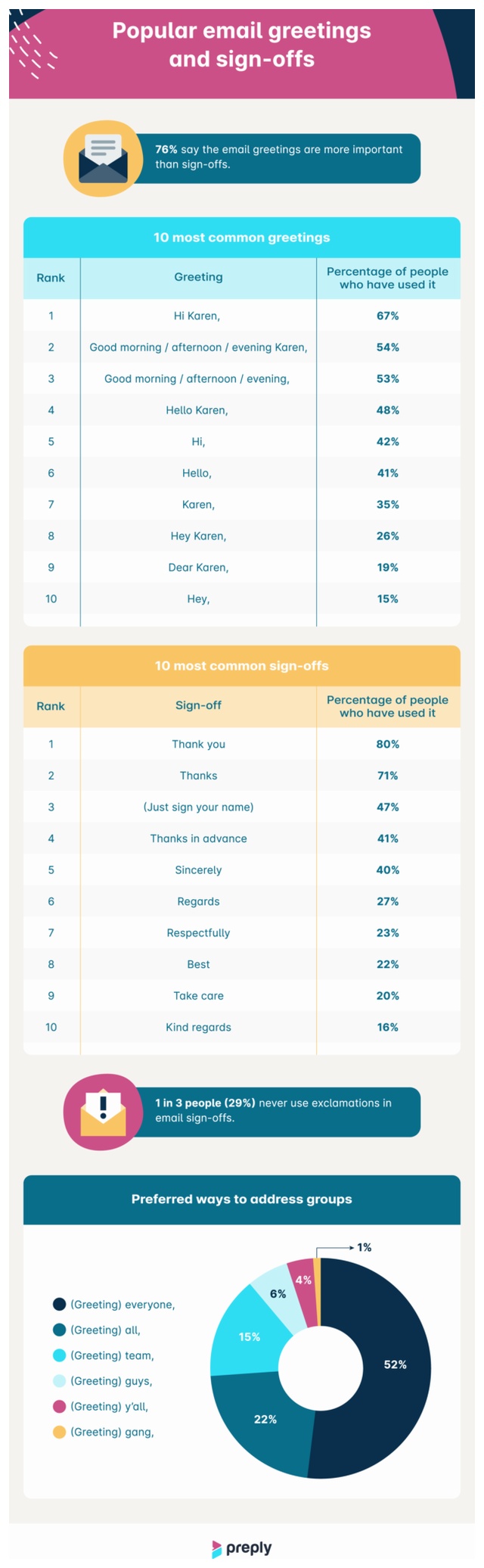
Interestingly, the most common greeting—“Hi Karen”—is also the most favored, chosen by 29% of people. In contrast, the more formal “Good morning/afternoon/evening, Karen” comes in a distant second at just 13%. When it comes to addressing a group in an email, “everyone” takes the lead with a notable 52% preference.
Sign-offs revealed an interesting trend, with the two most popular choices also leading in preference. “Thank you” topped the list, favored by 38% of respondents, while “thanks” closely followed at 30%. Interestingly, “thanks in advance” was a notable outlier; it ranked last in preference at just 5%, even though it was the fourth most commonly used sign-off, appearing in 41% of cases.
The vibe your greeting and sign-off give off
You might not give much thought to the opening and closing lines of your emails, but they can significantly influence how others perceive you. Surprisingly, nearly 46% of people report that they can gauge a coworker’s mood just from their greetings and sign-offs. So, the next time you hit send, consider the message you’re conveying!
An overwhelming 91% of employees say that the people they work with are sometimes passive-aggressive over email.
Surprisingly, just 37% of individuals acknowledge that they modify their usual greetings to convey frustration. Interestingly, younger employees, particularly those from Gen Z, are more inclined to express their emotions in emails, making this demographic the most likely to adopt such practices.
In the realm of aggressive emails, the most cutting greeting is surprisingly the absence of any greeting. It turns out that ultra-casual phrases can pack a punch too, with “hiya” ranking as the second most savage option, while “hiya Karen” secured the fourth spot.
Simply using a person’s name followed by a colon—like “Karen:”—ranks as the third most cutting way to address someone. However, not everyone is on board with this approach; 43% of people believe that this kind of direct call-out is too harsh to consider using.
Savage emails often kick off with no greeting, and they tend to leave you hanging at the end as well. Simply signing off with your name doesn’t offer much improvement, landing it in second place on our list. Meanwhile, the casual yet courteous “thanks in advance” takes third place, likely because some recipients might find it a bit presumptuous.
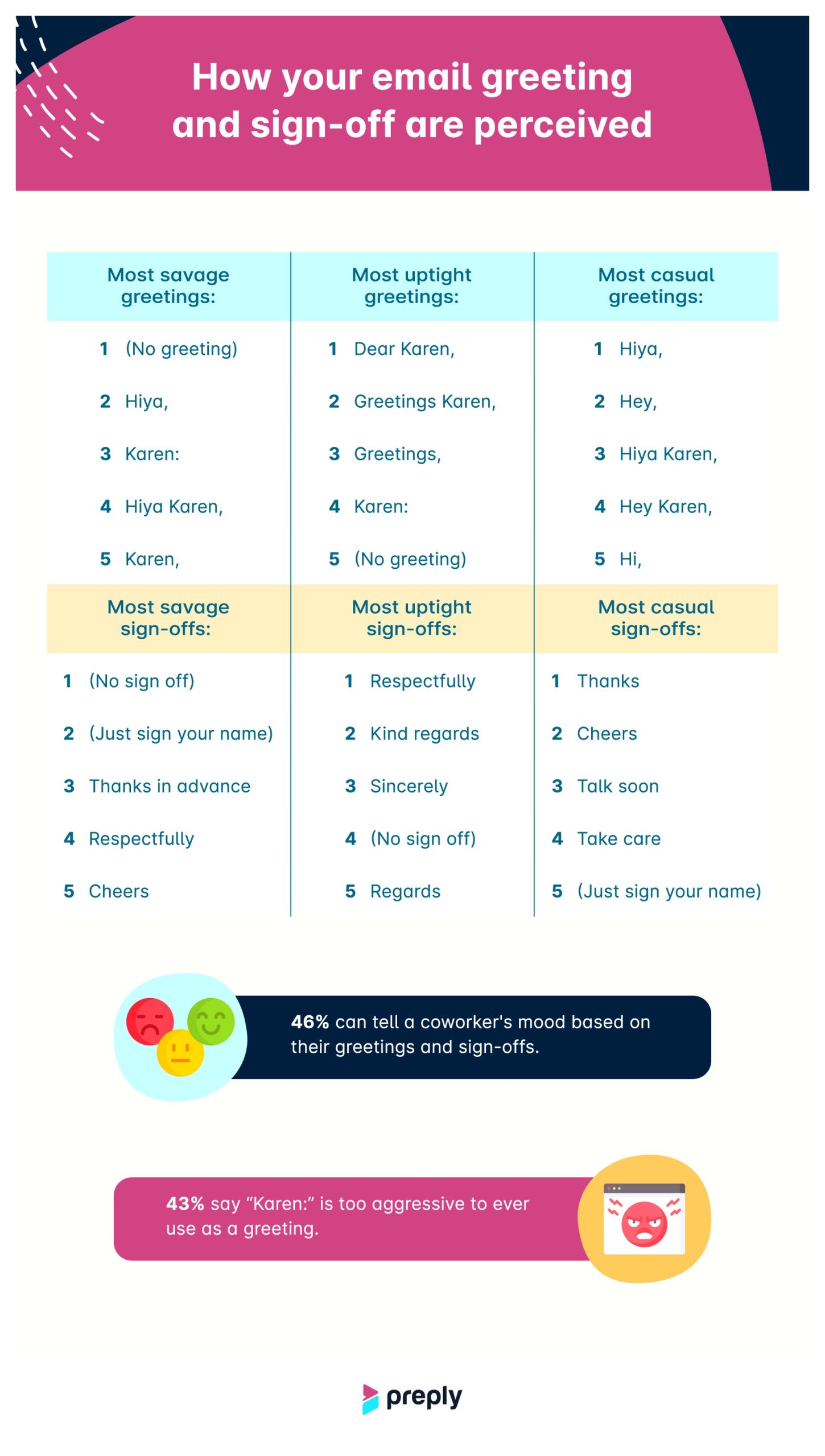
With the rise of casual work environments in modern offices, communication styles have shifted to a more relaxed tone. Traditional email greetings and closings such as “Dear Karen,” “Respectfully,” and “Kind regards” now feel somewhat stiff. In contrast, the most laid-back alternatives include friendly greetings like “hiya,” “hey,” and casual sign-offs such as “thanks,” “cheers,” and “talk soon.” This evolution reflects the changing dynamics of workplace communication.
If given the chance, what would people alter in their emails? A significant 36% of respondents express a desire to convey more confidence, while 28% wish for a more formal tone. Interestingly, only 7% want to tone down their enthusiasm. Gender also plays a role: 25% of men prefer a more casual style in their emails compared to just 16% of women.
Learn a language online with our free learning materials.
Learn English online
Learn French online
The Unspoken Rules of Email
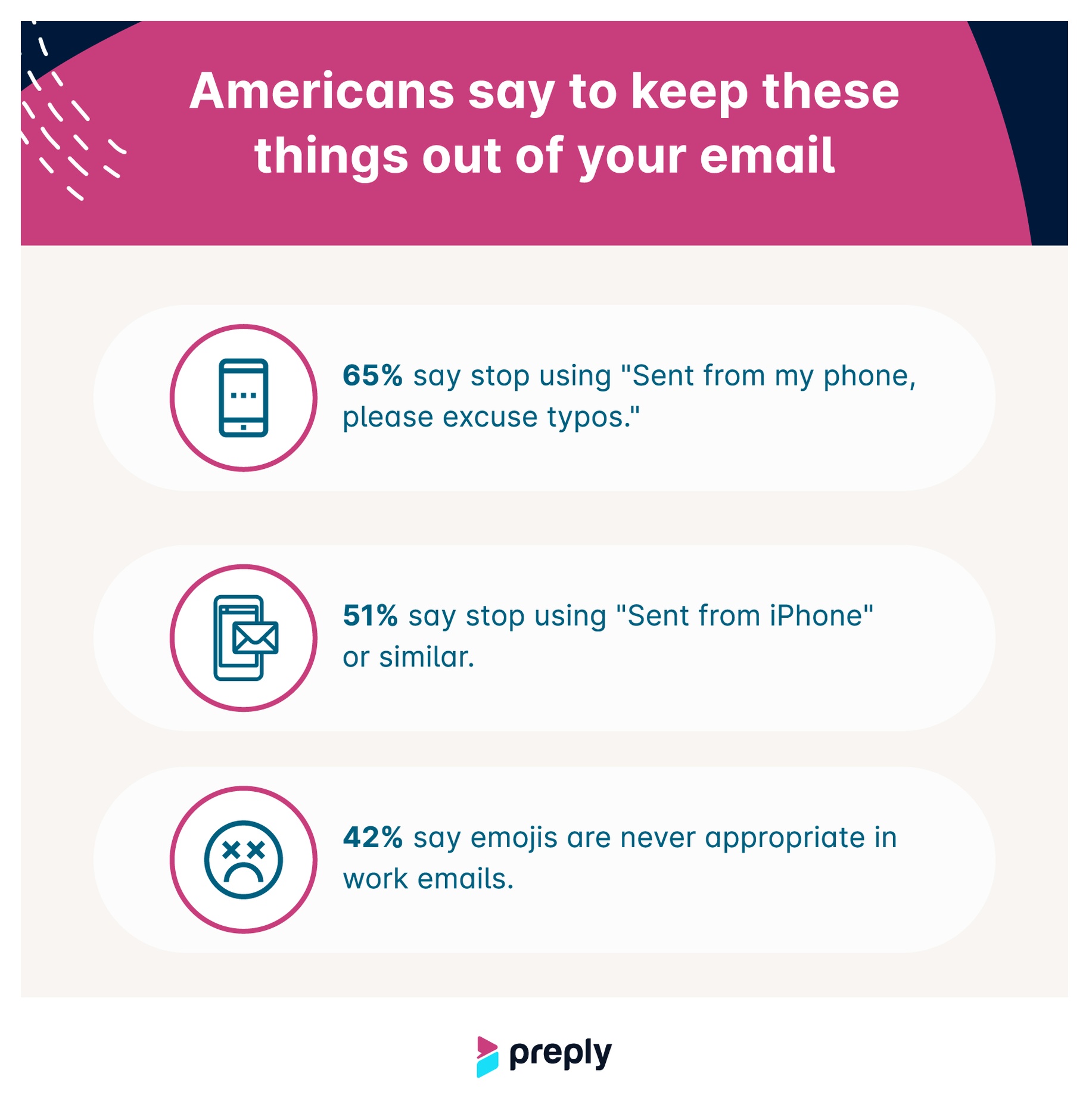
Email etiquette is evolving, and unspoken rules are shifting. Interestingly, only 42% of people believe emojis have no place in professional emails, which means a significant 58% are open to using them in certain contexts. This indicates a growing acceptance of a more casual communication style in the workplace.
The use of exclamation points varies significantly among email users. In fact, 48% of individuals frequently review their emails to eliminate exclamation points, while 25% choose to add them in during their edits. This highlights the differing attitudes towards this punctuation mark in written communication.
Certain unwritten rules resonate strongly with many. In fact, nearly two-thirds (65%) of our respondents wish for an end to the phrase “Sent from my phone, please excuse typos.” Additionally, over half (51%) believe that messages should avoid signatures like “Sent from iPhone” or similar phrases.
Following the first email, a significant number of people believe that greetings and sign-offs should be dropped—either right away (32%) or gradually over time (27%)—as the conversation progresses in the thread.
Conclusion
Writing a confident and effective business email can be a challenge, especially when it comes to choosing the right greeting, sign-off, and everything in between. It’s important to steer clear of corporate jargon and keep your message clear and concise.
Are you looking to improve your business English skills? Look no further than LingualNeeds! We offer free business courses tailored to your needs. Additionally, our platform connects you with experienced business English tutors for personalized, one-on-one coaching. Browse tutor profiles to find the perfect match for your budget and schedule. With the right support, you’ll be speaking the language of the workplace confidently in no time!
Methodology
- On December 9, 2022, we conducted a survey of 1,005 Americans aged 18 to 76 regarding their email greeting and sign-off preferences. The respondents comprised 49% female, 49% male, and 2% non-binary.
Frequently Asked Questions
What is the most commonly used email greeting among Americans?
“Hi Karen” is the most commonly used greeting, favored by 67% of respondents.
How do greetings and sign-offs affect perceptions in email communication?
Nearly 46% of people can gauge a coworker’s mood based on their greetings and sign-offs.
What percentage of employees report passive-aggressive behavior in emails?
An overwhelming 91% of employees say that the people they work with are sometimes passive-aggressive over email.
What do most Americans prefer as an email sign-off?
80% of Americans prefer a straightforward “thank you” as their email sign-off.
How has email etiquette evolved in recent years?
Email etiquette is evolving towards a more casual tone, with many individuals favoring relaxed greetings and sign-offs over traditional formalities.


