
- What are minimal pairs?
- Why should you practice minimal pairs?
- Consonant sound examples
- Vowel sound examples
- Minimal pairs practice activities
- Pronunciation pyramid
- Minimal pairs bingo
- 3 advanced ways to improve your English pronunciation
- 1. Say tongue twisters
- 2. Record yourself
- 3. Listen to native speakers
- Learn English pronunciation with LingualNeeds
- Frequently Asked Questions
- What are minimal pairs?
- Why is practicing minimal pairs important?
- What are some examples of minimal pairs for non-native speakers?
- How can I practice minimal pairs effectively?
- What advanced methods can improve my English pronunciation?
In English, subtle variations in pronunciation can create significant changes in meaning. This is where minimal pairs come into play—two words that vary by just a single sound yet convey completely different meanings. Understanding these nuances is essential for clear communication.
Working on minimal pairs is an effective way to enhance your English pronunciation. By focusing on these pairs, you’ll not only sound more like a native speaker, but you’ll also sharpen your ability to catch subtle differences in conversation, leading to clearer communication.
In this post, we’ve gathered lots of minimal pair examples for you to practice. So, let’s get into it.
What are minimal pairs?
A minimal pair consists of two words that have distinct meanings but differ by just one sound. In linguistic terms, when a single sound alteration changes a word’s meaning, that sound is referred to as a phoneme.
Take the words “bat” and “bad,” for instance. They may sound alike, but they differ by just one consonant at the end—/t/ in “bat” and /d/ in “bad.” This slight change in sound alters the meaning entirely, making it a perfect example of a phoneme.
If you’re a non-native speaker, you might find certain minimal pairs in English perplexing, especially if your native language lacks those specific sounds or doesn’t differentiate them in meaning.
For example:
- /r/ and /l/ such as row and low for Japanese speakers
- /b/ and /v/ such as berry and very for Spanish speakers
- /w/ and /v/ such as wine and vine for Hindi and Urdu speakers
- /ɪə/ and /eə/ such as cheer and chair for Arabic speakers

Why should you practice minimal pairs?
Practicing minimal pairs—words that differ by only one sound—can significantly enhance your English skills. By mastering these subtle distinctions, you’ll not only improve your speaking abilities but also boost your listening comprehension, allowing you to express yourself more clearly and effectively.
As an English learner, you might find it challenging to pronounce similar sounds or distinguish between them—a skill known as auditory discrimination. However, practicing these sound pairs can significantly enhance your pronunciation and improve your grasp of individual words and full sentences.
Martin Sketchley, a tutor at LingualNeeds, emphasizes the benefits of practicing minimal pairs for learners. He explains that this technique helps students develop a keen awareness of the differences between short and long vowel sounds. Additionally, it fosters a deeper understanding of unique English sounds that may not exist in their native language. As a result, learners gain confidence in their speaking abilities, becoming more intelligible and articulate.
English language learners frequently use minimal pairs in listening assessments and pronunciation drills. To enhance your pronunciation, try using an online dictionary to listen to the words mentioned in this post, then repeat them out loud. Additionally, the activities outlined later will provide effective ways to practice your target words.
Consonant sound examples
Certain words can sound quite different due to variations in consonant sounds. Take the “th” sound (/θ/) as an example; many English learners struggle with it. When attempting to say “three,” they might unintentionally drop the ‘h’ and pronounce it as “tree.” Unfortunately, “tree” has an entirely different meaning, which can create confusion in conversation.
Enhance your consonant phoneme skills by reading the minimal pairs provided below aloud, paying close attention to your articulation. For clarity on the sounds represented, refer to a phonemic chart, which visually transcribes various phonetic elements.
| Phonemic symbols | Beginner | Intermediate | Advanced |
| /b/ vs /v/ | berry / very | gibbon / given | bowels / vowels |
| /d/ and /ð/ | day / they | sudden / southern | dare / there |
| /f/ vs /θ/ | free / three | deaf / death | fort / thought |
| /f/ vs /v/ | fan / van | surf / serve | belief / believe |
| /j/ vs /ʤ/ | jam / yam | jaw / your | joke / yolk |
| l/ vs /r/ | alive / arrive | pilot / pirate | law / raw |
| /p/ vs /b/ | pig / big | poured / bored | pier / beer |
| /s/ vs /θ/ | sin / thin | miss / myth | symbol / thimble |
| /s/ vs /ʃ/ | sea / she | sell / shell | seize / she’s |
| /v/ vs /w/ | vet / wet | vine / wine | vein / wane |
| /tʃ/ vs /ʃ/ | choose / shoes | cherry / sherry | witch / wish |
| /ŋk/ vs /ŋ/ | bank / bang | think / thing | sunk / sung |
Vowel sound examples
For non-native speakers, English vowel sounds can often seem quite similar, which can lead to challenges in both pronunciation and understanding. Take, for instance, the words “chip” (/ɪ/) and “cheap” (/i:/); their distinct meanings can be easily confused due to their similar vowel sounds, highlighting the importance of mastering these nuances for effective communication.
The following examples help you practice common vowel sounds:
| Phonemic symbols | Beginner | Intermediate | Advanced |
| /ɪ/ vs /i:/ | ship / sheep | hill / he’ll | fist / feast |
| /e/ vs /ɪ/ | left / lift | pet / pit | messed / mist |
| /e/ vs /eɪ/ | sell / sale | trend / trained | phlegm / flame |
| /æ/ vs /ʌ/ | cat /cut | mad / mud | rabble / rubble |
| /æ/ vs /e/ | bad / bed | sad / said | cattle / kettle |
| /əʊ/ vs /ɔ:/ | bowl / ball | moaning / morning | node / gnawed |
| /eɪ/ vs /æ/ | bake / back | base / bass | reign / ran |
| /aɪ/ vs /aʊ/ | find / found | tire / tower | aisle / owl |
| /əʊ/ vs /aʊ/ | hole / howl | groaned / ground | scold / scowled |
| /ɪə/ vs /eə/ | cheer / chair | really / rarely | earring / airing |
Minimal pairs practice activities
Enhance your practice of minimal pairs by not only reading the words aloud on your own but also turning it into an engaging group activity with a partner. Sharing this experience can make learning more interactive and enjoyable!
According to Sylvia Johnson, a language expert at LingualNeeds, games are powerful tools for language learning. They help reduce stress, boost motivation, and create an environment conducive to spontaneous and free speaking practice. She explains:
Positive emotions trigger the release of dopamine and serotonin in the brain, enhancing both memory and learning capacity. Incorporating games into your learning process not only boosts creativity but also sharpens your problem-solving abilities.
Create flashcards featuring words or pairs of words that contain the target sounds, and have your partner practice pronouncing them. To make it more fun, consider incorporating the minimal pairs activities listed below into a game!
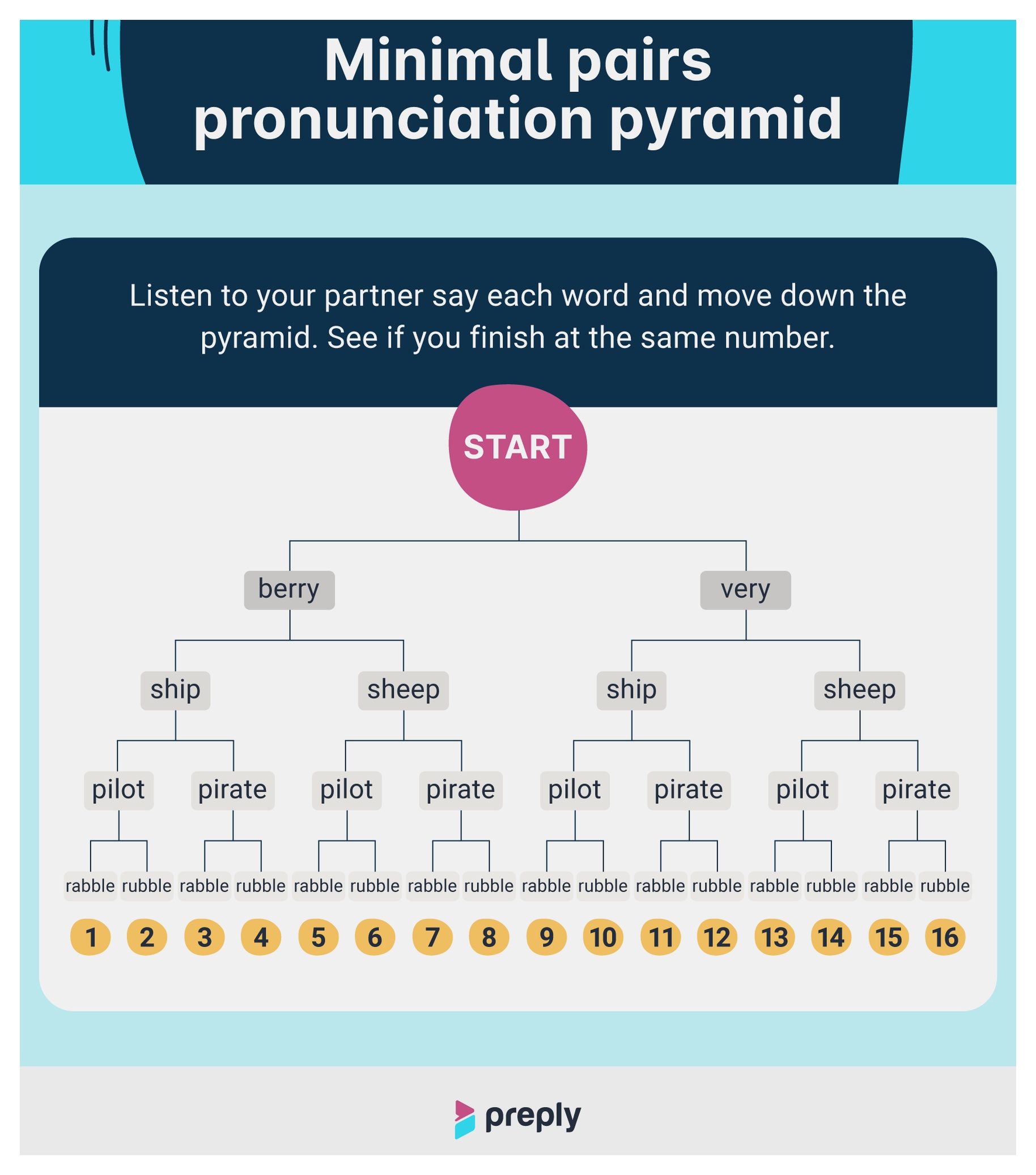
Pronunciation pyramid
Here’s how to play:
Getting ready:
- You need two people (person A and person B).
- To complete a blank pyramid, both participants should fill in two minimal pair words for each step. Alternatively, refer to the example provided below.
- Both people should have the same words in their pyramids.
Playing the game:
- Person A reads a word from the top pair of the pyramid, while Person B traces it on their worksheet using a finger or pencil.
- Person A reads a word from the next step. Person B follows on their pyramid.
- Repeat until the bottom of the pyramid.
- A and B compare if they ended up at the same number.
Try practicing with the following pronunciation pyramid:
Minimal pairs bingo
Here’s how to play:
Getting ready:
- You need two people.
- Each person has a blank five-by-five bingo card and the same list of minimal pairs.
- Each person chooses words from the list of minimal pairs and writes them in the spaces on the card.
Playing the game:
- Alternate reading words from a minimal pairs list with your partner, checking them off as you go.
- When one person hears a word on their card (listen carefully), they mark it.
- The first person to get five in a row shouts “bingo!” and is the winner.
- Check together using the list to make sure you heard the correct word.
3 advanced ways to improve your English pronunciation
If you’re looking for more challenging ways to improve your English pronunciation, try out the following ideas.
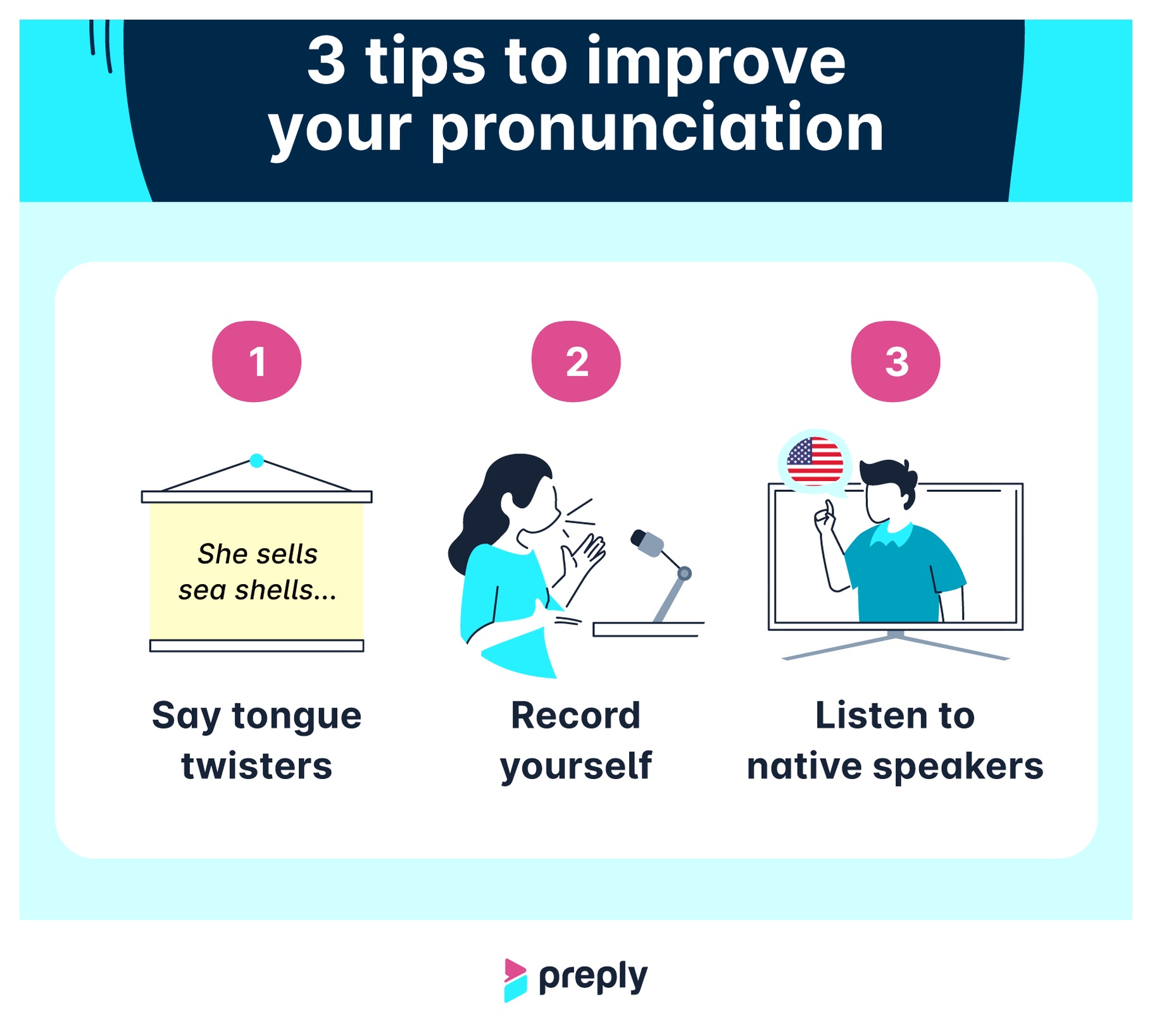
1. Say tongue twisters
Tongue twisters are an excellent tool for enhancing your pronunciation skills. They allow you to compare various sounds, practice mouth movements, and improve your speed. Many English tongue twisters feature minimal pairs—words that differ by just one sound. A classic example is the pair “sea” and “she” (/s/ vs. /ʃ/), highlighted in the well-known tongue twister: “She sells seashells by the seashore.”
Preparing for a presentation or phone call in English? Try incorporating tongue twisters into your warm-up routine! They’re not only fun but also an effective way to enhance your pronunciation. You can use them before your English lessons or even practice on your own to boost your speaking confidence.
2. Record yourself
Recording your voice and listening to the playback is a great way to identify pronunciation errors. If you’re unsure of what to express, consider repeating phrases from a textbook, reading aloud from your written work, or describing an image. This practice can significantly enhance your speaking skills!
Describing a photo is often a key component of speaking exams. To enhance your preparation, consider combining this activity with recording yourself as you read through different sets of minimal pairs. This approach not only boosts your speaking skills but also sharpens your pronunciation.
3. Listen to native speakers
Did you realize that honing your listening skills not only enhances your understanding of English but also boosts your pronunciation? To make the most of this, immerse yourself in the sounds of the language by listening to native speakers. You can do this through various media, including movies, TV shows, YouTube videos, and podcasts.
As you practice, consider incorporating shadowing into your routine. This technique involves listening to a short sentence or phrase and then repeating it aloud, mimicking the pronunciation as closely as possible. It’s a fun and effective way to improve your speaking skills!
Learn English pronunciation with LingualNeeds
Minimal pairs are pairs of words that have different meanings but are distinguished by a single sound. Practicing these pairs can enhance both your pronunciation and your comprehension of English. To sharpen your skills, try using minimal pairs flashcards, watching English-language TV shows, or engaging in various pronunciation games.
To truly enhance your language skills, practicing minimal pairs aloud with a knowledgeable English speaker is essential. While solo practice of words and phrases is beneficial, engaging in one-on-one tutoring can significantly accelerate your language-learning journey, especially if you’re committed to mastering a new language.
Whether you’re looking to enhance your language skills for business or simply wish to expand your linguistic capabilities, a LingualNeeds English tutor is here to provide valuable feedback on your pronunciation and support you in all aspects of English. Whatever your goals may be, a LingualNeeds tutor can guide you on your journey to mastering the language.
Sign up for your trial lesson today! If you’re not completely satisfied after your first session, you have the option to try a different tutor at no extra cost or receive a full refund. Your satisfaction is our priority!
Frequently Asked Questions
What are minimal pairs?
Minimal pairs are two words that have distinct meanings but differ by just one sound.
Why is practicing minimal pairs important?
Practicing minimal pairs significantly enhances English pronunciation, listening comprehension, and overall communication skills.
What are some examples of minimal pairs for non-native speakers?
Examples include /r/ and /l/ such as row and low for Japanese speakers, and /b/ and /v/ such as berry and very for Spanish speakers.
How can I practice minimal pairs effectively?
You can practice minimal pairs through activities like pronunciation pyramids and minimal pairs bingo, or by using flashcards.
What advanced methods can improve my English pronunciation?
Advanced methods include saying tongue twisters, recording yourself, and listening to native speakers.


