- Final thoughts
- Frequently Asked Questions
- Why do Spanish speakers seem to speak so quickly?
- What is the role of information density in language learning?
- What are some effective tips for adapting to the fast pace of spoken Spanish?
- How can I improve my Spanish pronunciation?
- Is it beneficial to engage with native speakers while learning Spanish?
Have you ever noticed how quickly Spaniards tend to speak? At first, my child thought they were anxious about being interrupted mid-sentence. Meanwhile, my teachers described it as a “language peculiarity.” While researching this article, I’ve finally had the chance to explore this fascinating phenomenon for myself.
In a review of various studies, researchers from the University of Lyon provided compelling insights into the rapid speech patterns of the Spanish language. Their findings confirm that the perception of Spanish being spoken quickly is not just a misconception among learners. By analyzing seven languages and 20 text passages read by 59 native speakers, the team measured the rate of spoken syllables per second. The results revealed that Spanish speakers articulate 26% more syllables per second compared to their English counterparts. Interestingly, Japanese emerged as the fastest language overall, as illustrated in the figures below:
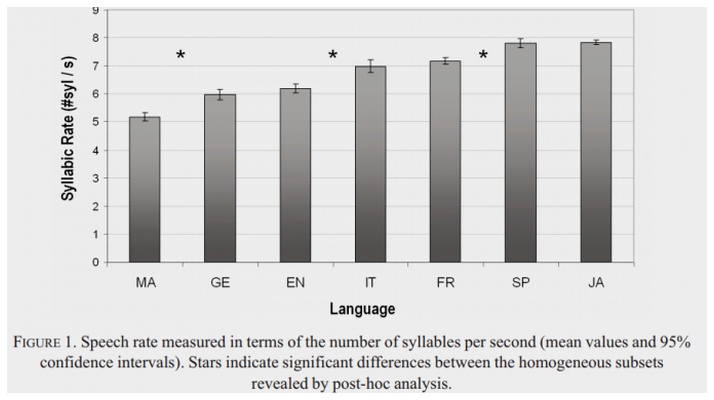
Interestingly, information density plays a crucial role in language comparison. In Spanish, each syllable communicates less information than in English. This means that while Spanish speakers tend to use more words and speak more quickly, the actual information conveyed is lower. Check out the chart below to explore how speech rate and information density compare across various languages.

While the rapid speech rate can be a challenge for English speakers learning Spanish, it’s not the only hurdle. The complexities of verb conjugations across various tenses and the inconsistent grammar rules among different Spanish dialects add to the difficulty. Thankfully, a wealth of resources—such as training exercises, video tutorials, and other supportive materials—are available to facilitate language learning. However, many tutors suggest that adapting to the fast pace of spoken Spanish is simply a matter of time. So, how can you speed up that adjustment? Here are some practical tips drawn from my own experiences and expert recommendations to help you navigate this challenge effectively.
- Engage with Spanish songs, YouTube videos, and training podcasts to practice breaking down sentences into meaningful segments. Once you can identify key words and comprehend around 60% of the dialogue, challenge yourself with longer conversations.
- Discover two engaging Spanish video channels that offer captivating content and daily updates. Join the conversation and share your thoughts on relevant topics.
- Practice reading aloud and at a faster pace, mimicking the speech patterns of native Spanish speakers. With consistent effort, you can achieve a similar speech rate and become familiar with the sounds of the language.
- The syllabic structures of Spanish (syllable-timed) and English (stress-timed) create a distinct rhythm that can be challenging for learners. To overcome this, dedicate at least 2 hours daily to practice outside of your Spanish lessons. This consistent practice will help familiarize you with the natural flow of the language, making it sound less foreign.
- Encourage patients to listen to a two-minute dialogue or monologue multiple times, ideally over four times. This technique involves breaking the passage into smaller sections and writing down each word while relistening. It helps train the mind to recognize and understand various language units effectively.
- Focus on grasping the main ideas rather than catching every word. This approach differs from detail-focused listening and helps you learn Spanish while alleviating the pressure to understand every single word in a conversation.
- Engage with native speakers in online Spanish classes or join speaking clubs to immerse yourself in the language and boost your motivation. Even if you’re at an elementary level, participating in these sessions is beneficial. Keep in mind that while tutoring helps, teachers often slow their speech for clarity, which can hinder your ability to understand native speakers in real-life situations.
Final thoughts
One of the biggest hurdles in mastering Spanish is overcoming the initial confusion about its rapid pace and unique pronunciation. Instead of getting caught up in why it sounds different, set clear objectives and immerse yourself in the essential vocabulary and phrases. Embrace the learning process and you’ll find your skills improving swiftly!
Frequently Asked Questions
Why do Spanish speakers seem to speak so quickly?
Spanish speakers articulate 26% more syllables per second compared to English speakers, which contributes to the perception of rapid speech.
What is the role of information density in language learning?
In Spanish, each syllable communicates less information than in English, leading to a faster speaking rate but conveying less actual information.
What are some effective tips for adapting to the fast pace of spoken Spanish?
Engage with Spanish songs and videos, practice reading aloud, listen to dialogues multiple times, and focus on grasping main ideas.
How can I improve my Spanish pronunciation?
Practice reading aloud at a faster pace while mimicking native speakers and dedicate time outside of lessons to familiarize yourself with the language’s rhythm.
Is it beneficial to engage with native speakers while learning Spanish?
Yes, engaging with native speakers in online classes or speaking clubs significantly boosts motivation and helps improve comprehension skills.