- Beginner level
- 1. Camarón, caramelo. Caramelo, camarón.
- 2. Un perro rompe la rama del árbol.
- 3. Juan junta juncos junto a la zanja.
- 4. Papá pone pan para Pepín. Para Pepín pone pan papá.
- 5. Pepe pecas pica papas con un pico. Con un pico pica papas Pepe pecas.
- 6. Hoy ya es ayer y ayer ya es hoy, ya llegó el día, y hoy es hoy.
- 7. Pancha plancha con cuatro planchas.¿Con cuántas planchas plancha Pancha?
- 8. El perrito de Rita me irrita, dile a Rita que cambie el perrito por una perrita.
- Intermediate level
- 9. La araña con maña amaña la laña. La araña con maña es una tacaña.
- 10. De generación en generación las generaciones se degeneran con mayor degeneración.
- 11. Pedro Pérez Pereira, pobre pintor portugués, pinta pinturas por poca plata, para pasear por Portugal.
- 12. La Bruja Maruja: El Brebaje Mágico de Cera de Abeja y Ajo
- “13. Nuestro Llorar: Tu Llanto es Mi Llanto”
- 14. Si yo como como como, y tu comes como comes, ¿Cómo comes como como si yo como como comes?
- 15. Cuando cuentes cuentos, cuenta cuantos cuentos cuentas, cuando cuentes cuentos.
- 16. Tres tristes tigres tragaban trigo en un trigal. En un trigal, tres tristes tigres tragaban trigo.
- 17. El que poco coco come, poco coco compra. Como poco coco como, poco coco compro.
- “El Amor: Una Locura que Solo el Cura Puede Sanar, Pero su Cura es Otra Locura”
- 19. Compré pocas copas, pocas copas compré y como compré pocas copas, pocas copas pagué.
- 20. La sucesión sucesiva de sucesos sucede sucesivamente con la sucesión del tiempo..
- Advanced level
- 21. El perro cachorro de Enrique Becerra se enrosca en la ropa, la enrolla y la enreda.
- 22. Erre con erre cigarro, erre con erre barril. Rápido corren los carros cargados de azúcar del ferrocarril.
- 23. Mariana Magaña desenmarañará mañana la maraña que enmarañara Mariana Magaña.
- 24. El burro disfrutaba berros, ¡pero el perro se los quitó! Su rebuzno hizo que el perro cayera al barro.
- “Juan y su Tubo: La Curiosa Historia de un Tubo Roto y su Reemplazo”
- 26. La astuta rata que perdió su tesoro: la historia de la lata y la plata
- “27. Evitemos las Miradas: Una Reflexión sobre el Arte de No Mirarnos”
- “Teodoro el Moro y su Loro Dorado: Un Dueto de Elegancia”
- “33 Log Segments Cut by Three Diligent Loggers: Tripling Timber Tasks”
- 30. El Dilema del Amor: Quiero Amar a Quien No Debo
- Tips for practicing with tongue twisters
- Frequently Asked Questions
- What is the purpose of using tongue twisters in language learning?
- Are there different levels of difficulty for tongue twisters?
- How can I effectively practice tongue twisters?
- Can tongue twisters help with specific sounds?
- Where can I find personalized Spanish practice?
If you’ve ever attempted to say, “Sally sells seashells down by the seashore,” you know just how fun and challenging tongue twisters can be! These playful phrases are designed with tricky sequences of similar sounds, demanding focus and practice to master.
Engage your tongue and boost your Spanish pronunciation with these fun phonetic exercises! They serve as excellent tools for improving your fluency. Are you ready to challenge yourself? Explore our collection of Spanish tongue twisters below, or dive into online Spanish lessons to enhance your skills even further!
Beginner level
These beginner-level tongue twisters help loosen your tongue and familiarize your mouth with the basic sounds of Spanish.
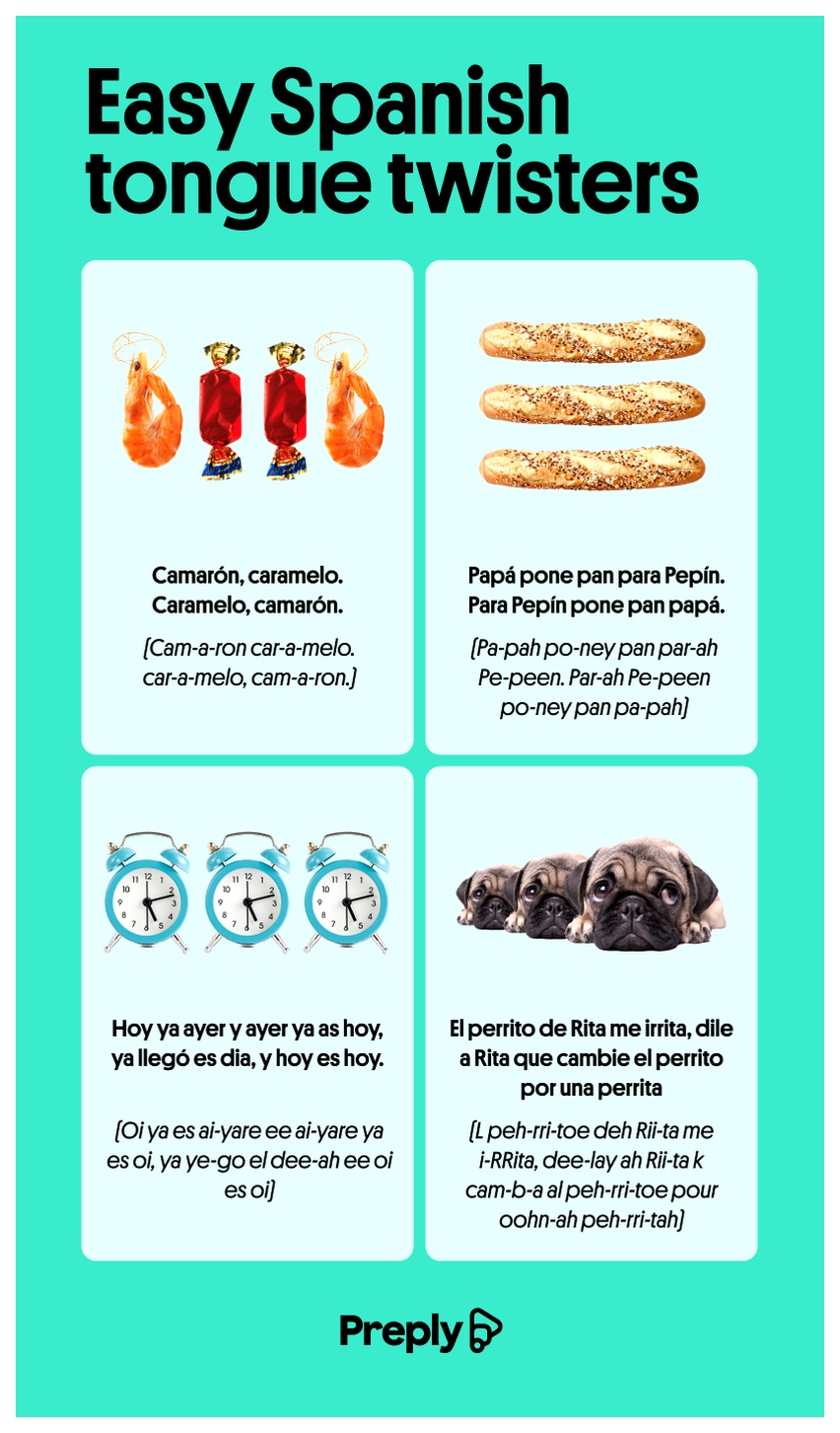
1. Camarón, caramelo. Caramelo, camarón.
Pronunciation: (Cam-a-ron car-a-melo. car-a-melo, cam-a-ron)
English translation: Shrimp, caramel. Caramel, shrimp.
This phrase can be tricky because the letters in each word are arranged in reverse order. It starts with “them,” followed by “the,” and concludes with “ther.” Interestingly, the second word features the same sounds but in a different sequence. Additionally, both “ther” and “the” demand similar tongue movements, as the tongue taps against the front of the palate.
2. Un perro rompe la rama del árbol.
Pronunciation: (Un pe-rr-oh rrom-pay la rahm-ah del are-bowl)
English translation: A dog breaks the tree branch.
In this case, pay attention to the pronounced double ‘r’ in “perro,” which creates a strong, rolling sound. In contrast, the softer single ‘r’ in “árbol” has a gentler tone. It’s interesting to note that when a single ‘r’ appears at the start of a word, like in “rompe” or “drama,” it is pronounced with the same trilled sound as the double ‘r.’ Additionally, when ‘r’ occurs at the end of a word or syllable, it is articulated more softly, almost like a gentle tap.
3. Juan junta juncos junto a la zanja.
Pronunciation: (Hoo-ahn hoon-ta hoon-cos hoon-toe ah la zan-ha)
English translation: Juan gathers branches next to the ditch.
This phrase highlights the unique sound of “thej,” which in Spanish resembles the English “h.” Compounding the difficulty, producing “theju” at the start of words and the “j” sound involves distinct mouth shapes.
4. Papá pone pan para Pepín. Para Pepín pone pan papá.
Pronunciation: (Pa-pah po-ney pan par-ah Pe-peen. Par-ah Pe-peen po-ney pan pa-pah)
English translation: Dad puts the bread for Pepín. For Pepín Dad puts the bread.
This classic Spanish tongue twister is a fun challenge, featuring only words that begin with the letter “p.” It also includes accents on two of the words, which adds an extra layer of difficulty. In Spanish, accents mark the stressed syllable, often requiring you to raise your pitch when pronouncing them.
5. Pepe pecas pica papas con un pico. Con un pico pica papas Pepe pecas.
Pronunciation: (Peh-pay pay-cas pea-kah pah-pas con oon pea-ko. Con oon pea-ko pea-ka pah-pas Peh-pay pay-cas)
English translation: Pepe Freckles chops potatoes with a pick. With a pick Pepe Freckles chops potatoes.
Pronouncing “thep” can be tricky due to the variety of vowel sounds it contains: pe, pi, and pa. To master it, take a moment to familiarize yourself with each vowel. Practice gradually, focusing on establishing a smooth rhythm, which will help you increase your speed over time.
6. Hoy ya es ayer y ayer ya es hoy, ya llegó el día, y hoy es hoy.
Pronunciation: (Oi ya es ai-yare ee ai-yare ya es oi, ya ye-go el dee-ah ee oi es oi)
English translation: Today is already yesterday and yesterday is already today, the day has arrived, and today is today.
This phrase can be tricky because of the repeated ‘s’ sounds at both the start and end of the words. To master it, take your time initially to prevent skipping words or confusing the ‘ai’ and ‘i’ sounds. Additionally, this tongue twister serves as an excellent tool for practicing the silent ‘h’.
7. Pancha plancha con cuatro planchas.¿Con cuántas planchas plancha Pancha?
Pronunciation: (Pahn-cha plahn-cha con qua-tro plan-chas. Con quan-tas plan-chas plan-cha Pahn-cha)
English translation: Pancha irons with four irons. With how many irons does Pancha iron?
The opening line of this tongue twister presents you with three words that change by just one or two letters. It then cleverly flips the phrase into a question, prompting you to say the same words but in reverse order.
8. El perrito de Rita me irrita, dile a Rita que cambie el perrito por una perrita.
Pronunciation: (L peh-rri-toe deh Rii-ta me i-RRita, dee-lay ah Rii-ta k cam-b-a el peh-rri-toe pour oohn-ah peh-rri-tah)
English translation: Rita’s doggie irritates me; tell Rita to change the male doggie for a female doggie.
To master pronunciation, start by ensuring that the “singler” sound at the beginning of words matches the way you say “therr.” A great way to practice your trills is by using this fun tongue twister. Concentrate on perfecting your “doubler” sound until you feel confident enough to tackle more advanced phrases.
Intermediate level
At the intermediate level, tongue twisters become more intricate, featuring a greater number of words that blend into one another, which can make it tricky to distinguish the sounds. This complexity is precisely what makes tongue twisters so enjoyable—their purpose is to challenge us while we play with the arrangement, pronunciation, and intricacy of language.

9. La araña con maña amaña la laña. La araña con maña es una tacaña.
Pronunciation: (La ah-rahn-ya con mahn-ya ah-mahn-ya la lan-ya. La ah-rahn-ya con mahn-ya es oohn-ah ta-cahn-ya)
English translation: The crafty spider is a cheap spider. The crafter spider is a penny pincher.
This tongue twister creatively uses the ñ sound, pronounced like the “ny” in “canyon.” It also features a variety of words incorporating the “th” sound, which should be pronounced like the “th” in English words.
10. De generación en generación las generaciones se degeneran con mayor degeneración.
Pronunciation: (Deh heh-neh-rah-see-ohn ehn heh-neh-rah-see-ohn las heh-neh-rah-see-hn-es say deh-heh-neh-rahn con mah-yor deh-heh-neh-rah-see-ohn)
English translation: From generation to generation, the generations degenerate with further degeneration.
Not only does this tongue twister bring a smile to your face while you practice, but it also focuses on the pronunciation of Spanish “g,” which sounds like a hard English “h.” The challenge increases with multiple “n” and “r” sounds, demanding that you press your tongue against the roof of your mouth.
11. Pedro Pérez Pereira, pobre pintor portugués, pinta pinturas por poca plata, para pasear por Portugal.
Pronunciation: (Paid-ro peh-rez peh-ray-ra, po-bre peen-tor pohr-to-guess, peen-ta peen-turas pohr po-ka plah-ta par-ah pah-say-ahr pohr Por-too-gahl)
English translation: Pedro Pereira, a poor Portuguese painter, paints paintings for little money to walk around Portugal.
This tongue twister provides a fun challenge for your mouth as you try to pronounce 15 words that all start with the letter “P.” It also features several soft sounds that require you to tap your tongue against the roof of your mouth, similar to the way you articulate certain sounds in English. Get ready to test your pronunciation skills!
12. La Bruja Maruja: El Brebaje Mágico de Cera de Abeja y Ajo
Pronunciation: (La brew-ha mah-roo-ha pre-pah-ra un brey-bah-hey, con seh-ra deh ah-bay-ha, dos dee-n-tays de ah-ho, qua-rent-ah len-tay-has e oon pay-low deh obey-ha)
To pronounce this phrase correctly, break it down into manageable parts: “La brew-ha mah-roo-ha” should flow smoothly into “pre-pah-ra un brey-bah-hey.” Next, articulate “con seh-ra deh ah-bay-ha,” followed by “dos dee-n-tays de ah-ho.” Finally, finish with “qua-rent-ah len-tay-has e oon pay-low deh obey-ha.” Practice each section to master the rhythm and tone!
English translation: The witch Maruja prepares a brew with beeswax, two cloves of garlic, 40 lentils, and a sheep’s hair.
Looking to enhance your Spanish pronunciation? Try tackling this tongue twister! It features the letter “j” — pronounced like the English “h” — appearing seven times with various vowel sounds such as “ja,” “je,” “jo,” and “jus.” It’s a fun and effective way to sharpen your skills!
“13. Nuestro Llorar: Tu Llanto es Mi Llanto”
Pronunciation guide: (Yoh yoh-roh see yo-ras, see yo-ras yoh yoh-roh. Too yahn-toh s mee yahn-toe, eh too yahn-toe mee ho-roh. See too yah noh yo-ras, tahm-po-co yoh yoh-roh.)
When you cry, I cry with you; your tears resonate with my own. Our emotions are intertwined—your sorrow becomes my sorrow. If your tears cease to flow, then mine will dry up too.
This fun tongue twister combines the “they” and “ll” letters, which have a similar pronunciation in Spanish. Depending on the region, some people say this sound like “j” in English, as in “lloro” pronounced “jo-ro,” while others pronounce it closer to “y,” making it sound like “yo-roh.” If you’re familiar with how to say “tortilla” in Spanish, you’re already on the right track!
14. Si yo como como como, y tu comes como comes, ¿Cómo comes como como si yo como como comes?
Pronunciation: (See yo coh-mo coh-mo coh-mo, e to coh-mes coh-mo coh-mes, Coh-mo coh-mes coh-mo coh-mo see yo coh-mo coh-mo coh-mes)
English translation: If I eat the way I do and you eat the way you do, how can you eat like I do if I eat like you?
Although the phrase may seem straightforward, the real challenge lies in the repetition of the same word with different meanings, along with a similar verb form. Gaining clarity about the context is key, as it reveals that these repeated terms are intentional and coherent, rather than mere typos!
15. Cuando cuentes cuentos, cuenta cuantos cuentos cuentas, cuando cuentes cuentos.
Pronunciation: (Quan-doe cuen-tes cuen-toes, cuen-tah quan-toes cuen-toes cuen-tas, quan-doe cuen-tas cuen-toes)
English translation: When you tell stories, count how many stories you tell, when you tell stories.
Don’t be fooled by the similar beginnings of these words; this tongue twister is no walk in the park! The alternating vowel sounds of “between” and “and,” combined with various word endings, can quickly leave your tongue tangled. Give it a try, but be prepared for a challenge!
16. Tres tristes tigres tragaban trigo en un trigal. En un trigal, tres tristes tigres tragaban trigo.
Pronunciation: (Trays trees-tays tee-grays trah-gah-ban tree-go n oon tree-gahl. En un tree-gahl, trays tree-stays tee-grays trah-gah-ban tree-go)
In a vast wheat field, three sorrowful tigers were munching on the golden grains of wheat. Their melancholy presence stood out amidst the swaying stalks as they quietly feasted on nature’s bounty.
This popular Spanish tongue twister features the notoriously tricky “tr” sound. To master it, focus on pausing thoughtfully and making deliberate tongue movements to articulate the “tra,” “tre,” and “tri” sounds. Just a heads up: repeating this tongue twister may leave your jaw feeling a bit sore!
17. El que poco coco come, poco coco compra. Como poco coco como, poco coco compro.
Pronunciation: (L que po-co co-co co-may, po-co co-co cohm-pra. Co-mo po-co co-co co-mo, po-co co-co cohm-pro)
English translation: Whoever eats few coconuts, buys few coconuts. Since I eat few coconuts, I buy few coconuts.
This intermediate tongue twister focuses on the “cos” sound, which is typically manageable on its own. However, the challenge arises when this sound appears at both the beginning and end of words—often simultaneously—making it trickier to pronounce quickly.
“El Amor: Una Locura que Solo el Cura Puede Sanar, Pero su Cura es Otra Locura”
Pronunciation: (El ahm-or, su nah-loo-kah rah keh so-lo el koo-rah, peh-roh el koo-rah keh lo koo-rah koh-meh-teh ooh-nah grahn lo-koo-rah)
English translation: Love is a wild frenzy that only a priest can heal, yet the very act of healing it drives the priest into his own form of madness.
This phrase cleverly contrasts the words “locura” (madness) and “lo cura” (it heals), which sound alike but convey entirely different concepts. When you introduce the alternating “elandloin” before “cura,” you might find yourself stumbling over the words if spoken too quickly!
19. Compré pocas copas, pocas copas compré y como compré pocas copas, pocas copas pagué.
Pronunciation: (Come-pre pok-cas cop-as, pok-as cop-as come-pre y come-o come-pre pok-as cop-as, poke-as cop-as pa-ge)
I purchased a few cups, and since I made that purchase, I paid for them as well.
At the core of this tongue twister are the letters “c” and “p,” creating a playful mix of sounds like “co,” “po,” “pa,” and “ca.” Mastering the rhythm is key to pronouncing this phrase correctly, as the central phrase “pocas copas” remains constant while the surrounding words shift around it.
20. La sucesión sucesiva de sucesos sucede sucesivamente con la sucesión del tiempo..
Pronunciation: (La sue-session sue-say-siva de sue-c-sos sue-say-de con la sue-session del ti-m-po)
English translation: The successive succession of events happens successively with the succession of time.
This tongue twister features a series of sounds that might make you feel like a hissing snake! In Spanish, the letter “c” produces a distinct sound when it comes before “e” or “i.” Although the sound itself is straightforward, the challenge lies in the fast repetition and the multisyllabic nature of the words, which can leave your tongue thoroughly tangled.
Advanced level
When you’re prepared to elevate your skills, it’s time to tackle advanced tongue twisters. These challenging phrases often present a unique set of hurdles, including tricky pronunciations, complex vocabulary, and longer text lengths, making them a true test of your linguistic agility.
21. El perro cachorro de Enrique Becerra se enrosca en la ropa, la enrolla y la enreda.
Pronunciation: (El pair-ro catch-or-row de En-ree-k Beh-ser-rah say en-row-ska en la row-pa, la en-roi-ja y la en-red-ah)
English translation: Enrique Becerra’s puppy dog curls up in his clothes, rolls them up, and tangles them.
Prepare to dive into a fun practice session with a variety of sounds! This tongue twister features rolled doubles, soft singles, and even singles pronounced as doubles when they appear at the beginning or end of words. Start off slowly to clearly differentiate between the sounds, and consider marking just the right amount of the doubles and singles to help the tongue twister glide smoothly. Enjoy the challenge!
22. Erre con erre cigarro, erre con erre barril. Rápido corren los carros cargados de azúcar del ferrocarril.
Pronunciation: (Air-ray con air-ray see-gar-roh, air-ray con air-ray bah-rreal. Rah-pee-doh cor-ren los cahr-rows deh ah-soo-car del fair-ro-car-real)
English translation: R with R cigarette, R with R barrel. The railroad cars loaded with sugar run fast.
The doubler takes center stage in this widely loved tongue twister, providing an excellent opportunity to practice the challenging rolled “r” sound. While this sound can be tricky for native English speakers, mastering it brings impressive rewards in pronunciation and fluency.
23. Mariana Magaña desenmarañará mañana la maraña que enmarañara Mariana Magaña.
Pronunciation: (Mah-ree-ana Ma-gahn-ya des-n-mah-rahn-ya-ra mahn-yana la mah-rahn-ya que n-mah-rahn-ya-rah Mah-ree-ana Ma-gahn-ya)
English translation: Tomorrow Mariana Magaña will untangle the tangle that Mariana Magaña entangled.
This tongue twister presents a real challenge due to a combination of factors. The presence of the sounds “th” and “ñ” appears repeatedly, and most words feature multiple syllables. Additionally, nearly all the words share similar letters. To master it, you’ll likely need to take your time at first, carefully “untangling” the phrase and ensuring you pronounce the two distinct “n” sounds accurately.
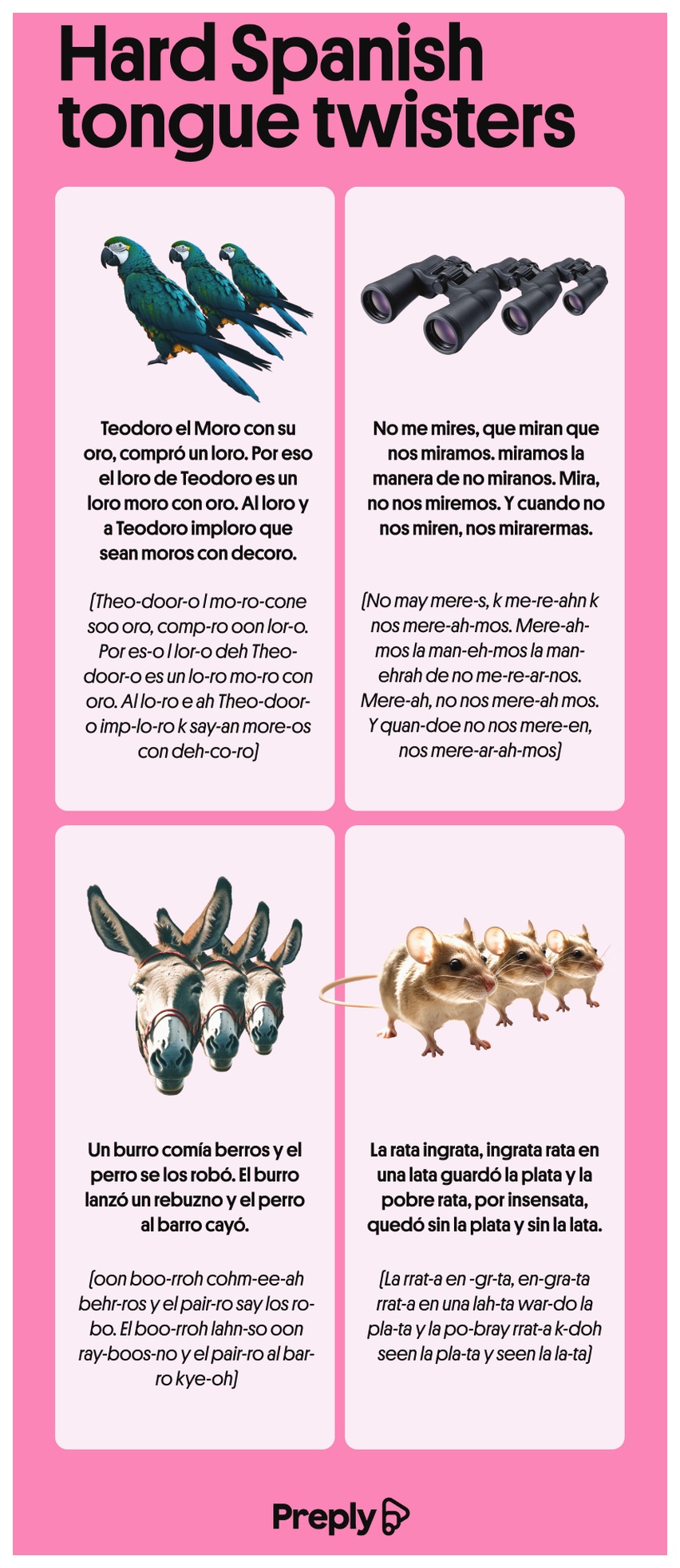
24. El burro disfrutaba berros, ¡pero el perro se los quitó! Su rebuzno hizo que el perro cayera al barro.
Pronunciation guide: (Oon boo-rroh cohm-ee-ah behr-ros y el pair-ro say los ro-bo. El boo-rroh lahn-so oon ray-boos-no y el pair-ro al bar-ro kye-oh.)
This phonetic breakdown will help you pronounce the Spanish phrases accurately.
One sunny day, a donkey was happily munching on some fresh watercress when a sneaky dog decided to snatch it away. Startled by the donkey’s loud bray, the dog lost its balance and tumbled right into a muddy puddle!
This tongue twister offers a fun opportunity to master the tricky “doubler” sound. It cleverly combines the rolled “r” with a variety of vowels—u, a, e, and o—making it an entertaining challenge to enhance your pronunciation skills.
“Juan y su Tubo: La Curiosa Historia de un Tubo Roto y su Reemplazo”
Pronunciation: (Hoo-ahn too-beh-oh oon too-beh-oh, eh l too-beh-oh seh lay rum-pee-oh, ee pah-rah ray-coup-er-ar el too-beh-oh keh too-beh-oh, too-beh-oh keh kohm-prahr oon too-beh-oh ee-gwal al too-beh-oh keh too-beh-oh ee rum-pee-oh)
Juan owned a pipe, but unfortunately, it broke. To replace it, he needed to purchase a new pipe identical to the one he had lost.
While “tuvo” and “tubo” may seem straightforward on their own, their similar sounds paired with completely different meanings can challenge even seasoned learners. This tongue twister’s length adds an extra layer of complexity, placing it firmly in the advanced category. Mastering it will take some patience and practice!
26. La astuta rata que perdió su tesoro: la historia de la lata y la plata
Pronunciation: (La rrat-a en-gra-ta, en-gra-ta rrat-a en una lah-ta war-do la pla-ta y la po-bray rrat-a k-doh seen la pla-ta y seen la la-ta)
In a tale of betrayal, the ungrateful rat hoarded the silver in a can, only to leave the naive rat empty-handed. In the end, the foolish rat lost both the precious silver and the can, highlighting the perils of misplaced trust.
In this section, we explore two distinct pronunciations of the letter “r.” The first is a single tap, similar to the Spanish word “ingrata,” while the second is a double roll, akin to “rata.” As you master these sounds, your tongue will also engage in unique movements for other consonants, like the tap needed for “stand.” Get ready to twist and turn your tongue for clear and accurate pronunciation!
“27. Evitemos las Miradas: Una Reflexión sobre el Arte de No Mirarnos”
Pronunciation Guide: (No may mere-s, k mere-ahn k nos mere-ah-mos. Mere-eh-mos la man-eh-rah de no mere-ar-nos. Mere-ah, no nos mere-ah-mos. Y quan-doe no nos mere-en, nos mere-ar-eh-mos)
English translation: “Don’t focus on me. They’re watching us watching one another. Let’s find a way to avoid making eye contact. Instead, let’s agree not to look at each other. Once they stop watching us, we can finally steal a glance.”
Not only does this tongue twister help you practice the softr(ra,re,ri) sounds, but it also serves as an excellent tool for refreshing your knowledge of verb conjugations and tenses.
“Teodoro el Moro y su Loro Dorado: Un Dueto de Elegancia”
Pronunciation: (The-oh-door-oh el mo-ro con soo oro, comp-ro un lor-oh. Por eso, el lor-oh de Theo-door-oh es un lor-oh mo-ro con oro. Al lor-oh e ah Theo-door-oh imp-lo-ro k say-an more-os con deh-co-ro)
Theodore the Moor decided to purchase a parrot with his gold, resulting in a beautiful Moorish parrot adorned in gold. I earnestly urge both the parrot and Theodore to embody the grace and dignity of their heritage.
Here’s an exciting tongue twister aimed at helping you master the soft “r” sound. The repeated “oro” endings can pose a challenge, but don’t worry! The key to nailing it lies in relaxing your tongue and maintaining a steady rhythm as you speak. The more fluid you are, the easier it will become!
“33 Log Segments Cut by Three Diligent Loggers: Tripling Timber Tasks”
Pronunciation: (Train-ta eh trays tra-mos day tron-cohs tro-za-ron trays tree-stays troe-sa-door-es de tron-cohs eh tree-plea-ca-ron su tra-ba-ho de troe-sar tron-cohs eh tron-cohs)
In a remarkable feat of hard work, three diligent log cutters tackled a challenging task: they cut down thirty-three sections of logs, tripling their usual output in the process.
This tongue twister offers a fun opportunity to practice the notoriously tricky combination that many English speakers find challenging to pronounce. Almost every word in the sentence begins with these letters, combining them with various vowel sounds to really test your skills!
30. El Dilema del Amor: Quiero Amar a Quien No Debo
Pronunciation: (Key-air-o eh no key-air-o care-air a key-en no care-ree-endo key-air-o. A care-e-doe seen care-air e es-toy seen care-air care-ee-endo. See por moo-cho k tay key-air-o, key-air-es kay tay key-air-a mas, tay key-air-o mas kay mey key-air-s. Kay mas key-air-s, key-air-s mas?)
To pronounce this correctly: say “Key-air-o” and “no key-air-o” followed by “care-air a key-en” and “no care-ree-endo key-air-o.” For “A care-e-doe,” emphasize “seen care-air,” and then “es-toy seen care-air care-ee-endo.” Lastly, when you say “See por moo-cho,” make it smooth with “k tay key-air-o,” and follow with “key-air-es kay tay key-air-a mas,” then “tay key-air-o mas kay mey key-air-s.” Finally, ask, “Kay mas key-air-s, key-air-s mas?” for clarity.
I find myself torn between wanting and not wanting to love someone deeply. I’ve experienced love that felt involuntary, and now I find myself loving you in the same way. If my feelings for you are as strong as I say, yet you desire even more affection from me, it seems I love you more than you love me. What else can I offer? Is there something more you seek?
Concentrating on the sounds and rhythm, this tongue twister presents a challenge with its length and variety of verb forms. At its heart is the romantic and poetic verb “querer,” which translates to both “to want” and “to love,” adding depth to the playful complexity.
Tips for practicing with tongue twisters
With these tongue twisters in hand, how can you master them and impress your Spanish teacher with your smooth pronunciation? Here are some practical tips to enhance your fluency and accuracy as you tackle these tricky phrases:
- Say the tongue twister slowly and clearly, speeding up as you get more comfortable.
- Practice several times daily by focusing on a single tongue twister, mastering one sound at a time, or warming up with a variety of sounds.
- Struggling with challenging sounds like the rolled ‘r’ or ‘th’? Practice them individually by listening to music, watching instructional videos, or hiring a professional tutor. Once you’re comfortable with the pronunciation, return to tongue twister exercises for further improvement.
To enhance your Spanish accent and pronunciation, incorporating tongue twisters is a fantastic strategy. However, one of the most effective ways to boost your speaking skills is to engage in conversations with native Spanish speakers as soon as you can. This real-life practice is unmatched in helping you become more fluent and confident in your speaking abilities.
Looking to enhance your Spanish skills with personalized practice? Explore online Spanish classes at LingualNeeds, where you can connect with a private tutor through video sessions. Tailor your learning experience by choosing a schedule and pricing that fits your needs, and start speaking confidently in no time!
Frequently Asked Questions
What is the purpose of using tongue twisters in language learning?
Tongue twisters help improve pronunciation, fluency, and familiarity with the sounds of a language.
Are there different levels of difficulty for tongue twisters?
Yes, tongue twisters are categorized into beginner, intermediate, and advanced levels, each presenting unique challenges.
How can I effectively practice tongue twisters?
Practice slowly and clearly, speed up as you get comfortable, focus on one sound at a time, and repeat regularly.
Can tongue twisters help with specific sounds?
Yes, they are particularly useful for mastering challenging sounds like the rolled ‘r’ and the ‘th’ sound.
Where can I find personalized Spanish practice?
You can explore online Spanish classes at LingualNeeds, where you can connect with a private tutor.