
- The primary German-speaking countries
- Austria
- Belgium
- Germany
- Liechtenstein
- Luxembourg
- Switzerland
- Other countries where German is spoken
- Interesting facts about the German language
- Conclusion
- Frequently Asked Questions
- Why should I learn German?
- What countries primarily speak German?
- Is German difficult to learn for English speakers?
- What are some interesting facts about the German language?
- How has the number of German speakers changed in the U.S. over time?
If you learn or want to learn German online, you’re in good company.
German ranks as the 12th most spoken language globally, boasting over 135 million speakers. For many individuals, it serves as their mother tongue, highlighting its significance in communication around the world.
German is predominantly spoken in six countries across Europe: Austria, Belgium, Germany, Liechtenstein, Luxembourg, and Switzerland. Notably, it holds the distinction of being the most widely spoken language in the European Union, where it is one of 24 official languages.
You don’t need to be European to find compelling reasons to learn German. In the U.S., you might encounter German speakers right in your neighborhood—about 25% of the nearly 80 million tourists visiting the country each year speak German. Plus, if you decide to travel abroad, Germany is a top choice, ranking as the second-most popular European destination for American travelers.
German belongs to the Germanic language family, specifically the West Germanic branch, alongside English and Dutch. Additionally, the North Germanic languages, primarily spoken in Scandinavia, include Danish, Faroese (used on the Faroe Islands, situated between Scotland and Iceland), Icelandic, Norwegian, and Swedish.
The East Germanic languages, once spoken by groups such as the Ostrogoths, Visigoths, Vandals, and Burgundians, represent the third branch of the Germanic language family. Unfortunately, this intriguing linguistic group has now become extinct.
German began to take shape as a unique language in the sixth century, with the earliest traces of Old High German discovered in the Elder Futhark runes. These inscriptions primarily feature proper names or concise coded messages. Old High German serves as the foundation for the modern German language we know today.
Modern German appeared in the 18th century, evolving from Middle German, which became common around the 16th century.
Keep reading to learn more or discover online German classes on LingualNeeds.

The primary German-speaking countries
German is a global language, but it holds official status in just six countries: Austria, Belgium, Germany, Liechtenstein, Luxembourg, and Switzerland. These nations are interconnected geographically, with Germany positioned at the heart of this linguistic region.
Germany stands out as the largest country on this list, boasting a vast territory and a population of approximately 85 million. To put that into perspective, Germany has over eight times the number of residents compared to Belgium, which has a population of 11.4 million.
Austria and Switzerland both boast populations exceeding 8 million, but Switzerland stands out with its rich linguistic diversity, having four official languages. Among these, German and Swiss German are the most prevalent, spoken by over 60% of the Swiss population.
Austria
German is the only official language of Austria and 98% of the population speaks it.
The official language of Austria is known as Austrian German, a unique variation of the German language that incorporates elements from Austro-Bavarian. This West Germanic language is also spoken in regions of Hungary and the Czech Republic. Despite this regional variation, most Austrians are proficient in Standard German as well.
Belgium
Belgium proudly boasts three official languages: Dutch, French, and German. These languages reflect the cultural ties with its neighboring countries. Notably, the presence of German-speaking communities along the border contributes to German’s status as the nation’s third most prominent language.
However, it lags significantly behind Dutch, spoken as a first language by 55% of the population, and French, which is the primary language for 39%. In contrast, German is the first language for nearly 1% of people, yet 22% are fluent in it as a second language, indicating a notable level of proficiency despite it not being their first choice.
Belgium is home to four distinct language regions as defined by its Constitution. These include three official languages: Dutch, French, and German. The fourth region is a bilingual area that encompasses the capital, Brussels, where both Dutch and French are recognized. While Belgium boasts three official languages, each one holds official status only within its respective region.
The German-speaking region of Belgium boasts a fascinating history that sets it apart. Nestled within the eastern part of Liège province in Wallonia, this area is significantly smaller than the larger Dutch and French-speaking regions. It became part of Belgium only after World War I, when it was annexed from Germany in 1920. Today, this vibrant German-speaking community is represented by its own parliamentary government and encompasses nine municipalities, home to nearly 78,000 residents as of 2020.
Germany
It’s no surprise that German, or “Deutsch,” serves as the official language of Germany, with an impressive 95% of the population speaking it natively. Among minority languages, Turkish is the most prominent, spoken by 1.8% of residents, followed by Kurdish at 0.3%, highlighting the country’s diverse immigrant community. Other languages have minimal representation, with Serbian at 0.09% and indigenous Romani at 0.08%.
Despite German being the predominant language, a significant 67% of Germans are proficient in at least one foreign language, with 27% speaking two or more. English is the most widely taught language, followed by French and Latin, highlighting the country’s commitment to multilingualism.
Before the Norman Conquest in 1066 introduced a wave of French and Latin influences, England was primarily shaped by Germanic tribes, particularly the Saxons and Angles. Interestingly, the name “England” itself is derived from the Angles, highlighting their significant impact on the region’s early history.
Due to their shared linguistic roots, German and English have many similar words or variations. For instance, the German word “Kamera” directly translates to “camera” in English. Similarly, “Haus” means “house,” and “Wasser” translates to “water.” This common heritage makes it easier to recognize familiar terms across both languages.
While some German words may not closely resemble their English counterparts, the similarities between the two languages provide valuable connections. For example, both German and English utilize comparable verb structures across various tenses. Additionally, their shared alphabet simplifies the process of translation compared to languages with different scripts.
Liechtenstein
Don’t worry if you struggle to locate Liechtenstein on a map; it’s easy to miss this tiny gem! Known as a “microstate,” Liechtenstein is the fourth smallest country in Europe, covering only 62 square miles and home to a mere 40,000 residents.
German serves as the national language of Liechtenstein, with approximately 86% of the population using it as their first language. Impressively, 92% of residents communicate in German, making it a vital part of daily life. In addition to standard German, various regional dialects and languages enrich the linguistic landscape, including Swiss German, spoken by around 29,000 individuals, as well as Alemannic and the Walser language.
Luxembourg
Luxembourg, while larger than Liechtenstein, remains a small nation, covering just 998 square miles and home to approximately 625,000 residents.
Situated between Belgium and Germany, Luxembourg also shares a brief southern border with France. It is one of the Benelux countries, alongside Belgium and the Netherlands, which have been united under the Benelux Union since 1944—a political and economic agreement aimed at fostering collaboration and integration among these nations.
Luxembourgish, a unique dialect closely related to those spoken in nearby Germany and Moselle, France, serves as the primary language of Luxembourg. Designated as the national language since 1984, it is spoken by 78% of the population. Additionally, German and French hold official status, reflecting the country’s rich linguistic diversity.
In Luxembourg, a remarkable 78% of the population communicates in German, while French is even more prevalent, spoken by 98% of Luxembourgers. This linguistic landscape reflects the country’s rich history of both German and French influence. Additionally, English, though not an official language, is spoken by 80% of residents, highlighting Luxembourg’s diverse and multilingual culture.
Switzerland
Switzerland is a multilingual country with four national languages, with German being the most predominant. Approximately 60% of the population, or six out of ten people, communicate in Swiss German, a unique dialect that incorporates various regional variations of standard German. This vibrant form of German is commonly heard across central, northern, and eastern regions of Switzerland.
Much like Belgium, the languages of Switzerland reflect the influence of its neighboring countries. In the western region, you’ll find Swiss French, while Swiss Italian is spoken in a southern enclave nestled between Italy.
In Switzerland, approximately 22.9% of the population speaks French, while 8.4% communicate in Italian. The fourth official language, Romansh (or Rumantsch), is much less common, spoken by only 0.5% of the population and primarily found in a few small regions in the southeast.
Switzerland is made up of 26 cantons, each with its own unique government and official language. Of these cantons, 17 declare German as their sole official language, while 19 are primarily German-speaking. This linguistic diversity reflects the rich cultural tapestry of the nation.
Other countries where German is spoken
German is a global language spoken by millions as their native tongue, with many more learning it as a second language. It holds significance in various countries, including:
- Brazil
- Belgium
- Canada
- Czech Republic
- Denmark
- Hungary
- Italy
- Kazakhstan
- Namibia
- Paraguay
- Poland
- Romania
- Russia
- Slovakia
German was one of three official Namibian languages until 1990, and still enjoys official recognition at the community level.
Argentina is home to over 3 million individuals of German descent, making it the largest German community in Central America. Interestingly, a significant portion of this population does not speak the German language.
Interesting facts about the German language
A fascinating feature of the German language is its unique approach to nouns, where every noun is capitalized. Additionally, each noun is assigned a gender—much like in French and Spanish, which have feminine and masculine forms. However, German adds an intriguing twist by introducing a third gender: neuter.
Germany boasts a rich tapestry of dialects, including the distinctive Berlin German spoken in the nation’s capital. Some of these dialects vary so significantly that even native German speakers from different regions may struggle to recognize or comprehend them.
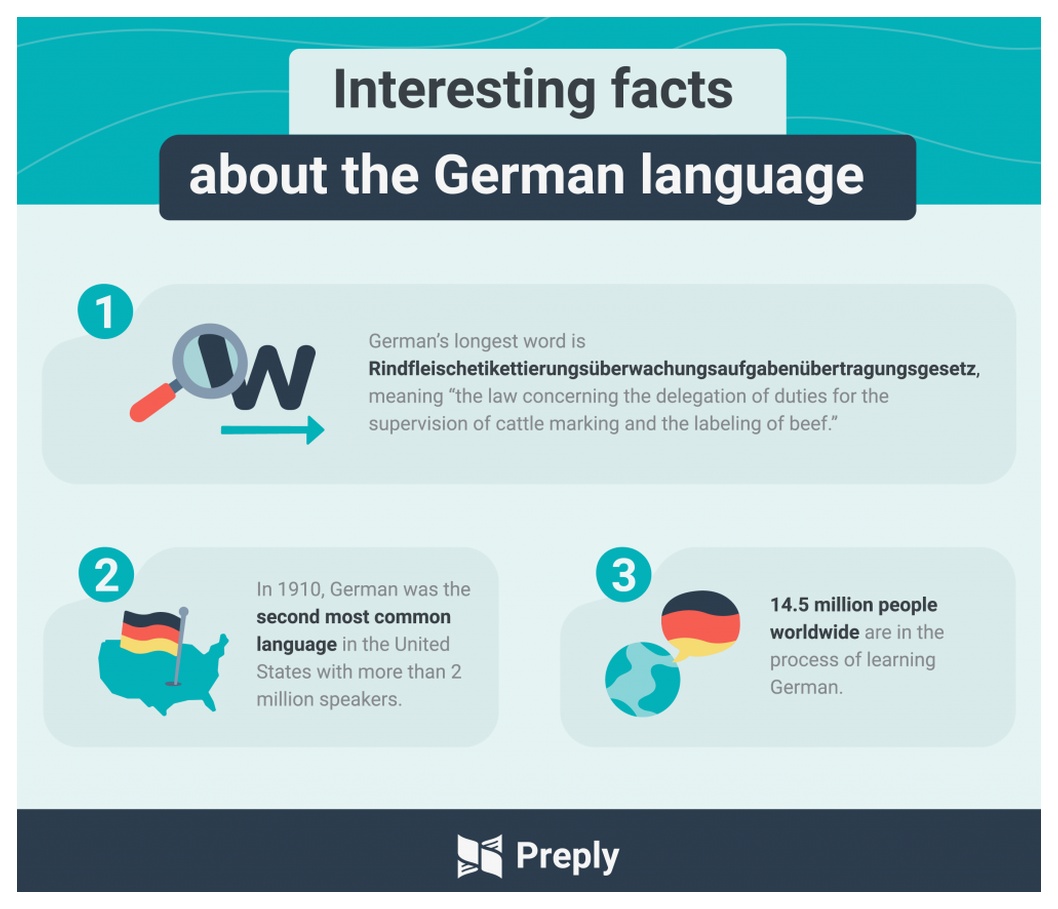
While many people recognize “antidisestablishmentarianism” as the longest word in English, stretching 28 letters and 12 syllables, German takes it a step further with an even longer term: “Rindfleischetikettierungsüberwachungsaufgabenübertragungsgesetz.” This mouthful translates to “the law regarding the delegation of responsibilities for overseeing cattle marking and beef labeling.” However, due to its excessive length, it has fallen out of use.
In the early 20th century, German held the position of the second most spoken language in the United States, boasting nearly 3 million speakers in 1910, during a time when the country’s population was around 92 million. Fast forward a century to 2010, and while the U.S. population had surged to 331 million, the number of German speakers had dwindled to just over 1 million.
In the 18th and 19th centuries, a significant wave of German immigrants made their way to the United States, among them the group commonly referred to as the Pennsylvania Dutch. This term is actually a misnomer, as these settlers originated from Germany, or “Deutschland,” rather than the Netherlands.
During World War I and World War II, speaking German in the U.S. became increasingly frowned upon as Germany was viewed as the enemy. During World War I, this shift in sentiment even led to German Shepherds being renamed Alsatians and German biscuits being called Empire biscuits, reflecting the widespread anti-German attitudes of the time. A similar trend was observed in Australia as well.
Throughout the 20th century, the percentage of Americans who spoke German declined significantly. In contrast, Spanish has emerged as the second most widely spoken language in the United States today and is the leading language taught in schools across the country.
On a global scale, the picture changes significantly. English leads the way with an impressive 1.5 billion learners, making it the most popular language to study. Following closely are French and Chinese, while German and Spanish are in a tight competition for fourth place, each attracting 14.5 million learners.
Conclusion
German is a global language spoken by millions as their first language, with many more learning it as a second language. With its similarities to English, the two languages share a rich common heritage, making German an accessible and fascinating choice for language learners.
Planning a trip to Europe? Learning German could be a smart move! This language is widely spoken, particularly in Germany and its neighboring countries. Even if you’re not traveling, mastering German can enhance your interactions with German visitors and deepen your understanding of the English language’s rich history. The benefits are undeniable!
Frequently Asked Questions
Why should I learn German?
Learning German can enhance your language skills, provide insights into German culture, and improve communication, especially if you travel to Germany or interact with German speakers.
What countries primarily speak German?
German is predominantly spoken in Austria, Belgium, Germany, Liechtenstein, Luxembourg, and Switzerland.
Is German difficult to learn for English speakers?
German shares many similarities with English, including vocabulary and grammatical structure, which can make it easier for English speakers to learn.
What are some interesting facts about the German language?
German nouns are always capitalized, it has three genders for nouns, and it features many dialects that can vary significantly from one region to another.
How has the number of German speakers changed in the U.S. over time?
The number of German speakers in the U.S. has declined significantly from nearly 3 million in 1910 to just over 1 million in 2010.