- Key Takeaways:
- Where Americans are the most and least welcoming
- A smile, a handshake, a hug? How Americans greet each other by state
- Idaho greets a stranger with a smile, while South Dakota is less welcoming.
- From Baby Boomers to Gen Z: Which generations are the most welcoming?
- A welcoming way to say hello
- Methodology:
- Fair use statement:
- Frequently Asked Questions
- What are the most welcoming states in the U.S.?
- How do most Americans greet strangers?
- Which state is considered the least inviting?
- How do different generations prefer to greet people?
- What unique greeting practice is noted in Delaware?
When it comes to welcoming someone, whether it’s a lifelong friend or a new acquaintance, what’s your signature greeting? How do you make someone feel valued and at ease from the very first moment?
Welcomes and greetings can take many forms, from a warm hug or a double-cheek kiss to a friendly handshake or a bright smile. These gestures can differ greatly based on your location and cultural background, reflecting the rich diversity of human interaction.
At LingualNeeds, we understand that greetings and welcomes are a reflection of our diverse cultures and languages. To explore this further, we surveyed over 1,000 Americans about their favorite greetings, gestures, and their feelings toward various welcoming practices.
Key Takeaways:
- The most welcoming states are Vermont, Maine, and Hawaii.
- The least welcoming states are Missouri, Massachusetts, and Illinois.
- Most Americans greet strangers with a handshake (60%), smile (47%), or by making eye contact (25%).
- Over 1 in 5 Americans say they aren’t comfortable with physical contact when greeting.
- 30% of Americans don’t smile at strangers.
- Nearly 1 in 5 people from Wisconsin avoid a stranger completely while walking by.

Learn a language with personalised 1-on-1 classes with our expert tutors from all over the world
French lessons online
Spanish lessons online
Where Americans are the most and least welcoming

Our research shows that greetings are more than polite gestures; they reflect a state’s openness and hospitality. Interestingly, the upper Northeast stands out as the most inviting region, with Vermont and Maine taking the top spots for their warm welcomes.
These states, characterized by stunning natural landscapes and a sparse population, offer an ideal retreat for anyone looking to escape the hustle and bustle of everyday life. Visitors can look forward to friendly interactions with locals, who are eager to showcase the unique treasures their region has to offer.
In contrast, Missouri ranks as the least inviting state. While residents are often thought to embody the warmth and hospitality typical of the South and Midwest, their reserved and cautious attitudes can sometimes be perceived as standoffish. Similarly, Massachusetts also struggles with its reputation, continuing to live up to its image of being less friendly.
A smile, a handshake, a hug? How Americans greet each other by state
Before embarking on your journey to the United States, online English classes can be incredibly useful, but understanding regional greetings is equally important. Have you ever encountered a stranger who greeted you with a warm smile or a friendly wave? In some states, this friendly gesture is the norm, while in others, people may choose to avert their gaze. Knowing these nuances can enhance your travel experience and help you connect with locals.
In a discussion about the common practice of smiling at strangers, one Reddit user shared their perspective: “I almost always smile at others! I believe that a simple smile not only lifts my spirits but also has the power to brighten someone else’s day.”
Another Reddit user expressed a differing opinion, stating, “Actually, I don’t. Most people just give me a blank stare and walk away when I try.”
Greetings can differ significantly depending on your location, and understanding these nuances can enhance your interactions. Our research provides valuable insights to help you choose the most appropriate greeting for each state, ensuring you make a positive impression on newcomers.
In Delaware and Rhode Island, making eye contact is the primary way to acknowledge strangers. In contrast, states like Alabama and Mississippi embody Southern hospitality, where a warm smile serves as a friendly greeting. This difference highlights the cultural traditions of each region, emphasizing warmth and courtesy in the South.
In North Dakota, it’s common for individuals to alter their paths when encountering strangers, often opting to avoid interaction altogether. This behavior may stem from a strong emphasis on privacy and a more reserved nature.
In Delaware, residents often opt for a clever ruse—a fake phone call—to avoid engaging with strangers they encounter. This strategy seems to be a more social approach compared to South Dakota, where people tend to completely sidestep any interaction with passersby. Whether out of nervousness or a desire for privacy, Delawareans find this tactic allows them to gracefully navigate social situations.
Language expert Sylvia Johnson emphasizes that a lack of gestures in communication doesn’t indicate unfriendliness; rather, it reflects a different style of interaction. These variations enrich our experiences and contribute significantly to the overall warmth of a place. They serve as a reminder that meaningful connections often extend far beyond mere words.
Learn a language online with our free learning materials.
Learn English online
Learn French online
Idaho greets a stranger with a smile, while South Dakota is less welcoming.
In the United States, gestures like hugs, smiles, and waves are common ways to greet one another, embodying warmth and friendliness. But which state is renowned for its open-armed welcomes, and which one tends to shy away? Let’s explore the most inviting places and those that might not roll out the red carpet.
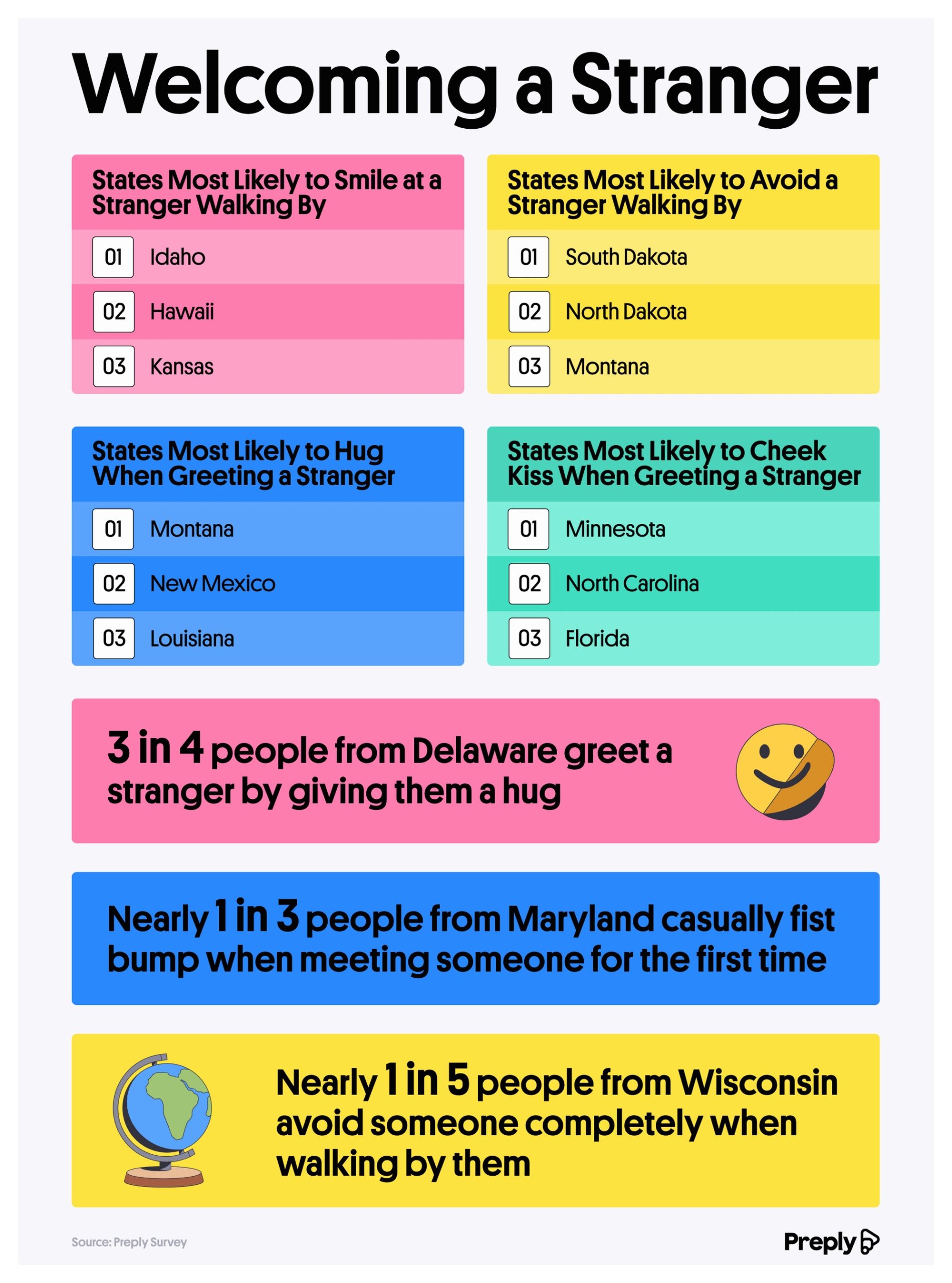
In Montana, New Mexico, and Louisiana, a warm hug is the go-to greeting, while Minnesotans, North Carolinians, and Floridians often greet each other with friendly cheek kisses. This trend is particularly fitting in Florida, where the sizable Spanish-speaking community embraces the custom. For Spanish speakers, a double-cheek kiss is simply part of everyday life!
Delaware stands out as the most welcoming state, with a remarkable 75% of residents greeting strangers with a friendly hug. In contrast, Marylanders tend to opt for a casual fist bump. These observations highlight the diverse ways people connect across the Northeast, revealing a blend of warm and informal greetings among its residents.
This underscores the rich diversity and uniqueness of social norms and cultural customs surrounding greetings in each state, showcasing the fascinating variety of characters that define America.
From Baby Boomers to Gen Z: Which generations are the most welcoming?
It’s not just states that differ in their greetings – generations do too!
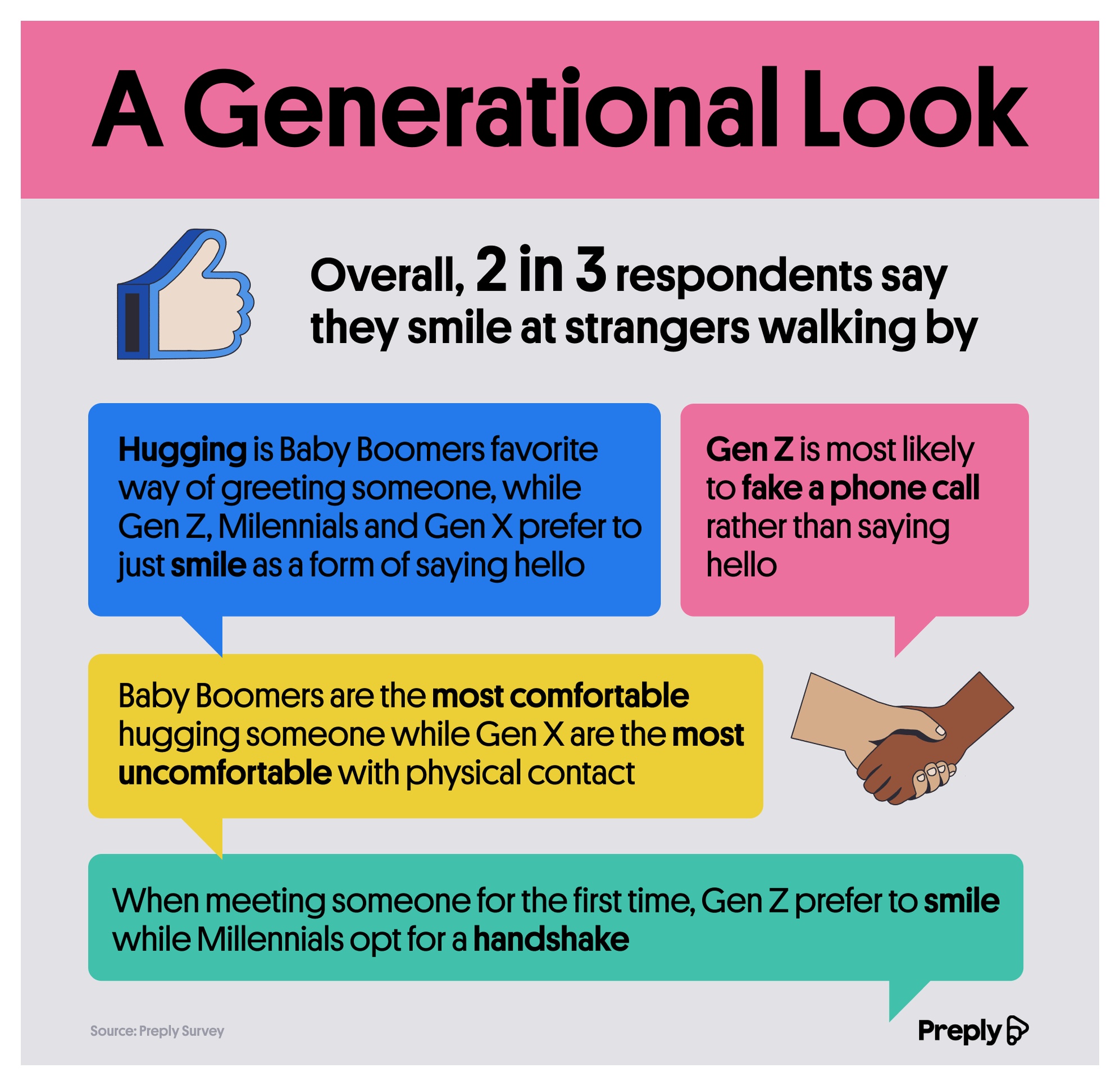
The way various generations convey warmth and hospitality highlights their distinct social dynamics. Baby Boomers often embrace with a heartfelt hug, whereas Gen Z, Millennials, and Gen X tend to favor a friendly smile as their preferred greeting.
When it comes to making introductions, Gen Z often greets others with a friendly smile, in contrast to the more traditional handshake favored by Millennials. Interestingly, nearly 30% of Gen Z members feel uncomfortable with physical contact and might even pretend to be on a phone call to dodge a greeting. After spending formative years in school and entering the workforce during the COVID pandemic, many in Gen Z have developed social anxieties that make them more inclined to avoid interactions altogether rather than engage openly.
A welcoming way to say hello
The diverse greetings people use across different states reflect the unique cultures that enrich our country. This variety not only highlights our individuality but also deepens our appreciation for one another. Embracing these differences fosters a greater sense of connection among us all.
Communication goes beyond just words; non-verbal cues can be incredibly powerful too. Our research indicates that even the simplest gestures can convey deep meanings, often making a more significant impact than spoken language. In many instances, it’s what remains unspoken that truly resonates.
Sylvia Johnson emphasizes that the ways people greet one another—whether through a warm smile, a friendly handshake, or other gestures—reveal much about their identities. These greetings and reactions are deeply rooted in cultural norms and traditions, showcasing the diverse ways we express welcome and connection.
The next time you’re on the road, remember that a simple smile, a friendly handshake, or a warm wave can significantly strengthen connections across cultural and geographical boundaries. Small gestures of kindness have the power to create lasting bonds!
If you’re eager to deepen your understanding of cultural nuances while enhancing your language skills—be it Spanish, Italian, or any other language—our dedicated tutors at LingualNeeds are here for you. Enjoy personalized one-on-one online sessions tailored to your needs and interests!
Methodology:
In March 2024, LingualNeeds conducted a survey involving 1,017 Americans to explore their perceptions of greetings, welcomes, and various nonverbal gestures. While the findings offer valuable insights, it’s important to note that the data relies on self-reported responses, which may introduce some biases in the results.
Fair use statement:
Feel free to share this data! You can use any of the information or graphics provided here for non-commercial purposes. Just remember to include a linked attribution to this page in your article to give credit.
Frequently Asked Questions
What are the most welcoming states in the U.S.?
The most welcoming states are Vermont, Maine, and Hawaii.
How do most Americans greet strangers?
Most Americans greet strangers with a handshake (60%), smile (47%), or by making eye contact (25%).
Which state is considered the least inviting?
Missouri ranks as the least inviting state.
How do different generations prefer to greet people?
Baby Boomers often use hugs, while Gen Z, Millennials, and Gen X tend to favor friendly smiles.
What unique greeting practice is noted in Delaware?
In Delaware, a significant 75% of residents greet strangers with a friendly hug.