- Key findings
- Language learning trends in 2024
- Challenges and goals among language learners
- Why Americans are learning new skills
- These are the skills Americans are learning in 2024
- The barriers to learning a new skill
- How Americans invest in skill learning
- Unlock your learning potential with LingualNeeds
- Methodology
- Frequently Asked Questions
- What percentage of Americans feel their current skill set limits their earning potential?
- What is the most popular language Americans plan to learn in 2024?
- What are some of the top skills Americans want to learn this year?
- What challenges do language learners face according to the survey?
- How much time do Americans typically spend learning new skills each week compared to their initial goals?
At LingualNeeds, we proudly connect over 40,000 skilled tutors with hundreds of thousands of eager learners across 50 vibrant languages. We believe that developing new skills is at the heart of our mission. As the new year begins, we’re excited to explore how individuals are setting their goals for personal growth and development!
To uncover valuable insights, we conducted an extensive survey with over 2,500 Americans. While our primary aim was to understand their language learning aspirations, we broadened our investigation to delve into the diverse new skills they are pursuing in 2024.
What are the ambitions for 2024? How much are they investing in acquiring new skills? And, crucially, what challenges are they facing? At LingualNeeds, our mission is to eliminate these barriers, empowering you to unleash your full potential through education. Dive into the data we’ve gathered to uncover the key trends that are currently shaping the learning landscape.
Key findings
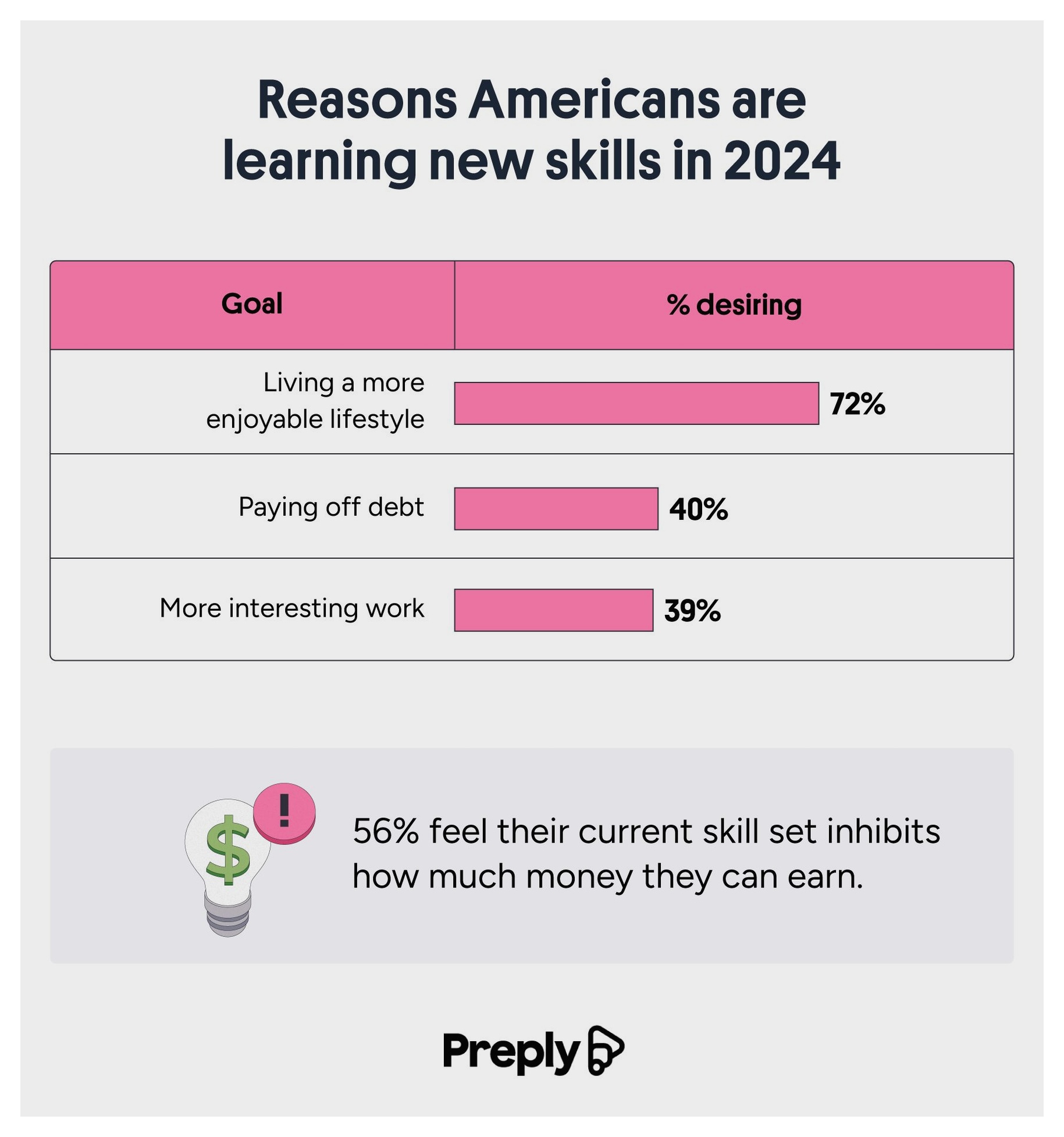
- The majority (56%) feel their current skill set inhibits how much money they can earn.
- Spanish is the top language Americans plan to learn in 2024.
- Cooking and baking are the top skills Americans want to learn in the coming year.
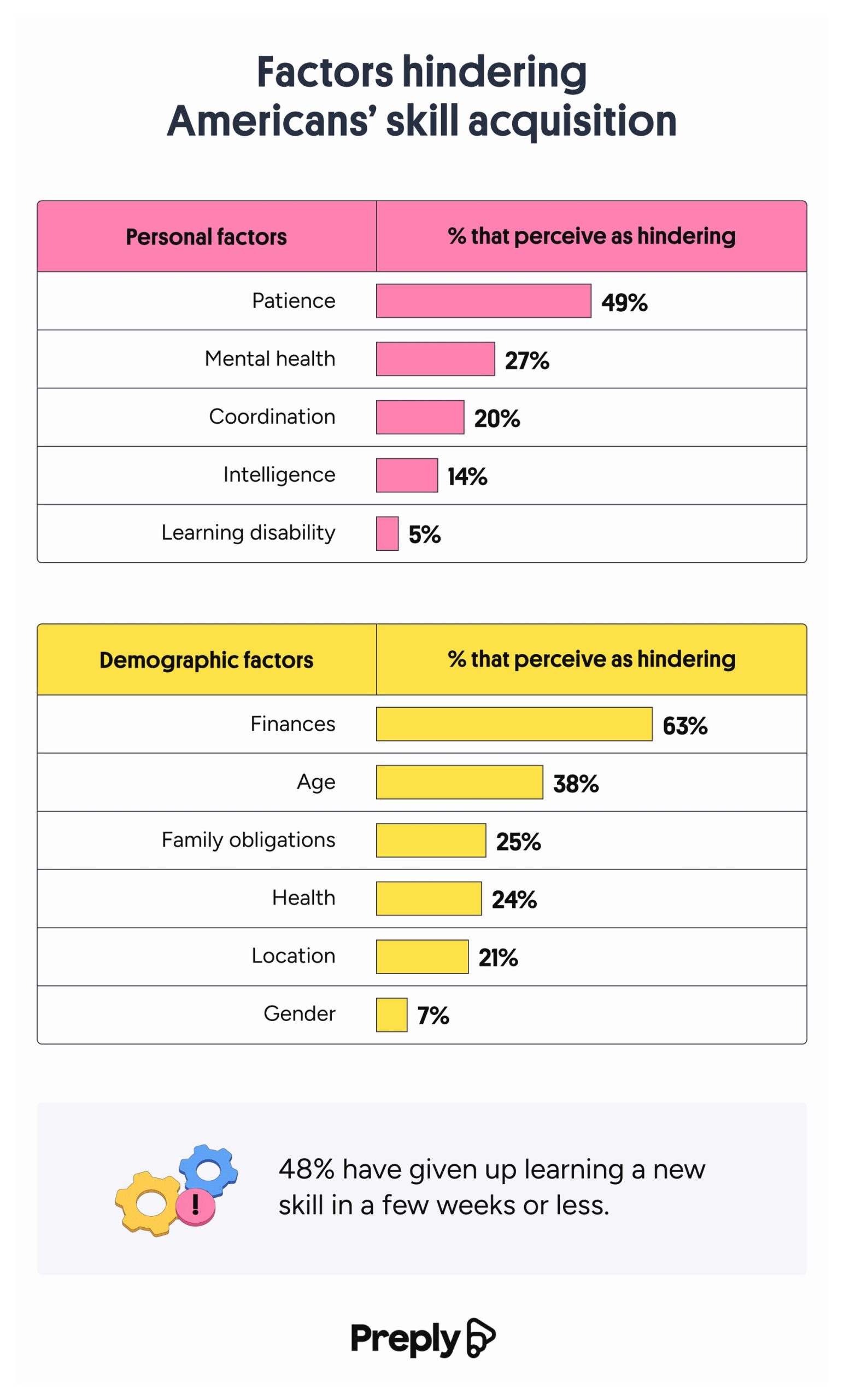
- Nearly half (48%) have given up learning a new skill in a few weeks or less.
- A significant 46% have at some point felt too old to begin learning a new skill.
- The average person spends 60% less time than planned learning new skills each week.

Learn a language with personalised 1-on-1 classes with our expert tutors from all over the world
French lessons online
Spanish lessons online
Language learning trends in 2024
In 2024, nearly four out of ten Americans are eager to learn a new language. This growing interest is largely fueled by career aspirations, with 30% of language learners identifying professional development as their primary motivation.
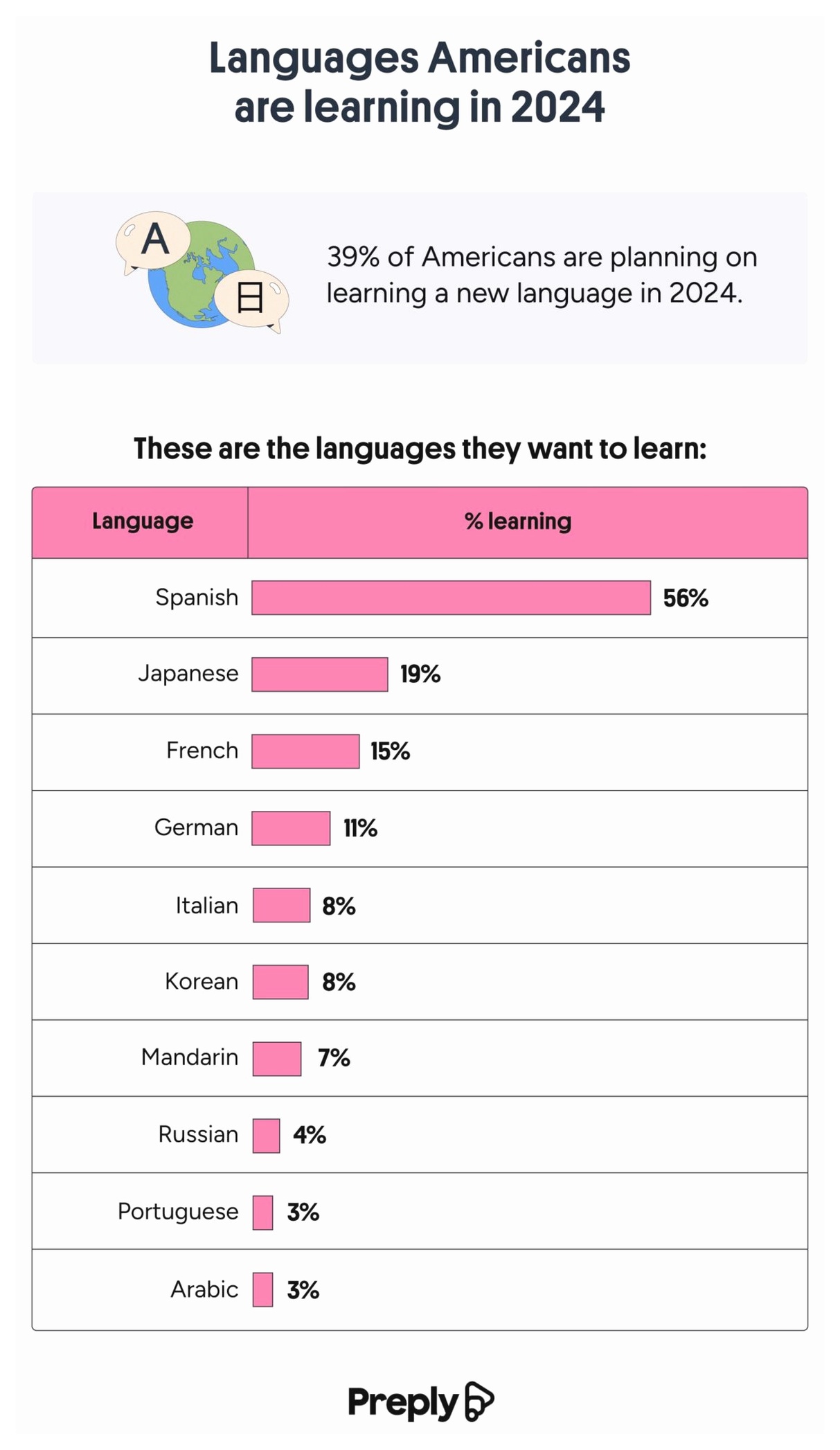
In 2024, Spanish, Japanese, and French are the most sought-after languages among American learners, with 56%, 19%, and 15% interest, respectively. Notably, 56% of learners emphasize the crucial role of a supportive teacher or mentor in mastering new skills. At LingualNeeds, we take pride in providing exceptional support to our students, ensuring they thrive in their language learning journey.
We spoke with Sylvia Johnson, a language expert at LingualNeeds, to explore the importance of teacher feedback in language learning. She emphasizes, “Feedback plays a crucial role in mastering a new language. It enhances acquisition, boosts retention, and promotes fluent usage.”
A tutor plays a crucial role in enhancing language learning by offering instant feedback on grammatical mistakes and pronunciation errors. This immediate guidance helps students identify and correct issues they may not even realize they have, deepening their understanding of the language’s rules and structures.
Feedback in language learning goes beyond simply identifying errors. It involves teachers providing explanations about proper usage and context, which enhances students’ comprehension and ability to apply the language effectively.
Feedback plays a crucial role in motivating language learners by affirming their progress. When students receive positive feedback, it instills a sense of achievement that fuels their enthusiasm for learning. Furthermore, by emphasizing their successes, feedback not only reinforces effective language use but also encourages learners to repeat those successful strategies, enhancing their overall language skills.
Challenges and goals among language learners
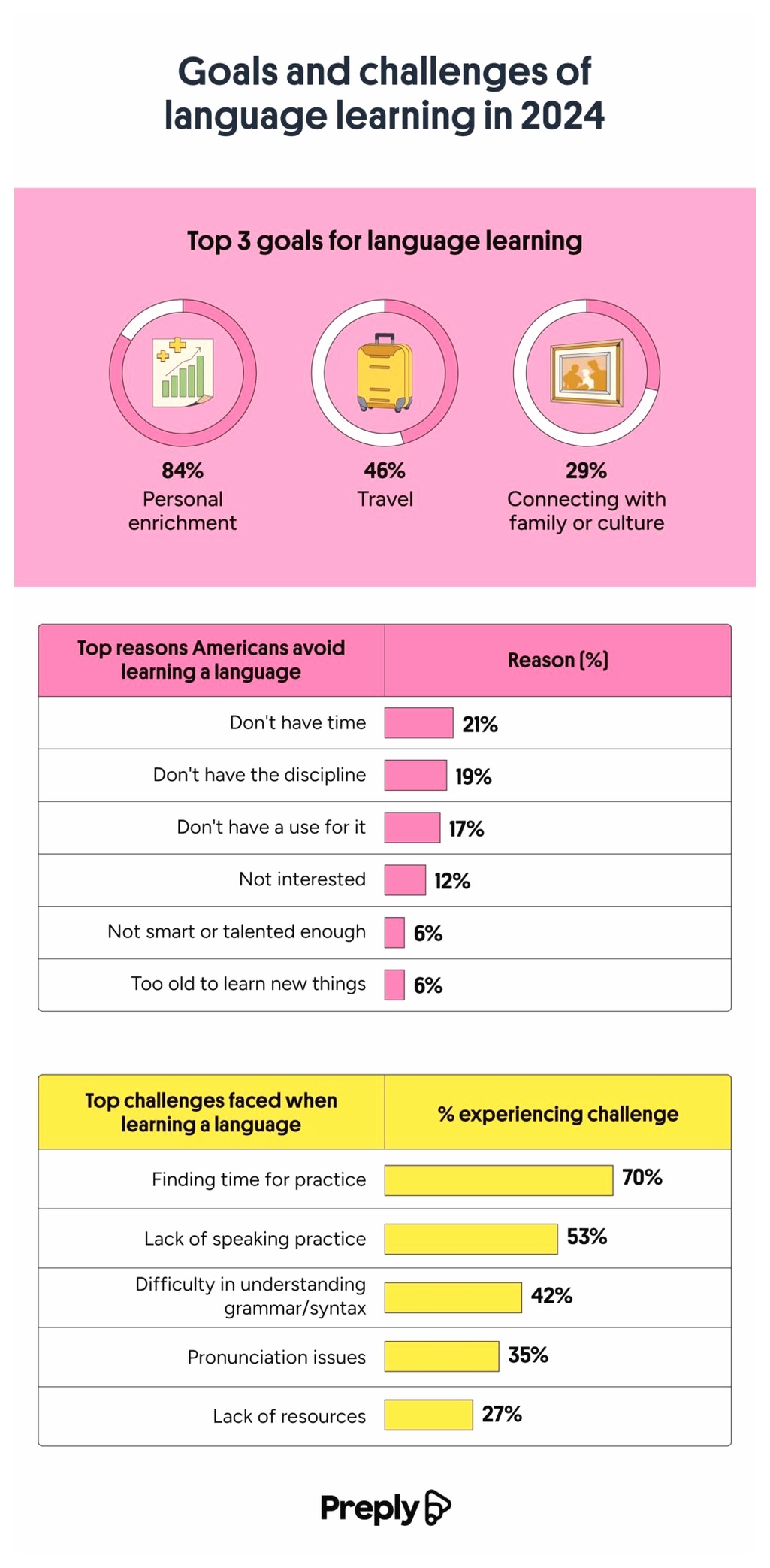
In 2024, a remarkable 84% of Americans are motivated to learn a new language primarily for personal enrichment. Additionally, almost half of all language learners (46%) view this endeavor as a strategic move to enhance their career prospects and stay competitive in the job market.
While many individuals are eager to learn a new language, a major obstacle stands in their way: time. A staggering 70% of learners report that fitting practice into their schedules is a challenge. This time constraint is the leading reason why 21% of Americans have chosen not to embark on the journey of language learning.
A notable 59% of individuals express their intention to integrate cultural immersion into their learning strategies. This prompts an intriguing question: how do immersion programs or living abroad influence the process of acquiring a new language?
Language expert Sylvia Johnson emphasizes that experiencing life abroad or participating in immersion programs offers invaluable exposure to the practical use of a language. This real-world interaction fosters a deep, context-driven understanding that traditional classroom settings simply cannot replicate.
Engaging in daily real-life activities in a foreign language offers learners a valuable chance for consistent practice, essential for effective language acquisition. By applying grammatical structures, vocabulary, and pronunciation in real contexts, learners can significantly enhance their fluency more quickly.
Living in a foreign country immerses you in its unique cultural nuances, idioms, slang, and nonverbal communication. This rich exposure significantly boosts your understanding and mastery of the language, making the learning experience more dynamic and effective.
Learners are optimistic about making significant strides in their language skills within a year and a half. To reach this goal, they intend to invest approximately 3.5 hours each week in 2024 to master their chosen language.
Language learning doesn’t just enrich the mind; it also enhances personal relationships. In fact, 41% of learners feel that mastering a new language can significantly improve their connections with others. Additionally, 20% believe that it will open up new dating possibilities, expanding their social horizons even further.
Learn a language online with our free learning materials.
Learn English online
Learn French online
Why Americans are learning new skills
In 2024, a significant motivation for Americans to acquire new skills stems from their current capabilities and financial ambitions. Notably, 50% of individuals believe that their present skill set is inadequate for reaching their aspirations.
Economic inflation significantly influences people’s priorities, with 58% feeling a heightened urgency to improve their skills in response to financial pressures.
The primary motivation for learning new skills is the pursuit of a more enjoyable lifestyle, a view shared by 72% of people. In 2024, Americans increasingly prioritize a balanced and fulfilling life over traditional measures of success, highlighting a noteworthy shift in societal values.
These are the skills Americans are learning in 2024
In 2024, Americans are honing a variety of essential skills, with cooking and baking leading the charge at 84%. Budgeting follows closely at 77%, while home repairs and maintenance capture the interest of 72% of the population. Notably, communication skills also rank high on the list, as over half (53%) of Americans express a desire to enhance their abilities in this crucial area.
YouTube has become the go-to platform for 85% of Americans seeking to learn new skills. However, the impact of social media reaches further; 69% of Americans report feeling motivated to acquire new skills after watching them highlighted on platforms like TikTok.
The barriers to learning a new skill
Embarking on the journey to acquire new skills in 2024 presents its fair share of challenges. Social media, a widely used platform for learning, can be a double-edged sword. While it offers valuable resources, a significant 53% of people report that it often fosters feelings of inadequacy and comparison, making them feel less talented than their peers.
The challenge of persistence in learning is striking, as 62% of individuals have attempted to acquire a new skill only to give up within the past five years. Alarmingly, 48% of learners drop out within just a few weeks, and 26% quit within days. This underscores the critical role of the initial stages of skill acquisition, where guidance can make a significant difference. In fact, 56% of learners believe that having a teacher or mentor is vital to their success in the learning journey.
Financial limitations pose a significant challenge for 63% of Americans seeking to acquire new skills. Additionally, almost half of the population (49%) cite impatience as a personal obstacle that hampers their learning progress.
Age-related self-doubt affects many, with 46% of people feeling "too old" to learn a new skill and nearly 40% believing their age hinders their ability to learn. If you share this concern, there's encouraging news ahead!
According to research published by Scientific American, the idea that learning new skills is only beneficial in childhood is a misconception. In fact, acquiring multiple new skills in a nurturing environment can foster cognitive development even in older adulthood.
How Americans invest in skill learning
In 2024, investing takes on a dual significance for Americans. Not only is it a crucial skill that 67% of the population is eager to master, but there's also a notable commitment to overall skill development. On average, individuals are spending $32 each month to enhance their abilities, alongside a dedication of substantial time to their learning journeys.
Even with the best intentions, a significant disconnect exists between planning and actual implementation. Although many aim to invest more than 5 hours per week in skill development, the reality is that Americans typically allocate just over 2 hours. This stark difference reflects a 60% decrease in the time individuals realistically commit compared to their initial goals.
Unlock your learning potential with LingualNeeds
As we look ahead to the skill acquisition and language learning trends of 2024, one prominent theme stands out: the transformative power of knowledge and communication. Language learning plays a crucial role in this, serving as a bridge between cultures and enhancing our ability to understand one another on a deeper level.
In this scenario, LingualNeeds stands out as a vital resource for learners. By addressing common obstacles like time limitations and insufficient support, LingualNeeds transforms the educational journey. It connects you with private tutors and offers flexible scheduling options, making it easy to integrate skill development into your hectic routine.
At LingualNeeds, we understand the crucial role that expert mentorship plays in skill development. A knowledgeable and supportive teacher can make all the difference in the learning process. That's why we connect learners with professional tutors for personalized one-on-one sessions, ensuring they receive the guidance they need to thrive.
This customized approach not only speeds up the learning process but also nurtures stronger, more meaningful relationships. By engaging in these personalized interactions, learners can express themselves clearly and confidently, supported by mentors who truly understand their individual learning paths.
At LingualNeeds, we provide essential resources for anyone looking to embark on online Spanish or French lessons. Our mission goes beyond simply teaching languages; we aim to break down barriers to personal and professional development. By fostering effective communication and expanding knowledge, LingualNeeds serves as a guiding light for individuals eager to excel in an increasingly interconnected world.
Methodology
We aimed to survey 1,000 or more individuals because such a sizable sample offers a clearer reflection of the broader population. This approach minimizes the margin of error, leading to more informed decision-making based on the gathered data. With a larger sample, we gain additional data points for statistical analysis, enhancing the reliability and validity of our findings. Ultimately, this allows us to make more robust conclusions about how the population perceives various issues.
On December 7, 2023, we conducted a survey involving 2,502 Americans to explore their experiences with acquiring new skills. The participants varied in age from 18 to 76, comprising 48% female, 50% male, and 2% nonbinary individuals.
Frequently Asked Questions
What percentage of Americans feel their current skill set limits their earning potential?
56% of Americans feel their current skill set inhibits how much money they can earn.
What is the most popular language Americans plan to learn in 2024?
Spanish is the top language Americans plan to learn in 2024.
What are some of the top skills Americans want to learn this year?
Cooking and baking are the top skills Americans want to learn in 2024.
What challenges do language learners face according to the survey?
70% of learners report that fitting practice into their schedules is a challenge.
How much time do Americans typically spend learning new skills each week compared to their initial goals?
Americans typically allocate just over 2 hours per week for learning new skills, which reflects a 60% decrease from their initial goals of more than 5 hours.