
Today, we offer a short list of interesting facts about English (and languages in general). You will be surprised!
- All Languages Have Common Roots
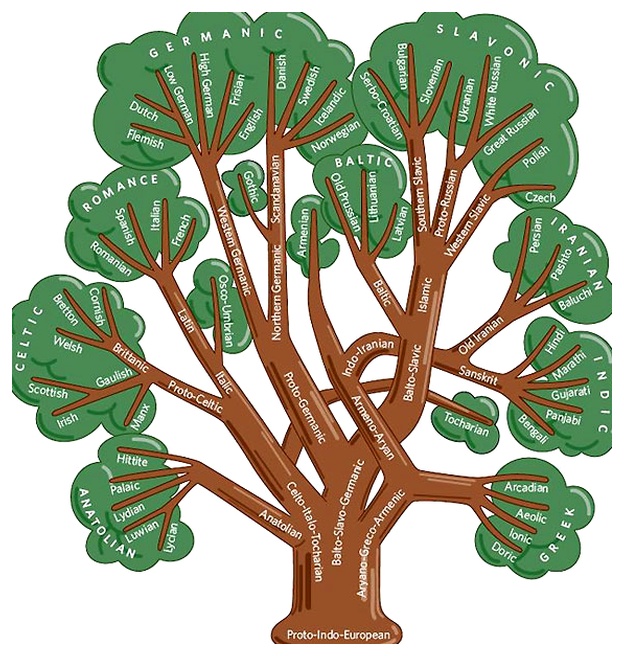
Linguists believe that many languages share a common ancestor known as Indo-European. To better understand this fascinating concept, let’s explore the captivating illustration of the Indo-European language tree.
- Finnish and Hungarian Are Related
Hungarian and Finnish are two fascinating languages that belong to the Finno-Ugric language family, yet they are not part of the Indo-European language group. Although these languages began to diverge around 6,000 years ago, they maintain a sibling-like connection, showcasing their shared heritage and unique linguistic characteristics.
- Tonal Languages
Many dialects of Chinese, along with Vietnamese and several other Asian and African languages, are tonal. This fascinating feature means that a single syllable can convey different meanings based on its pitch. Understanding this tonal aspect is essential for effective communication in these languages.
- The Word with the Most Meanings in English
The word “set” has more meanings than any other word in the English language.
- Special Question Mark
In Spanish, interrogative sentences feature two question marks: one at the beginning, inverted (¿), and one at the end (?). For instance, “How are you?” translates to “¿Cómo estás?” In contrast, Arabic and Persian utilize a single question mark that faces the opposite direction (؟), while Greek employs a semicolon (;) in place of a question mark.
- Vanishing Languages
UNESCO, the United Nations Educational, Scientific and Cultural Organization, reports that out of the world’s 6,000 languages, a staggering 2,500 are endangered or have recently vanished. This alarming trend highlights the urgent need to protect and preserve linguistic diversity, as each language carries unique cultural heritage and knowledge.
- The English words “Salary” and “Salad” Came from the Word “Salt”
The English words “salary” and “salad” both trace their roots back to the Latin word “salt.” The term “salary” originated from the practice of Roman soldiers being allowed to purchase salt, a valuable commodity at the time. Meanwhile, “salad” reflects the Romans’ fondness for seasoning their vegetables with salt.
- The Longest Word in the English Language
Challenge yourself to read it at first glance! The longest word in the English language is “pneumonoultramicroscopicsilicovolcanoconiosis,” a 45-letter term referring to a lung disease. Interestingly, it was famously featured in a song by Mary Poppins.
- Russian Words that Begin with the Letter “a” Were Borrowed
In the Russian language, nearly all words starting with the letter “a” are of foreign origin. Today, there are only a handful of words with genuine Russian roots that begin with “a.” Notable examples include “azbuka,” meaning alphabet, “az,” which refers to elements or rudiments, and “avos,” translating to perhaps.
Now it’s your turn to share some interesting facts about languages that you know.
Frequently Asked Questions
What is the common ancestor of many languages?
Many languages share a common ancestor known as Indo-European.
Are Hungarian and Finnish related?
Yes, Hungarian and Finnish belong to the Finno-Ugric language family and share a common heritage.
What are tonal languages?
Tonal languages, such as many dialects of Chinese and Vietnamese, use pitch to convey different meanings for the same syllable.
Which English word has the most meanings?
The word ‘set’ has more meanings than any other word in the English language.
How do question marks differ in Spanish and Arabic?
Spanish uses two question marks, one inverted at the beginning (¿) and one at the end (?), while Arabic uses a single question mark that faces the opposite direction (؟).