
- Key Findings
- The frequency of OOO emails
- The intentions behind OOO emails
- The sources behind OOO emails
- The most annoying OOO responses
- The most annoying festive OOO responses
- The desired information in an OOO email
- The most professional generations
- Conclusion
- Frequently Asked Questions
- What percentage of Brits never use an out-of-office (OOO) reply?
- Which generation is believed to craft the best professional OOO replies?
- What do most Brits prefer to see in an OOO email?
- How do younger workers influence the content of OOO emails?
- What is one of the most annoying phrases found in OOO emails?
Many of us have experienced the last-minute rush of preparing for a holiday, only to realize we’ve forgotten to activate our ‘out of office’ email responses. With our hectic lifestyles, it’s easy to overlook this simple task amidst the excitement of travel.
In contrast, many individuals take advantage of their out of office (OOO) emails to showcase their wit and humor, all while extending warm holiday wishes to their colleagues—whether it’s for Christmas, Halloween, or a pre-vacation send-off.
Keeping this in focus, the online tutoring specialists at LingualNeeds have explored the genuine perspectives of the British public regarding out-of-office (OOO) emails. Their goal? To uncover who appreciates this professional custom and who wishes it would disappear. Here are some of the most intriguing statistics derived from a survey of 1,000 British office workers:
Key Findings
- Over 21% of Brits never use an out-of-office (OOO) reply, while 25.1% only do so occasionally.
- Half of Brits (50.4%) have admitted that they have received an OOO reply they think is inappropriate or annoying
- 27.20% of Brits believe Generation X (born 1965-1980) craft the best professional out-of-office replies.
- Nearly all Brits (97.97%) say they have never used humour or a holiday-related joke in their own out-of-office email
- Only one in three Brits (30.7%) say they find OOO emails enjoyable

Learn a language with personalised 1-on-1 classes with our expert tutors from all over the world
French lessons online
Spanish lessons online
The frequency of OOO emails
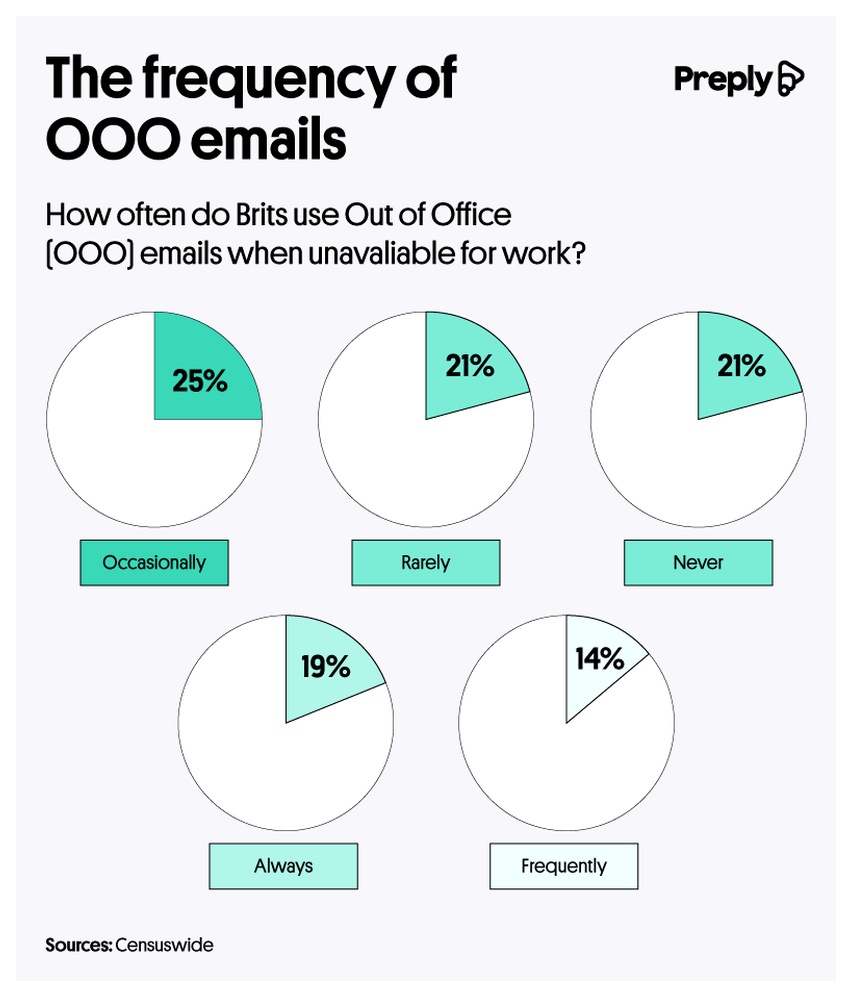
A remarkable 21% of Brits have never sent an out-of-office (OOO) email. This could stem from various factors, including forgetfulness, a belief that it’s unnecessary, or uncertainty about how to set it up. Interestingly, 25.1% of those surveyed acknowledged that they occasionally activate their OOO automated response, reinforcing the idea that many simply overlook this essential communication tool.
Notably, a higher percentage of individuals identifying as female (24.33%) frequently forgot to activate their out-of-office (OOO) response, in contrast to just 16% of those identifying as male. Additionally, the data revealed that the age group most inclined to turn on their OOO response was those aged 55 and older, with a striking 40% reporting they did so regularly.
The idea of out-of-office (OOO) emails dates back to the 1980s, originating with the auto-reply feature of Xenix, an early Microsoft operating system. For those who remember a time before OOO emails, this concept may still feel like a novelty. In contrast, millennials and Generation Z workers have grown up in an era where this feature has always existed, making it a standard part of their professional communication.
The intentions behind OOO emails
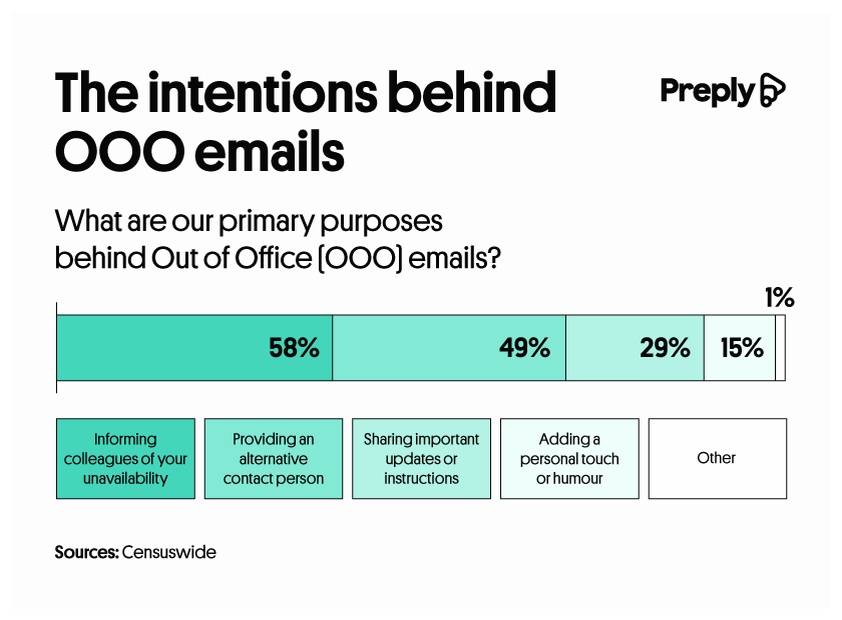
We delved into the various reasons people use the Out of Office (OOO) feature, and the findings were quite insightful. Contrary to the common belief that OOO emails are primarily for vacationers, a significant 58.35% of users actually employ them to notify colleagues of their unavailability. This can encompass a range of situations, from scheduled appointments to participating in remote training sessions.
This illustrates the flexibility of the feature, ensuring that new clients and colleagues feel acknowledged rather than overlooked. However, it may create uncertainty about whom to reach out to next. Fortunately, 48.86% of individuals utilize out-of-office emails to provide an alternative contact, ensuring that necessary information remains accessible even when they are unavailable. Failing to include an alternative contact can result in unfinished tasks and stalled projects.
Individuals aged 25 to 34 are leading the way in utilizing out-of-office (OOO) emails, with an impressive 55.42% reporting that they use this feature to provide an alternative contact. This highlights that, while notifying others of your absence is important, guiding them to someone who can address their inquiries is even more valuable.
28.61% of individuals reported utilizing their out-of-office (OOO) email feature to share crucial updates or instructions with colleagues. This proactive approach not only reassures coworkers that their absence won’t cause disruptions but also serves as a valuable resource for junior team members, providing them with guidance during their manager’s absence.
In a recent survey, 24% of respondents in Wales revealed that they use out-of-office (OOO) emails to add a personal touch when communicating with colleagues. This finding underscores the diverse ways OOO messages can foster connections and strengthen workplace relationships.
Learn a language online with our free learning materials.
Learn English online
Learn French online
The sources behind OOO emails
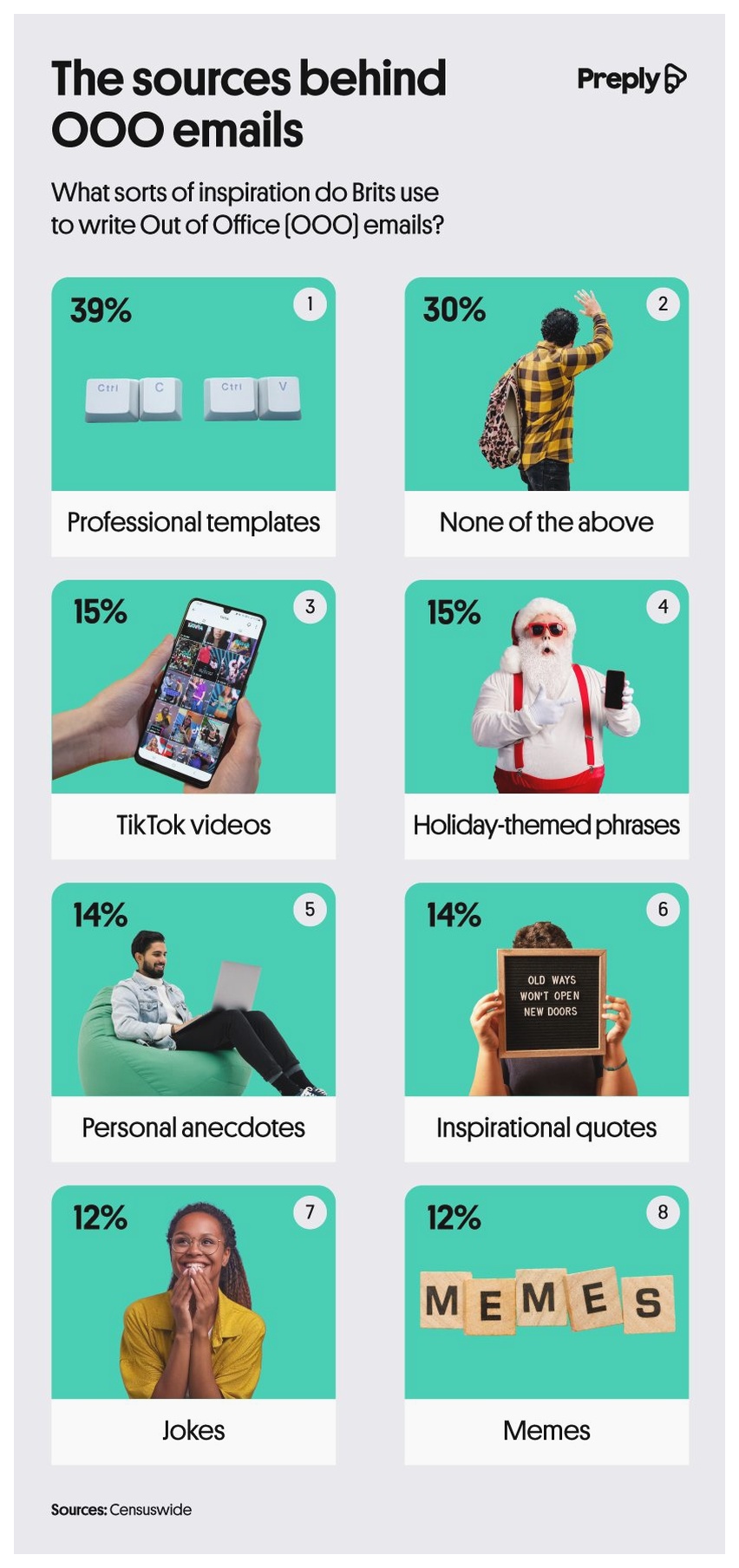
As TikTok continues to dominate the social media landscape, it’s making its way into the professional realm, especially among younger workers. A recent survey found that 15.06% of British office employees aged 16-24 are now infusing their out-of-office emails with elements inspired by TikTok. This includes trendy words, catchy phrases, and even snippets of song lyrics, showcasing how the platform’s influence has transcended casual use and entered the workplace.
As a result, we discovered that 22.61% of the younger generation are embracing their creativity by personalizing their out-of-office emails. However, a significant 38.86% still prefer to stick with professional templates, opting for a clean and straightforward approach.
A notable 11.77% of individuals acknowledge that they include ‘memes’—those funny images paired with witty text—in their emails. Interestingly, a higher percentage of men (19.35%) compared to women (11.89%) leverage TikTok content to spice up their email communication, often incorporating personal jokes and anecdotes for a more relatable touch.
This presents an intriguing opportunity: the casual language people use with friends and family online is increasingly blending with professional communication. Take TikTok, for instance, where calling someone the ‘CEO’ of a task, like ‘the CEO of editing videos,’ showcases their skill in a playful manner. This fusion of informal and formal language opens doors for younger professionals to express themselves in distinctive ways, enriching workplace communication.
The most annoying OOO responses
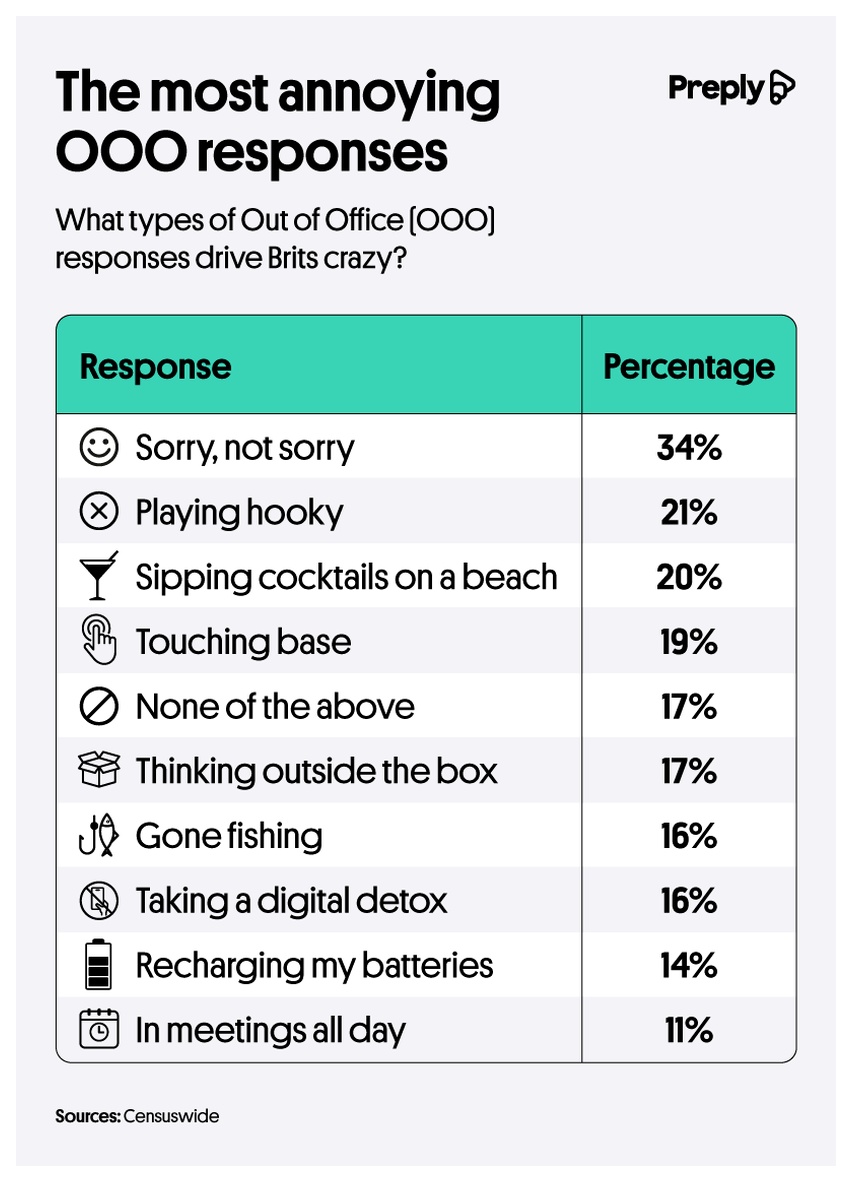
Unfortunately, not everyone views out-of-office (OOO) emails favorably. In fact, 50.4% of Brits surveyed expressed that they find OOO emails to be unprofessional and frustrating. This underscores the importance of knowing your audience before adding humor or memes to your message.
A notable 13.1% of individuals find Out of Office (OOO) messages bothersome, primarily because they often contain personal information about the sender or others. The age group most affected by inappropriate OOO emails is the 16-24 range, accounting for 75.56% of the cases. Additionally, a higher percentage of men (61%) reported receiving these unsuitable messages compared to women (43%). Interestingly, 60.87% of those who encountered inappropriate OOO emails are based in Greater London.
A striking 34.10% of Brits have encountered an out-of-office email featuring the dismissive phrase “sorry, not sorry,” making it the top annoyance among office workers. This reaction likely stems from the expectation that apologies in a professional context should be sincere and meaningful. The addition of “not sorry” diminishes the gravity of the apology, trivializing the situation at hand.
Coming in at a close second for the most irritating out-of-office emails are those featuring the phrase “playing hooky,” which accounted for 20.60% of disliked terms in the workplace. This expression implies skipping work under false pretenses, so it’s no wonder it rubs many people the wrong way. While it can be used lightheartedly, the lack of tone in emails makes it difficult for colleagues to interpret the intent, leading to potential misunderstandings.
Claiming the bronze medal for the most irritating out-of-office email is the classic “sipping cocktails on a beach,” which accounts for 20% of responses. Although this phrase is typically meant in jest, it often comes off as pretentious and may unintentionally stir feelings of envy among coworkers.
The least bothersome out-of-office email, rated at just 11%, was the straightforward message, “In meetings all day.” This type of notification is not only common but also effectively communicates your unavailability to colleagues without causing any offense.
The most annoying festive OOO responses
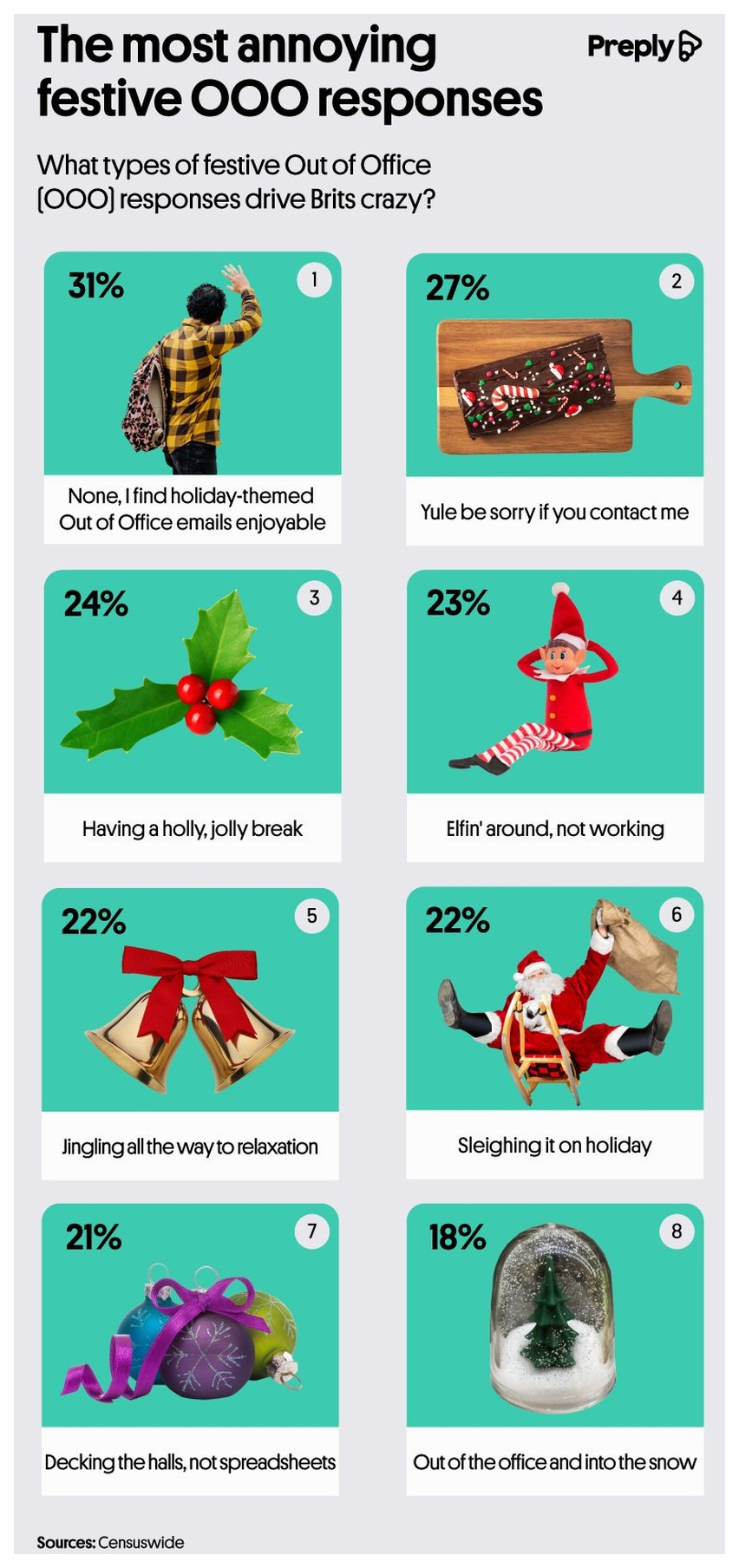
The holiday spirit isn’t shining through in everyone’s out-of-office (OOO) messages this Christmas. In fact, a remarkable 97.97% of respondents admit they’ve never included humor or a holiday-themed joke in their OOO emails during the festive season. Interestingly, younger individuals appear to embody the Scrooge mentality the most, with just 9.62% of those aged 16-24 and 20.41% of those aged 25-34 finding festive OOOs enjoyable.
Considering this, the most frustrating out-of-office email during the Christmas season was “Yule be sorry if you contact me,” which received a striking 27% irritation score. Its somewhat menacing tone understandably rubbed many office workers the wrong way, particularly those who had urgent matters requiring the sender’s attention.
The phrases “Having a holly, jolly break” (24.20%) and “Elfin’ around, not working” (23.90%) topped the list of most annoying festive messages among British workers. This highlights a clear disdain for Christmas puns in the workplace, showing that many prefer to keep the holiday spirit separate from their professional environment.
According to our survey, a significant 29.40% of respondents expressed a preference for festive emails that are friendly and warm, yet not too personal. We hope that those crafting Christmas-themed emails recognize their colleagues’ sentiments before the holiday rush hits!
The desired information in an OOO email
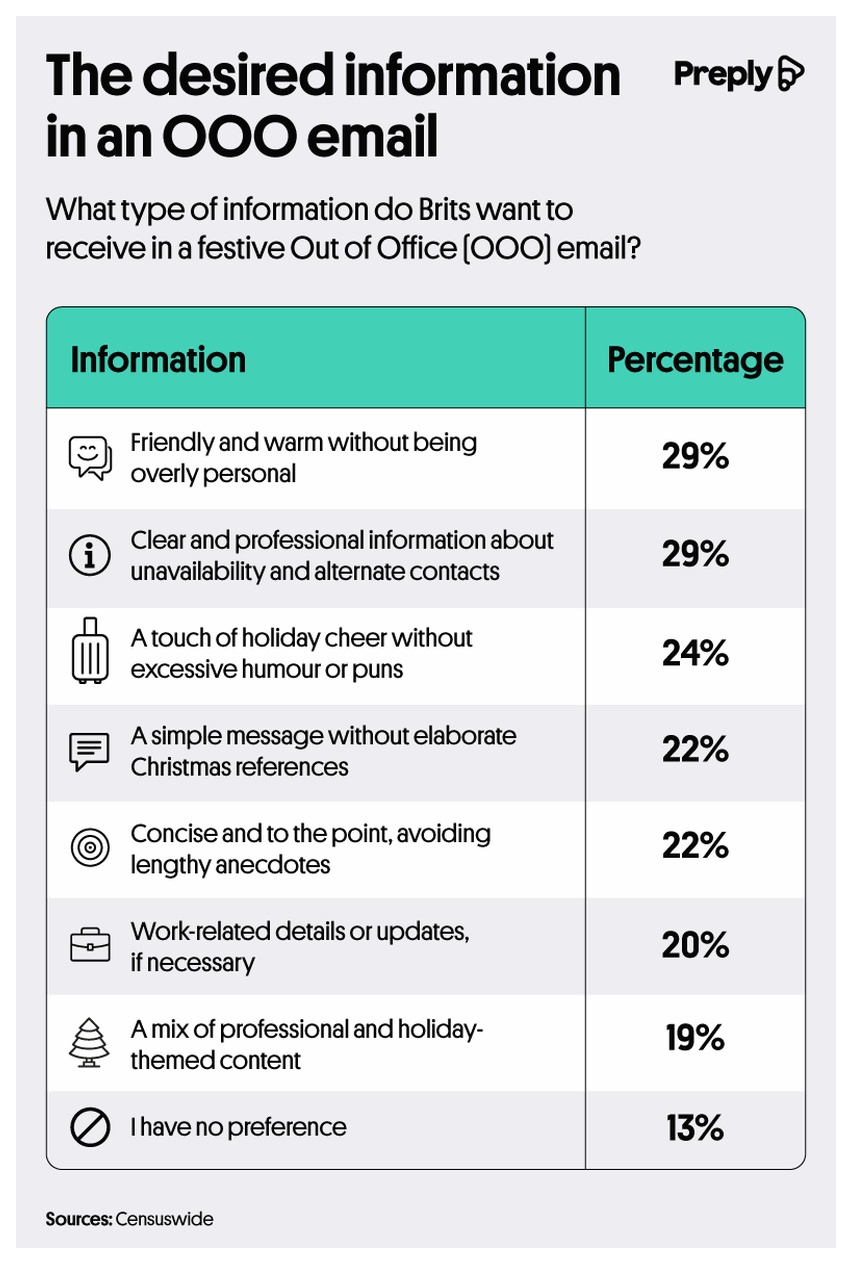
The content of any email is crucial, as it can evoke a range of emotions—from excitement to disappointment. This is especially true for out-of-office (OOO) emails. What do people in the UK prefer to see in these messages? A recent survey found that 29% of respondents appreciate a warm and friendly OOO email, as long as it avoids overly personal details.
A notable 29% of individuals expressed a preference for clear and professional communication in their out-of-office emails, while 24% appreciated a hint of festive spirit, steering clear of humor. These statistics reveal that UK office workers favor straightforwardness in OOO messages, valuing conciseness over unnecessary details.
This idea is further supported by a survey revealing that 22% of respondents appreciate straightforward messages during the holiday season. However, 19% prefer out-of-office emails that strike a balance between holiday spirit and professionalism. Overall, it seems wise to lean toward clarity and brevity in your OOO emails, as a significant majority favor concise communication over festive embellishments.
The most professional generations
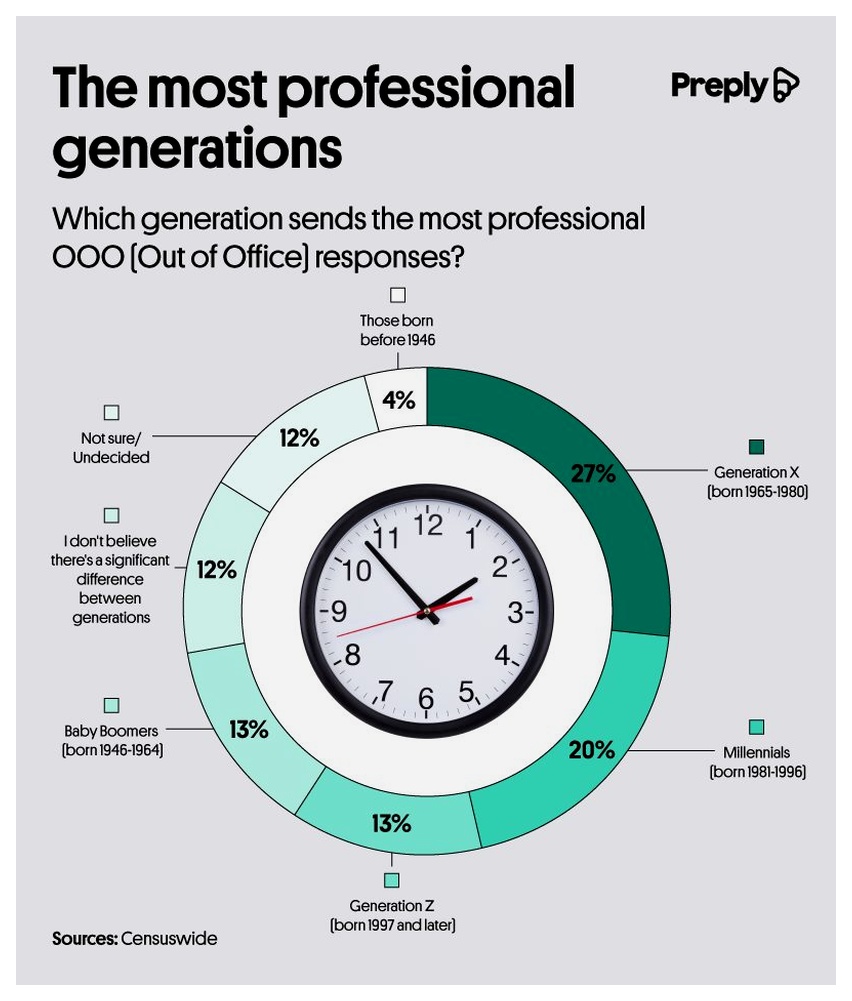
Have you ever been curious about your colleagues’ opinions on your meticulously crafted out-of-office (OOO) emails? Now, you can uncover their thoughts! Interestingly, a recent survey revealed that individuals born before 1946 received the fewest votes for having professional OOO messages, with only 3.70% rating them as such.
One reason for the perceived bluntness of older individuals in text communication may stem from their limited exposure to advanced technology during their upbringing, unlike younger generations. For instance, many view older adults as direct or curt in their messages, but this could simply reflect their lesser familiarity with phones and computers. Interestingly, our survey revealed that Generation X stood out for crafting the most professional out-of-office emails, with 27.20% of respondents commending their communication style.
It’s important to recognize that the older generation tends to be less active on social media, particularly on platforms like TikTok. As a result, their email communication often differs from that of younger individuals. While it may sometimes seem curt or impersonal, this style is often just an effort to communicate clearly and efficiently.
Moreover, a noticeable divide exists in out-of-office (OOO) email perceptions between office and remote workers. According to the survey, 44% of respondents believe there is a distinction. Additionally, 26.8% feel that remote workers send more bothersome emails, likely due to limited face-to-face interactions—often having met only once or not at all.
As a result, deciphering the intended tone of an out-of-office (OOO) email can be challenging. Interestingly, 17.20% of respondents found that office-based colleagues often sent the most frustrating emails, while 34% believed there was no noticeable difference in email tone between remote and in-office workers.
Conclusion
British office workers have decidedly mixed feelings about out-of-office (OOO) emails. Our research reveals that younger employees are leveraging these emails not just for notifications, but as a creative way to connect with colleagues. By incorporating TikTok clips, memes, and personal jokes, they are using OOO messages to foster relationships and strengthen workplace camaraderie.
Our data reveals that people sometimes unintentionally offend or annoy their colleagues, underscoring the need to carefully consider your audience when attempting humor.
The advent of out-of-office (OOO) emails has truly transformed the workplace, enabling employees to stay connected even when they’re away. These emails not only keep colleagues updated but also encourage creativity and originality in communication, all while maintaining professionalism.
Are you eager to enhance your English skills or wow your Spanish-speaking colleagues with a festive out-of-office message this holiday season? Look no further than LingualNeeds, which provides a wide selection of private online tutors tailored to your needs. Enjoy effective language-learning sessions from the comfort of your home, all at an affordable price. Plus, if you have a friend or family member keen to expand their language abilities, gifting them a LingualNeeds tutor could be the perfect Christmas surprise!
Methodology
Censuswide conducted a nationwide online survey of 1,000 UK office workers aged 16 to over 55 on behalf of LingualNeeds, aiming to explore British perspectives on “Out of Office” emails.
Frequently Asked Questions
What percentage of Brits never use an out-of-office (OOO) reply?
Over 21% of Brits never use an out-of-office (OOO) reply.
Which generation is believed to craft the best professional OOO replies?
27.20% of Brits believe Generation X (born 1965-1980) craft the best professional out-of-office replies.
What do most Brits prefer to see in an OOO email?
29% of respondents appreciate a warm and friendly OOO email, as long as it avoids overly personal details.
How do younger workers influence the content of OOO emails?
15.06% of British office employees aged 16-24 are infusing their OOO emails with elements inspired by TikTok, including trendy words and catchy phrases.
What is one of the most annoying phrases found in OOO emails?
34.10% of Brits have encountered an out-of-office email featuring the phrase ‘sorry, not sorry,’ making it the top annoyance among office workers.


