- The father figure
- Grandpa Frost
- St. Nicholas and Santa Claus
- Yule Goats and Pixies: Northern Europe
- Iceland’s thirteen Yule Lads
- Frequently Asked Questions
- What are some cultural names for Santa Claus around the world?
- How is St. Nicholas related to Santa Claus?
- What is the significance of the Yule Lads in Iceland?
- What are some names for Santa Claus in Northern Europe?
- What unique feature does Ded Moroz have in Russian culture?
Whether you refer to him as Santa Claus or St. Nick, this cheerful figure who brings gifts during the holiday season is celebrated globally. But have you ever wondered how various cultures depict this beloved Christmas icon?

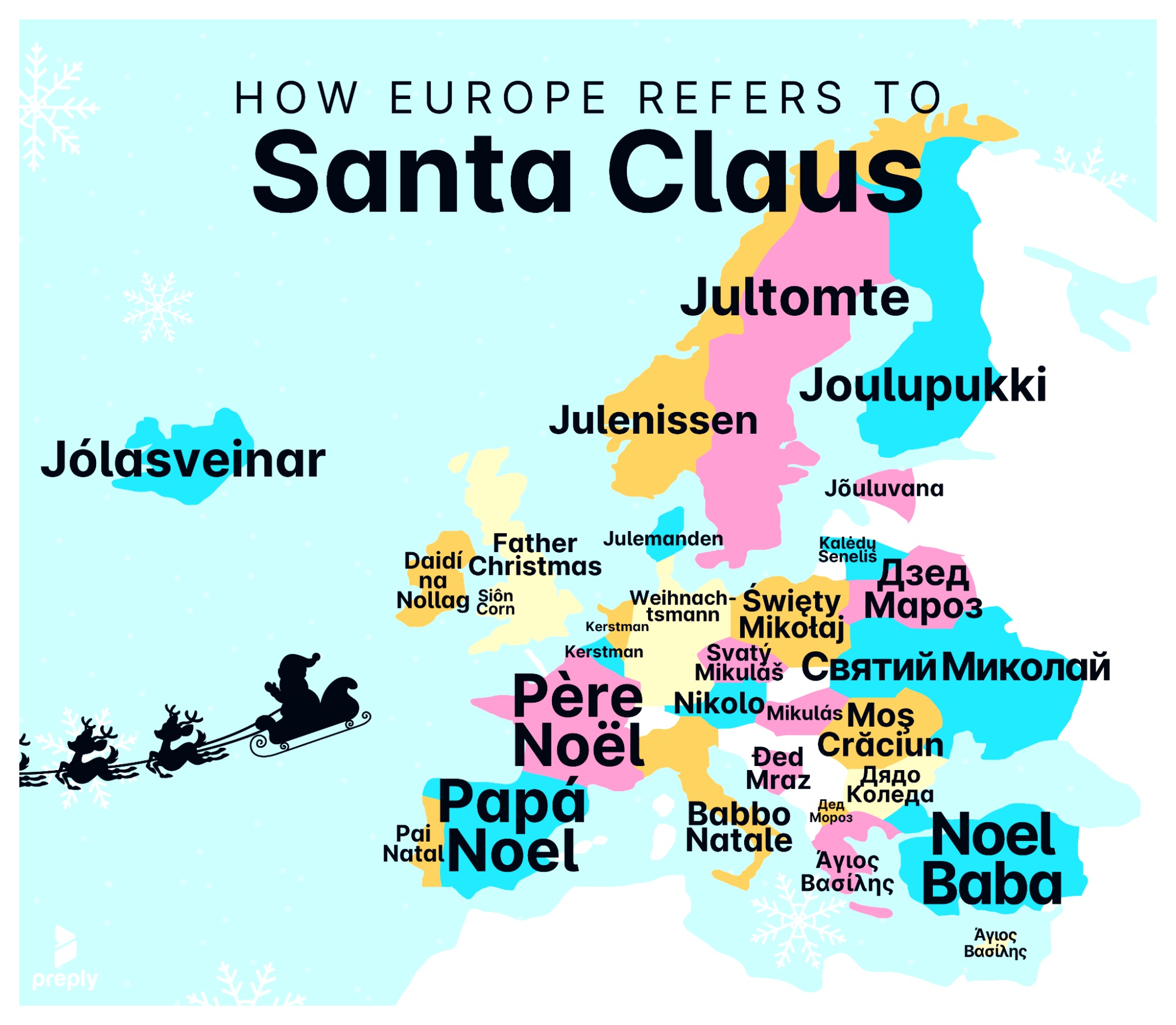
The story of Santa Claus is rich and multifaceted, with various cultures offering their unique interpretations of this beloved Christmas figure. At LingualNeeds, our exploration into Santa’s diverse names worldwide uncovered fascinating local legends, such as the Welsh ‘Chimney John’ (Siôn Corn) and Chile’s ‘Easter Old Man’ (Viejito Pascuero). Join us as we delve into the enchanting tales behind Santa’s many names!
The father figure
Santa Claus is universally recognized as a jolly old man dressed in a vibrant red coat with a flowing white beard. He personifies the joy and spirit of Christmas, which is why he’s also affectionately known as Father Christmas.
Father Christmas is the classic name for this beloved figure in English-speaking cultures, and his moniker has been embraced globally. In French, he is known as Père Noël, a title used not only in France but also in other French-speaking nations like Cameroon and Morocco.
The Spanish term “Papá Noel” translates to “Father Christmas” and is commonly used in Spain and many South American countries, including Argentina, Colombia, and Paraguay.
Other translations of ‘Father Christmas’ around the world include:
- Pai Natal (Portuguese – Portugal)
- Papai Noel (Portuguese – Brazil)
- Baba Noel (Arabic – Iraq)
- Bābā Noel (Persian – Iran)
- Noel Baba (Turkish)

Learn a language with personalised 1-on-1 classes with our expert tutors from all over the world
French lessons online
Spanish lessons online
Grandpa Frost
Another well-known title is Grandpa or Grandfather Frost, rooted in Slavic mythology. This legendary figure is especially popular in Southeastern Europe, where he’s celebrated under various names: Croatia calls him Đed Mraz, while in Macedonia and Russia, he’s known as Дед Мороз (Ded Moroz). Serbia refers to him as Деда Мраз (Deda Mraz), and in Belarus, he is called Дзед Мароз (Dzied Maroz).
Ded Moroz, the Russian counterpart of Santa Claus, is uniquely accompanied by his granddaughter, Snegurochka, which translates to “Snow Maiden.” This delightful duo makes Ded Moroz the only holiday figure to feature a female assistant, adding a special charm to their festive lore!
Other names portraying Santa as a grandfather figure around the world include:
- Өвлийн өвгөн (Övliin övgön) – ‘Grandfather Winter’. Mongolia
- თოვლის ბაბუა (tovlis babua) – ‘Grandfather Snow’, Georgia
- Ձմեռ Պապ (Dzmer Papik) – ‘Winter Grandfather’, Armenia
- Kalėdų Senelis – ‘Grandfather Christmas’, Lithuania
- Babagjyshi i Vitit te Ri – ‘Grandfather of the New Year’, Albania
St. Nicholas and Santa Claus
Saint Nicholas, celebrated as a patron saint, is renowned for his acts of kindness and his tradition of generous gift-giving. His legacy is believed to have inspired the contemporary figure of Santa Claus. Across Europe, various countries honor St. Nicholas in their own unique ways when referring to Santa, including:
- Luxembourg – Kleeschen
- Slovenia – Miklavž
- Hungary – Mikulás
- Switzerland – Samichlaus
- Austria – St Nikolaus / Nikolo
- Czech Republic – Svatý Mikuláš
- Poland – Święty Mikołaj
- Ukraine – Святий Миколай (Svyatyy Mykolay)
The term ‘Santa Claus’ has its roots in the Dutch name ‘Sinterklaas,’ which gained popularity in America during the 19th century. Sinterklaas is inspired by St. Nicholas, and is celebrated with a special holiday on December 5th in the Netherlands and Belgium, known as Sinterklaasavond, or ‘Sinterklaas evening.’ On this festive night, families traditionally exchange gifts, continuing the spirit of generosity associated with St. Nicholas.
Across the globe, numerous countries have adopted the name Santa Claus, or their own versions of it, to represent the beloved Christmas figure. In English-speaking nations like the USA, Canada, Australia, and the UK, the name Santa Claus is widely recognized, often alongside the classic title of Father Christmas. Additionally, many other countries also celebrate this festive character as Santa Claus, enriching the holiday’s cultural tapestry.
- El Salvador – Santa
- Cuba – Santa Cló
- Puerto Rico, Venezuela – Santa Clós
- Philippines – Santa Klaus
- Mexico – Santo Clós
- Thailand – ซานตาคลอส (Sāntākhlxs̄)
- Japan – サンタクロース (Santakurōsu)
- South Korea – 산타 할아버지 (Santa hal-abeoji, lit. ‘grandfather Santa’)
Learn a language online with our free learning materials.
Learn English online
Learn French online
Yule Goats and Pixies: Northern Europe
Northern European countries boast rich Christmas mythology and traditions rooted in the ancient pagan festival of Yule, celebrated by the Germanic peoples of Central Europe and Scandinavia. The term “Yule” and its variations continue to appear in Scandinavian languages, as well as in Finnish and Estonian, highlighting the enduring influence of these age-old customs on modern Christmas celebrations.
In Finland, Santa Claus is known as Joulupukki, which translates to “Yule goat.” This name has its roots in ancient pagan traditions, but today, it refers to the contemporary celebration of Santa Claus, blending historical significance with modern festivities.
In Norway and Sweden, the beloved figure of Santa Claus is known by names rooted in rich Nordic folklore. In Norway, he’s called **Julenissen**, while in Sweden, he’s referred to as **Jultomten**. Both terms translate to “yule pixie” or “yule gnome,” reflecting their cultural heritage. Today, these names are commonly associated with the modern-day Santa Claus, blending tradition with contemporary celebration.
In Estonia, he’s known as Jõuluvana, while in Denmark, he’s called Julemanden—both terms translate to ‘Old Yule’ and ‘The Yule Man,’ respectively. These names share a charming similarity with the English depiction of Father Christmas, highlighting a rich cultural connection to holiday traditions.
Iceland’s thirteen Yule Lads
While most countries celebrate Christmas with just one Santa Claus delivering gifts, Iceland has a unique twist: it boasts thirteen magical figures known as the Jólasveinar, or “Yule Lads.” These playful characters visit children individually on each of the thirteen nights before Christmas, rewarding well-behaved kids with small treats.
Each of the Yule Lads has their own specific name and personality, from Þvörusleikir (Spoon-Licker) to Gluggagægir (Window-Peeper).
Frequently Asked Questions
What are some cultural names for Santa Claus around the world?
Santa Claus is known by various names globally, such as Père Noël in French, Papá Noel in Spanish, and Ded Moroz in Russian.
How is St. Nicholas related to Santa Claus?
St. Nicholas is celebrated for his acts of kindness and gift-giving, and his legacy inspired the modern figure of Santa Claus.
What is the significance of the Yule Lads in Iceland?
In Iceland, the Yule Lads are thirteen magical figures who visit children on the nights leading up to Christmas, delivering treats to well-behaved kids.
What are some names for Santa Claus in Northern Europe?
In Northern Europe, Santa Claus is referred to as Joulupukki in Finland, Julenissen in Norway, and Jultomten in Sweden.
What unique feature does Ded Moroz have in Russian culture?
Ded Moroz is accompanied by his granddaughter, Snegurochka, making him unique among holiday figures.