
- What we did
- The most common ageist words used in UK job adverts
- Regions and counties in the UK most likely to use ageist language
- Which industries in the UK are most likely to use ageist language?
- The most common ageist words used in US job adverts
- States in the US most likely to use ageist language
- Which industries in the US are most likely to use ageist language?
- Q&A with Steph Lowrey-Willson, Executive Director of Age On
- What are the benefits of having a more diverse workforce?
- What impact can inclusive language choices within the workplace have on its employees and culture?
- How can employees be made aware of the importance of using inclusive language?
- Growing Awareness and Action Against Ageism in the Workplace: A Recent Trend
- Frequently Asked Questions
- What impact does language have on job advertisements?
- What are some examples of ageist phrases to avoid in job postings?
- Which regions in the UK are most likely to use ageist language in job ads?
- Which industries in the US are most prone to using ageist language?
- How can inclusive language benefit the workplace?
Crafting an effective job advertisement hinges on the language you choose, as it plays a crucial role in attracting the ideal candidate. However, it’s important to recognize that certain words and phrases can inadvertently discourage specific demographics from applying. Have you thought about the impact of your word choices?
A 2022 study from The National Bureau of Economic Research (NBER) revealed that job advertisements featuring age-related stereotypes tend to discourage older applicants from applying. This finding highlights the impact of language in recruitment and its potential to marginalize experienced workers.
The AARP, previously known as the American Association of Retired Persons, highlights several ageist phrases that businesses need to avoid. Terms like “digital native,” “high energy,” and “cultural fit” can unintentionally discriminate against older individuals.
The Association highlights that phrases of this nature can be viewed as discriminatory, as they suggest the company is seeking candidates who belong to a specific demographic group.
As this trend continues to expand, what implications could it have for job applicants? Additionally, which industries and job markets are most likely to inadvertently alienate older candidates through their advertising practices?
What we did
To uncover the prevalence of ageism in job advertisements, we examined the language used in millions of LinkedIn listings for positions in the UK and US.
Our research uncovers the most commonly used ageist phrases in job advertisements, as well as identifies the regions and industries that are most prone to employing such biased language in their online job postings.
We collaborated with Steph Lowrey-Wilson, the Director and Founder of Age On, to delve into the advantages of fostering a diverse workforce. Together, we examined how inclusive language and a supportive culture can significantly enhance the experiences of employees from underrepresented backgrounds.
The most common ageist words used in UK job adverts
Our analysis reveals that the term “innovative” is the most commonly used ageist descriptor by employers, appearing in more than 110,000 job postings.
The term “fast-paced” ranks second, appearing in over 82,000 distinct job advertisements. This translates to approximately 24 job listings for every 1,000 postings.
These phrases are often viewed as ageist because, according to former HP chief marketing officer Phil McKinney, many companies—particularly in the tech industry—hold the misconception that older candidates lack the ability to be innovative and creative.
In a 2017 report by HR Dive, it was highlighted that many employers might be dismissing older workers due to a common misconception that they struggle to thrive in a fast-paced work environment.


Learn a language with personalised 1-on-1 classes with our expert tutors from all over the world
French lessons online
Spanish lessons online
Regions and counties in the UK most likely to use ageist language
Our research reveals that ageist language in job advertisements is most prevalent in the East of England, with Essex leading the way. In this region, a striking 456 out of every 1,000 job listings include age-related biases, highlighting a significant issue in the local job market.
The South West may hold the second spot overall, but Devon, a beloved holiday destination, stands out for its surprising use of ageist language in job postings. In fact, it leads the nation, with 684 out of every 1,000 job ads featuring at least one instance of age-related terminology.

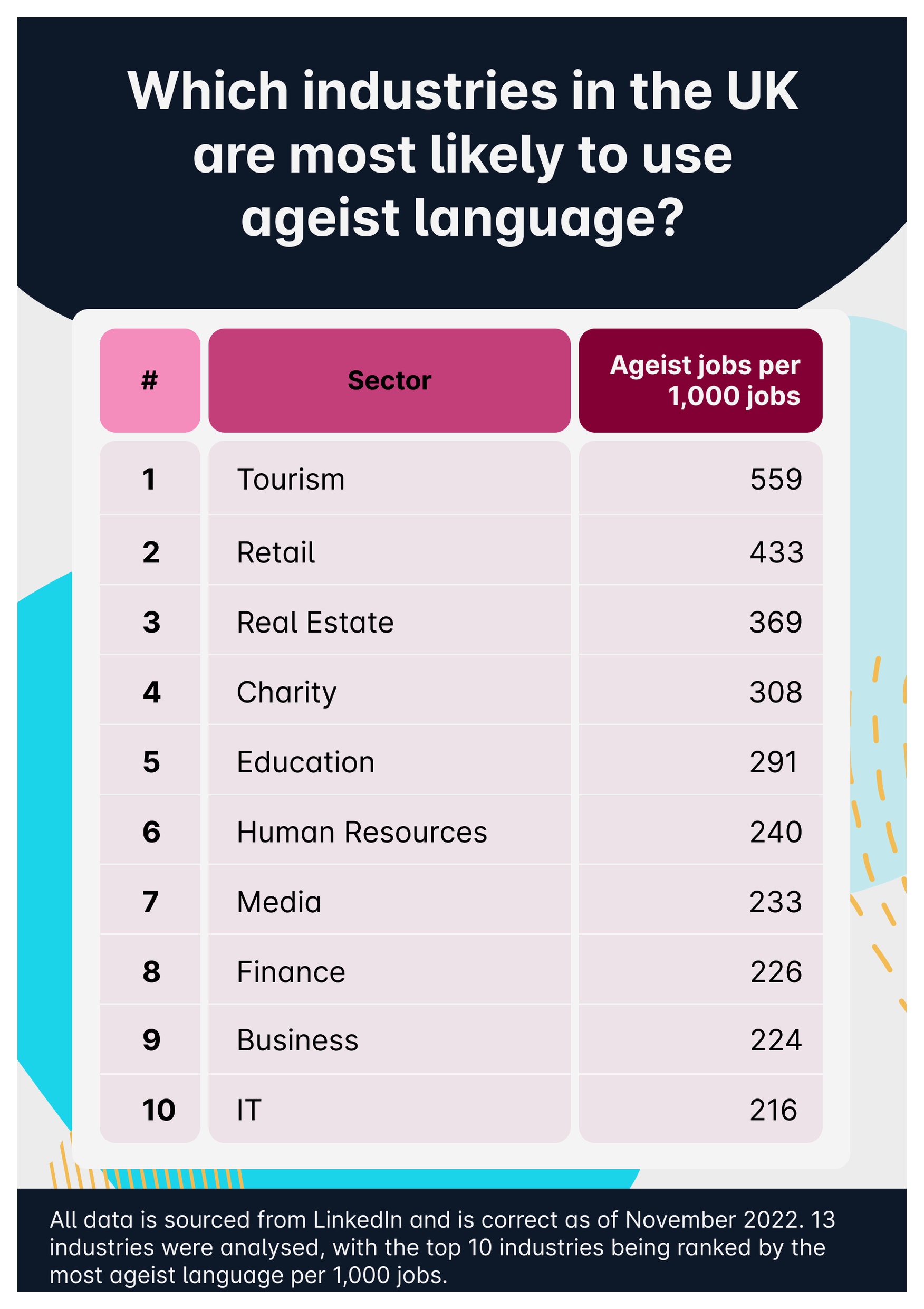
Which industries in the UK are most likely to use ageist language?
The UK’s tourism industry plays a vital role in the economy, contributing 9% to the annual GDP. However, this crucial sector often overlooks older workers, with more than half of job postings featuring ageist language. This trend raises concerns about inclusivity in a field that thrives on diverse talent.
The advertising and media industry, often criticized for its ageism, ranks seventh in terms of age-related bias, with 17.5% of job postings featuring ageist language.
Learn a language online with our free learning materials.
Learn English online
Learn French online
The most common ageist words used in US job adverts
Our analysis of over 21 million job advertisements in the US revealed that the terms “fast-paced” and “innovative” are the most commonly used ageist expressions.
Out of the total sample, “fast-paced” appeared over 63,000 times, followed by “innovative” with over 60,000.
The term “cultural fit” ranks as the lowest in the top 10, highlighting a growing awareness among companies about its ambiguous implications. Research from Join reveals that interviewers’ personal biases regarding what constitutes a “cultural fit” can result in unjust exclusions, as applicants cannot alter inherent traits of their personalities.

States in the US most likely to use ageist language
Our research reveals that Texas and Washington lead the nation in the use of ageist language, making them the states where this issue is most prevalent.
Texas emerged as the leader in ageist job advertisements, boasting more than 555,000 listings that included discriminatory language. This staggering figure translates to approximately 653 ageist mentions for every 1,000 job ads.
Washington falls short in promoting inclusive job advertisements, with just two fewer ageist listings per 1,000 compared to other regions. This highlights the ongoing challenge of creating equitable opportunities for all age groups in the job market.

Which industries in the US are most likely to use ageist language?
Every industry has grappled with the use of exclusionary language, but our research reveals that the retail and charity sectors are particularly prone to ageist terminology in their job advertisements. In fact, for every 1,000 job openings in retail, a staggering 380 contained age-related words or phrases. Similarly, almost 30% of job ads in the charity sector exhibited the same trend.
In the UK, the charity sector ranked fourth for the prevalence of ageist language, with 308 out of every 1,000 job postings containing such bias. A 2017 survey revealed that 38% of job seekers felt they faced age discrimination while attempting to enter this field.
Ageist language was prevalent in the real estate sectors of both the US and the UK, with 23% of job listings in the US and 27% in the UK featuring at least one identified age-related term.

Q&A with Steph Lowrey-Willson, Executive Director of Age On
After more than ten years of experience working with older adults, Stephanie established Age On in response to a common plea: “I just want to be heard.” Passionate about combating ageism and exploring intersectionality, she actively trains communities and creates tailored curricula for organizations. Her mission is to enhance diversity, equity, and inclusion training, specifically focusing on the challenges faced by older adults and the impacts of ageism.
What are the benefits of having a more diverse workforce?
Research shows that companies that actively recruit candidates from diverse backgrounds benefit from increased creativity, enhanced problem-solving, and greater innovation. By bringing together individuals with varied experiences, skills, and perspectives, these teams can approach challenges from multiple angles, leading to more effective solutions.
This diversity fosters smarter decision-making by bringing together individuals from various backgrounds, allowing them to collaborate and enhance critical thinking on complex tasks.
A diverse workforce not only enhances a company’s reputation but also signals its commitment to social responsibility. This positive perception attracts a wider pool of talent, making the organization a more desirable place to work.
What impact can inclusive language choices within the workplace have on its employees and culture?
Inclusive language sends a powerful message to individuals from historically marginalized communities, assuring them that they can be themselves at work and that they truly belong. It creates a welcoming environment where everyone feels valued and accepted.
Embracing inclusive language can empower under-represented individuals to thrive in their careers. When people feel free to express their true selves, their performance improves, and they are more inclined to share innovative ideas without the worry of harsh criticism.
A more diverse and inclusive work culture has been shown to reduce employee turnover for businesses too.”
How can employees be made aware of the importance of using inclusive language?
“You have to put the culture in place for people to stay there.
While companies may present an appealing image and use inclusive language during the hiring process, the real challenge lies in maintaining that sense of inclusion and dedication to diversity once new employees join the team. How can organizations ensure that their commitment to diversity continues to thrive in the workplace?
The process is straightforward and consists of three key steps. First, assess the hiring practices to identify and eliminate any biases. Next, implement training programs to ensure that all employees share a common understanding of these principles. Finally, take the time to identify any gaps within the organization, fostering an inclusive environment where everyone feels valued and included.
Employees come from diverse educational backgrounds regarding diversity and equality, which means ongoing education is crucial. It’s essential to raise awareness and foster advocacy, collaboration, and an understanding of intersectionality among both employees and employers. Additionally, recognizing cultural complexity is vital. Companies must assess their organizational, managerial, and team dynamics to identify gaps. This understanding is key to cultivating an inclusive culture, where language plays a fundamental role.
Growing Awareness and Action Against Ageism in the Workplace: A Recent Trend
“Yeah, absolutely. Although, if you would have talked to me pre-COVID, I would have said no.
Numerous activists and organizations are vigorously championing workplace equity, and it’s inspiring to witness the growing momentum in this important movement.
I’ve noticed a growing trend on LinkedIn where individuals are seeking advice on how to create job opportunities for older adults and what constitutes ‘inclusive language’ in job postings. This increase in interest is truly encouraging!
Five years ago it was not something that people thought about but now they are talking about it.
Aging is a natural part of life, and it’s vital for us to flourish at every stage, regardless of our age. Life can be challenging enough as it is, so let’s not complicate it further by worrying about something beyond our control. Embracing each phase of life can lead to greater fulfillment and joy.
Methodology
We conducted an in-depth analysis of more than 3 million job listings in the UK and over 21 million in the US on LinkedIn to investigate the prevalence of age-discriminatory language in recruitment practices.
We analyzed three categories of data:
- Which locations used the most ageist language?
- How often ageist terms and phrases appear in job advertisements?
- Which industries use ageist language in their job ads the most often?
Working alongside Steph Lowrey-Willson, we pinpointed 17 age-discriminatory words and phrases prevalent in the UK and 16 in the US. These terms are found across 13 key industries, highlighting a significant issue in workplace language.
All data is correct as of November 2022.
Frequently Asked Questions
What impact does language have on job advertisements?
The language used in job advertisements plays a crucial role in attracting ideal candidates and can inadvertently discourage specific demographics, such as older applicants.
What are some examples of ageist phrases to avoid in job postings?
Examples of ageist phrases include ‘digital native,’ ‘high energy,’ and ‘cultural fit,’ as they can suggest a preference for younger candidates.
Which regions in the UK are most likely to use ageist language in job ads?
The East of England, particularly Essex, has the highest prevalence of ageist language in job advertisements, followed by the South West, with Devon showing significant age-related biases.
Which industries in the US are most prone to using ageist language?
The retail and charity sectors in the US are particularly prone to ageist terminology, with a large percentage of job postings containing age-related words.
How can inclusive language benefit the workplace?
Inclusive language fosters a welcoming environment, enhances employee performance, reduces turnover, and promotes a culture where all individuals feel valued and accepted.


