- Where are the busiest cities in the world
- Cities that work the longest hours
- Sleepless in Seattle? Cities that get the most sleep
- No time for traffic
- Finding the perfect work/life balance
- Conclusion
- Frequently Asked Questions
- What city is considered the busiest in the world?
- Which city has the longest average working hours?
- How many hours of sleep do residents in Buenos Aires get on average?
- What city faces the longest traffic delays?
- What online learning opportunities are available for busy individuals?
Juggling a busy lifestyle often makes it challenging to find time for language learning, a struggle many face. However, the NHS highlights that immersing yourself in a new language can be a fantastic way to relax and de-stress, while also boosting your mental well-being.
As our lives get busier, many of us find ourselves racing to fit as much into each day as we can. Unfortunately, this hectic pace often means we allocate even less time to the rewarding pursuit of learning a new language.
This has got us wondering which are the busiest capital cities and which world capitals are the most relaxed.
The online tutoring specialists at LingualNeeds have thoroughly examined the data to identify which major capital cities around the globe stand out in terms of:
- Largest populations
- Longest average working hours
- Average hours of sleep
- Number of gyms
- Number of universities
- Number of entrepreneurs
- City attractions
We evaluated the cities based on these criteria to identify which capital city takes the title of the busiest. Let’s dive into the results!
Where are the busiest cities in the world
Our research shows that Mexico City holds the title of the busiest city in the world, achieving an impressive score of 69.6 out of 100. With a population exceeding 12.2 million, the Mexican capital keeps its residents on their toes, averaging a staggering 2,511 working hours annually—one of the highest rates globally.
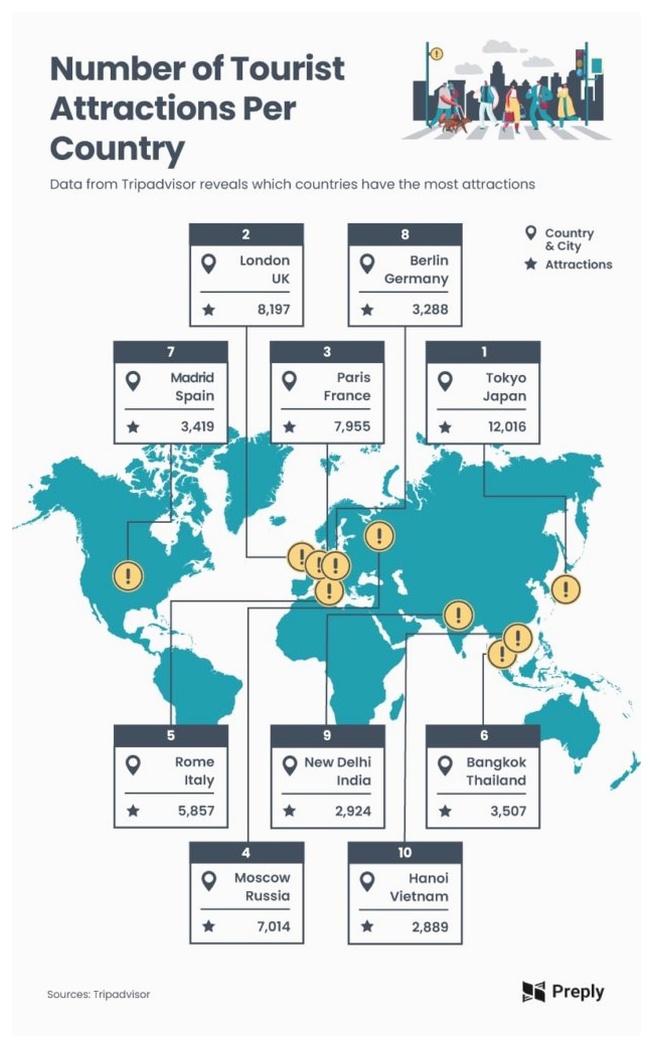
In the capital, you’ll find an impressive 1,777 attractions and 39 universities, making it a hub of culture and education. Additionally, the city boasts 181 gyms, providing ample opportunities for fitness enthusiasts to stay active.
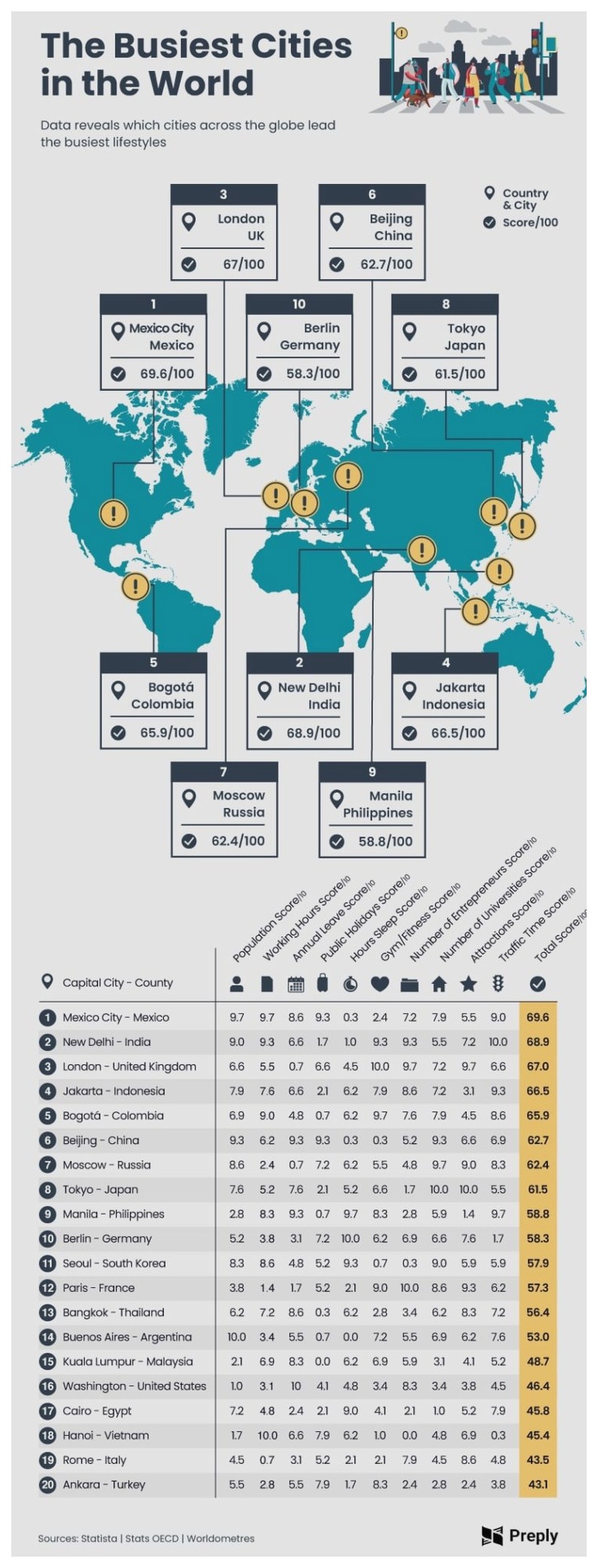
New Delhi, India, ranks a strong second with a score of 68.9 out of 100. As a bustling hub for entrepreneurs, the city boasts around 19,000 business professionals on LinkedIn. However, it faces a significant challenge with an average traffic delay of 57.37 minutes, potentially making it one of the most congested cities globally. On a brighter note, residents enjoy 17 public holidays each year and manage to get an average of 8.8 hours of sleep per night.
In third place, we find London, England, crowned as the busiest city in Europe with an impressive score of 67 out of 100. Known for its vibrant fitness culture, the English capital boasts a staggering 331 gyms and fitness centers—the highest number of any city globally—making it a haven for workout enthusiasts.
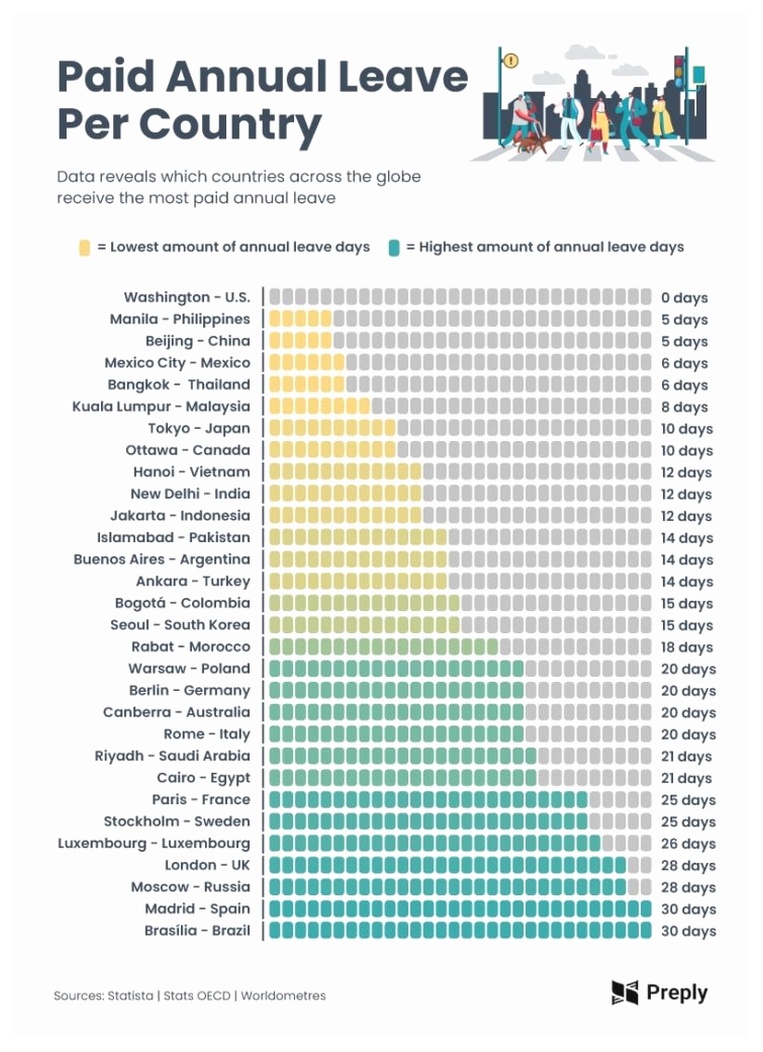
London is a vibrant hub, featuring an astounding 8,197 attractions and a thriving community of 20,000 entrepreneurs. Despite its reputation as a bustling metropolis, residents enjoy generous benefits, including 28 days of paid annual leave each year—one of the highest vacation allowances globally. This combination of a rich cultural landscape and favorable work-life balance makes London a unique place to live and work.
With a population of 11,716,620, many might assume that Beijing, China, would score higher in fitness rankings, yet it only secures sixth place with a total score of 62.7. The city has a surprisingly low number of gyms and fitness centers—just 125 for its vast population. Additionally, Beijingers work an average of 2,096 hours annually, leaving them with a scant five days of paid vacation each year.

Learn a language with personalised 1-on-1 classes with our expert tutors from all over the world
French lessons online
Spanish lessons online
Cities that work the longest hours
In the UK, several companies are testing a four-day workweek, a concept that has gained traction in countries like Japan, where it has significantly enhanced productivity and employee morale. Similarly, Sweden has explored the benefits of shorter six-hour workdays, achieving positive outcomes. Despite these successes, many countries remain hesitant to adopt such progressive work models. So, where in the world do people clock the longest hours?
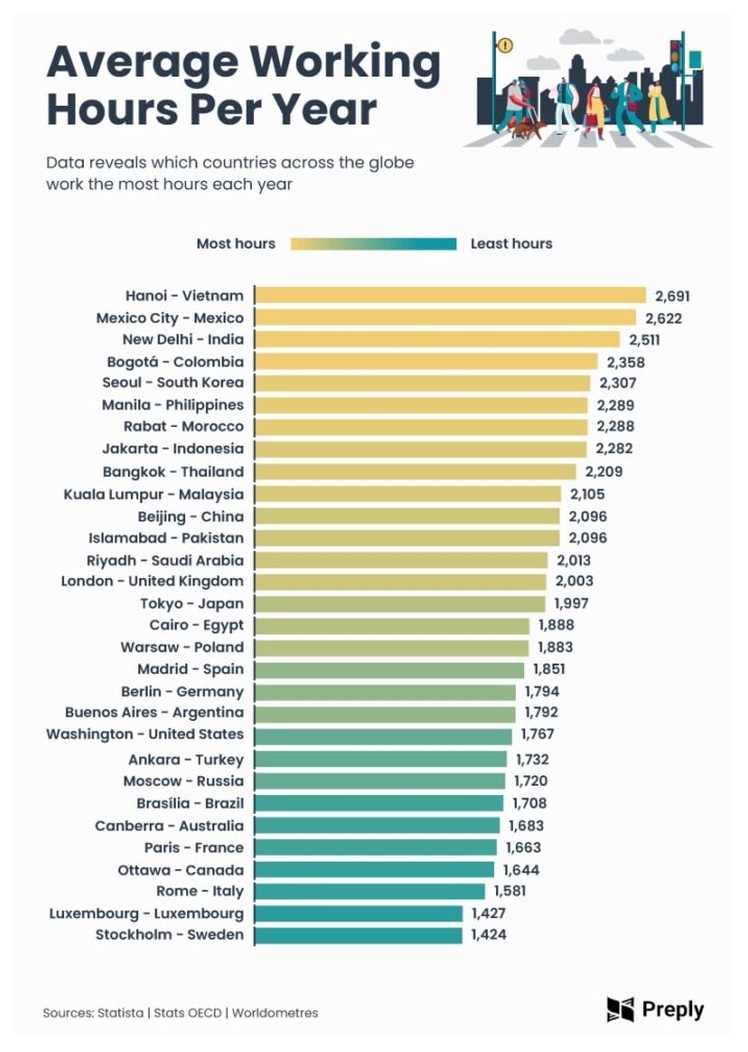
Hanoi, Vietnam, holds the title for the longest working hours in the world. Our data reveals that residents of this bustling city dedicate an impressive average of 2,691 hours to their jobs each year.
Our next destination is Mexico City, Mexico, which proudly holds the title of the busiest city in the world. Its residents put in an impressive average of 2,622 hours of work each year, making it the second-highest in terms of annual working hours globally.
New Delhi, India, boasts an impressive average of 2,511 hours worked per employee each year, making it home to the third most industrious workforce globally. This bustling city is a hub of productivity, reflecting the dedication and commitment of its workers.
London, England, stands out as the European city with the most demanding work hours. According to our data, Londoners log an impressive average of 2,003 hours annually, making it the city where employees put in the longest hours across Europe.
Achieving a healthy work-life balance can be a challenge for those residing in one of the world’s busiest cities. Fortunately, digital tools such as online learning offer a flexible solution, allowing individuals to seamlessly integrate personal development into their hectic schedules.
Conversely, cities with the shortest annual working hours include Stockholm, Sweden, where employees average only 1,424 hours each year. This impressive figure can be largely attributed to Sweden’s recent implementation of a six-hour workday policy, promoting a healthier work-life balance.
Sleepless in Seattle? Cities that get the most sleep
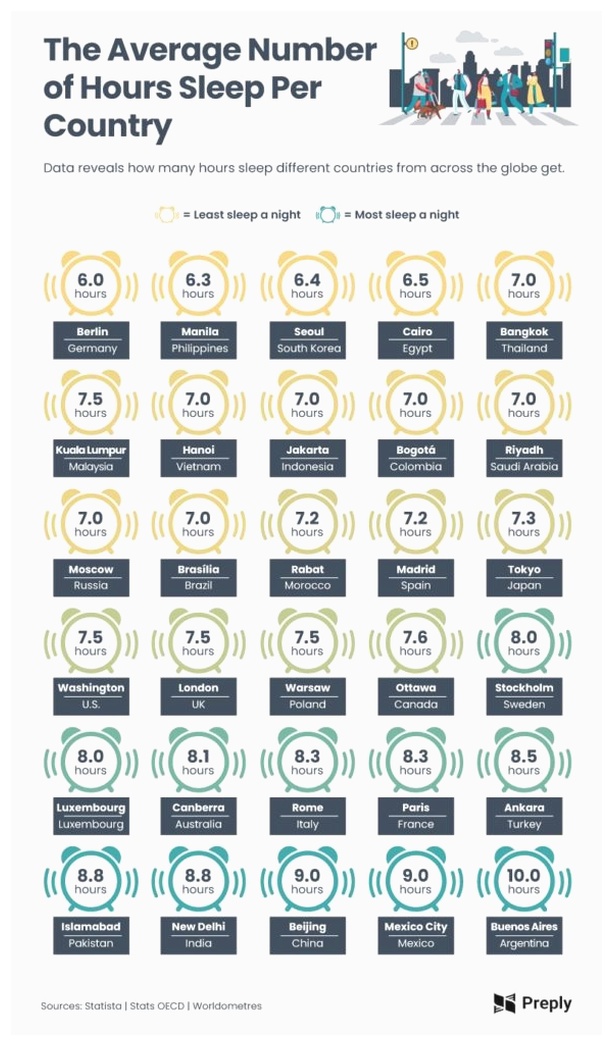
Buenos Aires, Argentina, has earned the title of the world’s best-rested city, with residents enjoying an impressive average of 10 hours of sleep each night. This focus on rest may be a secret to success, especially considering that legendary footballers like Lionel Messi and Diego Maradona come from this vibrant city. Perhaps other sporting nations should take note and prioritize sleep to boost their athletes’ performance.
Following closely in the ranks of the sleepiest capital cities are Mexico City and Beijing, where residents enjoy an impressive average of 9 hours of sleep each night. This ample rest is crucial, especially considering that workers in Mexico City clock in around 2,622 hours annually, while those in Beijing work an average of 2,096 hours per year. Prioritizing sleep can help these busy citizens recharge and perform at their best!
The most well-rested individuals in Europe can be found in the vibrant cities of Paris, France, and Rome, Italy. Residents in these capitals enjoy an impressive average of 8.3 hours of sleep each night. Additionally, both countries offer their citizens ample time to relax, providing 12 public holidays each year for leisurely pursuits.
Our research shows that Berlin, Germany, holds the title of the world’s most restless city, with residents averaging only six hours of sleep per night. Maybe it’s time for New York City to pass the crown of the “city that never sleeps” to this vibrant German capital!
Learn a language online with our free learning materials.
Learn English online
Learn French online
No time for traffic
No matter where we come from, one universal frustration unites us all: the agony of being stuck in traffic. But have you ever wondered which capital city endures the longest traffic jams in the world?
Our research shows that New Delhi, India, holds the title for the longest traffic delays among global capital cities, with commuters often facing travel times averaging 57.37 minutes.
Manila, Philippines, ranks as the second worst city for traffic congestion, with drivers facing an average wait time of 54.02 minutes. Just a notch better is Jakarta, Indonesia, taking third place with an average of 52.88 minutes spent in traffic. These figures highlight the significant challenges of commuting in Asia, where heavy traffic is a common struggle for residents.
The latest traffic studies reveal an intriguing trend: the top ten cities with the longest commute times are predominantly located outside mainland Europe and North America, suggesting that Western countries are experiencing relatively shorter delays. However, London, England, isn’t far behind, coming in at eleventh place with an average traffic time of 43.72 minutes. This puts it just ahead of Paris, France, which has an average commute of 42.52 minutes.
Some capital cities offer remarkably easy commuting experiences, and Canberra, Australia, stands out as a leader in this regard. With an average travel time of just 23.91 minutes per hour, it boasts the shortest commute times in the world, making daily travel a breeze for its residents.
In Hanoi, Vietnam, residents enjoy a swift average traffic time of just 28.68 minutes. Similarly, Brasilia, Brazil, and Riyadh, Saudi Arabia, follow closely behind with average times of 29.74 and 30.01 minutes, respectively. These shorter commutes allow citizens in these cities to reclaim valuable time for other pursuits, enhancing their overall quality of life.
Finding the perfect work/life balance
Living in a bustling city offers a thrilling experience, particularly for fitness enthusiasts and aspiring entrepreneurs. However, it’s essential to find a balance between professional pursuits and personal development to truly thrive.
For busy urban professionals looking to enhance their skill sets, online resources offer an excellent solution. Whether it’s learning a new language, experimenting with exciting recipes, or mastering a musical instrument, these activities not only foster personal fulfillment but also provide opportunities to expand your social network. Embrace the chance to grow and connect in today’s digital world!
Among the world’s most multilingual nations, bustling capital cities stand out, with Jakarta, Indonesia, being a prime example. Home to a central population of 8,540,121, Jakarta’s residents work an impressive average of 2,282 hours annually. The city is also a hub for innovation, featuring around 10,000 entrepreneurs on LinkedIn, who collectively speak 10.3% of the world’s languages.
India boasts a rich tapestry of official languages, among them Hindi, Bengali, Urdu, and English. Notably, its capital, New Delhi, ranks as the second busiest city globally, according to our data.
Conclusion
In today’s hectic world, carving out time for language learning can be tough, but its advantages for relaxation and mental health are significant, according to the NHS. The LingualNeeds team explored data to pinpoint the busiest capital cities and how they affect people’s lives, including their work hours, sleep patterns, and leisure time. Mexico City tops the list as the busiest, followed closely by New Delhi and London. Amid this relentless drive for productivity, online platforms like LingualNeeds provide a valuable opportunity to blend personal development with the demands of urban life, offering English and Spanish lessons that fit into busy schedules.
Methodology
Using a comprehensive seed list of countries and their capital cities, we examined and ranked ten key factors to identify the most bustling urban centers.
Here are ten key factors that influence quality of life: population size, average annual working hours, minimum paid leave mandated by the government, the number of public holidays, average nightly sleep duration, availability of gyms and fitness centers, the entrepreneurial landscape, the number of universities, recreational attractions, and traffic congestion times.
Each statistic was evaluated on a scale of 1 to 10 across various ranking criteria, and these scores were then totaled to produce a final score for each city out of 100.
In Turkey, employees who have been with a company for less than a year are not entitled to statutory annual leave. However, once they complete one year of service, they are eligible for 14 days of paid leave.
When it comes to annual working hours, cities such as Canberra, Brasília, Ottawa, Rabat, and Ankara rely on national data due to the availability of information.
Annual leave based on at least one year of tenure
Frequently Asked Questions
What city is considered the busiest in the world?
Mexico City holds the title of the busiest city in the world, achieving a score of 69.6 out of 100.
Which city has the longest average working hours?
Hanoi, Vietnam, has the longest working hours, with residents dedicating an average of 2,691 hours to their jobs each year.
How many hours of sleep do residents in Buenos Aires get on average?
Residents of Buenos Aires enjoy an impressive average of 10 hours of sleep each night.
What city faces the longest traffic delays?
New Delhi, India, holds the title for the longest traffic delays, with an average travel time of 57.37 minutes.
What online learning opportunities are available for busy individuals?
LingualNeeds offers personalized 1-on-1 language classes, allowing individuals to seamlessly integrate personal development into their busy schedules.