- What does bilingual mean?
- What percentage of people are bilingual in 2023?
- How many people are bilingual in the UK?
- Is bilingualism more common in men or women?
- Which age group is most likely to be bilingual?
- Multilingualism by age
- Which UK city has the highest proportion of bilingual speakers?
- How many people are bilingual in the US?
- Which second languages are most popular in the US?
- Which US states want to learn second languages the most?
- What are the benefits of being bilingual?
- Bilingualism facts and figures of 2024
- Frequently Asked Questions
- What percentage of the global population is bilingual?
- Which age group is most likely to be bilingual in the UK?
- What is the most popular second language to learn in the US?
- Which UK city has the highest proportion of bilingual speakers?
- What are some cognitive benefits of being bilingual?
Speaking multiple languages offers a wealth of advantages, including enhanced cognitive skills, deeper cultural understanding, and increased creativity. As we look ahead to 2024, how many people worldwide will be able to communicate in more than one language? Furthermore, which groups within society are most inclined to be bilingual or multilingual?
To uncover the landscape of language proficiency in the UK and the US, we surveyed 2,000 adults across the UK to discover how many speak additional languages fluently, aside from their native tongue. In parallel, we analyzed Google search trends to identify the most popular languages people are eager to learn in each US state. This data, combined with comprehensive research on global language usage statistics, offers you the latest insights into bilingualism and multilingualism as we move into 2024.
- There are approximately 3.3 billion bilingual people worldwide, accounting for 43% of the population.
- 36% of UK adults are bilingual. That’s over 24 million people.
- Spanish is the most popular second language to learn in the US, with more and more students taking Spanish lessons.
- More searches are made in California for terms related to learning a language than any other US state.
- More young people (aged 16-24) are bilingual than any other age group in the UK.
- Belfast and Brighton have more bilingual speakers than any other UK city.
- Indonesia is the largest bilingual country in the world being home to more than 200 million bilingual individuals.
What does bilingual mean?
Bilingualism refers to the ability to speak two languages fluently. The term comes from the Latin words ‘bi’, meaning ‘two’, and ‘lingua’, meaning ‘tongue’. But what exactly is a mother tongue? A mother tongue is the language a person learns from early childhood and is typically the first language spoken at home.
In this article, we’ll explore the concept of multilingualism, which is the ability to fluently understand and use more than two languages. This fascinating skill opens doors to diverse cultures and enhances communication in our interconnected world.
What percentage of people are bilingual in 2023?
While many language communities remain unexamined, pinpointing the exact number of fluent bilinguals worldwide is challenging. Nevertheless, current estimates suggest that approximately 43% of the global population speaks two languages fluently, and an additional 17% are multilingual, showcasing the rich tapestry of linguistic diversity across the globe.
This means that more than half of the world’s population can speak more than one language fluently.
Have you ever wondered how bilingualism varies across different countries? To uncover the bilingual population in the UK, we partnered with the market research firm Censuswide to survey 2,000 adults. Here’s what we discovered:
How many languages, if any, do you speak fluently (not including your first language)?
- 0 – Other than my first language, I don’t speak any other languages fluently
- 1
- 2
- 3
- 4
- 5+ (please specify)
How many people are bilingual in the UK?
Our survey of 2,000 UK adults was conducted in October 2023 and found that:
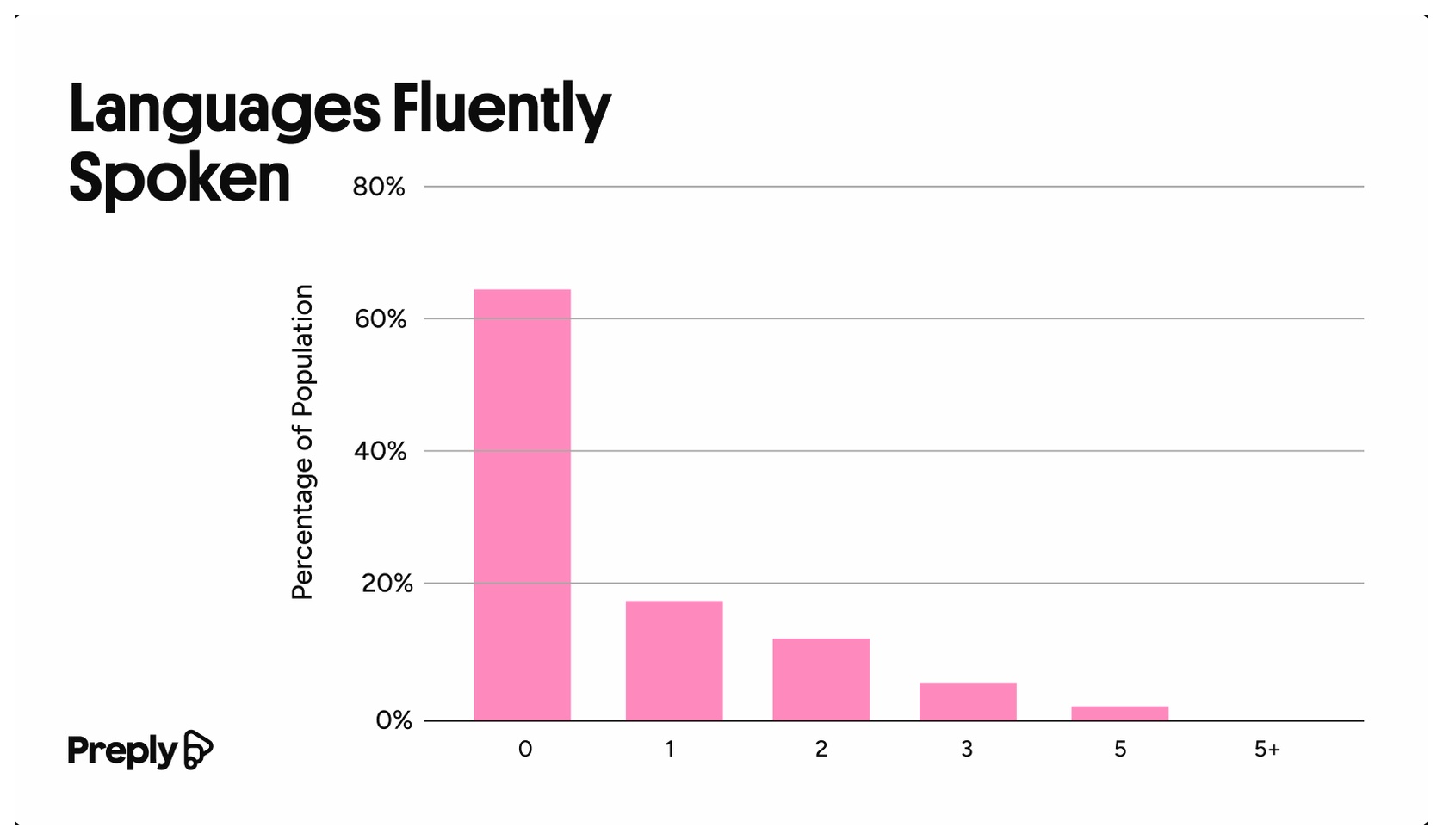
- Approximately 36% of UK adults are fluent in multiple languages, totaling around 24.5 million bilingual individuals in the UK.
- 17.5% are bilingual, so can fluently speak 2 languages.
- And 6.5% of people in the UK are multilingual, as they can speak 3 or more languages fluently.
What’s more:
- 1 in 20 people say they can speak 3 languages fluently (5%).
- Whilst 1.4% say they can fluently speak 4 languages.
- And 0.1% say they’re able to speak 5 or more languages fluently!
Is bilingualism more common in men or women?
Linguists have observed both the similarities and differences in language use between genders. But when it comes to fluency in a foreign language, which gender tends to excel more—men or women?
In an interesting survey of 2,000 UK adults, we discovered that the ability to speak a second language is nearly equal among genders. Specifically, 18% of men and 17.2% of women in the UK reported being fluent in a second language, highlighting a strong bilingual presence in the population.
The survey offered only two choices for gender: ‘male’ or ‘female,’ which restricts the accuracy of the data. This exclusion means that some respondents might not have been able to express their true identity, leaving them underrepresented in the results.
Which age group is most likely to be bilingual?
As we age, we often assume that our life experiences, such as travel, reading, and learning new languages, increase. However, our survey reveals a surprising twist: this isn’t necessarily true. In fact:
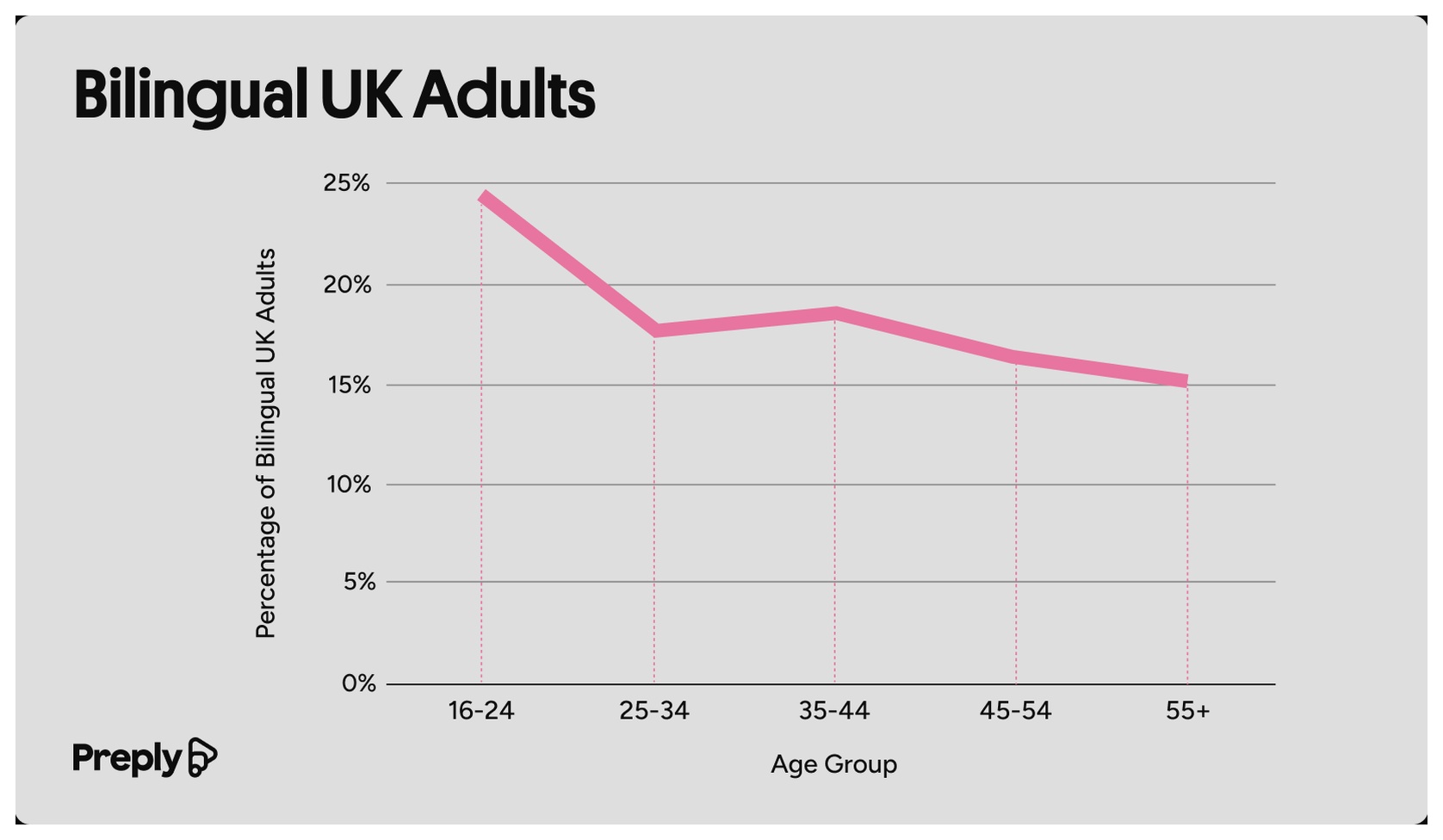
- Nearly 25% of individuals aged 16-24 are bilingual, making them the most multilingual age group.
- Individuals aged 35-44 are the second most likely to be bilingual, with 18.5% reporting proficiency in two languages.
- Only 15% of individuals aged 55 and older are fluent in two languages, making this age group the least likely to be bilingual.
Dr. Melissa Baese Berk, a Professor of Linguistics at the University of Chicago and a language expert at LingualNeeds, shared intriguing insights on age trends among bilinguals. She notes that many younger bilinguals are children of immigrants who grow up speaking multiple languages at home. Additionally, today’s youth understand that mastering extra languages is a valuable asset in the global job market, where international corporations thrive. Even when not mandatory, bilingualism can give younger workers a competitive edge over their monolingual counterparts.
Multilingualism by age
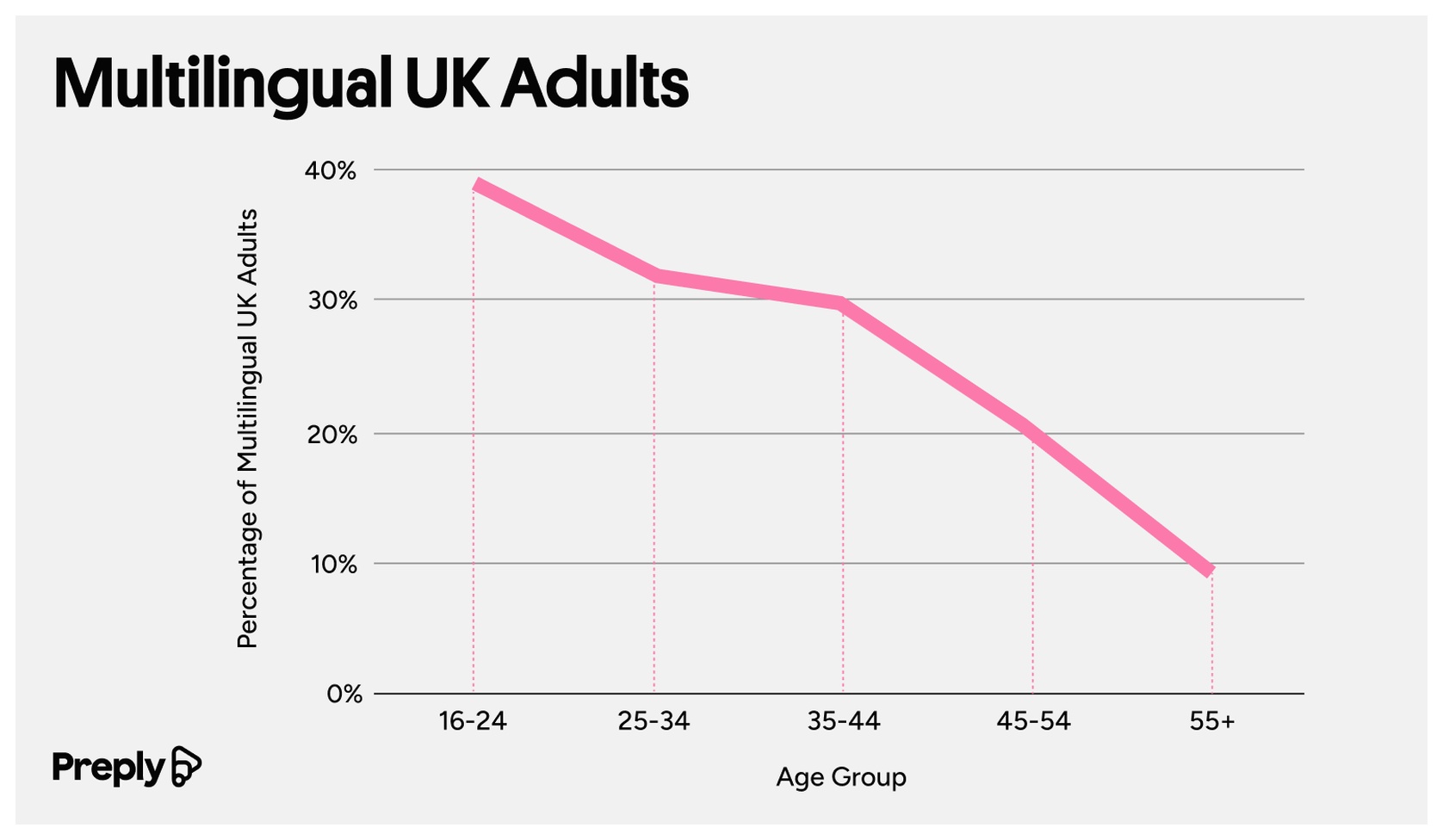
It’s evident that a growing number of young people in the UK are becoming bilingual. But which age group stands out as the most likely to be multilingual—fluent in more than two languages? To uncover this, we delved into the demographic details from our survey and discovered that:
- Over one-third of 16-24 year-olds are multilingual, making them the most likely age group to speak multiple languages.
- Individuals aged 55 and older are the least likely to be multilingual, with only 5% reporting fluency in more than two languages.
Which UK city has the highest proportion of bilingual speakers?
Are there more bilingual and multilingual people in major cities? Or do more rural areas have a higher proportion?
Our survey found that:
- Belfast and Brighton boast the highest number of bilingual speakers in the UK, with 25% of residents fluent in two languages.
- Cardiff also has one of the highest proportions of bilingual people in the UK, with 21.5% of people being bilingual.
- London ranks highest in bilingual and multilingual speakers, with nearly 50% of its population (49.5%) able to converse in at least one additional language.
How many people are bilingual in the US?
The U.S. Census Bureau reports that 21.6% of Americans speak a language other than English at home, translating to roughly 1 in 5 adults. This highlights the rich linguistic diversity present in the country.
It’s essential to recognize that the estimate of bilingual individuals in the US might not be entirely accurate. Many people may be fluent in additional languages yet choose not to use them at home, which can lead to underreporting of their bilingualism.
Which second languages are most popular in the US?
Learning a second language can take many forms. Some individuals may have been exposed to the language from a young age, growing up with native speakers. Others might have acquired it through formal education in school. Additionally, many adults choose to enhance their skills by hiring a tutor or opting for self-study methods. Each path offers unique benefits and challenges, making the journey of language learning both diverse and personal.
In 2024, we delved into the language learning preferences of US adults by analyzing search trends across each state. Utilizing the online tool Keyword Finder, we gathered data on the average monthly search volumes for the 20 most widely spoken languages, coupled with the term “learn” (for example, “learn Spanish” or “learn German”). This analysis sheds light on which languages Americans are most eager to master.
Our analysis found that:
- Spanish is the most sought-after second language in the US, with “learn Spanish” generating 75,300 monthly searches online for conversational classes.
- English ranks as the second most popular language to learn, with approximately 24,800 monthly online searches for “learn English.”
- Japanese is a popular language, with around 20,600 monthly searches in the US by individuals eager to learn it.
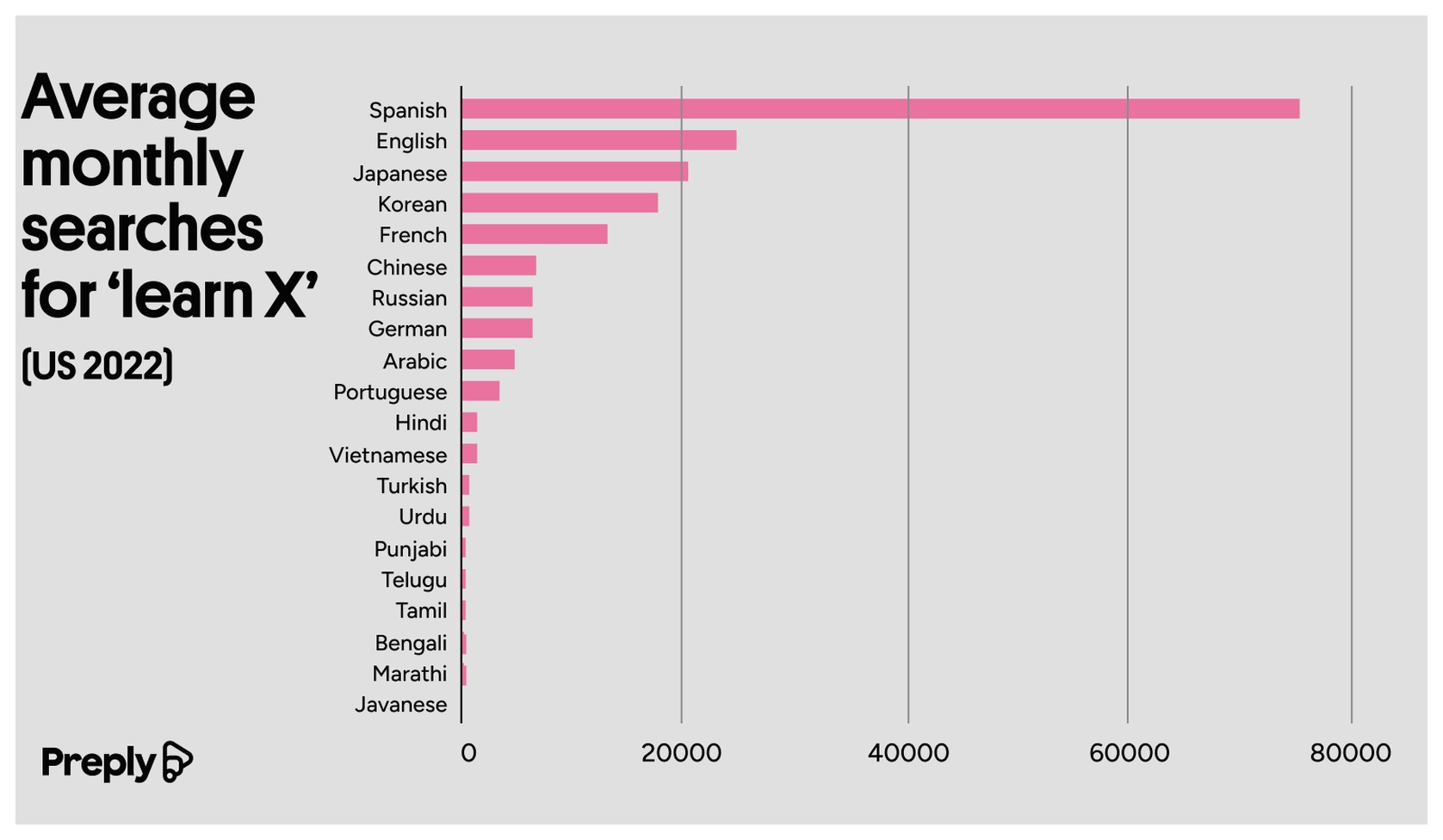
As you can see from the graph:
- Korean and French are in high demand for language learners, with monthly search volumes of 18,000 for “learn Korean” and 13,200 for “learn French.”
- Chinese, Russian and German are also popular choices amongst those in the US
- As are Arabic, Portuguese and Hindi.
Which US states want to learn second languages the most?
While bilingualism in the US may lag behind the global average, recent trends show a growing enthusiasm for language learning, particularly in the wake of the coronavirus lockdown. More individuals are seeking to expand their linguistic skills, reflecting a shift in priorities and interests.
The graph below clearly illustrates a notable spike in searches for phrases such as “learn Korean” at the onset of the lockdown. Interestingly, these search volumes have remained elevated, surpassing pre-lockdown levels.
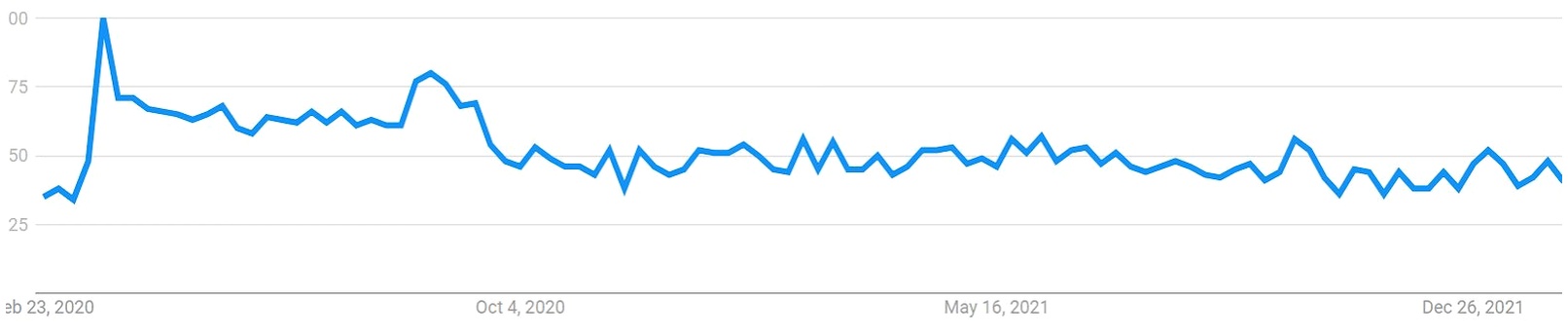
Search volumes overtime for ‘learn Korean’ in the US: Google Trends (Feb 2022)
The states with the highest search volumes for the phrase “learn X,” where X represents one of the 20 most spoken languages globally, are as follows:
| Rank | State | Average monthly searches for ‘Learn X’ |
| 1 | California | 196,420 |
| 2 | Nevada | 29,620 |
| 3 | New York | 18,670 |
| 4 | Florida | 13,460 |
| 5 | Illinois | 13,010 |
Search volumes extracted from the tool Keyword Finder
What are the benefits of being bilingual?
Being bilingual or multilingual offers numerous advantages for both adults and children! Here are some key benefits to consider:
- Research shows that children who learn a second language early exhibit improved memory and attention compared to monolingual peers.
- Bilingualism is associated with a delayed onset of Alzheimer’s disease, as studies indicate that bilingual individuals are more resilient to neurodegeneration compared to monolinguals.
- Research indicates a strong connection between bilingualism and creativity, with studies showing that bilingual individuals benefit from improved executive functioning and exposure to diverse cultures, both of which enhance creative abilities.
Professor of Applied Linguistics at Lancaster University, Panos Athanasopoulos says:
Learning a language offers much more than just mastering grammar and vocabulary; it opens the door to a new way of thinking and provides insight into another culture, often reflecting your own. Additionally, engaging with two languages exercises the brain, promoting cognitive vitality. Research indicates that bilingualism can potentially delay the onset of dementia and Alzheimer’s by up to five years, highlighting the significant mental benefits of being multilingual.
Bilingualism facts and figures of 2024
Still hungry for more fun bilingualism statistics? Check these out!
- There are approximately 33 billion bilingual people worldwide. That’s nearly half the population.
- Indonesia is the world’s largest bilingual country and one of the most multilingual nations. Many Indonesians become bilingual from a young age, often speaking Indonesian, Javanese, and English. It’s estimated that over 200 million people in Indonesia are bilingual.
- Myth: If you don’t learn a language before a certain age, you’ll never be able to. While it’s more challenging for adults to acquire a new language compared to children, adults can still effectively retrain their brains to learn a second language.
We trust you found these bilingualism statistics and insights intriguing! If you’re considering picking up a new language or skill, LingualNeeds is your go-to resource for connecting with the perfect online tutor. Let us help you embark on your learning journey!
Frequently Asked Questions
What percentage of the global population is bilingual?
Approximately 43% of the global population is bilingual.
Which age group is most likely to be bilingual in the UK?
Individuals aged 16-24 are the most likely to be bilingual, with nearly 25% reporting fluency in multiple languages.
What is the most popular second language to learn in the US?
Spanish is the most popular second language to learn in the US.
Which UK city has the highest proportion of bilingual speakers?
Belfast and Brighton have the highest number of bilingual speakers in the UK, with 25% of residents fluent in two languages.
What are some cognitive benefits of being bilingual?
Being bilingual is associated with improved memory, delayed onset of Alzheimer’s disease, and enhanced creativity.