
- The most dominant emotions that business leaders speak with
- The most emotional public speakers among business leaders
- The most dominant emotions that political leaders speak with
- The most emotional public speakers among political leaders
- The public speaking styles of male and female leaders
- Which language ranks highest per emotion?
- The importance of expressing authentic emotions when speaking in public
- Methodology
- Frequently Asked Questions
- What are the dominant emotions expressed by business leaders in public speeches?
- Which business leader was found to express the highest level of sadness in their speeches?
- How do male and female business leaders differ in emotional expression during public speeches?
- What emotional trends were observed in UK politicians’ public speeches?
- Which language conveys the highest level of sadness according to the research?
Public speaking involves a blend of physical and verbal elements that influence how a speaker and their message resonate with the audience. Many prominent figures skillfully leverage these aspects to effectively communicate their ideas, boost audience confidence, and enhance their public persona.
Have you ever considered how crucial the voice is in conveying emotions during public speeches? We utilized an AI emotion recognition tool to delve into the emotional nuances of voices, examining how prominent business and political leaders engage their audiences. Our study also revealed how 21 widely spoken languages express various emotions uniquely.
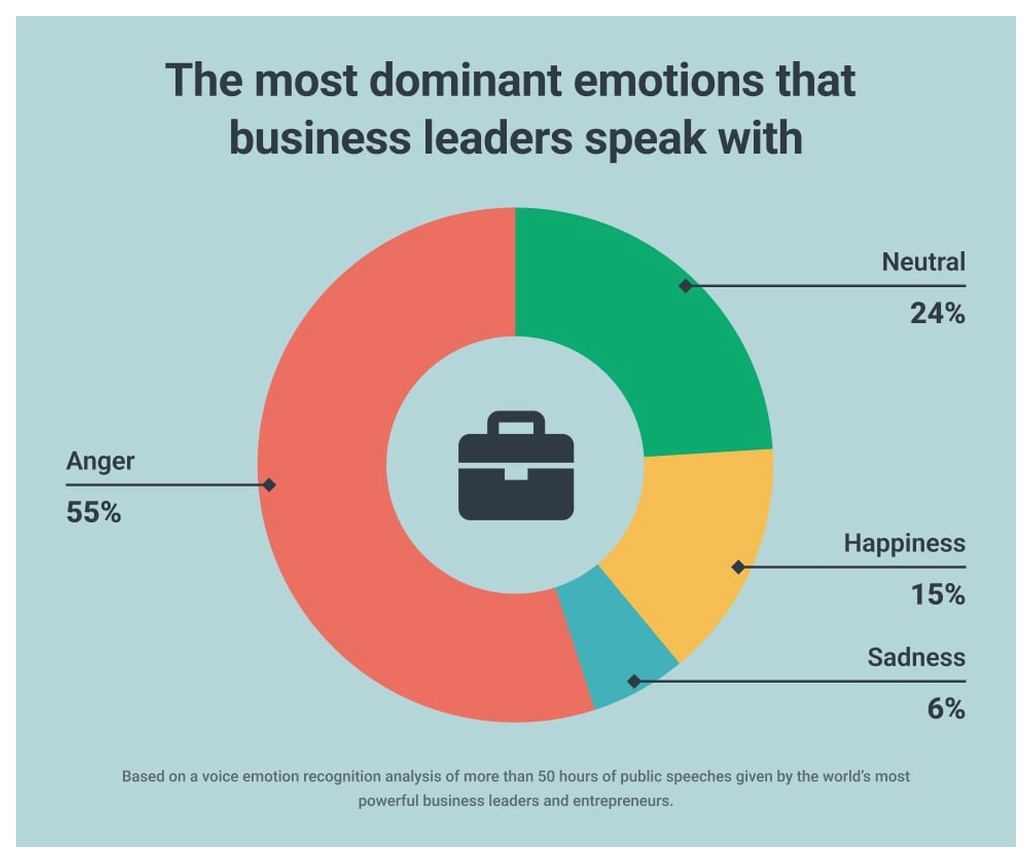
The most dominant emotions that business leaders speak with
To kick off our research, we gathered a selection of public speeches from prominent business leaders in the UK and the US. Using an advanced AI tool, we analyzed these speeches to assess the emotional tones conveyed in their voices. This tool generates an “emotional profile” for each speaker, highlighting the predominant emotions expressed, complete with scores that indicate the intensity of each feeling.
Our findings reveal that anger is the prevailing emotion in the speeches of most business leaders, accounting for more than half (55%) of their emotional tone. Neutrality follows as the second most common emotion at 24%, while happiness represents 15%. Interestingly, fear is minimal among these experienced public speakers, averaging less than 1%.

Learn a language with personalised 1-on-1 classes with our expert tutors from all over the world
French lessons online
Spanish lessons online
The most emotional public speakers among business leaders
In our analysis, we measured the average emotional levels among business leaders detected by the AI tool. This allowed us to identify individuals whose scores significantly exceeded that baseline. Notably, Amazon founder Jeff Bezos emerged as the most sorrowful, with his public speeches reflecting a sadness level that is 1,083% higher than the average among his peers.
Sheryl Sandberg, the COO of Meta (formerly Facebook, Inc.), delivers public speeches that resonate with an intensity 645% higher than the average fear level experienced by business leaders. In contrast, Lisa Su, the CEO of AMD, stands out as the most optimistic leader in our study, showcasing a happiness level that exceeds the average by 515%.

The most dominant emotions that political leaders speak with
Next, we turned our attention to a group of experts in public speaking: politicians from the UK and the US. Using our advanced AI tool, we analyzed a selection of their speeches to uncover the predominant emotions they express through their vocal delivery.
Our examination of UK politicians reveals that happiness reigns supreme, accounting for 37% of their emotional expression, while anger follows closely at 32%. Interestingly, UK politicians also report higher levels of sadness and fear compared to their American counterparts, with averages of 9% and 6%, respectively.

In our analysis of US politicians’ emotional profiles, anger stands out as the most prevalent emotion, comprising a striking 62%. Following that, happiness accounts for 29% of their emotional makeup. In contrast, both sadness and fear together represent a mere 2% of this profile, highlighting a significant emotional landscape dominated by anger and a surprising lack of negative emotions.

Learn a language online with our free learning materials.
Learn English online
Learn French online
The most emotional public speakers among political leaders
In our analysis, Ed Davey, the Leader of the Liberal Democrats, stands out as the most emotionally expressive UK politician, exhibiting a sadness level that is a staggering 1033% higher than the average for his peers. Meanwhile, Liz Truss, the Foreign Secretary, conveys an unusually high sense of fear, measuring 694% above the typical fear level found among UK politicians.

Our analysis of the emotional profiles of U.S. politicians reveals that House Speaker Nancy Pelosi exhibits the highest levels of fear in her public speeches, measuring 804% above the average for her peers. In contrast, former Vice President Dick Cheney’s public speaking is notably 431% sadder and 1466% more neutral compared to the emotional norms of his contemporaries.

The public speaking styles of male and female leaders
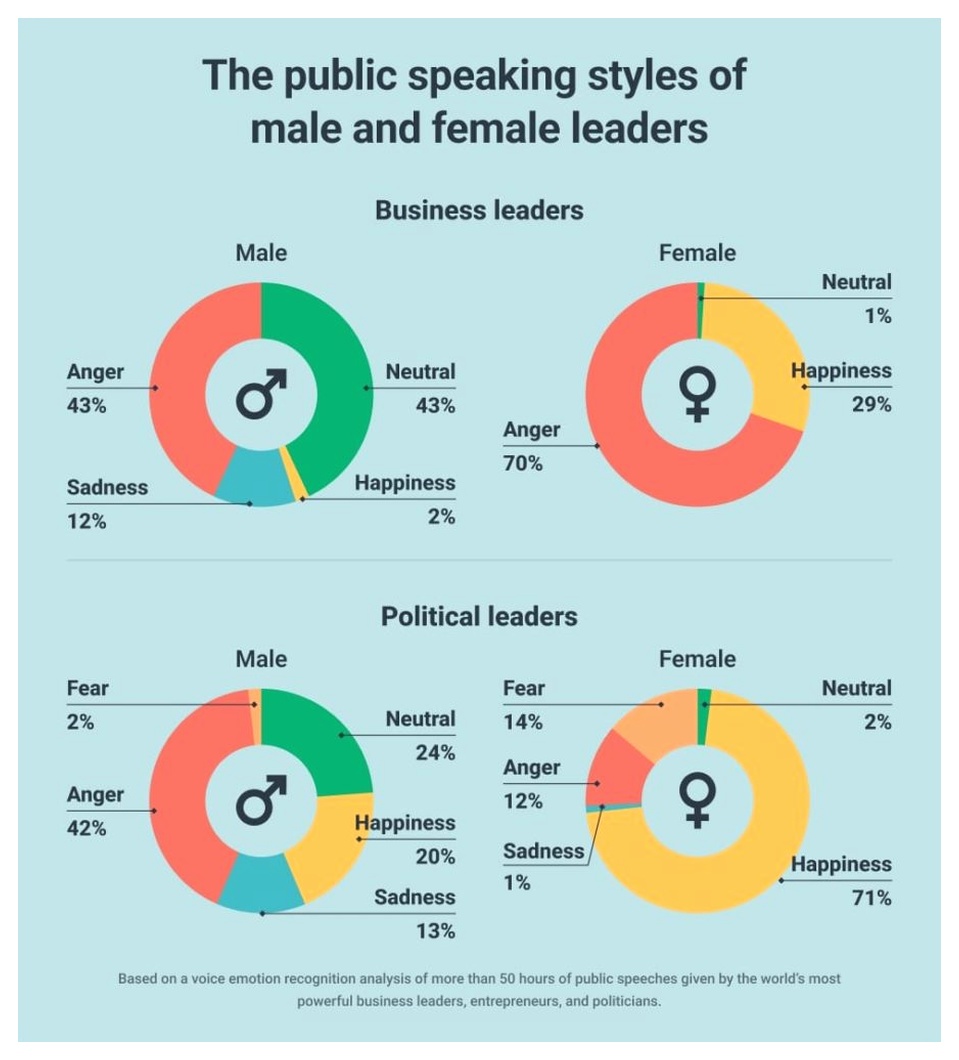
Our examination of the phonetic profiles of female business leaders revealed a striking trend: anger emerged as the predominant emotion in their public speeches, accounting for 70% of the emotional tone expressed by renowned female entrepreneurs. In contrast, male business leaders exhibited a lower anger score of 43%. This finding highlights a notable difference in emotional expression between genders in the business realm.
Women’s public speeches were found to convey a greater sense of happiness compared to their male counterparts. In fact, happiness constituted 29% of the speaking style of female business leaders, while male leaders exhibited only 2% happiness and 12% sadness in their speeches.
Analysis of public speeches by female politicians reveals that happiness is the prevailing emotion, accounting for 71% of their overall emotional expression. In contrast, male politicians exhibited lower levels of happiness at 20% and higher levels of sadness at 13%. Moreover, men’s speeches were marked by significantly more anger, with an average score of 42%, while women averaged only 12% for this emotion.
Which language ranks highest per emotion?
If you’ve ever studied English or any other second language, you can likely appreciate how distinct different languages sound. To delve deeper into this, we set out to discover which languages convey the most emotion, using AI to analyze public speeches. Our research began with a diverse selection of TED Talks and similar presentations, totaling over 13 hours of audio in 21 languages.
In our analysis, we examined 21 languages, all of which are either official languages of OECD member countries or among the most widely spoken languages globally. Utilizing the same AI tool from our earlier study, we assessed speeches in these languages to determine the average emotional scores. This allowed us to identify which languages stood out by scoring significantly higher than the established baselines.
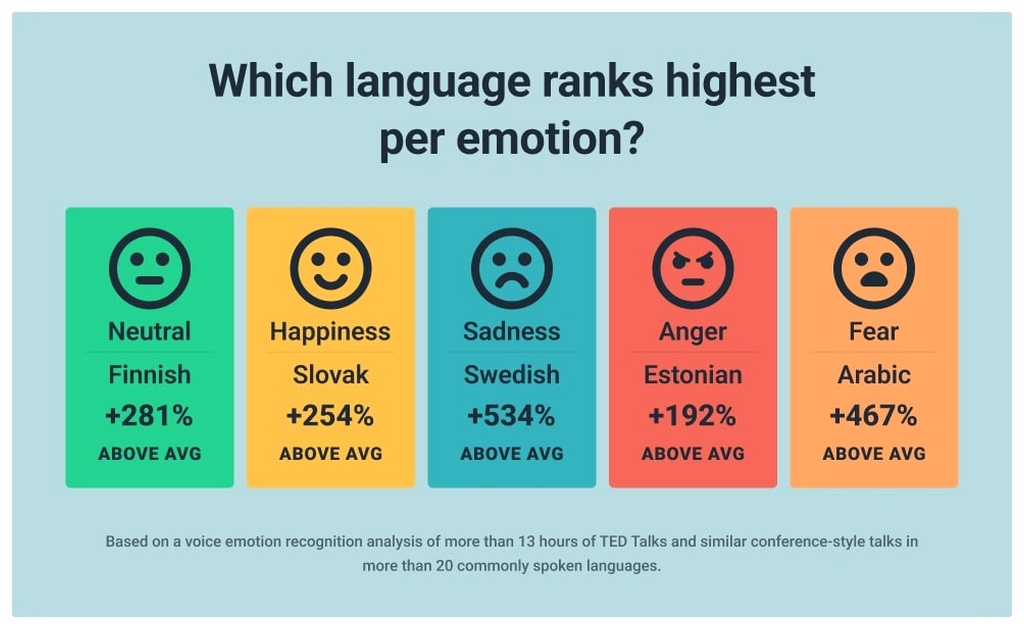
Our findings reveal some intriguing insights into the emotional nuances of different languages. Swedish emerges as the standout, with speeches displaying a staggering 534% above the average level of sadness. Meanwhile, Arabic conveys the highest sense of fear, measuring 467% over the average fear level. Slovak and Estonian take the spotlight for happiness and anger, respectively, with Slovak being 254% above average in happiness and Estonian 192% above average in expressing anger. Notably, Finnish stands out as the most neutral-sounding language in our study, lacking the emotional extremes of its counterparts.
Our research reveals that public speeches, whether delivered by renowned business and political figures or everyday individuals, are often infused with deep emotional expression. To delve deeper into the link between emotion and effective public speaking, we consulted with expert Matt Abrahams, who shared valuable insights on the topic.
The importance of expressing authentic emotions when speaking in public
Matt Abrahams is a dynamic lecturer in Organizational Behavior at Stanford University’s Graduate School of Business and a recognized authority on public speaking. As a seasoned communication consultant, he empowers professionals to enhance their speaking and communication abilities. He is the author of *Speaking Up Without Freaking Out* and hosts the podcast *Think Fast, Talk Smart*, where he explores public speaking anxiety and shares effective strategies to boost speaking confidence.
How crucial are strong public speaking skills in boosting audience confidence and trust in the speaker? What key characteristics define an effective public speech?
Effective public communication is essential for any leader. It fosters confidence and trust, enabling leaders to convey a clear vision and rally support from their teams. Successful communication and public speaking hinge on several key elements. First, the content must be relevant and easily understood by the audience, ensuring it is audience-focused. Additionally, the message should be well-structured, clear, concise, and engaging. Finally, the delivery should be authentic and compelling, capturing the audience’s attention and encouraging them to listen actively.
Our research reveals that certain speakers, like Jeff Bezos, express emotions in their public speeches at exceptionally high levels—he’s recorded a staggering 1083% above the average sadness level among business leaders. This raises an intriguing question: does highlighting specific emotions, such as sadness or anger, enhance the memorability and impact of a speech? Do audiences connect more deeply with speeches that evoke strong emotions?
As humans, we naturally gravitate towards what is new and exciting, and emotions play a crucial role in capturing our attention. We tend to overlook stagnant or monotonous content. By harnessing emotions and various engagement techniques, we can create memorable experiences for our audience. However, for these emotional appeals to resonate effectively, they must align with the context and audience expectations while remaining authentic to the speaker.
3. Can you identify when someone is being insincere in expressing their emotions during a public speech?
Deception is a complex topic, with extensive research highlighting how challenging it can be to identify when someone is being insincere. While blatant dishonesty may be easier to spot, subtle deceit can be much trickier to detect. I always advise against pretending to feel emotions or faking any aspect of communication. Instead, aim to genuinely connect with your message in a way that evokes authentic emotions. Remember, using emotions to manipulate others is not only unethical but can also come across as forced and uncomfortable.
4. What drives leaders in powerful positions, like those in business or politics, to adopt various emotional tones in their public speeches? There are several key reasons for this approach. Different emotional profiles can help leaders connect with their audience, convey urgency, or inspire confidence. Additionally, some leaders may naturally gravitate toward specific emotions based on their personality, experiences, or the context of their message, influencing how their style resonates with others.
Each individual has their own unique emotional triggers. Leaders, in particular, convey the emotions tied to their cause, business, or vision. For instance, if they are promoting an innovative and exciting initiative, their enthusiasm should mirror that spirit. Conversely, if the audience is feeling frustrated, it’s effective for leaders to acknowledge and express that frustration as well. This alignment helps create a deeper connection between leaders and their constituents.
Leaders who grasp the emotional nuances of their message and their audience can significantly enhance their communication. When their emotions are genuine, it shines through, making their message more impactful. The key is to be clear and authentic, allowing leaders to inspire and motivate their audience in memorable ways. While emotions play a crucial role in this process, it’s essential that they align with the message and feel appropriate to the context.
Methodology
To kick off our research, we compiled a diverse seed list featuring prominent business leaders, entrepreneurs, and politicians from the UK, the USA, and beyond. Next, we gathered over 50 hours of audio clips of these figures delivering public speeches. Utilizing Vokaturi, an advanced AI emotion recognition tool, we meticulously analyzed these recordings to gauge the emotional depth conveyed in their voices.
We assess each individual’s emotional expression by calculating an average score for their emotions and comparing it to the typical scores of others in their category. This process enables us to identify the emotions that rank highest in each person’s speaking style. Additionally, we analyzed over 13 hours of randomly selected TED Talks and similar conference presentations, featuring speakers from diverse backgrounds and in 21 widely spoken languages, including the official languages of OECD countries. This extensive analysis helps us uncover which emotions are most strongly associated with each language.
Our analysis examines the connection between various voices and languages in public speaking and how they relate to different emotions identified by our AI tool. It’s important to remember that individuals express emotions in diverse ways, regardless of the language they speak. Therefore, our findings should not be interpreted as definitive claims that one language is inherently more emotional than another.
Frequently Asked Questions
What are the dominant emotions expressed by business leaders in public speeches?
The dominant emotions expressed by business leaders are anger (55%), neutrality (24%), and happiness (15%).
Which business leader was found to express the highest level of sadness in their speeches?
Jeff Bezos was found to express the highest level of sadness, at 1,083% higher than the average among his peers.
How do male and female business leaders differ in emotional expression during public speeches?
Female business leaders express anger at 70% of their emotional tone, while male leaders express it at 43%. Women also convey more happiness, at 29%, compared to men who exhibit only 2%.
What emotional trends were observed in UK politicians’ public speeches?
UK politicians predominantly express happiness (37%) and anger (32%), with higher levels of sadness (9%) and fear (6%) compared to US politicians.
Which language conveys the highest level of sadness according to the research?
Swedish conveys the highest level of sadness, measuring 534% above the average level of sadness.