- Key takeaways
- America’s most underappreciated professions
- Which Americans show the most appreciation?
- The impact of showing gratitude in America
- Why Americans sometimes don’t say “thank you”
- In their own words: Heartfelt thanks from across America
- How language can empower a community
- Methodology
- How we determined the most under-recognized professionals in America
- How we found the most and least appreciative Americans
- Frequently Asked Questions
- What professions are considered the most under-recognized in America?
- Which state has the most appreciative residents?
- Why do many Americans fail to express gratitude?
- How does expressing gratitude impact individuals?
- What role does effective communication play in expressing gratitude?
Thank you, merci, gracias, danke, gamsahabnida – gratitude transcends language and culture. But how frequently do we express our appreciation in our everyday lives? Many essential workers, such as police officers and teachers, frequently go unrecognized and are often appreciated only when they’re absent. Let’s make it a point to acknowledge their invaluable contributions more often.
A recent study by LingualNeeds, a platform that connects learners with tutors for various language lessons, explores the ways Americans show gratitude. By surveying thousands of individuals nationwide, we identified which professions often go unappreciated and highlighted the states where expressions of gratitude are most and least common.
We’ve discovered some fascinating reactions Americans have experienced after saying a simple “thank you” and what elements make those expressions of gratitude truly memorable. Dive into our findings to learn how frequently people acknowledge the efforts of those who help keep our society functioning, and find out if your state is a leader in gratitude or has opportunities for growth.
Key takeaways
- The most under-recognized professions are sanitation, childcare, and lawn care workers.
- Roughly 85% of Americans have never thanked a park ranger, farmer, or lawn care worker.
- Almost half (44%) of Americans think janitors are the most under-appreciated professionals.
- Idaho residents are most appreciative and thank non-family members nearly 200 times annually per person.
- Nearly 1 in 5 Americans use being too busy as an excuse not to thank someone.

Learn a language with personalised 1-on-1 classes with our expert tutors from all over the world
French lessons online
Spanish lessons online
America’s most underappreciated professions
The unsung heroes of our cities—those who ensure cleanliness, nurture our children, and protect our forests—often go unrecognized. At the forefront of this group are sanitation workers, who play a vital role in upholding community hygiene and cleanliness. Despite their consistent and essential service, their contributions are frequently overlooked.
Sanitation workers play an essential role in keeping our communities clean and healthy, yet a surprising 80% of Americans confess they have never expressed gratitude to the individuals who collect their waste. Remarkably, more than a third of the population recognizes these dedicated professionals as some of the most underappreciated in the workforce. It’s time to acknowledge their hard work and show our appreciation!
In the United States, childcare and lawn care workers rank as the second and third most underappreciated professionals. Shockingly, nearly 80% of Americans have never expressed gratitude to a childcare worker, while an astounding 84% have never thanked a lawn care worker. These professions, often overlooked, share the spotlight with park rangers and farmers, who have received appreciation from only about 15% of the population. It’s time to recognize the invaluable contributions of these dedicated individuals!
While many Americans may not vocalize their gratitude, it doesn’t mean they aren’t appreciative. In fact, the regret they feel for not expressing thanks often highlights the individuals they truly value. Although saying “thank you” directly is always preferable, the professionals that Americans wish they had acknowledged demonstrate a profound appreciation. Notably, teachers top the list, with over 20% of Americans expressing regret for not thanking a teacher who significantly influenced their lives.

Sanitation workers may top the list of under-recognized professions, but it’s janitors who Americans most frequently see as undervalued, with 44% of respondents expressing this sentiment. Interestingly, 2 in 5 Americans have taken the time to thank a janitor at least once in their lives, a rate that is twice as high as those who have expressed gratitude to sanitation workers.
This disparity underscores a crucial element of gratitude: opportunity. Janitors frequently operate in our daily surroundings—offices, schools, and public spaces—making it simpler for many Americans to express their appreciation with a direct, face-to-face “thank you.”
While sanitation workers play a vital role in maintaining clean streets, the chance to meet them in person is often limited. Many of these dedicated individuals do their jobs early in the morning or during hours when most residents are at work. As a result, their crucial contributions often go unnoticed, leading to a lack of appreciation for their hard work.
These findings highlight that appreciation goes beyond merely acknowledging value; it often involves actively cultivating opportunities to express gratitude. As we go about our daily lives, we can enhance our well-being by becoming more aware of the unsung heroes around us and discovering meaningful ways to recognize their essential contributions to our communities.
Which Americans show the most appreciation?
Gratitude weaves its way through communities of all sizes across the U.S., but the way it’s expressed and how often it occurs can differ greatly from state to state. In our study, we examined this variability by asking participants to estimate the number of times they thank someone outside their family for their contributions each year, along with recalling their most recent moment of expressing thanks.
Idaho stands out as the state with the most grateful residents, who express their appreciation for non-family members’ efforts an impressive average of nearly 200 times a year. Remarkably, nearly 60% of respondents reported having thanked someone for their work on the very day they completed the survey, and every participant acknowledged extending gratitude to someone outside their family within the past month.
Conversely, residents of Arizona emerged as the least grateful Americans. On average, each person expresses gratitude to someone outside their family about 98 times a year. However, strikingly, 1 in 10 Arizonans haven’t thanked a non-family member for their efforts in over a month.
Arizona residents express gratitude more frequently than some other states, where many individuals haven’t thanked anyone in over a month. Nevertheless, Arizona ranks low across all three metrics we used for our assessment, ultimately placing them as the least appreciative state in the nation.
In West Virginia, a striking 13% of residents reported not expressing gratitude to anyone outside their family in the past month, making it the state with the lowest level of appreciation. In contrast, Rhode Island, Vermont, and North Dakota shine as the champions of daily gratitude, with every resident having thanked someone outside their family on the survey day. When it comes to annual expressions of thanks, New Yorkers top the charts, averaging an impressive 214 acknowledgments to individuals beyond their family each year.
Learn a language online with our free learning materials.
Learn English online
Learn French online
The impact of showing gratitude in America
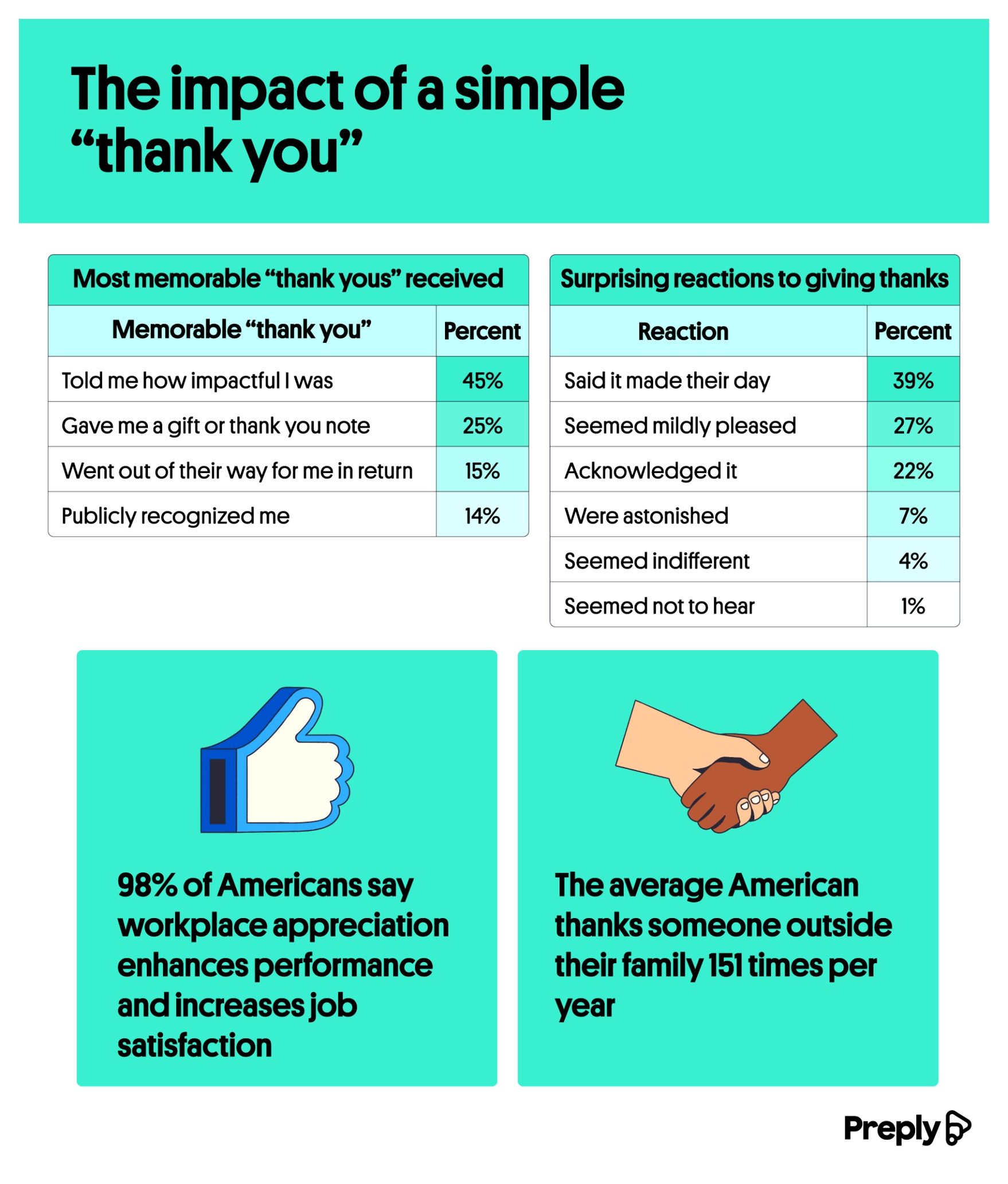
A simple “thank you” can truly uplift someone’s spirits! In fact, nearly 40% of Americans say that the most memorable response they’ve received after expressing gratitude was hearing that they had made someone’s day. It’s a powerful reminder of the impact our words can have on others.
Uninspiring responses can have a significant impact. In fact, 27% of respondents noted that the most memorable reactions they encountered were marked by indifference—ranging from seeming not to hear the gratitude to merely acknowledging it without engagement.
To make your expression of gratitude truly memorable, establishing a personal connection is key. A striking 45% of people noted that the most impactful “thank you” they received was a heartfelt acknowledgment of their influence. Similarly, one in four Americans found that a thoughtful gift or note left a lasting impression. For professionals who may be difficult to reach in person, sending a sincere note or a small gift can be an excellent way to convey appreciation when face-to-face interactions are limited or impractical.
Many Americans value the personal touch of in-person gratitude, but gift-giving—such as a homemade treat—can effectively bridge gaps created by social discomfort, language differences, or hectic lifestyles. If language barriers are hindering your connections, LingualNeeds can pair you with the perfect tutor to help you navigate these challenges.
Sylvia Johnson, a language expert and the head of Learning Design at LingualNeeds, emphasizes that effective communication hinges on the ability to connect with others on an empathetic level.
“Gratitude stands out as one of the most harmonious expressions,” Johnson noted. “Skilled communicators go beyond simply sharing information; they also convey emotions. Gratitude, in particular, is a potent emotion that can greatly enhance both personal and professional relationships.”
Why Americans sometimes don’t say “thank you”

Although gratitude can have a profoundly positive effect, many Americans frequently overlook opportunities to express it. Understanding the underlying reasons for this reveals that they’re not always selfish. In fact, over 75% of Americans have regretted missing a chance to say thank you, with 47% admitting they simply realized it too late. Shyness also plays a significant role, as 46% of people feel too shy or awkward to express gratitude, while 28% struggle to find the right words.
If you’ve ever found it challenging to express yourself, LingualNeeds is here to assist you in discovering the perfect words in your own language or another. By enhancing your language skills, you can break through communication barriers, including shyness, and effortlessly seize every opportunity to express your gratitude sincerely.
Johnson said there is a connection between language skills and the ability to resonate with the emotions of others.
“According to Johnson, fostering language skills in a diverse society like the U.S. is crucial for enhancing understanding. This investment not only enables individuals to master the nuanced art of expressing gratitude but also helps overcome obstacles such as shyness and cultural differences, paving the way for richer, more meaningful relationships.”
In our fast-paced lives, a moment of kindness, like saying “thank you,” can cut through the chaos and make a difference. Yet, nearly 1 in 5 Americans admit to using their hectic schedules as an excuse to skip expressing gratitude. These missed moments aren’t just lost opportunities for appreciation; they also represent missed chances to boost our well-being. A heartfelt “thank you” can linger in our minds, helping us stay grounded amid the whirlwind of everyday life.
In their own words: Heartfelt thanks from across America
Gratitude goes beyond mere numbers; it’s all about the significance of each heartfelt “thank you.” We surveyed thousands of Americans to discover who they would express gratitude to if given the opportunity. Their thoughtful responses highlight how a single “thank you” can leave a lasting impression, strengthening the connections that bind our communities. In fact, the simplest gestures often yield the most meaningful results.
How language can empower a community
In our society, essential workers play a crucial yet often overlooked role. Recognizing their contributions is more than just polite; it’s an important social skill that can elevate their thankless jobs into meaningful experiences. Expressing gratitude not only honors their hard work but also fosters a sense of appreciation and connection within our communities.
Countless dedicated yet underpaid professionals play a crucial role in our society, often without receiving the gratitude they deserve. A heartfelt “thank you” can create a lasting impression, nurturing a culture of appreciation that unites communities. Mastering the art of expressing gratitude is an invaluable skill; personalizing your message to resonate with the recipient can amplify its impact. By honing your communication skills, you can forge deeper connections with these essential workers from diverse backgrounds.
At LingualNeeds, we provide a wealth of language lessons, ensuring you can express “thank you” in countless ways. Our online Spanish courses are designed to help you master conversational Spanish tailored to your individual needs. Expand your language skills to foster deeper connections and convey heartfelt gratitude. With LingualNeeds, your appreciation can cross borders, touching the lives of those who matter most to you. Thank you for joining us on this journey!
Methodology
From August 6 to 8, 2024, we conducted a nationwide survey with 2,033 Americans, exploring their gratitude practices. Participants shared insights on how frequently they express thanks to non-family members, identifying who they thanked most recently and the time elapsed since their last expression of gratitude. Additionally, we inquired about any regrets they had for not thanking someone, including who that person was and the reasons behind their hesitation.
How we determined the most under-recognized professionals in America
In our quest to uncover America’s most underappreciated professions, we compiled a thorough list of essential occupations that are crucial for societal functioning yet frequently overlooked and undercompensated. These roles often involve significant emotional or physical labor and play a vital part in serving communities. To gain insights, we posed three questions to respondents regarding this list:
- Which professionals have they ever thanked?
- Which professionals do they wish they thanked but did not?
- Which professionals do they think are most under-appreciated?
We standardized the responses and developed an index that transforms the data into a 10-point scale, reflecting the percentage of selections for each profession. Notably, the first two questions reduced the scores for selected professions, while the third question increased them. Specifically, the second question lowered the index, as expressions of regret can often be seen as a form of appreciation.
How we found the most and least appreciative Americans
To discover which U.S. states express gratitude the most and the least, we surveyed participants about how often they feel thankful, including:
- An estimate of how often they tell others “thank you” every year.
- An estimate for when they last thanked someone.
Next, we developed an index transformed to a 10-point scale, relying on the aggregated estimates of respondents at the state level. Each respondent’s most recent “thank you” was assigned points, with newer expressions of gratitude receiving higher scores. We calculated the average number of “thank yous” per person each year for each state. To finalize our rankings, we normalized and weighted these metrics.
Frequently Asked Questions
What professions are considered the most under-recognized in America?
The most under-recognized professions are sanitation, childcare, and lawn care workers.
Which state has the most appreciative residents?
Idaho residents are the most appreciative, thanking non-family members nearly 200 times annually per person.
Why do many Americans fail to express gratitude?
Many Americans cite being too busy, shyness, or realizing it too late as reasons for not expressing gratitude.
How does expressing gratitude impact individuals?
Expressing gratitude can uplift spirits and strengthen connections, with nearly 40% of Americans noting it made someone’s day.
What role does effective communication play in expressing gratitude?
Effective communication, including connecting on an empathetic level, enhances the impact of gratitude and fosters deeper relationships.