- Key findings
- The U.S. politicians with the most angry tweets
- The U.S. politicians with the angriest tweets of all
- How do politicians tweet on personal versus professional accounts?
- Frequently Asked Questions
- What was the primary focus of the sentiment analysis conducted on Twitter accounts of U.S. politicians?
- Which political party exhibited more anger in their tweets according to the findings?
- Who were identified as the most aggressive tweeters in politics?
- How did politicians express their emotions differently on personal versus professional accounts?
- What methodology was used to analyze the tweets for emotional tone?
Despite its 280-character limit, Twitter provides users with ample opportunity to convey deep emotions and thoughts through the richness of the English language.
To explore how individuals express profound emotions within the confines of limited space, we performed a Machine Learning sentiment analysis on over 100 Twitter accounts of the most-followed U.S. politicians, including congress members and the president. Our focus was on the volume and intensity of angry tweets they posted over the past year.
We employed a Natural Language Processing model to assess the intensity and frequency of anger in politicians’ tweets. This advanced model examines the language used in each tweet, identifying words that convey specific emotions and considering their context to accurately predict the prevailing sentiment. For instance:
- Anger: “I feel irritated and rejected without anyone doing anything or saying anything.”
- Sadness: “I found myself feeling a little discouraged that morning.”
- Joy: “I feel very happy and excited since I learned so many things.”
The findings reveal that a single sentence can effectively convey strong emotions. Dive in to discover which prominent politicians are the most vocal about their anger online and explore the ways they articulate their frustrations.
Key findings
- 19 of the 25 politicians with the most angry tweets — 20 of the 25 politicians — are Republicans.
- The most aggressive tweeters in politics are Republican Chairwoman Ronna McDaniel, and Representatives Louie Gohmert and Matt Gaetz.
- McDaniel (R), Representative Marjorie Taylor Green (R), and Senator Ted Cruz (R) are the three angriest tweeters.
- More established Democrats like Senator Elizabeth Warren, are angrier on their professional accounts, while younger firebrands, like Representative Alexandria Ocasio-Cortez, are angrier on their personal accounts.

Learn a language with personalised 1-on-1 classes with our expert tutors from all over the world
French lessons online
Spanish lessons online
The U.S. politicians with the most angry tweets
At LingualNeeds, we understand that effective communication hinges on shared language and cultural norms. We learn to interpret specific behaviors as rude and recognize certain phrases as indicators of emotions such as anger or frustration. In the realm of social media, the choice of words, their arrangement, and the surrounding context play a crucial role in conveying feelings accurately.
Our analysis reveals that Republicans generally convey more anger in their tweets compared to their Democratic counterparts. Among the 25 politicians who posted the angriest tweets over the past year, 19 are Republicans and only 5 are Democrats. Notably, Tulsi Gabbard, who recently became an independent, also makes the list of the top 25.
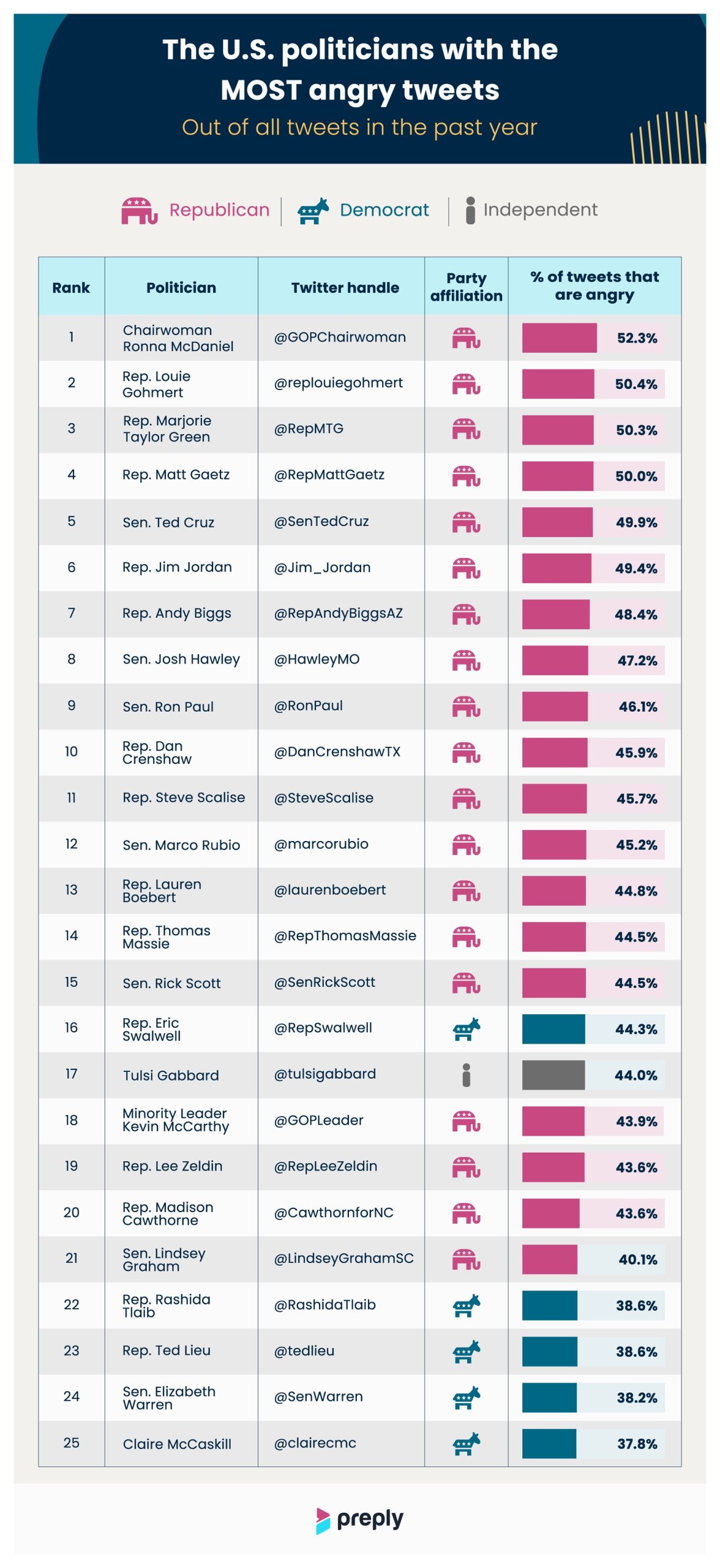
The individuals with the highest number of angry tweets are Chairwoman Ronna McDaniel (R), Representative Louie Gohmert (R), and Representative Marjorie Taylor Greene (R), with approximately 50% of their tweets over the past year expressing anger.
Real wages are DOWN and American families are POORER all because Joe Biden wasted our money. #Bidenflation
— Ronna McDaniel (@GOPChairwoman) September 27, 2022
Many politicians have taken to Twitter to voice their frustrations, using both their professional and personal accounts. While their official accounts often feature more intense expressions of anger, several Republican figures—such as Senator Ted Cruz and Representatives Matt Gaetz, Dan Crenshaw, and Madison Cawthorne—have also shown a significant level of indignation on their personal profiles.
This is WRONG. And lawless. And abusive.
Senate Democrats are currently hindering my efforts to pass legislation aimed at safeguarding our servicemen and women from unjust terminations under Joe Biden’s administration. Your support is crucial! [Link]
— Ted Cruz (@tedcruz) September 23, 2022
The U.S. politicians with the angriest tweets of all
A single word can transform an ordinary sentence into a powerful expression of emotion. By analyzing the politicians who posted the most furious tweets over the past year, we evaluated each one based on their tendency to share anger-fueled content on their timelines.
Our analysis revealed that 22 out of the 25 most irate politicians—determined by their high “anger scores” reflecting the likelihood of posting angry messages on Twitter—are Republicans. The top three contenders for the angriest tweets are Republican Chairwoman Ronna McDaniel and Representative Marjorie Taylor Greene, both with a mean score of 39.1, followed closely by Senator Ted Cruz at 39.0. Their tweets frequently feature charged language such as “wrong,” “absurd,” “terrifying,” and “deadly,” along with straightforward interjections that clearly convey their intense emotions.
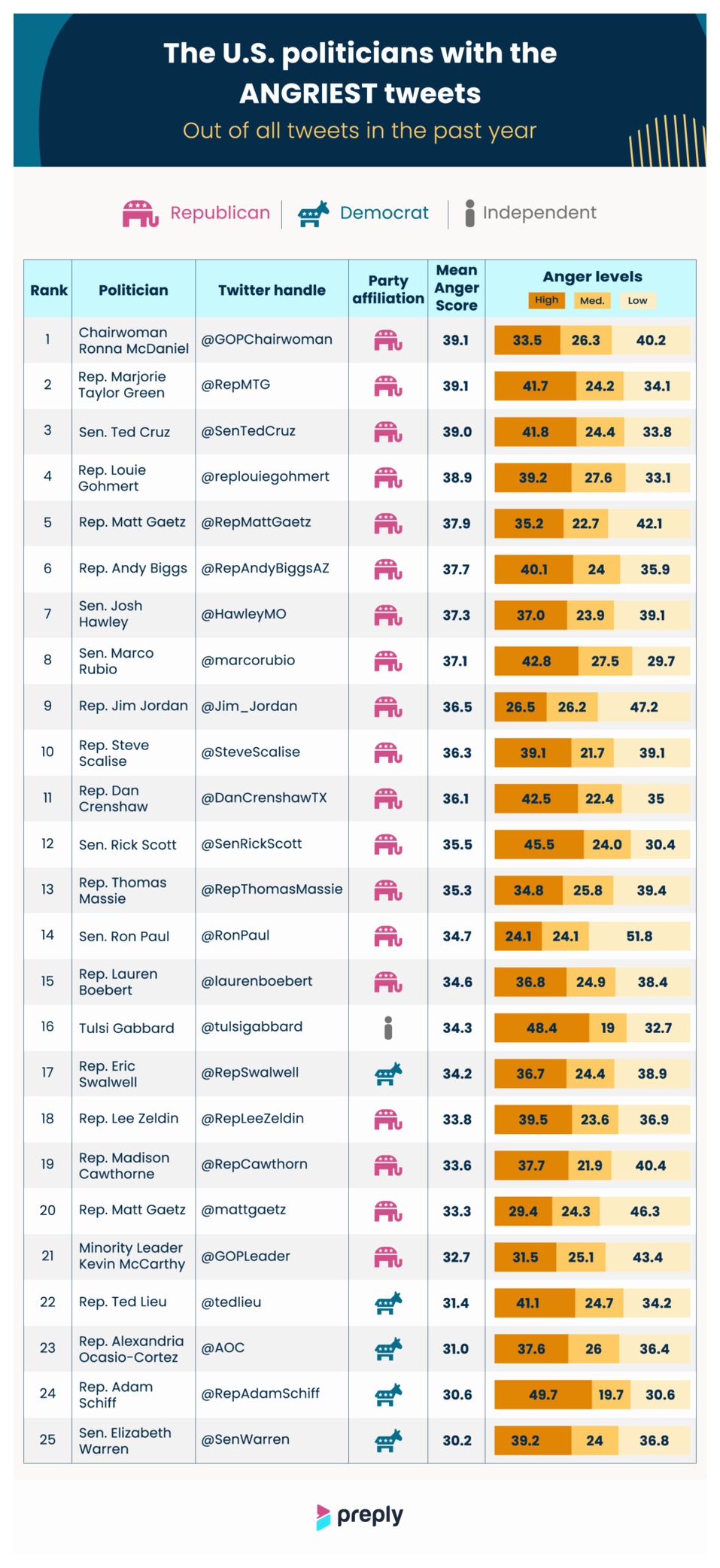
We analyzed the angry tweets of various politicians, categorizing them into three levels: high, medium, and low anger, to identify those who are particularly outspoken online. Our findings revealed that certain politicians exhibit notable levels of high anger in their tweets. For instance, nearly half of Representative Adam Schiff’s (D) angry tweets—49.7%—are classified as “high anger.” Similarly, former Senator Tulsi Gabbard, who recently departed from the Democratic party, also demonstrates a tendency toward high anger, with 48.4% of her angry tweets falling into this category.
How long can the Republican Party accept a leader with no respect for our democracy?
How long can it support someone who spreads dangerous and absurd conspiracy theories?
How long can it ignore the obvious signs of a mind at odds with reality?
— Adam Schiff (@RepAdamSchiff) September 6, 2022
Republicans and Democrats may have their ideological differences, but they do express their anger with similar vocabularies.
Learn a language online with our free learning materials.
Learn English online
Learn French online
How do politicians tweet on personal versus professional accounts?
It’s not uncommon for politicians to express varying sentiments on their professional Twitter accounts compared to their personal ones. For instance, when we examine Democratic representatives like Rashida Tlaib, Ilhan Omar, and Alexandria Ocasio-Cortez, it’s clear that they often reserve their more passionate and intense emotions for their personal profiles.
It’s shocking to observe that far-right politicians appear to have chosen the autumn season leading up to elections as their designated period for perpetrating injustices against refugees.
Don’t normalize this. Lying to & trafficking people for TV and clicks isn’t politics as usual. It’s abuse.
— Alexandria Ocasio-Cortez (@AOC) September 16, 2022
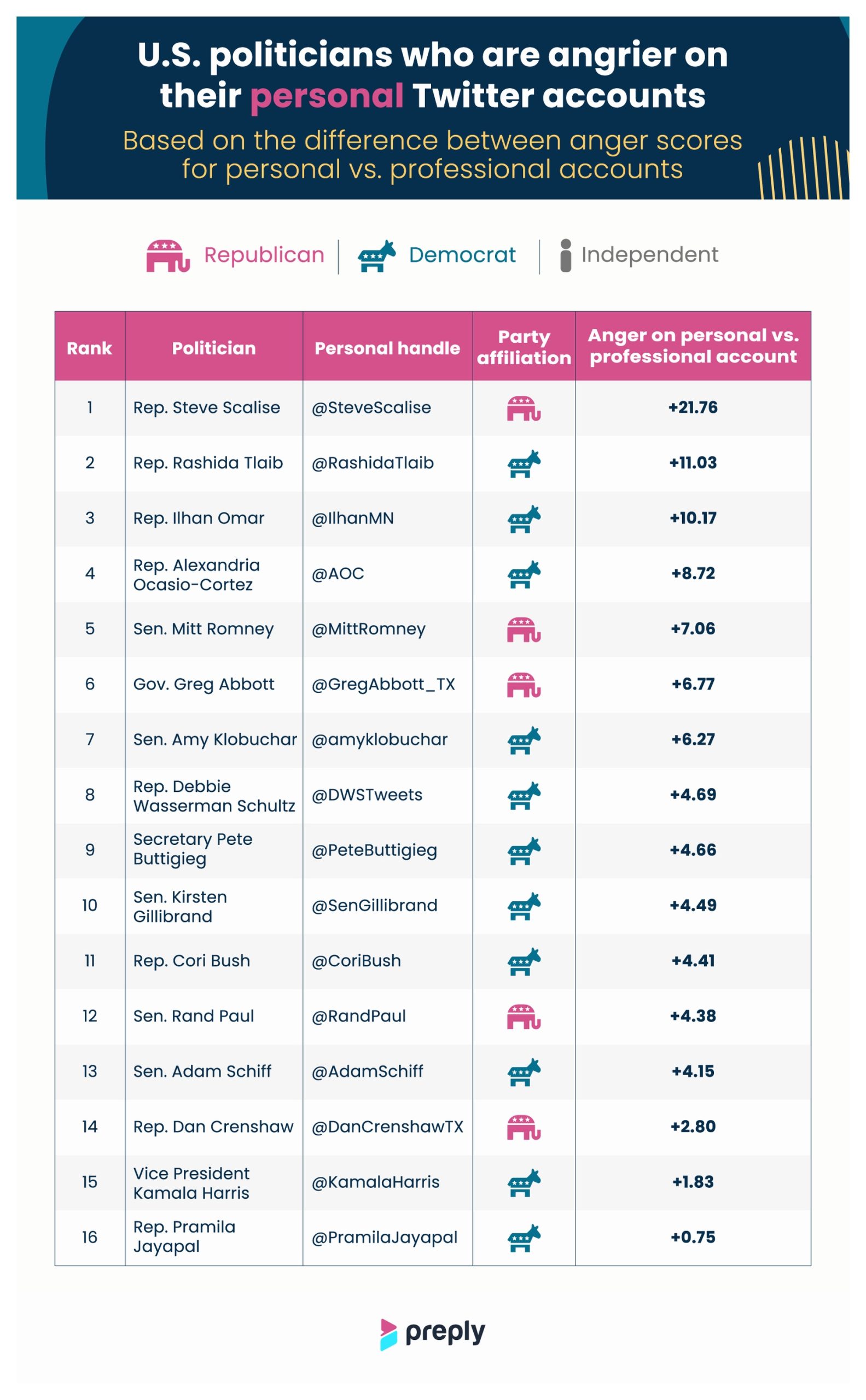
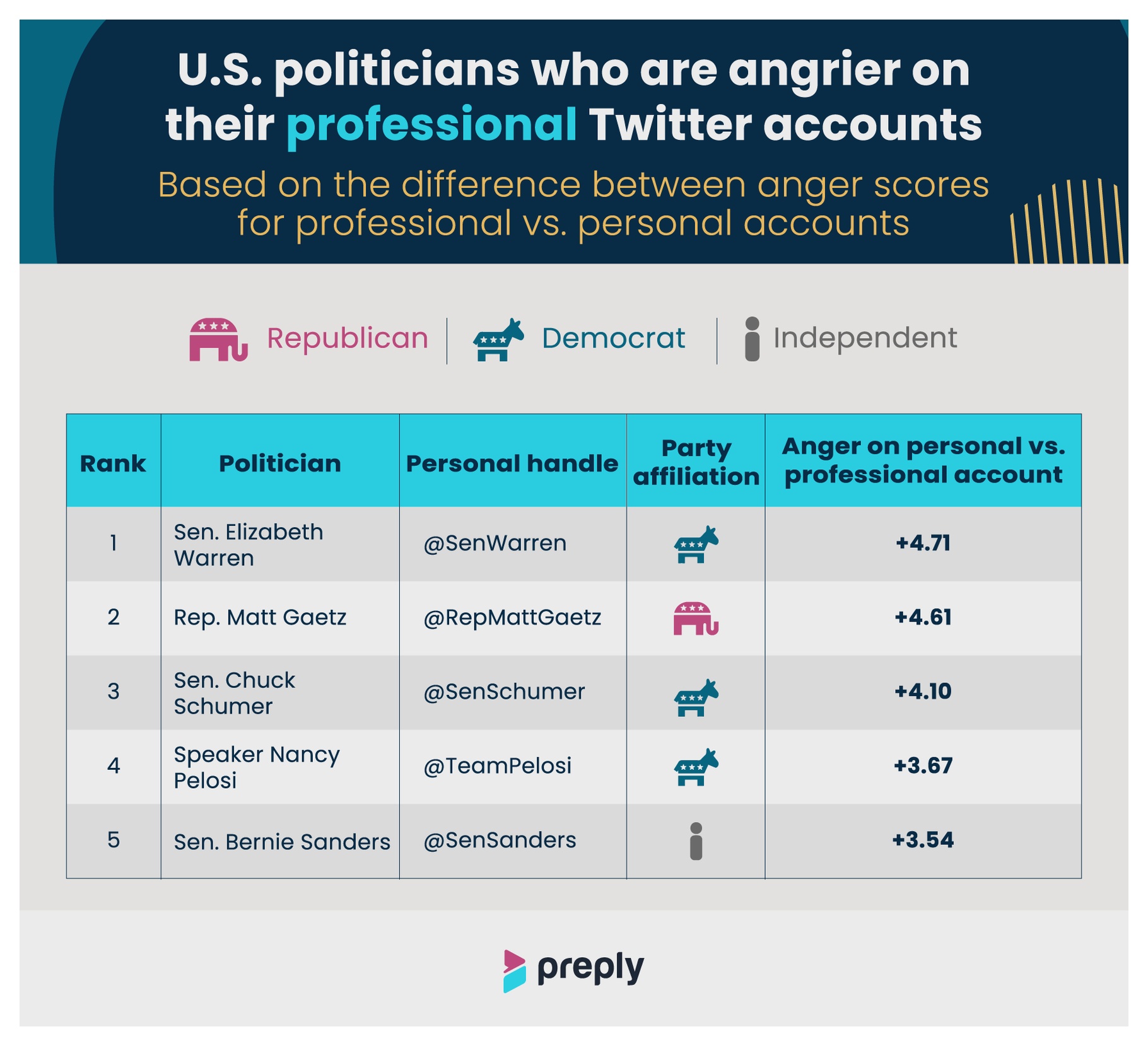
In contrast, senior Democratic leaders and those holding prominent positions, including Senators Bernie Sanders (+3.54), Elizabeth Warren (+4.71), Chuck Schumer (+4.10), and Speaker Nancy Pelosi (+3.87), express a higher level of anger on their professional social media accounts.
In a surprising twist, the trend among Republicans shows that Junior Congressman Matt Gaetz, known for his fiery demeanor, expresses even more anger on his professional account than on his personal one, with a notable increase of 4.61%.
Regardless of your personal views, universal emotions such as anger often express themselves through similar language patterns. By familiarizing yourself with the vocabulary and structure associated with these feelings, you can significantly deepen your grasp of any language.
**Methodology:** In September 2022, we identified the top 85 U.S. politicians with the highest Twitter followings. Using the Twitter API, we gathered tweets from their professional and personal accounts over the past year. To assess the emotional tone of these tweets, we employed a machine learning model known as BERT (Bidirectional Encoder Representations from Transformers). Unlike traditional models that read text sequentially, BERT analyzes the entire sequence of words simultaneously, enabling it to understand the context of each word based on its surrounding terms. This approach allowed us to measure both the volume and intensity of anger expressed in their tweets.
Prior to running the model, we meticulously prepared the Twitter dataset by eliminating all URLs, user handles, hashtags, and non-alphabetic characters. This careful preprocessing step was essential for enhancing the model’s ability to interpret the data effectively. Additionally, we removed English stopwords—common words that frequently appear but provide little meaningful information—to further refine the dataset.
The model underwent pre-training with a well-regarded emotion dataset to accurately identify the most suitable emotion for each tweet. This process generates a matrix displaying probability scores for each emotion, expressed as percentages. A higher percentage indicates a stronger match between the tweet and the emotion.
We analyzed the output according to three key metrics:
- **Percentage of Anger Tweets:** The proportion of tweets identified as expressing anger, represented as a percentage of the total tweets analyzed.
- AngerScore: The probability score of anger in each set of tweets
- Anger Levels: The degree of anger in each set of tweets
- Low: 30%–58%
- Medium: 58%–80%
- High: 80% +
Politicians were evaluated based on two key factors: 1) the number of angry tweets they posted over the last year, measured by the “Best Match” ratio, and 2) their AngerScores, which reflect the intensity of their emotional expressions.
Frequently Asked Questions
What was the primary focus of the sentiment analysis conducted on Twitter accounts of U.S. politicians?
The analysis focused on the volume and intensity of angry tweets posted by the most-followed U.S. politicians over the past year.
Which political party exhibited more anger in their tweets according to the findings?
The findings revealed that Republicans generally conveyed more anger in their tweets compared to their Democratic counterparts.
Who were identified as the most aggressive tweeters in politics?
The most aggressive tweeters identified were Republican Chairwoman Ronna McDaniel, and Representatives Louie Gohmert and Matt Gaetz.
How did politicians express their emotions differently on personal versus professional accounts?
Many politicians expressed more intense emotions on their personal accounts, while established Democrats showed higher levels of anger on their professional accounts.
What methodology was used to analyze the tweets for emotional tone?
The analysis employed a Machine Learning model known as BERT to assess the emotional tone of tweets, measuring both the volume and intensity of anger expressed.