- Key takeaways
- Close quarters, distant relationships?
- How often do we talk?
- WhatsApp with you, Nextdoor neighbor?
- Breaking down barriers – not privacy walls
- Bridging the neighborhood gap
- Methodology
- Fair Use
- Frequently Asked Questions
- What is the highest engagement level recorded for neighborly interactions in U.S. cities?
- What percentage of respondents report having rare interactions with their neighbors?
- Which cities have notably low engagement levels, and what are their scores?
- How many respondents wish to improve their relationships with neighbors?
- What are some obstacles to connecting with neighbors mentioned in the article?
When you think of the word “neighbors,” what images come to mind? Perhaps it’s friendly morning conversations while tending to your garden, cozy gatherings around a Saturday night fire, or fun weekly outings with families who share your interests. These moments create a sense of community and connection that enrich our lives.
Communities thrive on the connections we build with those around us, and the level of our engagement with these individuals is crucial to their vitality.
Urban communities in major U.S. cities are complex and multifaceted. While one might assume that simply being surrounded by people fosters strong relationships and frequent interactions, the reality is often quite different.
How well do city dwellers truly know their neighbors beyond quick nods and polite greetings? How often do they engage in meaningful conversations? In this study, we delve into data on neighborly interactions in major U.S. cities, revealing insights into the implications these interactions have for the fabric of modern communities.
Key takeaways
- The highest engagement level recorded in any city is a modest 6.6 out of 10, observed in Cleveland
- A significant 36% of respondents report rare interactions with their neighbors
- San Jose and Denver have notably low engagement levels, each receiving a score of just 3.0 out of 10.
- A significant 54% of respondents nationwide want to improve their relationships with neighbors, despite limited interaction.

Learn a language with personalised 1-on-1 classes with our expert tutors from all over the world
French lessons online
Spanish lessons online
Close quarters, distant relationships?
While neighborly connections can differ significantly across U.S. cities, which urban areas truly excel at cultivating strong community ties?
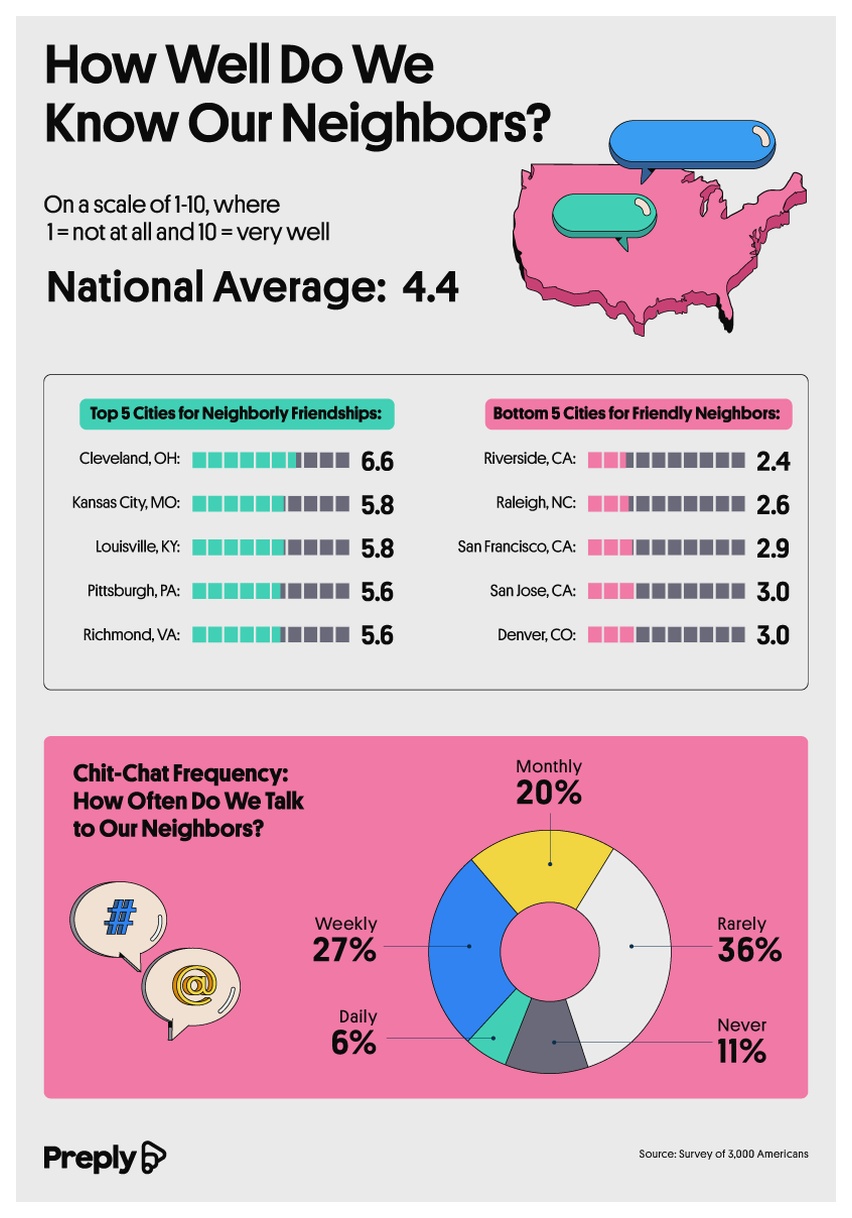
Leading our rankings is Cleveland, Ohio, the vibrant heart of the Midwest, boasting an engagement score of 6.6 out of 10. This indicates a solid level of interaction among residents, highlighting a community where neighbors play a vital role in everyday life. However, it’s noteworthy that no city achieved a score above 70%, suggesting room for improvement in community engagement across the board.
The final four cities in the top five—Kansas City, Louisville, Pittsburgh, and Richmond—each boast solid community scores of 5.8 and 5.6, respectively. While this indicates a decent level of connection, it doesn’t imply that residents are frequently mingling in hallways or stairwells. Instead, it suggests that these neighborhoods may not prioritize regular social gatherings, such as weekend cocktail hours or relaxing in local parks together.
What about cities where residents feel disconnected from their neighbors? Both sunny San Jose and the mile-high Denver rate a low 3.0 out of 10 in neighborly familiarity. Close behind are San Francisco at 2.9, Raleigh at 2.6, and Riverside, California at 2.4, highlighting a pressing need for community engagement and interaction. It seems that in these areas, the art of conversation is sadly lacking.
How often do we talk?
When it comes to neighborly chats, the frequency of these interactions sheds light on the dynamics in the cities mentioned. It’s encouraging to see that 27% of respondents have weekly conversations with their neighbors. However, a significant 36% reported infrequent interactions, while 11% confessed to never speaking with those living nearby. Surprisingly, just a tiny 6% engage in daily conversations with their neighbors.
What about the nature of interactions in different cities? In Cleveland, where residents feel a heightened sense of community, frequent conversations among neighbors help cultivate strong connections, creating a culture of shared experiences and mutual support. In contrast, cities like Raleigh, which score lower in connectedness, may experience less frequent casual interactions, leading to weaker social ties.
The significant differences in responses highlight the intricate nature of urban social dynamics. But what influences these surprising statistics across various cities?
WhatsApp with you, Nextdoor neighbor?
City size significantly influences the dynamics of community relationships, creating clear contrasts between large and smaller towns. In vast cities like San Francisco and Denver, residents often experience a sense of anonymity due to the sheer scale, while smaller cities such as Louisville and Richmond can cultivate a close-knit atmosphere through more frequent and meaningful interactions among their residents.
It’s a common misconception that larger cities lack neighborly connections while smaller towns automatically foster close friendships. In reality, the type of living situation plays a crucial role. In any city, apartment or condo living often encourages interactions through shared spaces, lending items, and close proximity. In contrast, more sprawling cities with single-family homes or townhouses may unintentionally lead to fewer social exchanges among residents.
Examining the relationship between social dynamics and residents’ homes reveals that neighborly engagement is intricately woven by these elements. Moreover, technology emerges as a powerful catalyst, actively reshaping and enhancing these interactions in today’s communities.
In vibrant urban centers, social media and community-building apps like Nextdoor serve as vital links that enhance connectivity and help bridge the gaps created by physical distance. Yet, many argue that while these online platforms are valuable tools for fostering community, they cannot truly replace the richness of in-person interactions.
In smaller cities, technologies like Facebook—once considered cutting-edge—can serve as powerful tools for connection, fostering closer communication among residents who often look out for one another. To grasp the changing dynamics of relationships in our increasingly digital world, it’s essential to explore how the size of a city and the impact of technology intertwine.
Learn a language online with our free learning materials.
Learn English online
Learn French online
Breaking down barriers – not privacy walls
Regardless of your identity, hometown, or living situation, it’s clear that obstacles to connecting with neighbors are numerous and complex. Recognizing these challenges is essential for building a more cohesive community across the country.

National data reveals an intriguing trend in neighborly relationships: about 54% of people wish for stronger connections with those living nearby. However, this desire varies widely across cities. For instance, in the lowest-ranking cities like Minneapolis, Milwaukee, and Tampa, only about 30% of residents seek closer ties. In contrast, cities that lead the pack, such as Columbus, Baltimore, and Sacramento, show much higher percentages—87%, 84%, and 77%, respectively—indicating a strong yearning for community bonds.
A significant challenge in addressing this issue is the fast-paced lifestyles that 42% of respondents acknowledge. While it’s understandable that a hectic schedule can limit engagement, this hurdle might be overcome by leveraging time-efficient platforms for connection. Options like monthly neighborhood gatherings or city-focused online community forums could provide valuable opportunities for interaction and involvement.
After busy schedules, the second biggest obstacle to connection is a lack of shared interests, affecting 23% of individuals. Local initiatives such as demographic clubs, hobby groups, and community spaces can help bridge these gaps. Privacy concerns follow closely at 20%, while cultural differences account for only 3%, highlighting varying challenges across cities. Overcoming these barriers can be as straightforward as signing up for online Spanish classes or attending an event outside your usual interests—after all, trying something new can lead to unexpected connections!
Bridging the neighborhood gap
Grasping the unique interests and needs of a community is essential for developing effective strategies to enhance neighborhood communication. Whether organizing inclusive community events, offering language learning workshops, or utilizing tech-driven platforms, it’s crucial that these initiatives align with the specific preferences and aspirations of each city and its residents.
Recognizing these differences is crucial for city planners, community leaders, and residents because they reveal the various factors that shape neighborhood relationships. By tackling these issues at their core, communities can collaborate to create more connected and supportive urban spaces. What steps can you take to contribute to this important initiative?
As the beloved Fred Rogers once suggested, “Imagine how our neighborhoods would transform if everyone made it a habit to share just one kind word with someone else.” Language barriers shouldn’t hold you back! With LingualNeeds’ online French lessons, you can learn to communicate with your neighbors. The next time you cross paths in the hallway, you’ll be ready to engage in a friendly chat—and who knows? You might just forge a new friendship!
Methodology
In January 2024, we conducted an engaging survey of 3,000 Americans, all proficient in English. Among the respondents, 65% identified as women, 33% as men, and 2% as non-binary. The average age of participants was 37 years, providing a diverse snapshot of perspectives across different demographics.
Fair Use
Feel free to share this data! You can use any of the information or graphics provided above for non-commercial purposes. Just remember to include a linked attribution to this page in your article.
Frequently Asked Questions
What is the highest engagement level recorded for neighborly interactions in U.S. cities?
The highest engagement level recorded is 6.6 out of 10, observed in Cleveland.
What percentage of respondents report having rare interactions with their neighbors?
A significant 36% of respondents report rare interactions with their neighbors.
Which cities have notably low engagement levels, and what are their scores?
San Jose and Denver have notably low engagement levels, each receiving a score of just 3.0 out of 10.
How many respondents wish to improve their relationships with neighbors?
A significant 54% of respondents nationwide want to improve their relationships with neighbors.
What are some obstacles to connecting with neighbors mentioned in the article?
Obstacles include fast-paced lifestyles, a lack of shared interests, and privacy concerns.