
- Which UK cities boast the highest percentage of top-rated companies?
- Which US cities boast the highest percentage of top-rated companies?
- Which countries boast the highest percentage of top-rated companies?
- Which countries score highest for worker satisfaction among non-native language speakers?
- Where do English speakers have the greatest worker satisfaction when working abroad?
- Which companies do non-native language speakers have the greatest experience working with abroad?
- Where does worker satisfaction differ the most between the average worker and non-native employees?
- Q&A with cross-cultural workplace expert Robert Johnson
- Methodology
- Frequently Asked Questions
- What are some challenges faced by expatriate employees when relocating for work?
- Which country has the highest percentage of top-rated companies according to the research?
- How does learning the local language benefit non-native employees?
- What did the research find about job satisfaction levels between native and non-native employees?
- Which companies received the highest ratings from non-native language speakers?
Embarking on a new job can be stressful, but relocating to a different country for work presents an entirely new level of challenge. Adapting to a fresh workplace, unfamiliar culture, and a new language can be daunting for newcomers. Fortunately, they are not alone in this journey; in fact, 2019 statistics reveal that almost 10% of employees in the EU hail from countries outside their current workplace.
How does working in a foreign country influence your job satisfaction? Are there specific countries or companies where non-native speakers enjoy a superior workplace experience? Additionally, what advantages come from learning the primary language used in your workplace?
To uncover the insights, we partnered with Robert Johnson, a Senior Lecturer in Cross-cultural Management and Intercultural Communication at Regent’s University. Together, we meticulously examined tens of thousands of Glassdoor reviews from both native and non-native employees.
These findings shed light on the levels of workplace satisfaction experienced by both native and non-native speakers across various countries globally.
Which UK cities boast the highest percentage of top-rated companies?
As we embarked on our research, our goal was to identify which cities in the UK have the highest percentage of top-rated companies on Glassdoor. To define “highly rated,” we focused on companies that received either four or five stars on this popular workplace review platform.
Our research reveals that London leads the way with an impressive 35% of top-rated companies on Glassdoor, surpassing other cities like Kingston upon Hull and Reading. This highlights London’s status as a prime location for exceptional workplaces.


Learn a language with personalised 1-on-1 classes with our expert tutors from all over the world
French lessons online
Spanish lessons online
Which US cities boast the highest percentage of top-rated companies?
In our analysis of cities with the highest percentage of top-rated companies, San Francisco shines as the leader in the US. An impressive 38.4% of companies based in this vibrant city received four or five-star ratings on Glassdoor, highlighting its reputation as a hub for exceptional workplaces.
San Jose, California and Boston, Massachusetts also rank highly.

Learn a language online with our free learning materials.
Learn English online
Learn French online
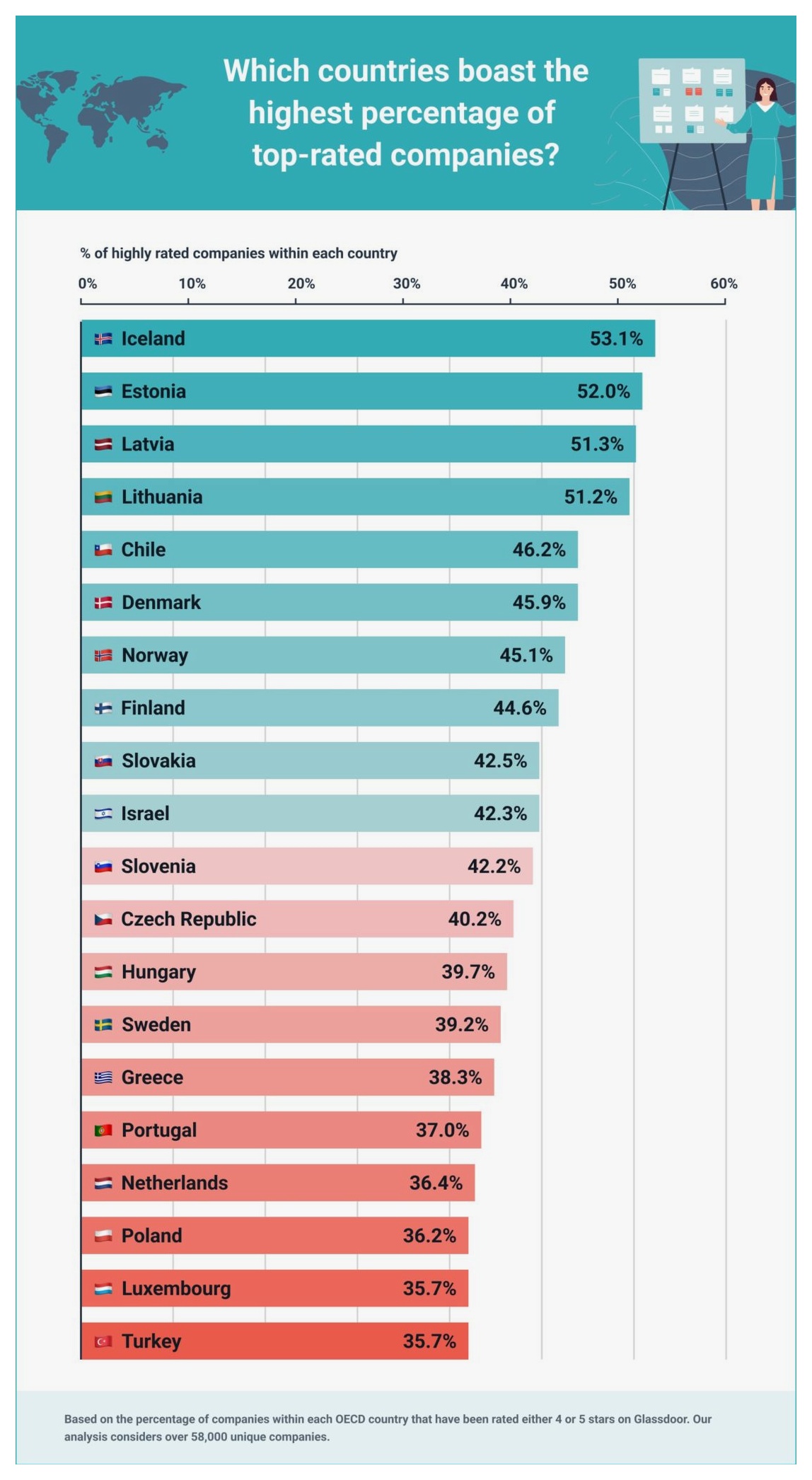
Which countries boast the highest percentage of top-rated companies?
We conducted an analysis of employee ratings for companies across each country in the Organisation for Economic Co-operation and Development (OECD). Our goal was to identify which country has the highest percentage of workplaces earning top ratings of four or five stars.
Iceland proudly claims the top position in our ranking, with an impressive 53.1% of companies listed on Glassdoor receiving high ratings from their employees. Close behind are Estonia and Latvia, which also show strong employee satisfaction.
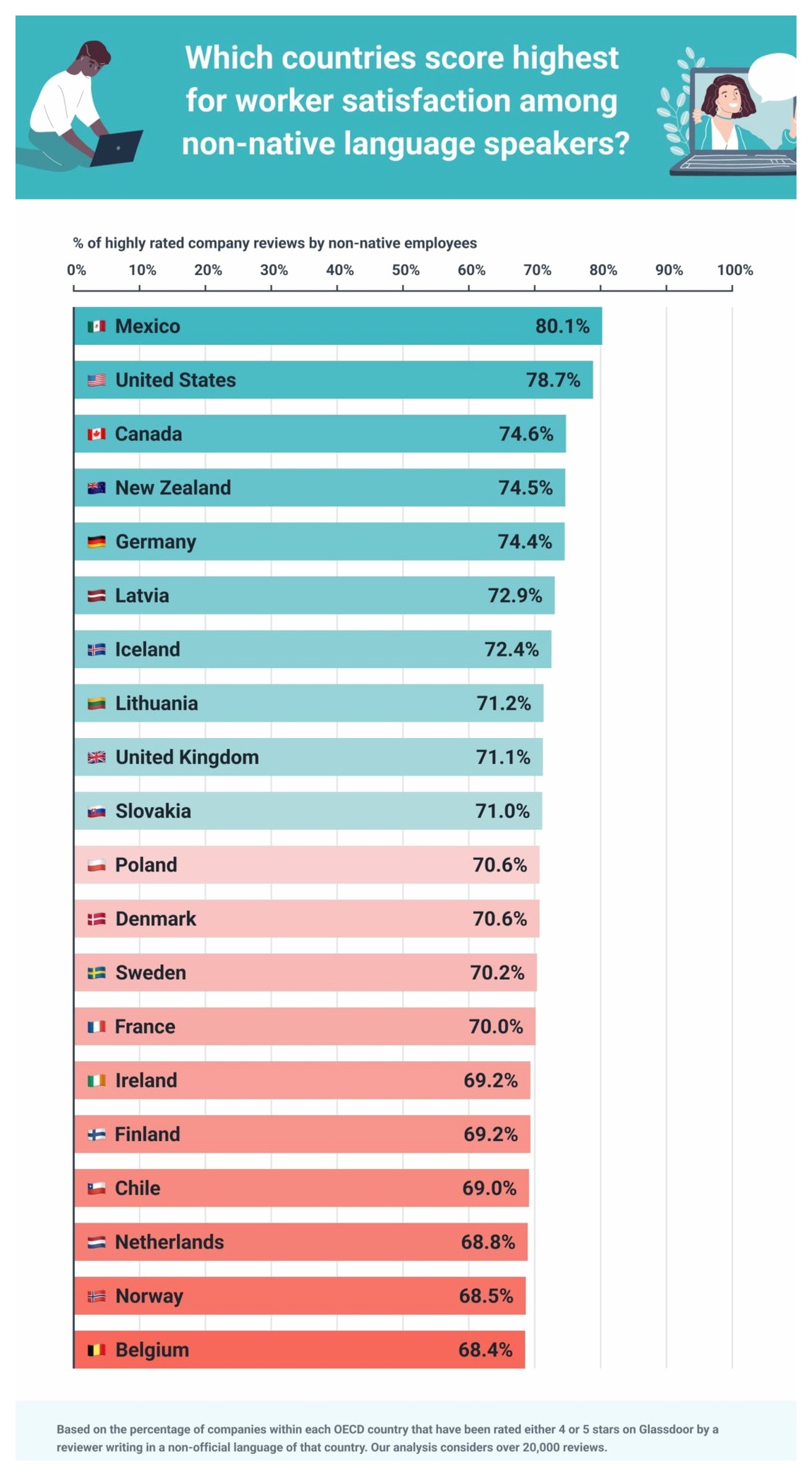
Which countries score highest for worker satisfaction among non-native language speakers?
Relocating to a new country for work can be daunting, especially if you’re not fluent in the local language. However, some countries are known for providing a more welcoming and supportive environment for non-native employees. Which destinations stand out in making this transition smoother?
To uncover valuable insights, we explored Glassdoor for employee reviews penned in languages other than the native tongue of their respective countries. For instance, our analysis features reviews written in Spanish by employees at companies located in the UK.
Our research reveals that Mexican companies stand out with an impressive 80.1% of non-Spanish employee reviews receiving four or five stars, making them the leaders in positive feedback among non-native reviewers worldwide.
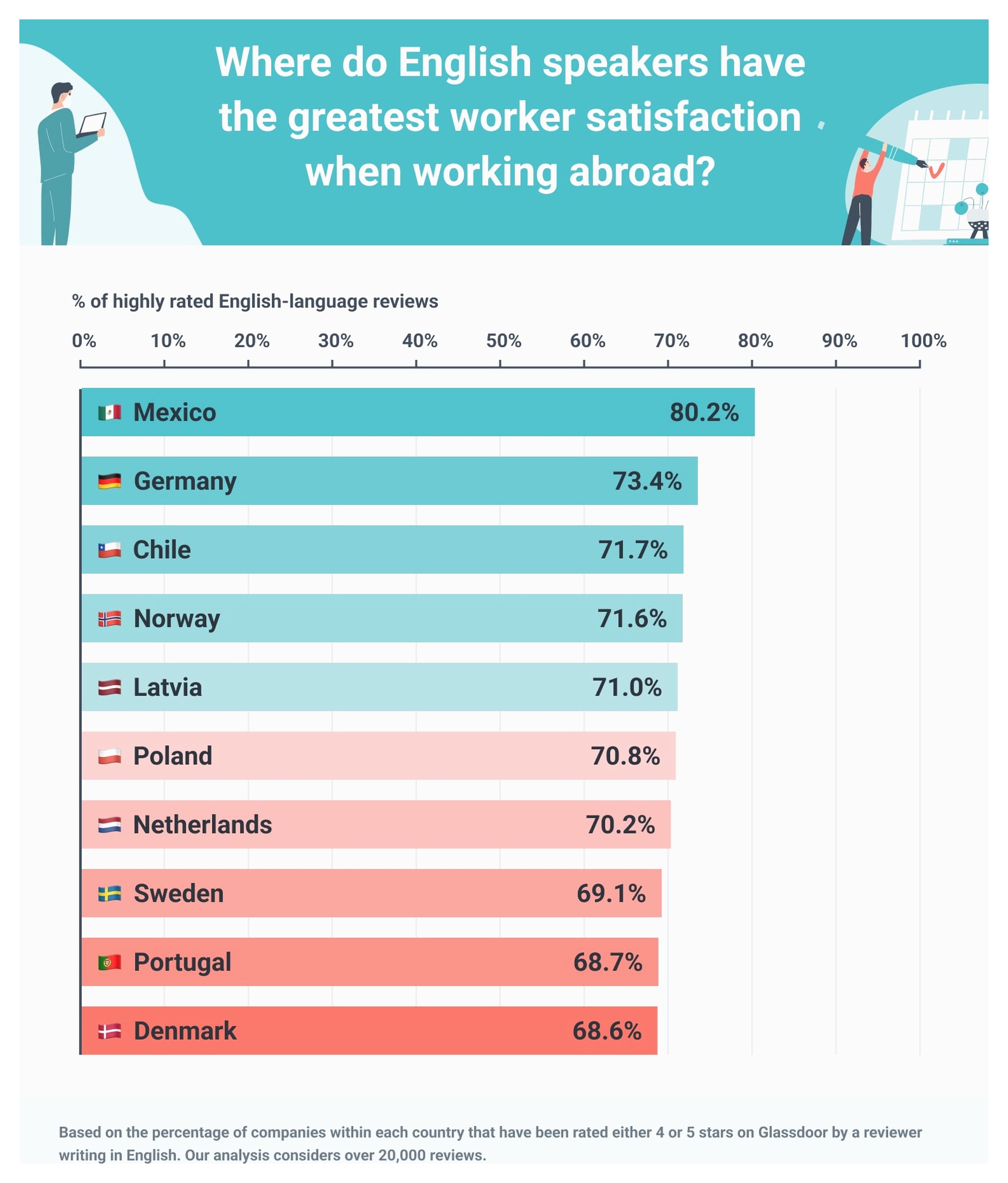
Where do English speakers have the greatest worker satisfaction when working abroad?
By analyzing English-language employee reviews from companies worldwide, we can uncover which countries offer the best workplace experiences for English speakers.
Our research reveals that Mexico is the top foreign country for English speakers seeking employment, with an impressive 80.2% of employee reviews rating companies there four or five stars.
Which companies do non-native language speakers have the greatest experience working with abroad?
Our research not only identified the countries where non-native workers enjoy the best working conditions, but we also aimed to uncover which companies receive top ratings from these employees.
Our analysis revealed that an impressive 88.6% of foreign-language reviews for Google’s multilingual workplaces received top ratings of four or five stars on Glassdoor. This remarkable figure surpasses that of any other company we examined, highlighting Google’s strong reputation among its international workforce.

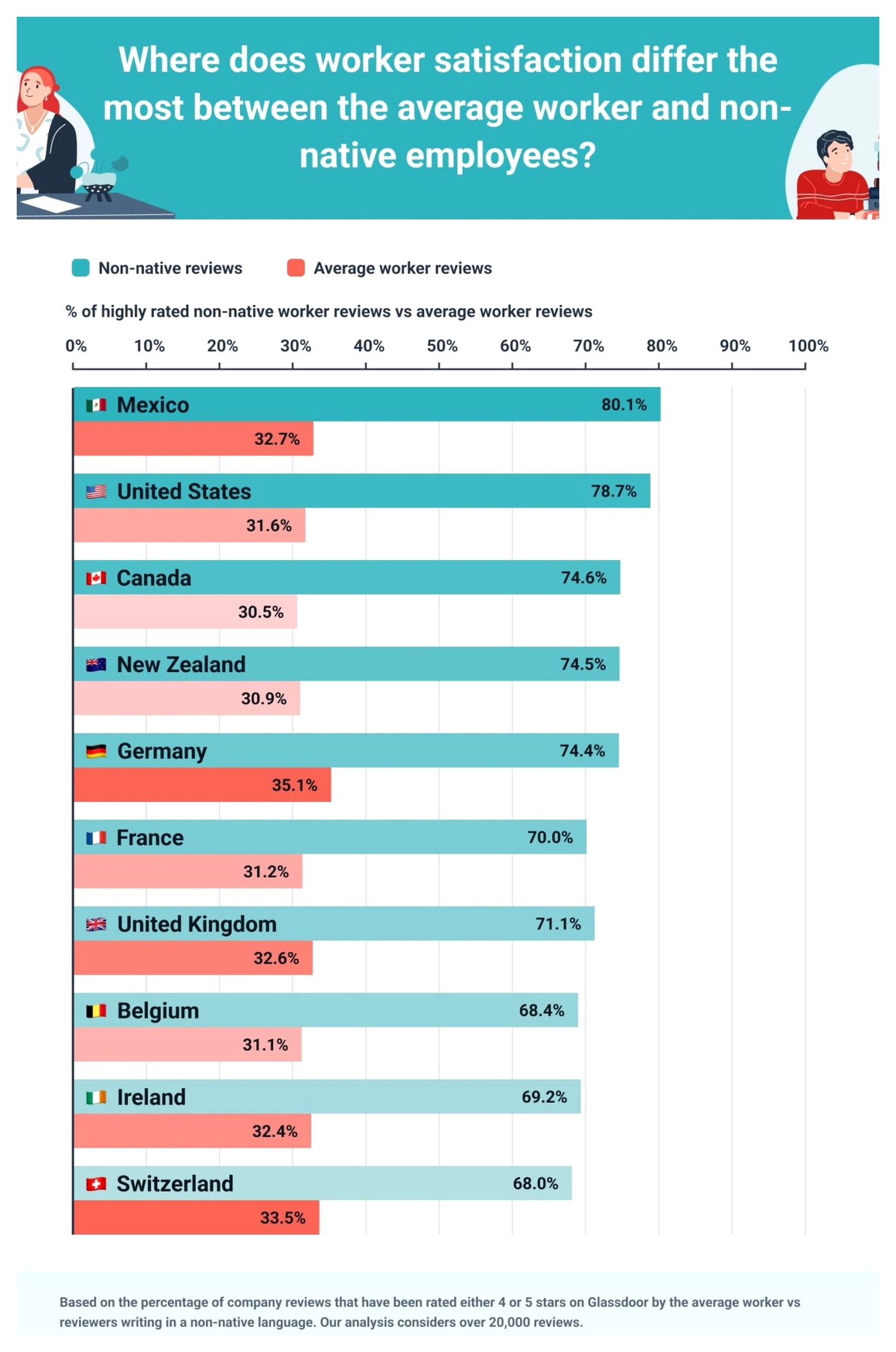
Where does worker satisfaction differ the most between the average worker and non-native employees?
In our analysis, we discovered that non-native employees reported higher levels of job satisfaction compared to their native counterparts in every country examined. We defined non-native employees as those who submitted reviews in languages other than their mother tongue. Meanwhile, the average worker rating for each company reflects a combined score from both native and non-native employee feedback.
In Mexico, non-native employees report a significantly higher satisfaction rate, with 80.1% giving positive reviews—47 percentage points above the overall average of 32.7%. This suggests that non-native workers enjoy a more favorable work experience in the country compared to their peers.
Trailing just behind Mexico in our ranking, the United States shows a notable gap of 47.1 percentage points between top-rated non-native and native reviews.
Q&A with cross-cultural workplace expert Robert Johnson
To gain deeper insights into navigating cross-cultural work environments and adapting to a job in a foreign country, we consulted with Robert Johnson, a leading expert in this field. As a Senior Lecturer in Cross-Cultural Management at Regent’s University London and a cultural awareness consultant, Robert specializes in intercultural communication, making him an invaluable resource for anyone looking to enhance their global workplace skills.
- Our research found that non-native employees reported higher workplace satisfaction than native workers across all studied countries. What factors do you think contribute to non-natives giving more favorable company reviews? Could motivation influence the differing experiences of non-native and native employees?
Motivation is a key factor in the success of employees who seek international assignments. Typically, these individuals are the most qualified, skilled, and adventurous members of the team. They often appreciate their companies for offering them the chance to experience the exciting lifestyle of living and working in some of the world’s most vibrant cities.
Their assignments typically have a set timeframe, which means that even during challenging moments, they can look forward to returning home soon, armed with valuable experiences and thrilling stories of enduring tough conditions. In contrast, the locals back home are left managing their everyday responsibilities and bills!
Expats often approach their host countries with fewer political and social preconceptions than locals, which can shape their experiences. However, many expats who aren’t fluent in the local language may find their interactions with the culture to be somewhat superficial, primarily enjoying it through food, festivals, and leisure activities. This leads them to form close-knit communities with fellow expats, creating a supportive and comfortable environment that can feel limiting yet appealing for an extended period.
- Reasons for Working Abroad: What Drives the Desire to Relocate for Employment, and Will This Trend Grow in the Future?
The pandemic has undeniably impacted companies’ readiness to send expatriates overseas. However, as economies reopen and restrictions ease, this reluctance will likely diminish. There remains a strong desire among ambitious employees to showcase their skills through international assignments.
It’s undeniable that the pandemic has ushered in a lasting transformation toward virtual teamwork, with companies opting for brief in-person meetings instead of lengthy overseas assignments. This shift makes sense, as sending employees abroad can be costly and carries its own set of risks for businesses.
It’s unfortunate that many overlook the significant advantages of advancing in their careers. The rewards are evident: gaining hands-on experience, acquiring local insights, and building connections beyond one’s home market can be incredibly beneficial for those aspiring to reach the top. These elements are invaluable assets on the path to success.
- Key Research Considerations Before Accepting a Job Abroad: Essential Factors to Evaluate
When considering a relocation, it’s essential to evaluate several key factors, including the location’s characteristics, political stability, healthcare quality—especially for any specific medical needs—openness to newcomers, and climate. However, the most crucial element is the level of support the organization provides to the assignee and their family during the transition. This support can significantly impact their overall experience and adjustment in the new environment.
Engaging with someone who has experience in a similar role can be invaluable, so it’s essential to seek their insights. Additionally, advocating for cross-cultural training and, if needed, basic language lessons from your company is crucial. It’s a common misconception that your partner will effortlessly secure job opportunities abroad; however, this isn’t always true. In fact, the ability of the partner, often referred to as the ‘trailing spouse,’ to find meaningful work and achieve personal satisfaction in the new setting is a key factor in the success of an expatriate assignment.
- Common workplace barriers and challenges faced by individuals relocating for a new job in a foreign country and strategies for overcoming them.
Expatriate employees face a variety of challenges, with complacency being the most significant. It’s easy to assume that you’ll remain unaffected by such a major life transition. While “culture shock” is often used, I find the term “new life stress” more accurate. This phrase captures the adjustment period as we navigate and adapt to a new environment over which we have little control.
Balancing your social circle is key! While it’s essential to forge new friendships for valuable informal feedback about your workplace, don’t overlook the importance of reconnecting with family and colleagues back home. Steer clear of those who have adopted a cynical mindset, and be open to social invitations from local acquaintances—just remember to prioritize your safety!
In the workplace, don’t hesitate to ask questions and express curiosity about anything that seems unusual. Take the initiative to understand the reasoning behind processes or decisions. Approach conversations with humility, as this will foster positive relationships. By demonstrating genuine interest, you’ll earn the respect and admiration of your colleagues.
- Is building international teams essential for companies? Explore the benefits for both organizations and employee experiences.
The approach a company takes largely depends on its aspirations. If the goal is merely to manage operations without embracing and learning from a new culture, there’s minimal motivation to collaborate with external partners or build a diverse team. In such cases, companies often fill their implementation teams with individuals from the head office, limiting fresh perspectives and insights.
To truly benefit from its experiences, a company must embrace the diverse backgrounds of its employees. When international teams are effectively nurtured and managed, they can unleash greater creativity and productivity. This approach not only helps the company adapt to unforeseen challenges but also positions it to thrive in new markets.
- Discover the top-rated companies for non-native workers according to our research. Have these organizations adopted effective cross-cultural strategies? Share your thoughts on the key strategies that contribute to their success.
Leading companies like Google, Apple, Microsoft, and major global banks clearly possess the resources to cultivate robust cross-cultural teams and leverage their diverse strengths. However, success isn’t solely about resources; it also hinges on a managerial mindset that embraces new perspectives and promotes cultural intelligence over ethnocentric confidence. By adopting this approach, organizations of any size can sidestep the dangers of groupthink and uncover opportunities that might otherwise go unnoticed.
- Which languages do you think will be in demand by employers in the next 20 years?
English is set to continue as the dominant language of global business for the foreseeable future. However, the impact of Anglo-American cultures is expected to diminish over time. Proficiency in additional languages will be a significant asset in the workforce, particularly for those fluent in Chinese, Spanish, French, or Arabic. Just a month or two ago, Russian might have been on that list, but predicting its relevance has become challenging. Additionally, knowledge of Japanese can definitely give you a competitive edge in the job market.
Methodology
Our study examines over 270,000 reviews from companies across 45 countries and 247 cities. Additionally, we include insights from 20,000 employee reviews written by individuals using a non-native language in their workplace’s location. This comprehensive analysis aims to provide a deeper understanding of global business environments.
A company earns the title of ‘top-rated’ when it achieves an average employee rating of four stars or higher on Glassdoor. Please note that all data is accurate as of March 2022.
Elevate your language proficiency with LingualNeeds’ dynamic business English courses and specialized corporate English training. Discover how these programs can enhance your communication skills in the professional world!
Frequently Asked Questions
What are some challenges faced by expatriate employees when relocating for work?
Expatriate employees often face challenges such as culture shock, complacency, and the stress of adjusting to a new environment.
Which country has the highest percentage of top-rated companies according to the research?
Iceland has the highest percentage of top-rated companies, with 53.1% receiving high ratings on Glassdoor.
How does learning the local language benefit non-native employees?
Learning the local language can enhance communication, foster better workplace relationships, and improve overall job satisfaction for non-native employees.
What did the research find about job satisfaction levels between native and non-native employees?
The research found that non-native employees reported higher levels of job satisfaction compared to their native counterparts across all studied countries.
Which companies received the highest ratings from non-native language speakers?
Google received the highest ratings from non-native language speakers, with 88.6% of reviews rating their workplaces four or five stars.