- Key findings
- How Americans use work chat apps
- 55% of Americans check work messages in their free time
- The language etiquette of work chat apps
- Conclusion
- Frequently Asked Questions
- How have work chat apps transformed workplace culture?
- What percentage of remote workers fake being active on work chat apps?
- What are some common anxieties associated with receiving messages from bosses?
- How do work chat apps impact work-life balance?
- What are the prevalent language practices on work chat apps?
As remote work continues to flourish across the United States, work chat apps like Slack, Microsoft Teams, and Google Chat have transformed into the virtual water coolers for distributed teams. These platforms not only facilitate discussions about projects but also foster connections and camaraderie among teammates, making remote collaboration more engaging and personal.
These innovative apps are transforming workplace culture by fostering connection and celebration among coworkers. Employees can now cheer each other on using fun emojis and memes, keep track of each other’s online presence, and engage in instant messaging throughout the day—ideally without the usual business jargon. This interactive environment helps build stronger relationships and a more vibrant workplace community.
To gain insights into messaging and work chat app culture in American workplaces, we conducted a survey involving over 1,200 full-time employees, both remote and in-person.
Key findings
- 44% of remote workers have faked being active on a work chat app.
- 33% of bosses have faked being active on a work chat app.
- 34% keep work chat notifications off because they cause anxiety.
- 56% have a work chat app on their personal phone.
- 46% of people think it’s cringy to receive a GIF or meme at work.
How Americans use work chat apps
Our survey highlighted several popular workplace chat apps, including Microsoft Teams, Slack, Google Chat, Skype, WhatsApp, and Discord. These platforms enable employees to engage in conversations on a wide range of subjects, from project updates and company announcements to personal matters and current events. Additionally, they serve as valuable tools for sharing experiences, such as learning new languages through online French lessons.
A significant portion of Americans, approximately 35%, check their messaging apps several times a day. Around one-third of users receive messages on an hourly basis, while over 10% find themselves getting notifications every few minutes.

While work chat apps have become commonplace, they don’t always foster a positive environment for employees. In fact, these tools can sometimes harm workplace culture by heightening anxiety levels. A striking 34% of surveyed employees mute notification sounds, revealing how the constant pings can contribute to their stress.
When it comes to anxiety in the workplace, a striking 61% of employees reported feeling anxious upon receiving a simple message from their boss on a work chat app that reads, “Hi [name].” Lacking any additional context, this seemingly innocuous message can trigger heightened anxiety, especially among Gen Z and Millennial workers who are particularly sensitive to it. Interestingly, women expressed significantly higher levels of anxiety about such messages compared to their male counterparts.
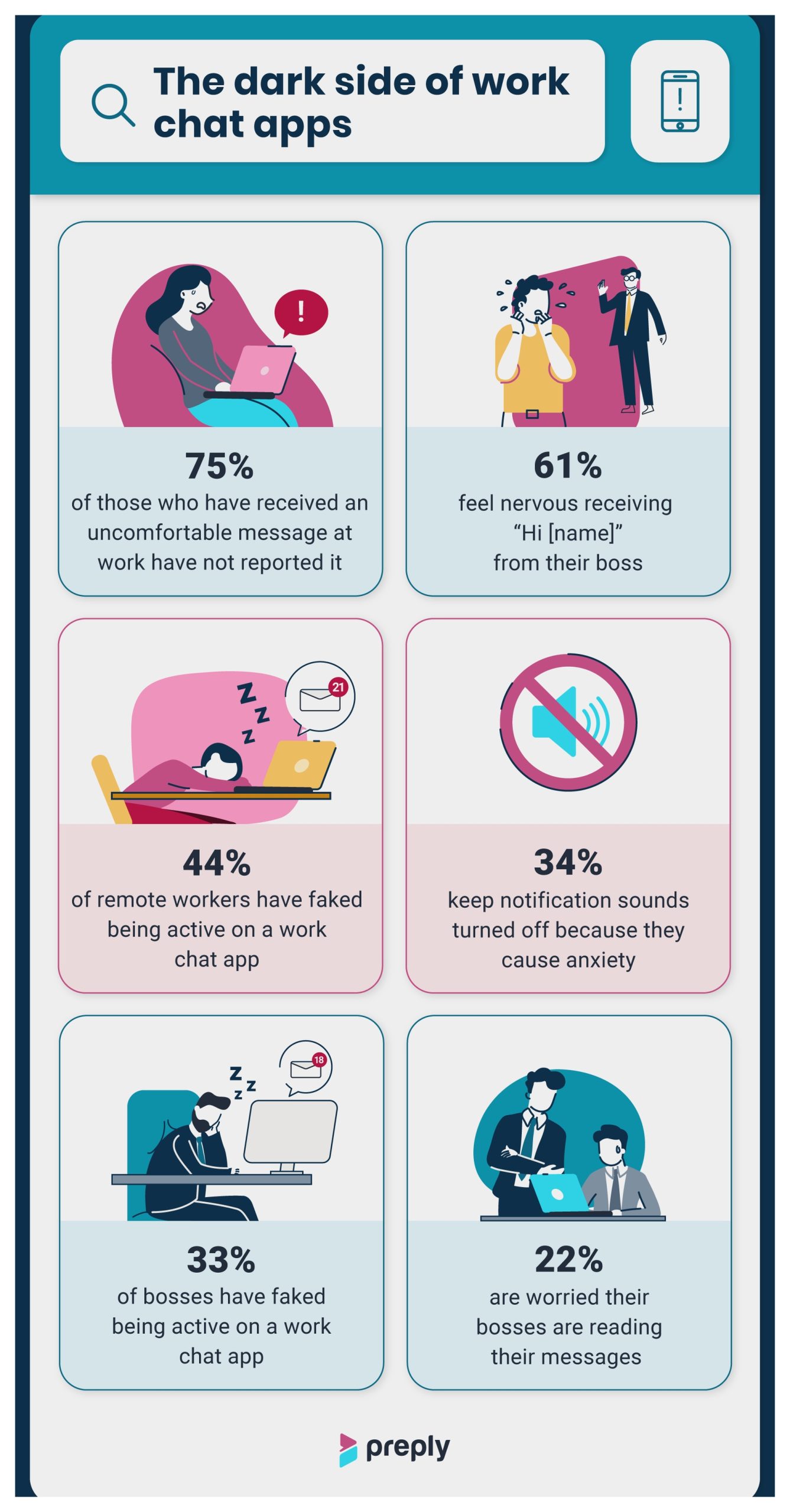
Work chat applications come with the possibility of employee surveillance, leading to concerns among workers—over 20% fear that their supervisors might be reading their messages. Additionally, these platforms allow employees to seem active even when they aren’t actually working; in fact, 35% of workers admit to having pretended to be online on these apps.
A recent study reveals that 44% of remote workers admit to pretending to be active, a stark contrast to just 23% of their on-site counterparts. Among younger generations, nearly 40% of Gen Z and Millennials have engaged in this behavior on work chat platforms, with Gen Z being four times more likely to do so than Baby Boomers. Interestingly, the trend extends to management, where 33% of bosses have also faked their online presence, compared to 36% of individual contributors.
Many respondents expressed hesitation when it comes to reporting inappropriate messages in work chat apps. Although 16% have received an uncomfortable message, a staggering 75% chose not to inform their supervisor or human resources about it.
55% of Americans check work messages in their free time
Work chat apps can complicate work-life balance by enabling continuous direct messaging with colleagues. Many Americans perceive these apps as more urgent than traditional email. Notably, among the 56% of respondents who have a work chat app on their personal phones, 52% keep push notifications enabled to ensure they never miss a message.
Work chat apps have become an integral part of our daily lives. A striking 55% of survey respondents confessed to checking messages during their personal time, with many even using those moments to pursue online Spanish lessons. American workers are constantly connected, monitoring work messages at various times: 88% do so in the evenings after hours, 71% check in the mornings before starting their day, 75% stay updated over the weekends, and 36% remain engaged while on vacation.
Among those who respond to messages after work hours, 29% feel compelled to reply immediately. Interestingly, older generations, including Baby Boomers and Gen X, are more inclined to check their messages during off-hours and often feel an urgency to respond quickly.
Workers often keep an eye on each other’s availability, with 29% checking their coworkers’ chat app statuses to gauge whether they’re online, on a call, or out of the office. Interestingly, these statuses don’t deter communication; in fact, 53% of employees will still reach out to a colleague, regardless of whether they’re marked as busy or away.
According to the survey, 18% of respondents believe that work chat apps have become overly intrusive in their daily lives, suggesting that messaging culture at their workplace may be too pervasive. Additionally, the same percentage expressed a desire for clearer rules or boundaries regarding work-related messaging.
The language etiquette of work chat apps
Work chat apps, despite their advantages and limitations, foster a unique communication culture—both explicit and implicit—within each workplace. This leads to the development of an internal language that reflects the preferences and dynamics of the team using their selected app.
In the diverse landscape of workplaces, language etiquette can vary significantly. Some environments may prioritize formal communication, while others actively promote ongoing education, like offering online English classes. Our survey reveals some prevalent language practices on chat apps: 74% of respondents emphasize the importance of proper capitalization and grammar, 73% advocate greeting colleagues before discussing work, and 55% discourage the use of abbreviations.

Let’s explore the essential elements of online communication: GIFs, memes, and emojis. A significant 57% of American workers incorporate emojis in their chat apps, with Millennials and Gen X leading the way in usage. In contrast, Gen Z and Boomers tend to use them less frequently. Additionally, women are 18% more likely to use emojis at work compared to their male counterparts.
Why use emojis at work? According to our respondents, the most common reasons are:
- To add levity to a conversation (women are twice as likely to use emojis for this reason as men)
- To emphasize what they’re saying
- To seem less demanding
- To respond quickly to someone
It’s no surprise that workers frequently turn to emojis to lighten the mood, with the most popular choices being the smiley face, thumbs-up, and laughing face. These cheerful symbols help convey positivity and camaraderie in the workplace.
Interestingly, 46% of survey participants use GIFs or emojis in workplace chat apps, yet the same percentage finds their usage to be cringeworthy. Millennials and Gen Xers are the primary users of these digital expressions. Notably, men are more inclined to share GIFs and memes in professional settings compared to women.
Conclusion
Work chat apps have revolutionized communication in remote workplaces, but they can also foster a culture that needs careful management. To combat burnout, it’s essential for organizations to set clear boundaries regarding their use. On a personal level, mastering effective and professional online communication can enhance both workplace culture and your career prospects. Consider enrolling in LingualNeeds’ business English courses and corporate English training to elevate your communication skills and make a lasting impact in your professional environment.
**Methodology:** Between June 10 and 12, 2022, we conducted a survey of 1,207 full-time American employees to explore their usage of work chat applications. The demographic breakdown revealed that 50% of respondents identified as men, 48% as women, and 2% as nonbinary. Age-wise, 6% were Baby Boomers, 23% were Generation X, 60% were Millennials, and 11% were Generation Z. In terms of work arrangements, 42% worked on-site, 25% worked remotely, and 34% employed a hybrid model. Additionally, 58% of participants were individual contributors, while 40% held management or supervisory roles, with the remaining 2% holding other positions.
Frequently Asked Questions
How have work chat apps transformed workplace culture?
Work chat apps have created a more engaging and personal remote collaboration environment, fostering connections and camaraderie among teammates.
What percentage of remote workers fake being active on work chat apps?
44% of remote workers admit to faking being active on work chat apps.
What are some common anxieties associated with receiving messages from bosses?
61% of employees feel anxious upon receiving a simple message from their boss on a work chat app due to lack of context.
How do work chat apps impact work-life balance?
Work chat apps can complicate work-life balance by enabling continuous messaging, with 55% of respondents checking work messages during their personal time.
What are the prevalent language practices on work chat apps?
74% of respondents emphasize proper capitalization and grammar, 73% advocate greeting colleagues before discussing work, and 55% discourage abbreviations.