

- What are the challenges of learning a language?
- 5 language training challenges & solutions for employees
- 1. No time for training
- Solution: Flexible learning options
- 2. Irrelevant content
- Solution: Personalized learning
- 3. Lack of motivation
- Solution: Fun lessons and clear incentives
- 4. Working remotely
- Solution: Online language lessons
- 5. Not making progress
- Solution: Regular level tests
- 5 language training challenges & solutions for employers
- 1. No time to organize language training
- Solution: Find a language provider
- 2. Can’t find the right language training provider
- Solution: Consider what you need from your provider
- 3. Running on a tight budget
- Solution: Get the best value for your money
- 4. Challenges of pitching to decision-makers
- Solution: Measure the return on investment (ROI)
- 5. Difficult monitoring employee progress
- Solution: Find a provider who tracks progress
- Conclusion
- Frequently Asked Questions
- What are the main challenges of corporate language training?
- How can flexibility be incorporated into corporate language training?
- What is personalized learning in the context of language training?
- Why is motivation important in language learning?
- How can employers track employee progress in language training?
Businesses around the globe recognize the value of language training for their employees, as it not only helps attract top talent but also facilitates entry into new markets and enhances the advantages of a multilingual workforce. However, successfully implementing an effective corporate language training program can present several challenges.
In this article, we delve into the hurdles that corporate language training poses for both employees and employers. We’ll also provide tailored solutions to each challenge, equipping you to foster a vibrant multilingual workforce through high-quality training.
What are the challenges of learning a language?
Learning a foreign language as an adult is a rewarding yet challenging journey that demands both time and dedication. One of the most significant hurdles is the vast amount of material to memorize, including essential vocabulary and complex grammar rules.
Language learning goes beyond just acquiring new vocabulary; it requires honing a variety of skills. To truly grasp and effectively communicate in your new language, you must become proficient in reading, listening, speaking, and writing. Mastering these abilities will enable you to navigate diverse professional situations with confidence.
Language learning goes beyond just vocabulary and grammar; it opens the door to understanding diverse cultures and honing specialized skills. For instance, you might explore German business meeting etiquette or master the art of persuasive communication in English that feels natural and respectful.
Corporate language training faces several challenges that can hinder its effectiveness. To successfully navigate these obstacles, companies need a sustainable program that maximizes study time and tailors learning experiences to meet individual employee needs. This approach ensures that workers acquire the essential language skills necessary for success in their roles.
5 language training challenges & solutions for employees
Having explored the difficulties of language learning, we can better grasp the unique challenges associated with corporate language training. We’ve categorized these obstacles into two groups: those faced by employees and those encountered by employers.
Let’s dive into the typical challenges employees face and explore effective strategies to address them. By doing so, we can maximize the benefits of your training program and empower your workforce to thrive.
1. No time for training
Many professionals juggle demanding careers, household duties, and family obligations, leading to a common belief that there simply isn’t enough time to learn a new language. However, with the right approach, it’s entirely feasible to incorporate language learning into a full-time work schedule.
Solution: Flexible learning options
Although we can’t stretch the hours in a day, we can certainly enhance the flexibility of your corporate language training program. Many training providers offer the option for participants to select their lesson times each week, enabling them to seamlessly integrate face-to-face learning into their hectic schedules.
When employees can decide when to engage in learning, they are far less likely to miss lessons due to prior obligations and won’t feel that their educational pursuits clash with their other responsibilities. This flexibility promotes a more balanced approach to professional development.
2. Irrelevant content
Engaging with material that doesn’t resonate with your life can sap your motivation and obscure your language-learning goals. When employees encounter irrelevant content, their progress often stalls significantly.
Solution: Personalized learning
The most effective corporate language training is tailored to meet the unique needs of each employee, focusing on topics that are directly relevant to their roles and everyday lives. This personalized approach not only enhances their professional skills but also reinforces the value of their training, keeping them engaged and motivated throughout their learning journey.
The most effective personalized language training comes from one-on-one lessons, where each employee works with a dedicated tutor. This tailored approach allows instructors to design lessons that address individual strengths, weaknesses, and specific language requirements, ensuring optimal learning outcomes.
3. Lack of motivation
Learning a language requires a significant amount of motivation, and even the most dedicated learners can find it challenging to maintain their focus. Sustaining high motivation is crucial for achieving impressive progress in your language journey.
Solution: Fun lessons and clear incentives
Staying motivated in language learning is a breeze when the lessons are enjoyable! By implementing a training program that features interactive sessions, diverse content formats, and engaging activities, you can significantly boost your employees’ enthusiasm and drive to learn.
Employees seek assurance that the time they dedicate to learning is a valuable investment in their future. Communicate to your team how mastering a new language can unlock exciting professional opportunities. Don’t forget to follow through on your commitments to support their growth!
4. Working remotely
A 2023 study by Forbes reveals that more than 40% of full-time employees are now working from home or embracing a hybrid work model. As a result of this shift away from traditional office settings, arranging in-person language lessons has become increasingly challenging.
Solution: Online language lessons
Discover top-notch online corporate language training that delivers the same advantages as traditional classroom learning, specifically designed for remote employees. Not only do private online lessons provide the quickest route to mastering a new language, but they are also more affordable and adaptable than in-person classes.
5. Not making progress
When it comes to language learning, it’s crucial to distinguish between genuine stagnation and simply being unaware of your progress. Many learners experience a slowdown in their advancement when they hit the intermediate level, a phenomenon often referred to as the “intermediate plateau.” This is a common and normal stage in the learning journey!
When learners sense a lack of progress, their motivation can quickly wane, impacting how swiftly they advance in their studies.
Solution: Regular level tests
The most effective corporate language training includes regular progress assessments that target the material covered in recent lessons. These tests not only help learners gauge their improvement but also reinforce the idea that they are advancing in their language skills, even if the progress feels subtle compared to their initial learning stages.
When tests reveal that learners are not making significant progress, this insight is still highly valuable. If several employees face similar challenges, it’s essential to investigate the underlying reasons for their struggles and consider revising aspects of your language training program.

5 language training challenges & solutions for employers
Having explored the difficulties faced by language learners, let’s turn our attention to the obstacles encountered by those putting language skills into practice. Here are five typical challenges you may face, along with practical solutions to overcome them.
1. No time to organize language training
Identifying suitable content, scheduling classes, and tracking progress can be time-consuming, and many companies lack the necessary resources to implement a comprehensive training program on their own.
Solution: Find a language provider
Numerous outstanding corporate language training providers are available to take the reins, tackling the complexities of language learning and helping you navigate the challenges we’ve discussed.
For instance, LingualNeeds provides tailored one-on-one lessons, frequent progress assessments, and a comprehensive corporate dashboard, allowing you to easily monitor your employees’ development.
2. Can’t find the right language training provider
Choosing a language provider can be an excellent way to enhance your learning experience, but it’s important to find one that truly fits your needs. With a plethora of providers and various learning formats available, navigating your options can quickly become daunting.
Solution: Consider what you need from your provider
When selecting a language training provider, it’s essential to weigh several key factors such as your budget, time constraints, and the learning styles of your employees. Fortunately, we offer a comprehensive article to guide you in finding the perfect training solution tailored to your specific requirements.
3. Running on a tight budget
Investing in corporate language training is a smart decision for any organization. However, with many companies facing budget constraints, it’s essential to strike a balance between quality and cost when selecting a training program.
Solution: Get the best value for your money
Discovering a reliable and effective service provider doesn’t have to break the bank. There are several strategies to reduce expenses while still ensuring high-quality service.
Online language training often proves to be more affordable than traditional in-person classes. This is primarily because tutors can eliminate costs associated with travel and language school facilities, allowing them to offer lower prices while still delivering quality instruction.
Numerous online platforms, such as LingualNeeds, provide a variety of pricing options, ensuring that businesses of all sizes can find a solution that fits their budget.
4. Challenges of pitching to decision-makers
While you may recognize the advantages of language training, persuading your company’s decision-makers can be challenging. These leaders often seek concrete evidence that their investment will yield returns and enhance the company’s profitability.
Solution: Measure the return on investment (ROI)
Investors often seek concrete data to guide their decisions, but measuring progress in language learning can be challenging. Unlike traditional investments, the advancements in language acquisition can be subtle and hard to quantify, making it difficult to present clear metrics.
To persuade decision-makers, it’s essential to evaluate the cost of language training against the progress employees are achieving and the subsequent benefits for the business.
Navigating the complexities of measuring the ROI of corporate language training can be challenging. To assist you in making a compelling case, we’ve developed a comprehensive article focused on this very topic.
5. Difficult monitoring employee progress
We’ve delved into the difficulties of tracking learners’ progress, and it’s worth noting that employers face similar challenges. With the impracticality of monitoring every employee’s class—both cumbersome and distracting—how can employers confidently assess their team’s development?
Solution: Find a provider who tracks progress
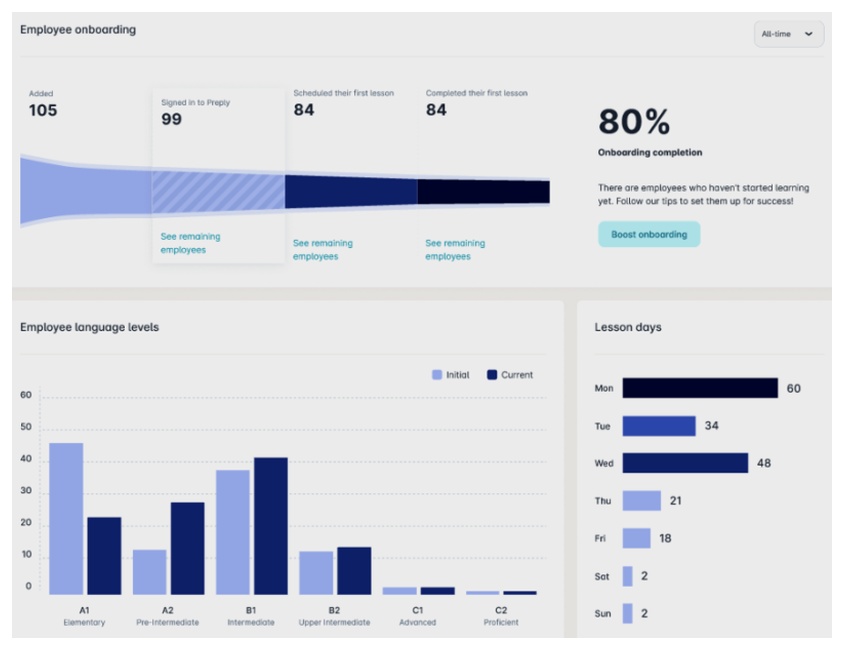
Companies such as LingualNeeds provide regular progress assessments and monitor employee attendance, consolidating this information into a user-friendly corporate dashboard. This empowers employers with valuable insights into their workforce’s performance and engagement levels.
You’ll gain valuable insights into each employee’s progress, providing you with confidence in the effectiveness of your program. Additionally, it can highlight those who may be struggling, allowing you to identify individuals who might benefit from additional support to achieve their goals.
Conclusion
Learning a new language can be quite challenging, demanding careful and effective training methods. The ten obstacles we’ve discussed today are important to recognize, but with the right strategies in place, they can all be easily surmounted.
In today’s diverse landscape of corporate language training providers, you’ll discover a wealth of support and resources designed to help you tackle challenges and launch a successful program that yields outstanding results.
LingualNeeds offers an exceptional corporate language training solution that stands out for its personalized lessons and flexible learning options. With regular assessments included, employees can effectively track their progress and focus on the areas that need improvement.
Schedule a demo with our team to explore our corporate language training solutions. Discover how we can help you tackle language training challenges and foster a vibrant, multilingual workforce.
Frequently Asked Questions
What are the main challenges of corporate language training?
The main challenges include lack of time for training, irrelevant content, lack of motivation, difficulties with remote learning, and not making progress.
How can flexibility be incorporated into corporate language training?
Flexible learning options, such as allowing employees to choose their lesson times, can help integrate language learning into busy schedules.
What is personalized learning in the context of language training?
Personalized learning involves tailoring language training to meet the unique needs of each employee, focusing on relevant topics to keep them engaged.
Why is motivation important in language learning?
Motivation is crucial as it helps learners maintain focus and enthusiasm, which is necessary for making significant progress in acquiring a new language.
How can employers track employee progress in language training?
Employers can monitor progress through regular assessments and by utilizing providers that offer corporate dashboards to consolidate performance data.


