

- What is a language learning plateau?
- Who experiences the language plateau?
- What counts as progress in learning a new language?
- What impacts progress when learning a language?
- 6 ways to overcome the language learning plateau
- 1. Review your reasons for learning a language
- 2. Build your discipline
- 3. Change your activities
- 4. Personalized 1-1 lessons with a native
- 5. Immerse yourself
- 6. Focus on your psychology
- Language experts on beating the plateau
- John Fotheringham
- Lindie Botes
- Steve Kaufmann
- In summary: overcoming the language plateau
- Frequently Asked Questions
- What is a language learning plateau?
- Who experiences the language plateau?
- What factors impact progress when learning a language?
- What are some strategies to overcome a language learning plateau?
- What counts as progress in learning a new language?
“Limitations are illusions; what truly exists are plateaus. It’s essential not to remain stagnant on these plateaus but to strive to surpass them.” – Bruce Lee.
Learning a new language can be one of life’s most fulfilling experiences. However, it can also be incredibly frustrating when you find yourself stuck in a language-learning plateau, where progress seems to stall.
Experiencing a language plateau can be frustrating, and it often manifests in a few recognizable ways. You might find yourself repeating the same phrases like a parrot, struggling with basic vocabulary, or feeling like a child in a room full of adults when trying to communicate. It’s easy to become disheartened during these times and consider giving up on your learning journey.
You’re about to discover that hitting a language plateau is a common experience, particularly during the transition from B1 to B2 levels. Even the most proficient language learners encounter this challenge. Continue reading to understand the reasons behind this plateau and learn effective strategies to overcome it.
What is a language learning plateau?
A language learning plateau is when you feel your learning pace has slowed down.
As you embark on the journey of learning a new language (or any skill), you’ll likely notice a surge in your progress. This initial phase is marked by a boost in motivation, making it an exciting time for growth and discovery.
However, you’ll soon realize that achieving progress requires double the effort. Encountering a language plateau can transform the journey to mastering a new language into a daunting and seemingly insurmountable challenge.
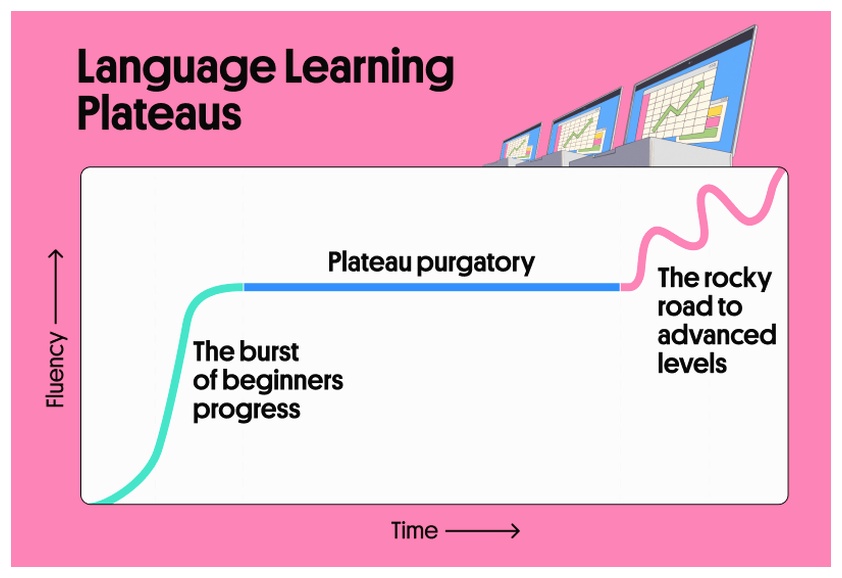
As you hit the plateau, the thrill of this new challenge can start to wane. Instead of celebrating your small victories, you might find yourself fixating on what you haven’t learned yet. This shift in focus can lead to complacency, making your language practice feel repetitive and less engaging.
As you dive deeper into learning a new language, you might start to feel mentally overwhelmed, as if your brain has reached its limit. This can lead to frustration and a sense of being stuck in a language-learning desert. However, it’s important to remember that countless others have faced this same challenge and emerged more resilient and skilled in their language journey.
Who experiences the language plateau?
Even the most skilled language learners, including those featured at the end of this article, have encountered the frustrating challenge known as the language plateau.
The language learning plateau typically occurs between the B (intermediate) and C (advanced) levels of the CEFR framework. To understand why this plateau happens, it’s essential to explore the psychology behind skill acquisition.
In their insightful book, *Peak: Secrets from the New Science of Expertise*, Anders Ericsson and Robert Pool reveal that achieving proficiency in most skills typically requires around 50 hours of dedicated practice. Beyond this threshold, our attention often wanes, leading us to operate on “auto-pilot” rather than engaging fully with the task at hand.
We often become complacent when we believe we’ve mastered a skill, settling into our comfort zone. Since discomfort is something we instinctively avoid, this marks the start of a decline in our growth. Essentially, we find ourselves stuck on a plateau, where progress stalls.
Language learners often encounter plateaus for various reasons. A new job might leave you too exhausted to enjoy a foreign language show on Netflix each night. Skipping your favorite language learning app, even just for a day or two, can quickly become a habit. Additionally, relocating to a different country can significantly reduce your exposure to the language you’re trying to master.
For many language learners, the frustrating plateau phase can feel like an insurmountable barrier, often leading to discouragement and abandonment of their goals. But fear not! Here are effective strategies to break through this stagnation and elevate your skills to the gratifying level of fluency.
What counts as progress in learning a new language?
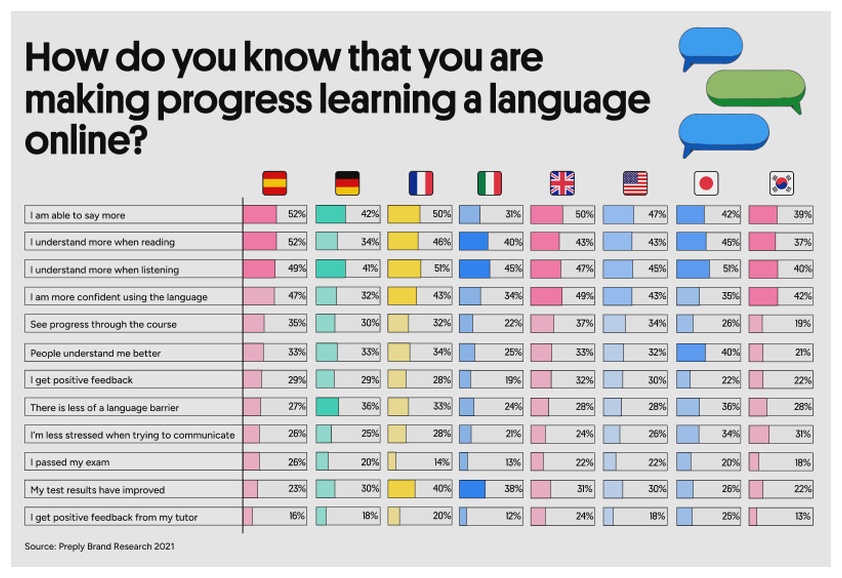
The journey of learning a new language is unique for every individual, with progress taking on various meanings. For many, a key indicator of advancement is the boost in self-confidence when it comes to speaking and listening skills.
LingualNeeds undertook a study to explore what constitutes progress for various language learners. The findings revealed that the three primary skills linked to progress are speaking, listening, and reading, while writing typically emerges later in the learning process. Interestingly, the study also highlighted that the definition of progress can vary depending on the specific language being learned. Check out the details below to see how progress differs across languages.
What impacts progress when learning a language?
Mastering a new language demands dedication and discipline, yet it’s essential to recognize that each learner progresses at their own speed. Language acquisition is a personal journey influenced by various factors, including motivation, exposure, and learning methods.
1. Teaching methods:
The teaching method you choose can significantly influence a learner’s experience and outcomes. For instance, personalized one-on-one tutoring and learning through an app offer vastly different benefits, shaping the way knowledge is acquired and understood.
2. Number of hours dedicated:
A learner who spends just one hour a week studying will progress at a different pace than someone who engages with a tutor for three hours weekly. It’s also important to consider the forgetting curve, a concept introduced by German psychologist Hermann Ebbinghaus. He found that after one day, we retain only about 33% of what we’ve learned, dropping to 28% after two days. This retention continues to decline, reaching just 20% by the end of 31 days. Understanding this curve highlights the importance of consistent practice and reinforcement in the learning process.
3. Resources:
Access to the right resources significantly boosts your progress. Actively participating in learning activities accelerates your learning journey.
4. Personal traits:
Various factors such as gender, age, language skills, learning styles, and strategies significantly influence language acquisition. Moreover, elements like motivation, personality traits, beliefs about the learning process, and emotional states—especially those related to positive psychology—can also affect your progress in mastering a new language.
6 ways to overcome the language learning plateau
To overcome the plateau and reach advanced language knowledge, we’ll guide you through 6 top strategies to keep progressing.
1. Review your reasons for learning a language
The key to mastering a language sustainably lies in having a compelling purpose. As John Fotheringham highlighted in LingualNeeds Talks, “Without a solid reason to learn, staying committed can be a challenge. You need a powerful ‘why’ to keep you motivated.”
If you find yourself on a plateau in your language learning journey, it’s time to reassess your “why.” Whether you’re new to this reflection or your motivations have shifted over time, understanding your purpose is crucial. A compelling and emotional reason will drive your progress far more effectively than superficial goals. For instance, wanting to “sound cool” pales in comparison to the motivation of passing your IELTS exam to begin university studies in England.
Take a moment to consider the amazing advantages that learning a new language offers. Not only are you unlocking the door to a vibrant culture, but you’re also embarking on a journey of self-discovery. Embracing a new language can open up a fascinating world that goes beyond your current experiences, revealing new perspectives and opportunities.
2. Build your discipline
Achieving our goals requires more than just motivation; it demands discipline to push through those days when motivation wanes. One effective strategy is to establish a weekly language study plan. This approach not only helps you stay focused but also ensures consistency in your learning journey, guiding you steadily toward your objectives.
Choose language learning activities, such as:
- Watching a movie
- Listening to a podcast
- Taking an online language lesson
Next, allocate specific times for your activities by adding them to your calendar. This method not only fosters accountability but also helps you clearly see what you need to learn and when, making your plans more actionable and organized.
Even on the days when you “don’t feel like it,” work on forcing yourself to participate in these tasks.
3. Change your activities
When life starts to feel monotonous, it’s essential to shake things up to rediscover joy and fulfillment. This could mean taking a refreshing hike, experimenting with a new hair color, or even making the bold decision to relocate. The same principle holds true for your language activities; a little change can reignite your passion and enthusiasm for learning.
Begin by evaluating your current language learning activities. Embrace the Marie Kondo philosophy: if it doesn’t spark joy, let it go! With countless options available, focus on activities that enhance your language inputs, like listening and reading, as well as those that allow you to practice outputs, such as writing and speaking.
Instead of reading the same old textbooks, you could try:
- Get creative with your own flashcards by drawing or recording audio
- Start a language journal where you record your day, jot down random ideas, and track your progress
- Read one of your favorite books in your target language
- Play online video games (if you’re a fan of them)
- Speak with a new language tutor and get to know a native speaker personally
Looking for more exciting choices? Check out the top language activities favored by LingualNeeds users, perfect for enhancing your skills beyond tutoring sessions!
4. Personalized 1-1 lessons with a native
A key sign that you’ve hit a plateau in your language learning journey is the frequent repetition of the same words. You might even have a friend who notices this pattern and playfully remarks, “You really love saying ____, don’t you?” This repetition can signal the need to expand your vocabulary and break free from those habit loops.
It can be frustrating to realize that a vast array of rich and nuanced vocabulary exists, yet you find yourself relying on the same familiar words. To enhance your speaking skills significantly, consider engaging with a native speaker. They can provide valuable feedback, gently correcting any unusual phrases and suggesting alternative expressions. Improving your conversational fluency goes beyond using an app or attending a crowded class; it requires personalized interaction for truly natural speech.
Luckily, there are countless budget-friendly options for practicing online. You can meet new friends through language exchange apps or select from a variety of excellent online language tutors. Regular conversations with native speakers will help you focus on your weak points and reignite your progress in language learning.
5. Immerse yourself
Imagine transforming all the information at your fingertips—from your computer, smartphone, books, and movies—into your target language. How empowering would that be for your learning journey?
You might have felt a little uneasy when considering this, but that discomfort is an essential part of stepping outside your language comfort zone. Many enthusiasts advocate for language immersion, as it provides valuable passive exposure. The more you engage with the language, the better you train your eyes, ears, and tongue, ultimately enhancing your fluency.
Fortunately, you don’t have to travel to a country where your target language is spoken to immerse yourself in it. Transforming your home into a language-rich environment is simple and begins with your devices.
To immerse yourself in a new language, start by changing your phone’s settings to that language. This simple adjustment will provide you with more reading material each time you use your device. Next, consider switching your YouTube and Google searches to the same language. For those truly committed to their language journey, replace books, TV shows, and podcasts in your lineup with content in your target language. This approach will boost your learning and keep you engaged!
6. Focus on your psychology
When you find yourself struggling to learn a language, the issue may not lie in your techniques but rather in your mindset. A positive and open attitude can make all the difference in your language-learning journey.
Learning a language can feel overwhelming, with numerous challenges along the way. When you encounter these tough moments, it’s crucial to be kind to yourself. Remember, language learning is a marathon, not a sprint. Comparing your progress to that of others can lead to unnecessary frustration, so focus on your own journey and celebrate your achievements, no matter how small.
Reflect on your journey and recognize how much progress you’ve made. Take a moment to revisit the challenging material you encountered months ago; this can serve as a powerful motivator. If you maintain a language journal, flip through it to see the new vocabulary you’ve acquired and the improvement in your writing accuracy since those early days.
Let’s shift our perspective on plateaus from viewing them as insurmountable disasters to embracing them as challenges ripe with potential. As Ryan Holiday emphasizes in his book, *The Obstacle is the Way*, “The obstacle in the path becomes the path.” Each obstacle we encounter carries within it a chance to enhance our situation and foster growth.
Language experts on beating the plateau
Ready to break through that language plateau? Check out the insights from seasoned polyglots and linguists below. Their experiences show that everyone encounters this challenge, but with the right strategies, anyone can conquer it.
John Fotheringham

Creator of LanguageMastery.com and host of The Language Mastery Show
No matter if you’re mastering a new language, starting a business, or preparing for a marathon, everyone faces a dip in motivation once the initial excitement fades. This is often when the challenges start to overshadow the rewards, leading many to consider giving up. It’s common to question, “Why am I even doing this?” If you can’t pinpoint a compelling reason to continue, you might find yourself ready to give up.
This marks your first genuine “crisis of faith,” a pivotal moment that will challenge the foundation of your personal “WHY.” If you’re feeling the urge to give up, take a moment to refine your statement, making it more compelling. Keep in mind that when your “why” is powerful enough, you can overcome any obstacle along the way.
Lindie Botes

Polyglot YouTuber on a mission to master 12+ languages
It’s crucial to invest effort into language practice every day. I often fall into the trap of thinking that once I reach a certain proficiency, I can maintain it without further effort. However, I’ve noticed my French and Hungarian skills have declined because I became complacent. Without regular practice, you may initially feel fluent, but this false sense of security can lead to unexpected deterioration in your abilities.
You might feel confident in your language skills, thinking, “I’m still fluent!” However, when it comes time to speak, it can become quite challenging. To keep your fluency sharp, dedicate time to practice regularly. One effective strategy is to mix up your language learning techniques—experimenting with different methods can make the process more enjoyable and productive.
Consider downloading a new language-learning app, finding a different tutor, or exploring local language meetups. By diversifying your approach to learning, you can make the process more enjoyable and potentially accelerate your journey from intermediate to advanced proficiency.
Steve Kaufmann

Speaker of 20 languages and Co-founder of LingQ.com
Reaching a plateau in your learning journey requires self-motivation and a clear understanding of your purpose. It’s essential to remind yourself why you embarked on this path, as it holds great value. Personally, I’ve found renewed excitement in exploring new cultures and languages, which brings me immense satisfaction—something I lacked when I first began my intensive language studies. Remember to engage in activities you love, stay committed, and you will ultimately overcome the plateau.
In summary: overcoming the language plateau
Although it feels difficult now, the language plateau is an exciting challenge to face. To overcome it, you should:
- Review your mindsets and reasons “why” you should learn the language
- Increase your discipline on the days when motivation is not enough
- Mix up your methods, focusing on immersion and making the language fun again
- Practice with a native speaker to iron out any consistent errors
Lastly, keep in mind that every language learner, whether a seasoned expert or a complete beginner, faces the dreaded language learning plateau. It’s a common hurdle that can dampen motivation, but overcoming it is in your hands. Stay determined and good luck on your language journey!
Frequently Asked Questions
What is a language learning plateau?
A language learning plateau is when you feel your learning pace has slowed down.
Who experiences the language plateau?
Even the most skilled language learners encounter the frustrating challenge known as the language plateau.
What factors impact progress when learning a language?
Factors include teaching methods, the number of hours dedicated, access to resources, and personal traits such as motivation and learning styles.
What are some strategies to overcome a language learning plateau?
Strategies include reviewing your reasons for learning, building discipline, changing your activities, engaging in personalized lessons with a native speaker, immersing yourself in the language, and focusing on a positive mindset.
What counts as progress in learning a new language?
Progress can be indicated by an increase in self-confidence in speaking and listening skills, as well as improvements in reading and writing.


