- Key findings
- Most choose a cordial communication method when quitting, but some part ways bluntly
- Americans tend to avoid bridge-burning words when resigning
- Americans’ quitting habits are both cutthroat and caring
- People in these industries express the most regret over parting words
- Managers tell all
- The power of poise when quitting
- Methodology
- Frequently Asked Questions
- What is the significance of a resignation notice?
- How do most Americans prefer to communicate their resignation?
- What percentage of employees avoid using negative language when resigning?
- What are some common feelings employees experience after resigning?
- How do managers typically feel during resignations?
Resigning from a job is a pivotal moment that holds deep personal and professional significance. This decision blends cultural expectations, business etiquette, and personal feelings, culminating in the crafting of a thoughtful resignation notice.
When it comes to leaving a job, is the conversation straightforward or carefully measured? Exit interviews play a crucial role in this process, serving as a platform for honest feedback and reflection. How are these discussions structured, and what do they reveal? Additionally, what thoughts and feelings do employees carry with them after departing from their workplace?
To shed light on these queries, LingualNeeds conducted a survey of more than 1,000 Americans, revealing key trends in communication during job resignations. Join us as we delve into the art of quitting a job gracefully and examine how these experiences mirror the larger culture of the American workplace.
Key findings
- The majority (91%) avoids using negative language when quitting.
- Nearly 60% of individuals desire to express more emotion or criticism when resigning but restrain themselves to maintain a professional image.
- A surprising 1 in 8 admit they’ve purposefully timed a resignation to be maximally hurtful to their employer.
- Over 1 in 10 have written an emotionally charged review of a former employer online.
- More than 1 in 10 managers report being unjustifiably yelled at by an employee about their experience.

Learn a language with personalised 1-on-1 classes with our expert tutors from all over the world
French lessons online
Spanish lessons online
Most choose a cordial communication method when quitting, but some part ways bluntly
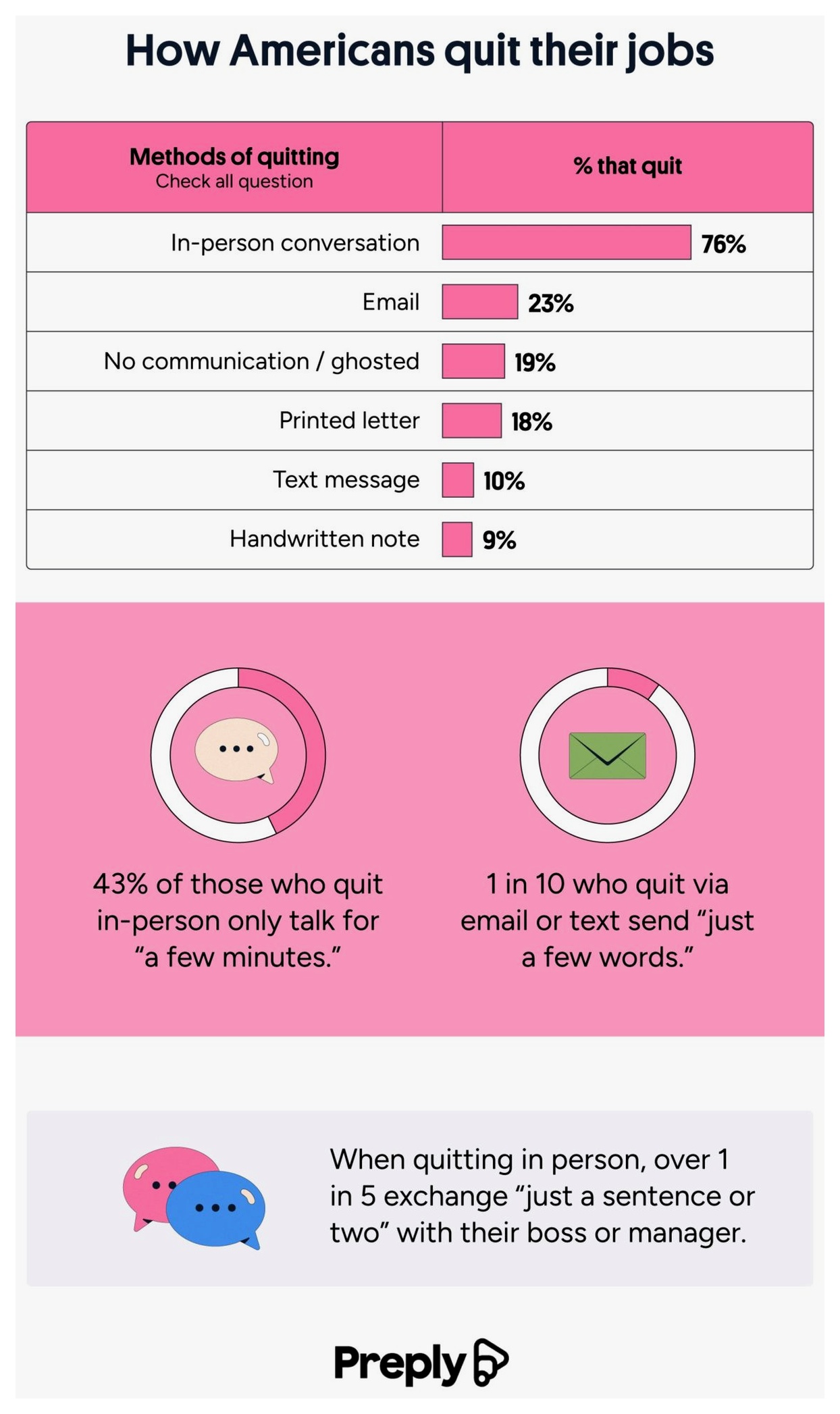
In October 2023, an astonishing 3.6 million Americans chose to resign from their jobs. Our survey showed that the majority, 76%, preferred to quit in person, opting for a direct and personal approach. Additionally, a noteworthy 9% of employees took it a step further by delivering a handwritten resignation note to their employers.
Not all job departures are friendly. In fact, around 19% of employees opt for a more abrupt exit by “ghosting” their employer, leaving without any notice or communication. Interestingly, about 10% of those who resign choose to do so through a simple text message.
Among those who choose to express their decision to leave, almost half—43%—say their conversations are brief, lasting just a few minutes. This suggests a strong inclination for keeping these often awkward discussions short and to the point.
In a similar vein, nearly 40% of individuals who choose to resign via email or text prefer to keep their messages brief, typically confining their communication to just a paragraph or two.
Americans tend to avoid bridge-burning words when resigning
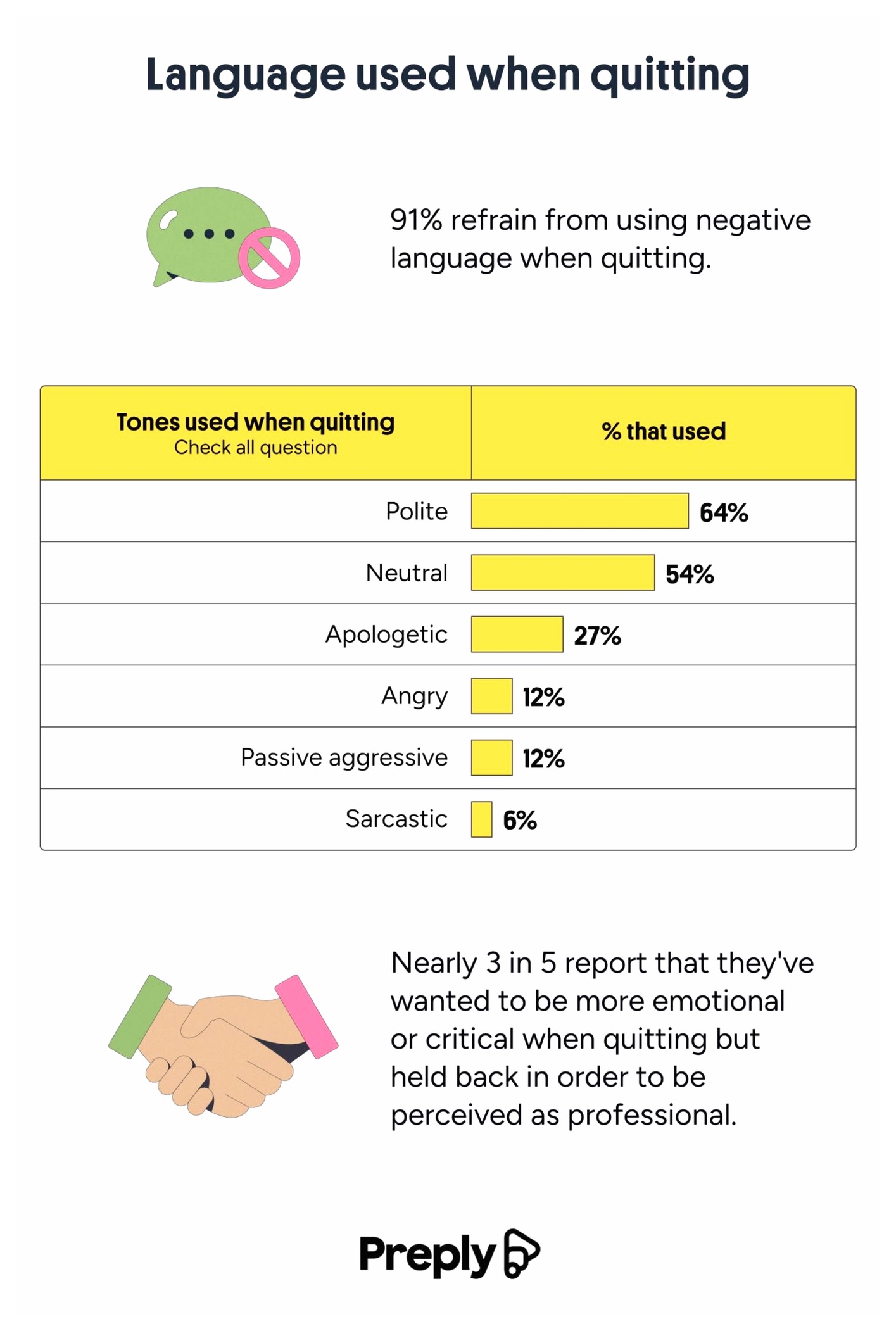
Americans prioritize professionalism and decorum in their resignation process, with an impressive 91% consciously steering clear of negative language. This commitment highlights their desire to leave on good terms and uphold a respectful work environment.
A significant 64% of employees intentionally adopt a polite tone when resigning, while more than a quarter (27%) express feelings of apology during the process.
Almost 60% of employees choose to suppress their emotions or criticisms when resigning, valuing professionalism over candid expression. This trend is particularly pronounced among Gen Z, where 61% opt for restraint, followed closely by baby boomers at 59%, Gen X at 58%, and millennials at 57%.
Gender differences play a significant role in emotional expression during the resignation process, with 63% of women choosing to suppress their feelings compared to only 53% of men. This highlights a notable trend in how different genders manage their emotions in professional transitions.
Interestingly, more than 40% of individuals who participated in exit interviews reported that expressing their thoughts openly during these discussions eased their tensions. This indicates that, although many employees prefer to keep a professional demeanor when resigning, there is significant value—and potential emotional relief—in engaging in honest dialogue within the structured environment of an exit interview.
Learn a language online with our free learning materials.
Learn English online
Learn French online
Americans’ quitting habits are both cutthroat and caring
American quitting habits reveal a fascinating blend of ruthless tactics and thoughtful actions. For instance, research shows that 1 in 8 employees deliberately time their resignations to create the greatest disruption for their employers.
This trend is especially noticeable among Gen Z, where more than 1 in 6 individuals are timing their resignations strategically. Millennials follow closely, with about 1 in 7 doing the same, while Gen X sees 1 in 10 engaging in this behavior, and boomers trail with fewer than 1 in 10. Notably, men are more inclined than women to choose this tactic, with 1 in 7 men compared to 1 in 9 women opting for this approach.
Moreover, more than 10% of Americans have shared emotionally charged reviews about their previous employers on platforms like Glassdoor and other online sites. Notably, healthcare professionals lead this trend, with over 16% posting these reviews, followed closely by those in the corporate and hospitality industries.
Both Millennials and Gen Z are more inclined to leave reviews compared to Gen X and Baby Boomers. Their feedback frequently highlights negative experiences, using words such as “stressful,” “frustrating,” and “disorganized” to convey their dissatisfaction.
Amidst the tough criticism often directed at employers, there’s a compassionate aspect to how Americans handle resignation. More than one in six people admit to softening their feedback to protect their boss’s feelings. Notably, Gen Z leads this trend, with one in four opting for kindness in their critiques. In comparison, millennials show a similar sentiment at one in five, while Gen Xers and baby boomers are less inclined, with figures at one in nine and one in ten, respectively.
Research shows that women are generally more forthright than men when it comes to honesty in the workplace. Only about 25% of women report lying to spare their employer’s feelings, compared to 14% of men. Additionally, 20% of women admit to fabricating their reasons for leaving a job to prevent awkwardness during conversations.
Despite the criticism, reviews from former employees also highlight positive aspects such as being “professional,” “supportive,” and “rewarding.” This blend of feedback offers a more nuanced perspective on the American workplace.

People in these industries express the most regret over parting words
When it comes to resigning from a job, an impressive 95% of people express no regrets about the way they conveyed their decision. This overwhelming figure indicates a strong sense of satisfaction and acceptance regarding their resignation communication.
Regret surrounding parting words varies significantly by gender and industry. Men report a 7% likelihood of feeling regret, compared to just 4% of women. Additionally, employees in industrial or manufacturing sectors are notably affected, with 1 in 9 expressing regret about what they said when leaving.
Many individuals who regret their resignation often cite “ghosting” their employer as the most common misstep. This practice entails abruptly leaving a job without any notice or communication, which can create unresolved issues and harm professional relationships in the long run.
To ensure a professional exit when resigning, Sylvia Johnson, a language expert at LingualNeeds, advises that individuals should express their intentions clearly and respectfully. This approach not only preserves professionalism but also fosters positive relationships in the workplace.
When resigning, you could express your gratitude by saying, “I truly appreciate the opportunities and experiences I’ve gained during my time here, and I hold great respect for both the team and the important work we accomplish together.”
To maintain a professional tone and foster a positive relationship, focus on expressing gratitude for the opportunities and experiences received, steering clear of blame or criticism. Additionally, offering support can facilitate a smoother transition.
Managers tell all
Managers significantly influence the dynamics surrounding employee resignations, providing valuable insights into these transitions. Interestingly, more than 40% of managers report feeling upset when team members leave, yet they consistently uphold a professional demeanor during these challenging times.
Moreover, over 10% of managers report having been unjustly yelled at by an employee during the resignation process. These incidents underscore the heightened emotions that often accompany resignations and the difficulties managers encounter while handling these challenging situations.
When it comes to exit interviews, a notable 72% of managers perceive them as merely a formality, rather than a true chance for valuable feedback. This perspective is particularly strong in the corporate sector, where 76% of managers feel this way. The hospitality industry follows closely with 74%, while 73% of managers in education share the same sentiment.
We consulted language expert Sylvia Johnson on how managers can communicate effectively when an employee resigns. She emphasizes that it’s crucial for managers to respond with professionalism, showing understanding and respect for the employee’s choice.
For instance, a manager might respond to a resignation letter by saying, “I appreciate your decision to resign and want you to know how much I value your contributions to our team. While I’m saddened to see you go, I wholeheartedly respect your choice. Thank you for your hard work, and I wish you every success in your future endeavors.”
In that scenario, the manager expresses gratitude for their service, seeks to understand the reasons behind their decision to leave—gathering valuable feedback for improvement—and outlines the transition plans. By following these steps, the manager upholds a tone of dignity and professionalism throughout the conversation.
The power of poise when quitting
Our study highlights the crucial role of clear and culturally-sensitive communication during the resignation process. Grasping the nuances of language and cultural expectations is vital for ensuring that resignations are conducted with both professionalism and respect.
LingualNeeds enhances language skills, empowering individuals to skillfully navigate the cultural nuances and linguistic intricacies of the resignation process. This capability is especially crucial for professionals operating in multilingual settings or adapting to cultures distinct from their own.
Communicating effectively during a resignation goes beyond mere practicality; it reflects your professionalism and awareness of cultural nuances. At LingualNeeds, we offer a network of skilled private tutors and diverse language classes that equip individuals with essential language skills while deepening their understanding of the cultural contexts that influence workplace interactions. This expertise is crucial for crafting a resignation that is both respectful and culturally sensitive.
How we communicate our exit from a job reflects our professional and intercultural skills. With LingualNeeds’s language learning support, professionals can craft farewell messages that not only convey their intentions clearly but also align with the cultural and professional values of their workplace, creating a memorable and positive impact.
Methodology
We aimed to survey over 1,000 individuals, as this larger sample size enhances the accuracy of our findings and allows us to confidently generalize results to a broader population. By minimizing the margin of error, we can make better-informed decisions based on the data gathered. Additionally, this expanded sample provides more data points for statistical analysis, boosting the reliability and validity of our conclusions. Ultimately, it empowers us to draw more robust insights into the perceptions of the population as a whole.
On November 21, 2023, we conducted a survey involving 1,016 Americans about their job quitting experiences. The participants included a diverse age range from 18 to 76 years, with a demographic breakdown of 49% female, 50% male, and 1% nonbinary.
Frequently Asked Questions
What is the significance of a resignation notice?
A resignation notice blends cultural expectations, business etiquette, and personal feelings, marking a pivotal moment in an individual’s career.
How do most Americans prefer to communicate their resignation?
The majority, 76%, prefer to quit in person, while 9% choose to deliver a handwritten resignation note.
What percentage of employees avoid using negative language when resigning?
91% of employees consciously avoid using negative language during their resignation.
What are some common feelings employees experience after resigning?
Many employees reflect on their experiences and often feel a mix of relief and regret, especially regarding their parting words.
How do managers typically feel during resignations?
More than 40% of managers report feeling upset when team members leave, yet they maintain a professional demeanor.