- Explaining has and have
- Definition and function
- Indicating possession
- Indicating possibility
- Indicating a completed action
- Questions and negations
- The singular and plural usage
- Usage of has
- Simple present tense
- Present perfect tense
- Usage of have
- Simple present tense
- Present perfect tense
- Other verb forms
- Progressive form
- Past tense
- Has vs. have in different verb forms
- Ready to practice has and have?
- Recap of has vs. have
- Frequently Asked Questions
- What is the difference between ‘has’ and ‘have’?
- How do you use ‘has’ in the present perfect tense?
- Can ‘has’ and ‘have’ indicate possession?
- How do you form questions using ‘has’ and ‘have’?
- What grammatical structure is used for ongoing actions with ‘has’ and ‘have’?
Mastering verb usage is essential for clear and effective communication in English. Whether you’re taking online English lessons or practicing on your own, selecting the correct form can be challenging. This is particularly true when deciding between options like “has” vs. “have” or “has been” vs. “have been.” Understanding these distinctions will enhance your language skills and boost your confidence in speaking and writing.
In this article, we’ll explore the two commonly used verbs, “has” and “have.” While these small words can often be confusing, don’t worry! By the end, you’ll gain the confidence to use them correctly in both your writing and conversations. Let’s get started!
Explaining has and have
Let’s dive into the meanings of “has” and “have.” Both terms are present tense forms of the verb “to have,” which is frequently used to indicate possession or ownership. Understanding these words is essential for effective communication in English.
This verb not only expresses possession but also suggests possibility, experience, consumption, and completed actions. To dive deeper into its nuances and discover the intricacies of the verb “to have,” check out our comprehensive guide.
Definition and function
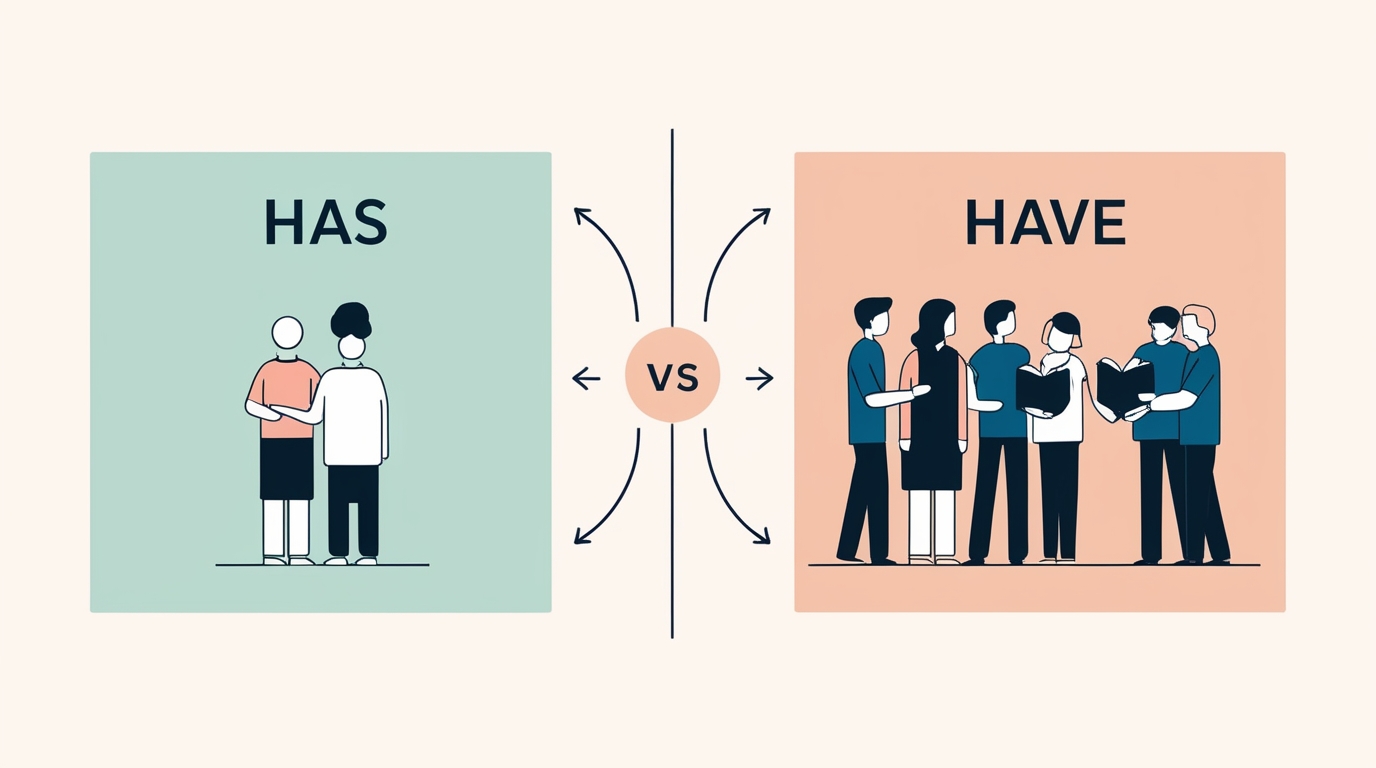
The key distinction between “has” and “have” is based on the subjects they accompany. “Has” is used with third-person singular subjects like “he,” “she,” “it,” or any singular noun. In contrast, “have” is paired with first-person subjects (“I,” “we”), second-person (“you”), and third-person plural subjects (“they”). Understanding this difference can help you use these verbs correctly in your writing.
Examples:
- Johnny has to leave soon.
- I have not called the doctor.
- Do you have a question?
Let’s explore the applications of “has” and “have” in various contexts.
Indicating possession
“Has” and “have” can indicate possession.
For example:
- He has a PhD in English.
In this example, “has” is used with the singular pronoun “he” to indicate the subject’s possession of a PhD.
- We have clothes to give out.
“Have” is used with “we,” a third-person plural pronoun, to indicate the possession of clothes.
Indicating possibility
The words “have” and “has” can indicate potential actions that are yet to take place. To clarify their usage: “have” pairs with the pronouns “I,” “you,” “we,” and “they,” while “has” is used with “he,” “she,” and “it.”
For example:
- You have to go there today.
- She has to submit her homework by Monday.
These actions haven’t occurred yet, but there is a possibility of them happening.
Indicating a completed action
“Has” and “have” play a crucial role in forming the present perfect tense, which signifies that an action has been completed. To effectively use these auxiliary verbs, pair them with the main verb in its past participle form.
For example:
- She has completed the homework.
- My neighbors have moved out of the house.
- Janet has played the piano for two years.
These examples show actions that have been completed alongside verbs in their present perfect tense.
Questions and negations
“Has” and “have” play a vital role in forming questions and negations. To create a question using these verbs, simply invert the subject and the verb.
For example:
- Has she finished her homework?
- Have you seen the movie?
To form negations, we need to use “not” after “have” or “has.”
For example:
- I have not been there before.
- She has not completed the project.
The singular and plural usage
One major confusion people experience with has vs. have is around which subject to use with which verb. Let’s clarify:
- “Has” is used with third-person singular subjects (“he,” “she,” and “it”).
- “Have” is used with first, second, and third-person plural subjects (“I,” “you,” “we,” and “they”).
Here’s a conjugation table for the verb “to have” focusing on “has” and “have”:
| Subjects | Verb | Examples |
| I | have | I have two jobs |
| You | You have a busy schedule | |
| We | We have a meeting with the CEO | |
| They | They have a big family | |
| He |
has |
He has a new car |
| She | She has three cats | |
| It | It has a collar |
Note: You can check out this article on plural rules to better understand singular and plural subjects.
Usage of has
Let’s look at the usage of “has” in different verb forms, contexts, and sentence structures.
Simple present tense
In the simple present tense, the verb “has” is employed to indicate actions occurring at this moment or to express habitual behaviors, specifically for third-person singular subjects.
For example:
- He has a beautiful garden.
- She has an adorable dog.
- Chris has a new bicycle.
Present perfect tense
To discuss actions that began in the past and still relate to the present, we use “has” combined with verbs in the present perfect tense. This grammatical structure effectively highlights the ongoing relevance of those past actions.
Check out these examples:
- He has written a fascinating story.
- She has completed her homework.
- Keanu Reeves has won several awards.
- The book has been a bestseller for weeks.
In the present perfect tense, “has” indicates completion or ongoing impact.

Usage of have
Let’s delve into the use of “have” in the simple present tense, present perfect tense, and other verb forms.
Simple present tense
In the simple present tense, “have” is used with first-person, second-person, and third-person plural subjects.
For example:
- You have a talent for playing the guitar.
- We have three cats as pets.
- I have a skateboard.
- They have a great sense of humor.
Remember, “have” accompanies these subjects in the simple present tense.
Present perfect tense
To convey an action that began in the past and continues to influence the present, we use the present perfect tense with “have.” This grammatical structure effectively links past events to their current significance.
Let’s explore some examples:
- They have finished their project.
- You have visited Paris.
- They have seen the Grand Canyon.
- We have won three swimming competitions.
In the present perfect tense, “have” signifies completion or ongoing relevance.
Other verb forms
In addition to the simple present and perfect tenses, “has” and “have” play important roles in other verb forms. Let’s explore how they function in progressive and past tense constructions.
Certainly, I can help you revise your explanation to address the editor’s comment. Here’s an improved version:
Progressive form
The progressive form captures ongoing actions by combining “have” or “has” with an “-ing” ending. In this structure, the verb “to be” (is, am, are, was, were) is adjusted according to the subject, followed by “having” or the present participle of the main verb. This format allows for a dynamic expression of actions in progress.
Examples:
1. Original sentence: She has a great time at the party.
Progressive form: She is having a great time at the party.
2. Original sentence: The families have dinner together every night this week.
Progressive form: The families are having dinner together every night this week.
3. Original sentence: Joey has a housewarming party tonight.
Progressive form: Joey is having a housewarming party tonight.
Utilizing the progressive form allows us to highlight the continuous nature of an action, infusing sentences with a sense of immediacy and dynamism.
Past tense
When referring to the past, we replace “has” with “had.” For example:
- They had a fantastic picnic last weekend.
- He had a vacation last summer.
- She had a great time at the concert.
Has vs. have in different verb forms
| Has | Have | |
| Simple present tense | Beyoncé has a beautiful voice. | I have a soccer game tomorrow. |
| Present perfect tense | He has visited Paris. | They have finished their project. |
| Progressive form | She has been having fun learning to play the guitar. | I am having a blast at the amusement park. |
| Past tense | He had a great time at the concert. | We had a delicious dinner last night. |
Ready to practice has and have?
Get a book and pen:
- Write two sentences using “have” in the simple present tense.
- Write two sentences using “has” in the present perfect tense.
Try these other “has vs. have” exercises:
Exercise 1: Fill in the blanks with either “has” or “have”:
- I ____ invited you here to talk to you.
- You ____ one hour to get ready.
- Joshua ____ learned an important lesson from his trip.
- She doesn’t ____ time for this.
- My roommate ____ a bottle of wine on the shelf.
Exercise 2: Correct the errors with “has” or “have” in the following sentences:
- She have gone to work.
- Lydia and her friends has gone to a party.
- My neighbor have gotten another apartment.
- They has studied French for five years.
- The car have not been repaired yet.
Exercise 3: Circle the correct verb:
- Our dog (have/has) white fur.
- I (have/has) three siblings.
- He (has/have) a cool smartphone.
- The cat (have/has) caught a fast mouse.
- Trevor (have/has) a new skateboard.

Recap of has vs. have
Grasping the distinction between “has” and “have” is essential for clear communication in English. Remember, use “has” when referring to third-person singular subjects, while “have” is appropriate for first-person, second-person, and third-person plural subjects. This simple rule will enhance your writing and speaking accuracy.
Continue to reinforce your knowledge by tackling exercises that boost your verb usage and deepen your grasp of English grammar. Always keep in mind that practice is key to effective learning!
Elevate your English skills with personalized 1-on-1 tutoring! At LingualNeeds, you can connect with thousands of dedicated online English tutors who specialize in grammar, helping you master the nuances of the language.
Choose tutors based on their availability, pricing, and ratings to ensure the best match for your needs. To help you make an informed decision, many tutors offer trial lessons, allowing you to assess compatibility. If you’re not completely satisfied after your initial session, you can either try a different tutor at no cost or request a full refund.
So, check out LingualNeeds tutors today, and move one step closer to achieving your language-learning goals.
Frequently Asked Questions
What is the difference between ‘has’ and ‘have’?
‘Has’ is used with third-person singular subjects, while ‘have’ is used with first-person, second-person, and third-person plural subjects.
How do you use ‘has’ in the present perfect tense?
‘Has’ is used in the present perfect tense to indicate completion of actions that began in the past and still relate to the present, e.g., ‘She has completed her homework.’
Can ‘has’ and ‘have’ indicate possession?
Yes, both ‘has’ and ‘have’ can indicate possession, such as ‘He has a car’ and ‘We have a house.’
How do you form questions using ‘has’ and ‘have’?
To form questions, invert the subject and the verb, e.g., ‘Has she finished her homework?’ and ‘Have you seen the movie?’
What grammatical structure is used for ongoing actions with ‘has’ and ‘have’?
The progressive form captures ongoing actions by combining ‘has’ or ‘have’ with the present participle of the main verb, e.g., ‘She is having a great time at the party.’