- How to count to 10 in Chinese
- How to count to 10 in Chinese with hand signals
- Interesting facts about Chinese numbers
- Go beyond counting in Chinese
- Frequently Asked Questions
- What is a good starting point for learning Chinese?
- How many tones are there in Mandarin Chinese?
- What are the numbers from 1 to 10 in Chinese?
- Why is the number 8 considered lucky in Chinese culture?
- What should I do if I find learning Chinese challenging?
With over 1.3 billion speakers globally, Chinese is one of the most widely spoken languages in the world. However, many find it challenging to begin their learning journey. Take Mandarin, for instance; it features five distinct tones, making pronunciation crucial for effective communication. Additionally, the Chinese writing system boasts more than 50,000 characters! Fortunately, you won’t need to master all of them to become proficient.
Starting your studies with counting in Chinese is an excellent choice! This fundamental skill is incredibly useful if you intend to live, study, or work in China, as it will help you navigate everyday interactions with ease.
If you’re focusing on learning Mandarin, you’ll find that mastering the numbers from 1 to 10 is quite straightforward, paving the way to counting up to 99 with ease. For those eager to deepen their understanding of the language, check out our online Chinese classes for more comprehensive study options!
How to count to 10 in Chinese
To start things off, we’ve put together a table on how to count in Chinese.
We’ve added a “How to Say It” column to assist you in pronouncing numbers in Chinese. If you’re new to Chinese pronunciation, you may find that some numbers sound different from what you might anticipate. This guide will help clarify those differences and enhance your language skills.
| Number | Chinese character (hanzi) | Romanized spelling (pinyin) | How to say it |
| 0 | 零 / 〇 | Líng | Ling |
| 1 | 一 | Yī | Ee |
| 2 | 二 | Èr | Are |
| 3 | 三 | Sān | San |
| 4 | 四 | Sì | Suh |
| 5 | 五 | Wǔ | Woo |
| 6 | 六 | Liù | Lio |
| 7 | 七 | Qī | Chi |
| 8 | 八 | Bā | Ba |
| 9 | 九 | Jiǔ | Geo |
| 10 | 十 | Shí | Shuh |
How to count to 10 in Chinese with hand signals
To enhance your ability to count in Chinese, it’s beneficial to familiarize yourself with the corresponding hand signals for each number. These gestures not only aid memory retention but also enrich your understanding of the language.
In China, hand signals for numbers are commonly used due to the wide variety of dialects and pronunciations found throughout the country. This non-verbal communication method helps bridge the gap between speakers of different languages, making it easier to convey numerical information clearly and effectively.
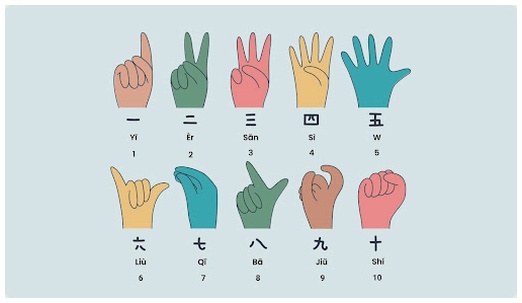
0: Make your hand into a fist.
1: Just like in English, raise only your index finger.
2: Also the same as in English, raise your index finger and your middle finger.
In China, the way people signify the number 3 is a bit different from English-speaking cultures. Instead of using the index finger like in English, many Chinese individuals raise their little finger, ring finger, and middle finger to indicate the number 3.
4: Once again, the same as in English. Raise all your fingers except your thumb.
5: Another easy one, just like in English. Raise all your fingers including your thumb and open your palm.
6: Extend your thumb and pinky finger while curling in the rest of your fingers. This gesture resembles the popular “shaka” or “hang loose” sign, often associated with a laid-back, friendly vibe.
7: Bring all your fingers (including your thumb) together into a point.
8: Extend your thumb and your index finger and curl in the rest. This hand signal looks like a gun.
9: Curl in all of your fingers except your index finger. Now, slightly bend your index finger.
You have two creative ways to signify the number 10. One option is to cross your index and middle fingers, while another is to use both hands to create a cross shape with your index fingers. Choose the method that feels right for you!
Interesting facts about Chinese numbers

There are lots of interesting facts out there about Chinese numbers. Here are a few of our favorites:
- Chinese numbers may appear complex at first, but they are actually logical and straightforward. Numbers 1 to 10 are single-syllable, and mastering these makes it easy to learn higher numbers.
- Most Chinese numbers have two different character options, which distinguish between normal use and financial/mathematical use.
- In Chinese culture, the number 8 (八) is considered the luckiest due to its phonetic similarity to “fa” (發), which signifies wealth, fortune, and prosperity. As a result, many Chinese individuals incorporate the number 8 into their daily lives, choosing it for special dates, lottery tickets, and license plates to attract good fortune.
- In Chinese culture, the number 4 (四) is deemed unlucky due to its pronunciation, which closely resembles the word for “death” (死 or sǐ). As a result, many buildings in China omit the 4th floor and any floor numbers containing 4, reflecting common superstitions.
- In China, even numbers are favored over odd numbers, particularly when giving gifts at weddings, where it’s common to present two or more items. However, the number 4 is an exception to this preference due to its association with bad luck.
Go beyond counting in Chinese

Chinese is a fascinating language, but mastering it on your own can be challenging. The complexities of intonation and pronunciation require careful attention and practice. Enrolling in a group class or partnering with a tutor for personalized instruction can significantly enhance your learning experience, especially in the early stages.
Are you learning Chinese and seeking expert guidance? Look no further than LingualNeeds! Explore our team of qualified Chinese tutors who are ready to assist you in advancing your studies and achieving your language goals.
Frequently Asked Questions
What is a good starting point for learning Chinese?
Starting with counting in Chinese is an excellent choice as it helps with everyday interactions.
How many tones are there in Mandarin Chinese?
Mandarin features five distinct tones, making pronunciation crucial for effective communication.
What are the numbers from 1 to 10 in Chinese?
The numbers from 1 to 10 in Chinese are 一 (Yī), 二 (Èr), 三 (Sān), 四 (Sì), 五 (Wǔ), 六 (Liù), 七 (Qī), 八 (Bā), 九 (Jiǔ), 十 (Shí).
Why is the number 8 considered lucky in Chinese culture?
The number 8 is considered lucky due to its phonetic similarity to ‘fa’ (發), which signifies wealth, fortune, and prosperity.
What should I do if I find learning Chinese challenging?
Consider enrolling in a group class or partnering with a tutor for personalized instruction to enhance your learning experience.