- Key Findings
- Waterford: The sweariest Irish city
- Do Irish men swear more than women?
- Irish people swear most at home
- Swearing at self is most popular in Ireland
- So, why do some Irish people swear so much?
- Conclusion
- Methodology
- Frequently Asked Questions
- What is the primary focus of the study conducted by LingualNeeds?
- Which Irish city is reported to have the highest frequency of swearing?
- How do Irish men and women compare when it comes to swearing?
- What percentage of respondents in Ireland avoid swearing in front of children?
- What are some of the social benefits associated with swearing according to the study?
At LingualNeeds, we celebrate the expressive power of language. In this study, we delve into the fascinating world of swearing, revealing its important role in human communication. Join us as we unravel the complexities and explore the vibrant, often overlooked, aspects of language.
According to Sylvia Johnson, our language expert at LingualNeeds, swearing is a powerful linguistic and psychological tool. It allows people to convey strong emotions, build connections with others, and assert authority. This form of communication captures deep feelings and reveals insights into our mental state, showcasing its multifaceted role in how we express ourselves.
Building on our recent study that explored swearing habits in the US as a cultural phenomenon, we turned our attention to Ireland. We surveyed over 1,500 residents across five major cities to discover not only the frequency of their swearing but also the contexts in which they swear and the targets of their exclamations.
Did you assume that Ireland is known for its frequent use of colorful language? The findings below may challenge that perception and offer a more nuanced view.
Key Findings
- Over half of Ireland swears regularly throughout the day.
- The Irish city that swears most frequently is Limerick, at over 10 times per day.
- “Taboo Swearing: The Irish most commonly avoid swearing in front of children (54%), at work (36%), and in the presence of elders (32%).”
- Two in five respondents admit they are the target of their own bad language.

Learn a language with personalised 1-on-1 classes with our expert tutors from all over the world
French lessons online
Spanish lessons online
Waterford: The sweariest Irish city
The Irish have a reputation for their colorful language, and Waterford proudly claims the title of the country’s “sweariest” city. In this historic city, a striking 66% of residents admit to using profanity daily. However, most only drop one or two expletives throughout the day, with a small 2% pushing the envelope by cursing ten times or more.
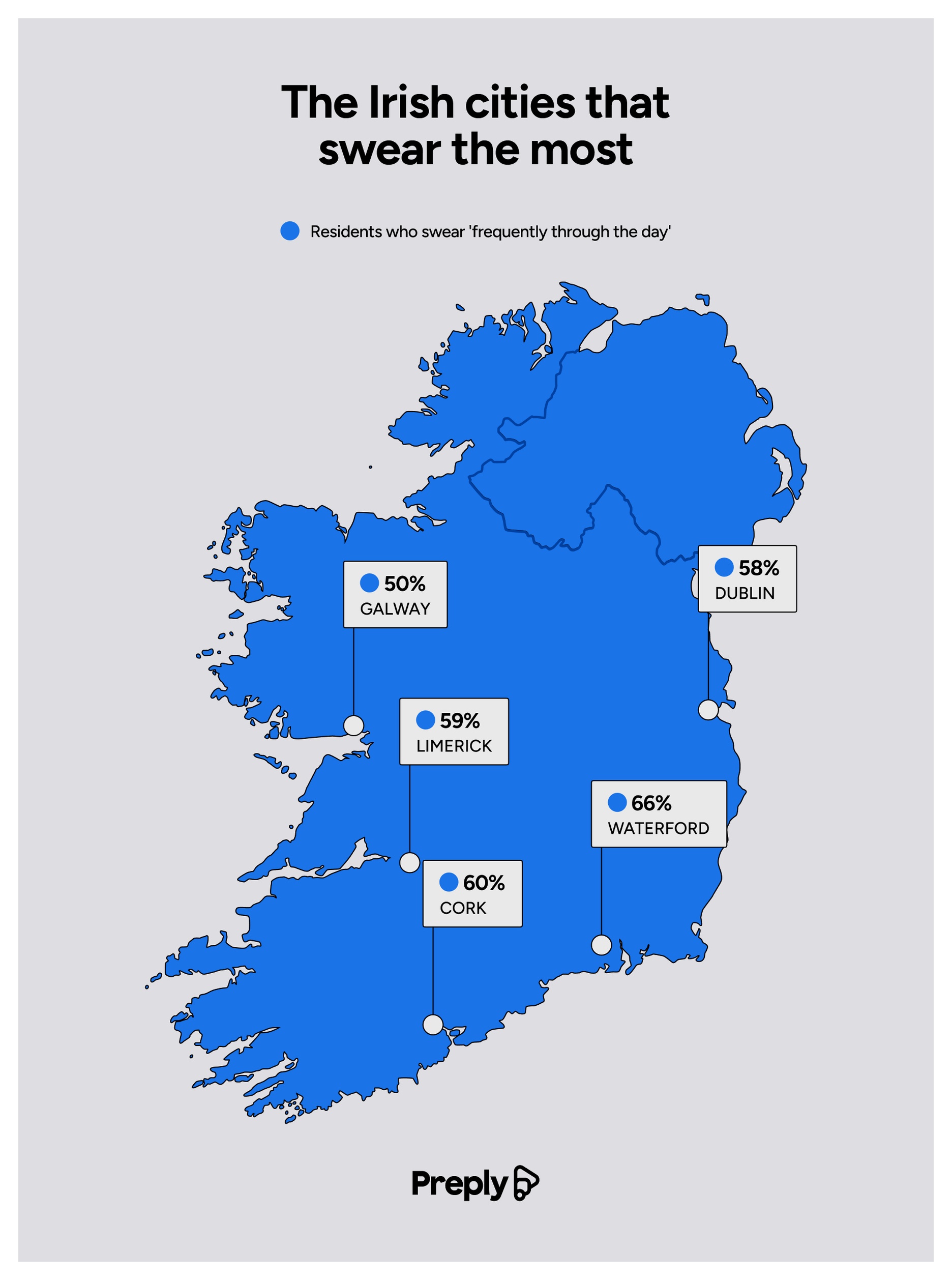
In Limerick, a dedicated group of residents embraces the art of swearing, with nearly one in five (9%) admitting to cursing over ten times each day. Meanwhile, Cork boasts an even more colorful reputation, as about a quarter of its population reports using foul language an average of nine to ten times daily.
In Cork, the lines between friends and family often blur, highlighting a unique social dynamic. A recent study revealed that 30% of participants are most likely to swear at home, while 24% prefer to let loose with friends. This close margin signifies a distinctive connection among Cork residents compared to other major Irish cities.
In Galway, one of the more reserved cities, only 50% of residents use swear words regularly throughout the day. This is notably 8% lower than the national average, highlighting the city’s unique character.
Dublin ranks highest for being tight-lipped, with more than one-third (35%) of respondents from the capital expressing that they are against swearing and feel it has “no place in society.” If you prefer to keep your language clean, you’ll find common ground with the locals in both Galway and Dublin.
Do Irish men swear more than women?
When it comes to fiery tongues, the “lads” and the “lasses” have a special way of doing things.
In Ireland, the prevalence of swearing among women (58%) and men (57%) is nearly equal, challenging the stereotype that women curse less than men. This finding aligns with other research indicating that swearing is more influenced by social identity and class than by gender.
Unlike the simple phrases typically taught in Spanish lessons or the intricate compounds introduced in German classes, Irish swearing is a delightful mix of humor, passion, and poetic charm.
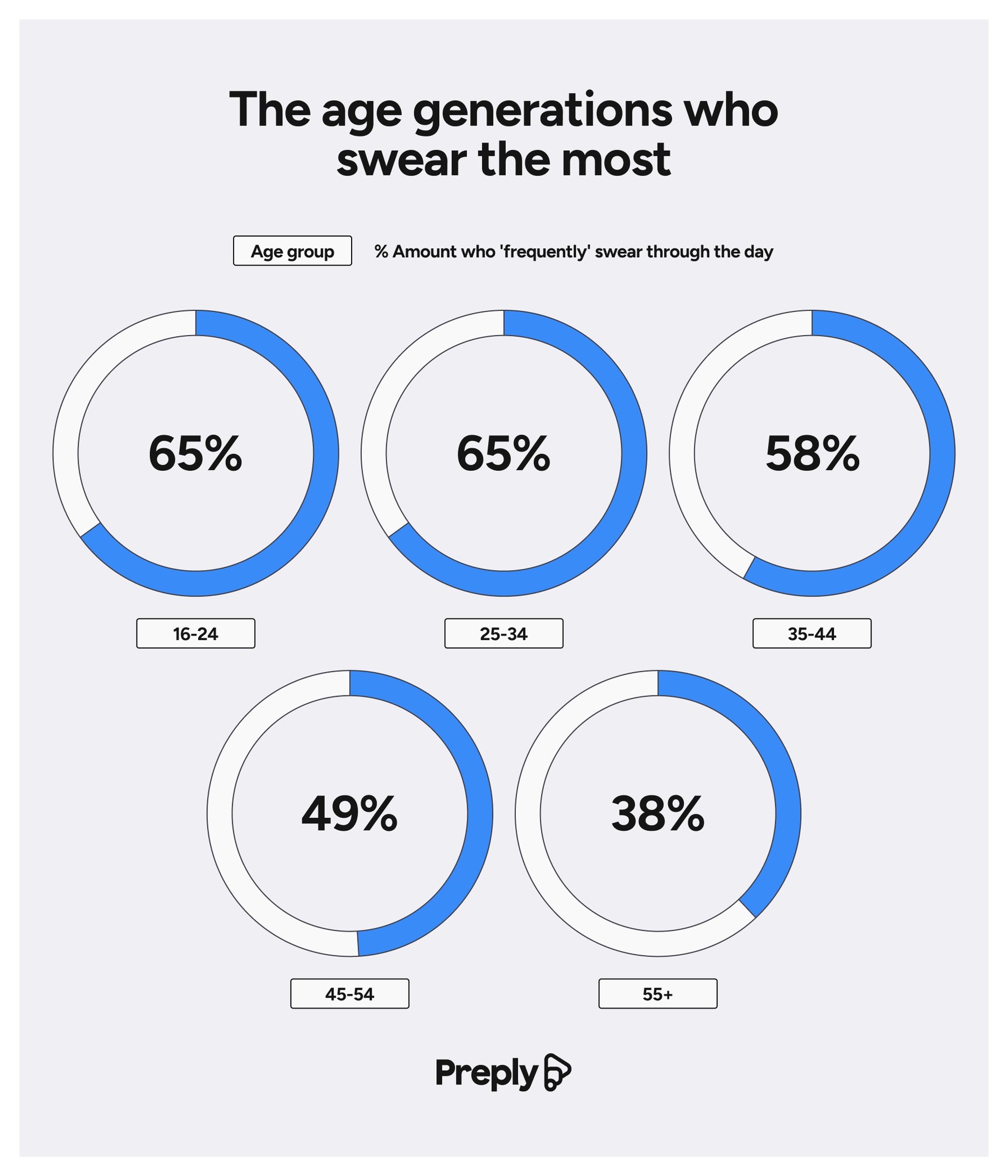
Exploring the vibrant culture of intergenerational swearing in Ireland reveals that the younger crowd takes the lead in colorful language. A recent study highlights that among 16 to 24-year-olds, a striking 65% confess to swearing regularly throughout their day. Just behind them, the 25 to 34 age group comes in a close second, missing the top spot by a mere 0.02%.
Older generations tend to be more cautious when it comes to profanity, with only 38% of individuals aged 55 and older swearing regularly. In fact, 43% of this age group express a dislike for any form of swearing.
Learn a language online with our free learning materials.
Learn English online
Learn French online
Irish people swear most at home
According to a recent survey, 38% of Irish residents admit that their home is the most common place for them to let loose with a curse word. In the sanctuary of their own space, people feel free to express their emotions without restraint, making swearing a frequent occurrence.
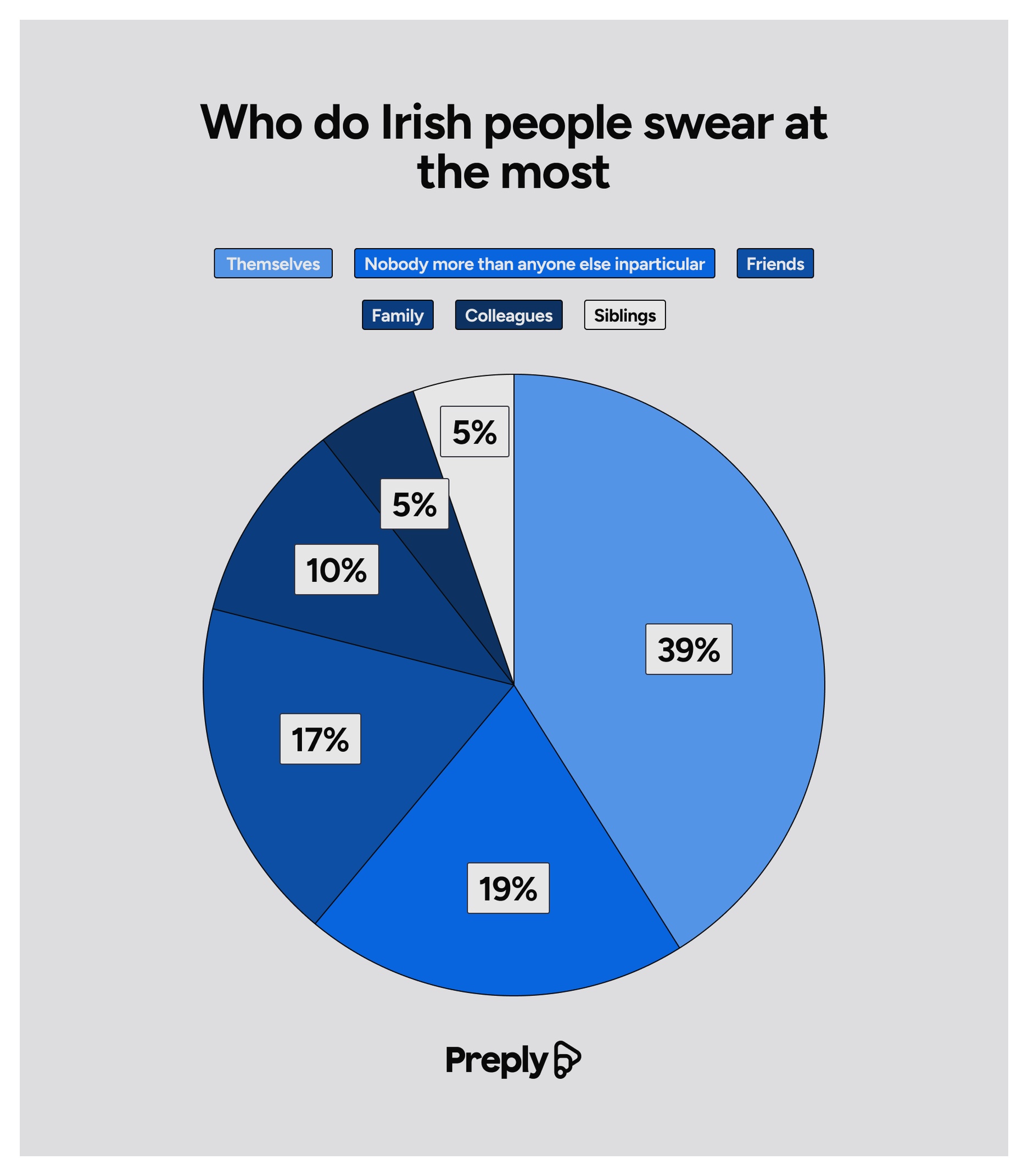
According to a survey, one in five (19%) Irish residents say that swearing is most common when they’re out with friends. Interestingly, using strong language in this context can actually enhance camaraderie and foster greater trust among friends.
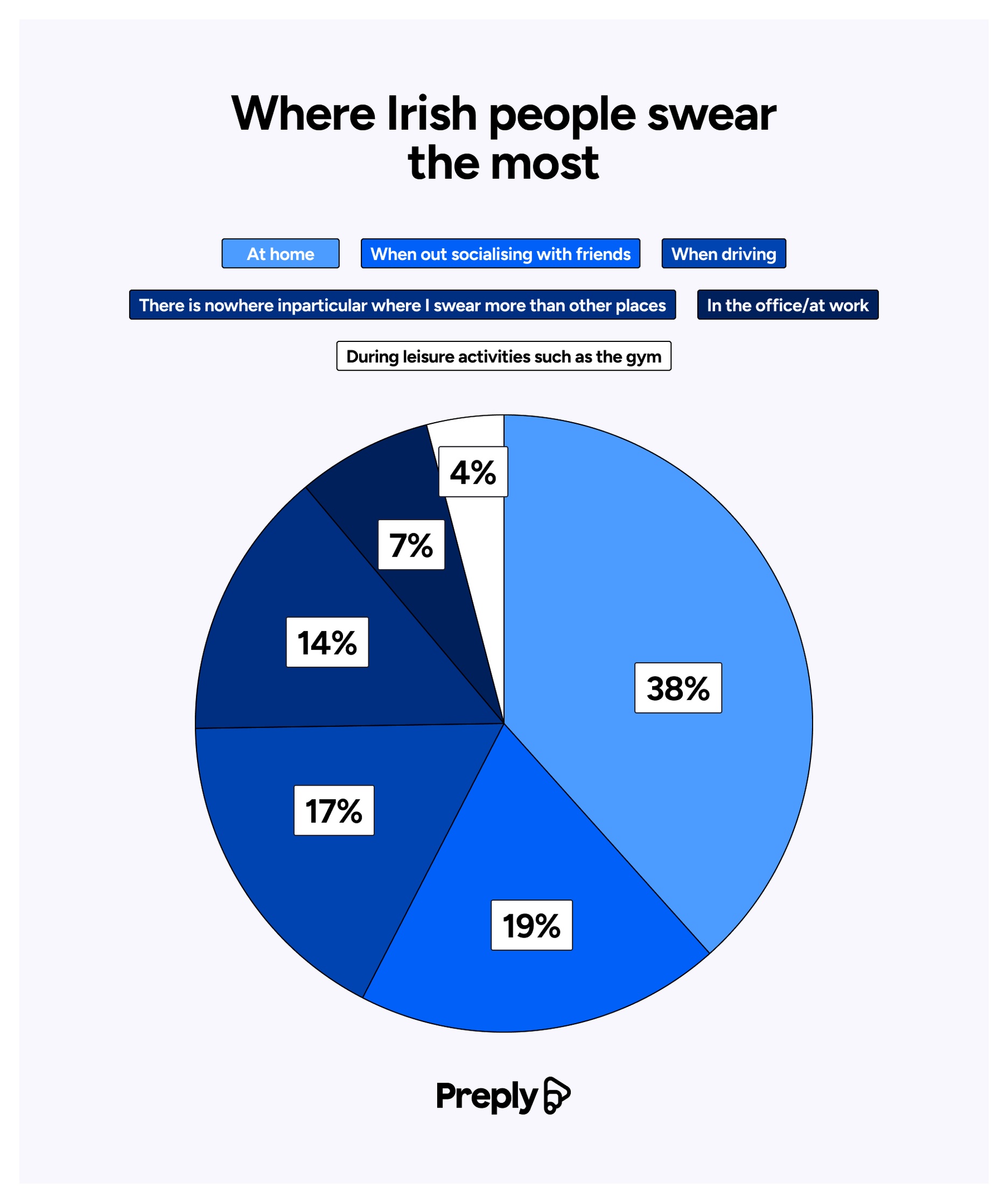
Using profanity around children is widely considered unacceptable. Our survey reveals that more than half (54%) of respondents consciously watch their language when kids are around. Additionally, many people in Ireland also avoid cursing at work (36%) and in the presence of elders (32%).
Swearing at self is most popular in Ireland
In Ireland, humor is deeply woven into the fabric of culture, with self-deprecating swearing serving as a unique expression of affection for our own imperfections and quirks. When surveyed about their most frequent target for swearing, nearly two out of five respondents (39%) humorously pointed to themselves.
This highlights the fascinating connection between language and self-expression. Working with an English teacher allows you to delve deeper than just mastering the basics; you’ll explore how our word choices reflect and shape larger linguistic cultures.
So, why do some Irish people swear so much?
In Ireland, where lively conversation and a pint of Guinness go hand in hand, swearing transcends mere language—it embodies a vibrant way of life! Yet, beneath the playful banter and charming blarney lies a fascinating science that explores the nuances of cursing.
A compelling study conducted by Dr. Karyn Stapleton at Ulster University reveals that using taboo language can significantly influence our thoughts, behaviors, and interpersonal connections. Expressing profanity is not just about shock value; it is associated with various physical, emotional, and social advantages. Benefits include enhanced pain tolerance, improved physical strength, and even the ability to foster trust, humor, and engaging storytelling among individuals.
The impact of swear words doesn’t stem from the words themselves; for instance, hearing a curse in a foreign language lacks the same emotional punch. This study reveals that swearing triggers a learned emotional response, creating a memory pattern similar to the feelings evoked by your favorite song.
Conclusion
One of the most exciting aspects of learning a new language is uncovering its intricacies and connecting on a personal level. While this journey can be enjoyable, our research reveals that swearing often highlights how people truly communicate in their daily lives. With LingualNeeds, you can enhance your understanding of slang through online Irish lessons. Just remember to tread carefully—using the wrong phrase at the wrong moment might get you into ‘feckin’ hot water!
Methodology
Between January 31- February 5, 2024, we surveyed 1,504 Irish residents from five of its largest cities.
71% identified as women, 28% identified as men and 1% identified as non-binary or other.
The age breakdown was 20% 16-24 year-olds, 26% 25-34 year-olds, 30% 35-44 year-olds, 15% 45-54 year-olds, 9% 55+ year-olds.
Frequently Asked Questions
What is the primary focus of the study conducted by LingualNeeds?
The study focuses on the role of swearing in human communication and its importance in expressing emotions and building connections.
Which Irish city is reported to have the highest frequency of swearing?
Limerick is reported to have the highest frequency of swearing, with residents cursing over 10 times per day.
How do Irish men and women compare when it comes to swearing?
The prevalence of swearing among women (58%) and men (57%) in Ireland is nearly equal, challenging the stereotype that women curse less than men.
What percentage of respondents in Ireland avoid swearing in front of children?
More than half (54%) of respondents consciously avoid swearing in front of children.
What are some of the social benefits associated with swearing according to the study?
Swearing is associated with enhanced pain tolerance, improved physical strength, and the ability to foster trust, humor, and engaging storytelling.