
- Frequently Asked Questions
- How does AI impact the job market in education?
- What role does LingualNeeds play in integrating AI in education?
- How can teachers adapt to new technologies like AI?
- What are the ethical considerations regarding AI in education?
- What is the future of AI in the language learning industry?
Are you pursuing a career in the field you studied at university? For some, the answer is a clear yes, while for many, it’s a definite no. Today, we enjoy an extraordinary level of flexibility that allows us to redefine our career paths. This empowers us to explore new industries and gain knowledge in ways that were once unimaginable.
Josh Crossick, the Chief Product Officer at LingualNeeds, began his academic journey with a history degree from Cambridge. However, driven by his insatiable curiosity and a hands-on approach to learning, he pivoted into marketing and eventually product management. With a wealth of experience leading teams at renowned companies like Expedia and innovative startups such as Blinkbox, Josh is now passionately committed to transforming the global learning experience for educators and students at LingualNeeds.
In my exclusive interview with Josh, we dive deep into the intriguing challenges of our time: the coexistence of artificial intelligence and its transformative influence on online education.
What would be your response if someone said to you, “I am afraid that AI will take my job”?
It’s important to understand that change unfolds at a slower pace than many anticipate. While those deeply invested in AI often envision a swift transition to an AI-driven world, the truth is that human behavior evolves gradually, and societal shifts take even longer. Fortunately, this allows individuals and communities ample time to adjust to new developments.
I believe AI holds incredible potential to enhance numerous jobs, enabling individuals to concentrate on what truly matters to them by simplifying various tasks. While it’s undeniable that some disruption will occur and certain roles may vanish, I am optimistic that many people will find their jobs becoming more rewarding and fulfilling as a result.
I remain optimistic about AI because history shows that humanity has consistently embraced technological progress, often turning challenges into opportunities. While some innovations create significant disruptions and others are more subtle, we are simply continuing our long-standing tradition of pushing technological boundaries. It’s crucial to recognize and manage the risks associated with AI, but we shouldn’t shy away from embracing new technologies.
In a recent article in The New Yorker, the founder of Duolingo expressed his openness to the idea of AI taking over teaching roles. However, at LingualNeeds, our focus is on developing AI-powered tools that are specifically designed to support and elevate the work of language teachers, rather than replace them. How do we achieve this?
Teachers must continually embrace new technologies as an integral part of their profession. They excel at identifying which innovations truly enhance student learning. I recall the release of Microsoft Encarta on CD-ROM in the 1990s, which posed a challenge for educators trying to determine if students were completing their own assignments or simply copying from an online encyclopedia. Nevertheless, teachers quickly learned to incorporate these tools into their teaching strategies, showcasing their remarkable adaptability.
LingualNeeds is instrumental in empowering our tutors to identify what truly benefits them and their students. By offering access to innovative tools alongside comprehensive training and support, we enhance the teaching and learning experience for everyone involved.
“AI will accelerate education. I think that’s something to celebrate.”
AI is poised to revolutionize education, and that’s truly exciting! By merging the expertise of human tutors with cutting-edge AI technology, we can create dynamic learning tools that enhance the learning process. This innovation will not only enable learners to grasp concepts more quickly but also enrich the teaching experience for tutors, making it more fulfilling and impactful.
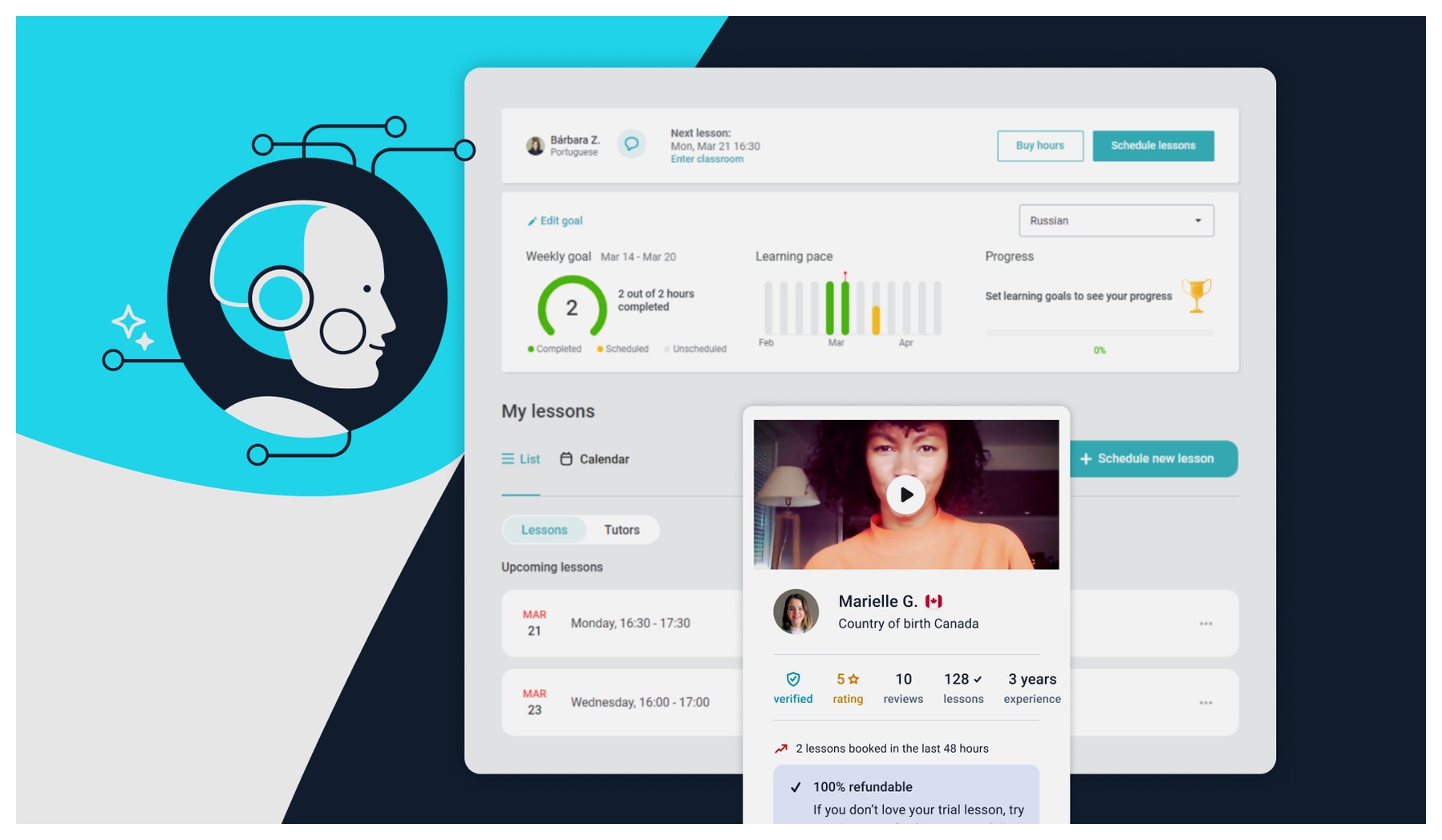
Imagine a day in the life of a tutor with LingualNeeds. How will their experience on the platform evolve compared to the current methods of instruction?
Imagine starting your morning by glancing at your calendar: a class with Josh at 10:00 am followed by a session with Nadia at 11:00 am. As you review your Google Docs notes, you recall that your last class with Josh focused on his holiday plans and strategies for handling travel challenges. Meanwhile, with Nadia, you’ve been working on enhancing her presentation skills for work. With these insights in mind, you craft a tailored lesson plan for the upcoming class, assess their homework to pinpoint areas where they need extra support, and seamlessly integrate that feedback into your teaching strategy.
Imagine waking up to an email that instantly prepares you for your day! It says, “You have two classes today with Josh and Nadia. Last time with Josh, you discussed travel plans, while you helped Nadia enhance her presentation skills. Both students submitted their homework: Josh struggled with the subjunctive mood, making several errors, while Nadia’s work was flawless. To kick off your session with Josh, here are some tailored conversation starters and an exercise to improve his subjunctive usage. Plus, you’ll find extra tips to elevate Nadia’s presentation techniques.”
As a teacher, you have the flexibility to either implement these recommendations as they are or tailor them to fit your unique style. Whether you’re seeking inspiration or a comprehensive lesson plan, these resources can significantly streamline your preparation time, allowing you to focus more on engaging your students.
AI has the potential to significantly lighten the cognitive load for teachers by handling tasks such as organizing materials, managing topics, overseeing operations, and assigning homework. This allows educators to focus their time and energy entirely on what they do best—teaching.
Currently, there’s a significant buzz surrounding the rapid adoption of AI technology. However, the focus shouldn’t solely be on speed; the real key lies in understanding your customers’ needs and effectively implementing solutions that meet those demands.
The key to success lies in how quickly you can provide something truly valuable. With AI still in its early stages, organizations like LingualNeeds are rapidly experimenting to discover what holds real significance. This swift approach not only fosters innovation but also enhances our understanding of what users truly need.
Innovations in technology often take surprising turns. For instance, GPS began as a military tool, yet today it helps us locate the nearest grocery store. Similarly, artificial intelligence is a groundbreaking technology whose full potential remains unpredictable. Our best approach is to experiment with it, learn from our experiences, and adapt as we go.
Experimentation and errors often go hand in hand, especially in the realm of AI. To ensure the responsible use of AI technologies, companies must prioritize several ethical considerations. What steps can they take to minimize potential harm to individuals and society during their experimentation?
The ethical boundaries of AI are still quite ambiguous, presenting significant challenges for us. It’s crucial that we engage in active discussions with our tutors and students, staying alert to the changing ethical standards and regulatory frameworks that govern this technology.
In navigating unclear boundaries, regular communication and transparency are crucial. By fostering open dialogue, we can collectively address challenges and find solutions as a united society.
“We put control in the hands of the tutors and the students. That’s our starting point and overall approach.”
We empower both tutors and students by placing control directly in their hands. Instead of guessing how they might want to use our technology, we prioritize their needs and preferences. This approach ensures that our technology enhances their experience, providing greater autonomy and influence over their learning journey.

Finally, what do you see as the future of AI in the language learning industry?
I believe the future of education lies in creating opportunities for teachers and students to engage more deeply on the topics that truly resonate with them and enhance their learning experiences. This means reducing time spent on tedious, routine tasks, allowing for a richer, more meaningful interaction focused on what really matters.
I recently came across an intriguing New York Times piece by Zeynep Tufekci that explored a thought-provoking perspective from over 2000 years ago. In it, Plato expressed his concerns about the invention of the alphabet, arguing that it could be detrimental to society. He believed that reliance on written texts diminished the need for memorization, which he felt was essential for truly understanding and internalizing knowledge. According to Plato, memorizing material fosters a deeper connection to the wisdom contained within those texts.
Today, it’s hard to imagine the alphabet as anything but a catalyst for human creativity and progress. Rather than hindering our thinking, it freed us from the burdensome task of memorization, allowing knowledge to flow more freely. This shift not only enhanced accessibility to information but also sparked greater insight and innovation across societies.
This viewpoint truly struck a chord with me. I believe that AI has the potential to create a similar transformation in education. By automating repetitive tasks, both students and teachers can dedicate more time to engaging in meaningful learning experiences, honing their skills, and building valuable human connections.
Frequently Asked Questions
How does AI impact the job market in education?
AI has the potential to enhance jobs by simplifying tasks, allowing individuals to focus on more rewarding aspects of their roles, although some disruption may occur.
What role does LingualNeeds play in integrating AI in education?
LingualNeeds focuses on developing AI-powered tools that support language teachers, enhancing their teaching experience rather than replacing them.
How can teachers adapt to new technologies like AI?
Teachers can embrace new technologies as integral to their profession, identifying which innovations enhance student learning and incorporating them into their teaching strategies.
What are the ethical considerations regarding AI in education?
Companies must engage in active discussions about ethical standards and prioritize transparency and communication to address challenges associated with AI.
What is the future of AI in the language learning industry?
The future lies in creating deeper engagement opportunities for teachers and students while reducing time spent on routine tasks, enhancing meaningful interactions.


