

- How to successfully track the language learning progress of your team
- Take a level test and regular progress tests
- Set SMART goals
- Receive feedback from other employees
- Technology-based language learning tracking tools
- Additional tips for successfully tracking the language learning progress of employees
- Set clear goals
- Use a variety of methods
- Track progress regularly
- Share results with employees
- Conclusion
- Frequently Asked Questions
- Why is tracking progress important in language learning?
- What is the CEFR and how does it relate to language learning progress?
- How can SMART goals be used to measure language learning progress?
- What role does technology play in tracking language learning progress?
- How often should language learning progress be assessed?
Tracking progress is a crucial aspect of language learning in the workplace. It’s important for employees to see their advancements, as this boosts their motivation to continue learning. Simultaneously, you require confirmation that your training program is achieving its objectives and delivering a solid return on investment.
Looking for insight into your team’s language development? You’ve come to the right spot! In this guide, we’ll explore effective methods to assess language learning progress, helping you and your team stay aligned with your objectives. Let’s dive in!
How to successfully track the language learning progress of your team
Learning languages takes time, and employees and their companies need assurance that their consistent hard work is paying off.
Measuring language progress can be challenging, particularly as learners advance to higher levels and begin to master more nuanced skills and complex content.
Choosing the most effective method for measuring progress hinges on several factors, including your organization’s size and your team’s language proficiency levels. For instance, using CEFR levels can be a great way to track rapid advancements among beginners, but this approach may not be as beneficial for advanced learners, who often take much longer to achieve the next level.
We’ve gathered a range of effective techniques to help you monitor language learning progress within your organization. It’s essential to select the methods that align best with your company’s objectives, likely combining several approaches for optimal results.
Take a level test and regular progress tests
To effectively track progress, it’s essential to establish a baseline. That’s why every company should initiate training programs with a level test. These assessments evaluate each employee’s knowledge and skills, assigning them a CEFR level and highlighting their strengths and weaknesses. This foundational step ensures that training is tailored to meet individual needs and maximize growth.
Level tests are useful for gauging your initial proficiency, but they aren’t the best way to measure progress over time. Since it can take learners a significant amount of time to move up a level, these tests may overlook improvements in specific language skills. Exploring alternative assessment methods can provide a more comprehensive view of your development.
In contrast, regular progress tests provide a clearer picture of a learner’s advancement. These assessments concentrate on specific language topics that employees have recently covered, confirming their understanding and retention of the material before they advance to new concepts.
Every successful test completion by employees demonstrates their acquisition of new knowledge and progress, regardless of whether they’ve advanced to the next level. However, the key challenge with progress tests is that they need to be tailored to each individual’s study material, making it impossible to apply a one-size-fits-all test for everyone.
LingualNeeds provides top-notch language assessments for businesses, allowing you to launch your language training program with a clear insight into your team’s proficiency levels. This ensures a tailored approach that meets everyone’s needs right from the start.
LingualNeeds also offers regular progress tests linked to specific learning modules so each employee can accurately track their progress.
Set SMART goals
SMART goals are a widely recognized method for monitoring personal progress. This powerful acronym stands for Specific, Measurable, Achievable, Relevant, and Time-bound, serving as a framework to help you effectively set and reach your objectives.
When employees adhere to established guidelines and set their goals thoughtfully, every goal achieved becomes a clear indicator of progress.
We’ll clarify each word and then explain how you can use SMART goals to measure your team’s progress.
- **Be Specific:** Concentrate on particular aspects of the language instead of overwhelming yourself with everything at once. For instance, aim to “Learn polite phrases for emails” instead of the vague goal of “Improving writing skills.” This focused approach yields more tangible results.
- **Measurable Goals:** Set specific, quantifiable goals to track your progress and confidently transition to new content. For instance, instead of a vague target, aim to “Learn 20 phrases to enhance email politeness.”
- Achievable: Set realistic yet challenging goals to maintain motivation and ensure steady progress. Choosing the appropriate difficulty level is crucial to avoid frustration and stagnation.
- **Goal Relevance**: Establishing language goals that align with your specific needs enhances the practical application of your skills, fulfilling the core objective of language learning. This approach not only emphasizes the value of language study in employees’ lives but also serves as a powerful motivator.
- Time-bound: Set a deadline for each goal to track your progress effectively. For instance, specify, “Learn 20 phrases to enhance email politeness by the end of the week.”
Having a grasp of SMART goals is just the beginning; the next step is tracking your language learning progress effectively. Monitoring each employee’s goals can be challenging, so organizing your workforce into dedicated language learning groups can be a smart strategy. This approach not only simplifies tracking but also fosters collaboration and support among team members.
Consider organizing regular meetings for small groups of five to six employees to discuss their SMART goals. This approach not only simplifies progress tracking but also fosters stronger connections among team members, creating a supportive environment where employees can inspire and motivate one another on their learning journeys.
Receive feedback from other employees
Many companies launch training programs to enhance their employees’ language skills for work-related tasks. As a result, the most significant improvements will be seen in their ability to perform job responsibilities more effectively.
Implementing a peer review process where team members can provide feedback on each other’s progress is a powerful strategy to monitor growth in key areas. This collaborative approach not only enhances accountability but also fosters a culture of continuous improvement within the team.
Many organizations conduct annual or bi-annual peer reviews, and incorporating questions about language skills can provide valuable insights into each employee’s development. This simple addition allows you to assess progress and fine-tune your language training program to better meet their needs.
Technology-based language learning tracking tools
To effectively measure progress in language learning, it’s essential to balance practical approaches with both detailed and broad assessment techniques. While the methods we’ve explored provide valuable insights into individual progress, they may lack the ability to give a comprehensive view of your program’s overall success. A well-rounded evaluation strategy will help you track both depth and breadth in your language learning journey.
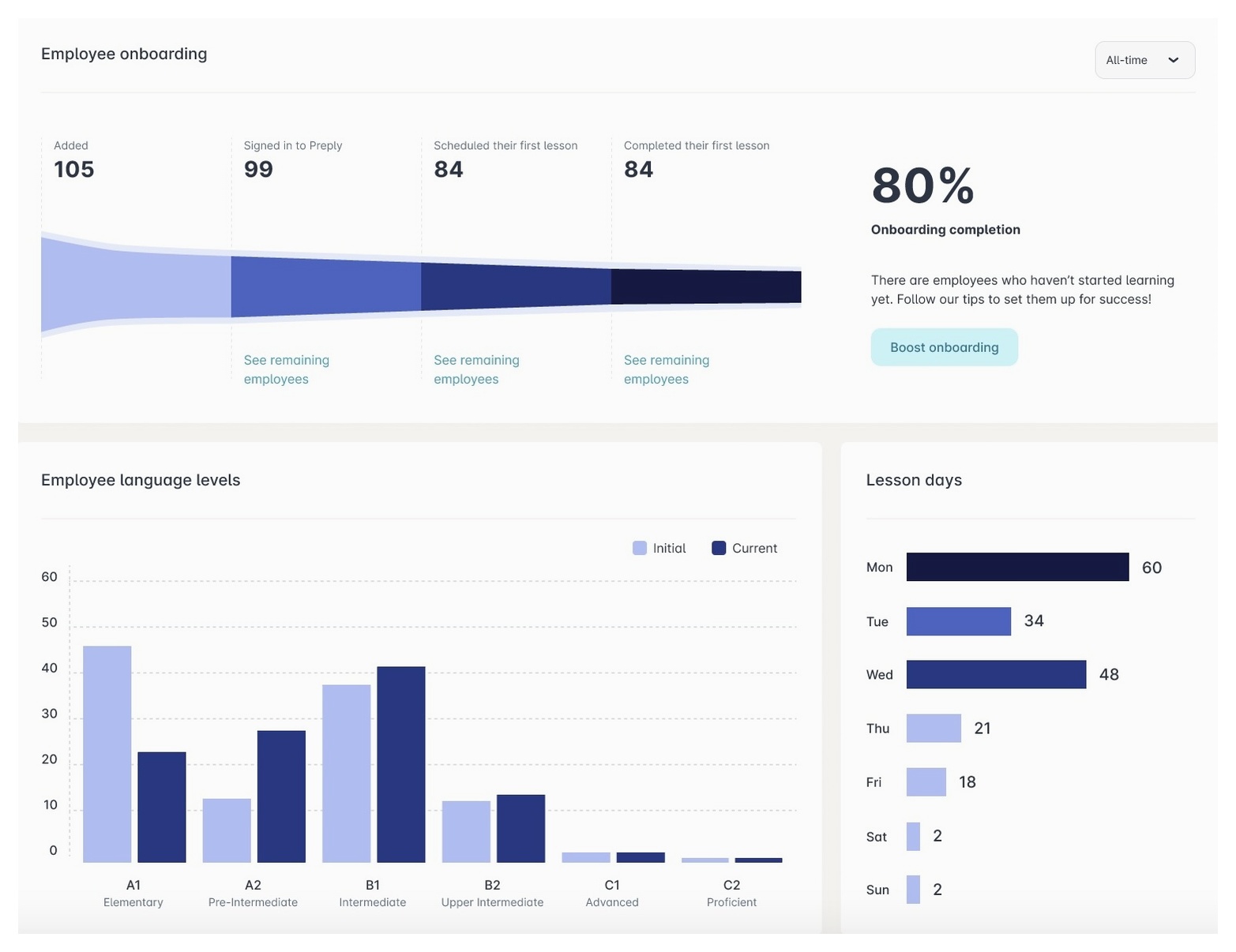
Technology-driven tracking tools offer significant advantages in managing employee performance. Take LingualNeeds’s corporate dashboard, for instance; it empowers management and program coordinators to monitor each employee’s skill level, attendance, and progress—all in one convenient platform. This centralized approach enhances oversight and supports informed decision-making.
This helps you get a big-picture understanding of whether your program is functioning well and delivering results.
Additional tips for successfully tracking the language learning progress of employees
Having explored different methods for measuring progress in language learning, let’s delve into some additional factors to consider. By following these tips, you’ll enhance the accuracy of your progress tracking and gain a clearer picture of your language development.
Set clear goals
Your employees aren’t the only ones who should track their progress against specific goals. It’s crucial for you to define your objectives for the language program clearly, as this will enable you to effectively evaluate its success.
Language learning objectives can differ greatly from one company to another. However, a prevalent target is to ensure that every employee reaches a B2 proficiency level in a particular language within their first six months on the job.
Use a variety of methods
Various progress measurement techniques cater to distinct objectives, so effectively tracking your team’s advancement often requires a blend of at least two approaches.
From the methods we’ve discussed, consider implementing one that highlights the subtle advancements you’ll notice while learning languages, alongside another that provides a comprehensive snapshot of your team’s overall progress.
Track progress regularly
Consistently evaluating your team’s progress not only ensures that your program is achieving the desired outcomes but also identifies any challenges. This proactive approach allows you to address issues swiftly and effectively, keeping your initiatives on track.
It’s important to remember that mastering a language is a gradual process. If assessments are conducted too often, employees might become discouraged or feel pressured to progress at an unrealistic pace.
The ideal frequency for assessments hinges on your chosen method for tracking progress. For smaller SMART goals, consider having employees share updates weekly or bi-weekly to stay on track. In contrast, if you’re using level tests, it’s important to note that most learners typically require a minimum of six months to observe meaningful improvements.
Share results with employees
The progress tracking methods discussed in this article are most effective when employees are actively involved and kept informed about the outcomes.
Students who recognize their progress tend to stay motivated, while those who aren’t advancing need feedback to identify areas for improvement and explore solutions.
The progress tracking methods we’ve explored, such as SMART goals and progress tests, actively engage learners throughout the entire process.
It’s a great strategy to create additional opportunities for your team to receive feedback, as this reinforces the value of their hard work and demonstrates that their efforts are recognized.
Conclusion
We’ve explored effective methods for tracking language learning progress that not only keep employees motivated but also ensure they are mastering relevant content. Additionally, these approaches provide you with a comprehensive overview of your training program’s effectiveness across the entire company.
It’s time for you to select the tracking methods that best suit your team’s needs. While the options may seem daunting, rest assured that plenty of resources are available to guide you. Many corporate training providers are ready to take on much of the heavy lifting, making the process smoother for you.
LingualNeeds offers a dynamic language training program that integrates three effective teaching methods. Participants benefit from level and progress assessments, access to a corporate dashboard, and personalized support from private tutors. These tutors motivate learners to establish achievable short-term goals following the SMART criteria, ensuring a focused and productive learning experience.
If you seek additional support, schedule a demo with our team to discover how LingualNeeds can assist you in implementing and monitoring an impactful corporate language training program for your staff.
Frequently Asked Questions
Why is tracking progress important in language learning?
Tracking progress is crucial as it boosts employee motivation and confirms that the training program is achieving its objectives.
What is the CEFR and how does it relate to language learning progress?
The CEFR, or Common European Framework of Reference for Languages, is a system used to measure language proficiency, helping to track progress particularly for beginners.
How can SMART goals be used to measure language learning progress?
SMART goals, which stand for Specific, Measurable, Achievable, Relevant, and Time-bound, provide a structured framework for setting and tracking language learning objectives.
What role does technology play in tracking language learning progress?
Technology-driven tracking tools, like LingualNeeds’s corporate dashboard, allow for centralized monitoring of employee performance, skill levels, and overall program effectiveness.
How often should language learning progress be assessed?
Progress should be tracked regularly, with the frequency depending on the selected method; for smaller goals, weekly or bi-weekly updates may suffice, while level tests may require a minimum of six months between assessments.


