

- Providing effective language training for remote employees: where to start
- 1. Assess language proficiency
- 2. Offer a tailored corporate language training program
- 3. Use cutting-edge technology
- 4. Track employee progress
- 5. Know how to measure training ROI
- Overcome language barriers in online communication
- Use subtitles in Zoom meetings
- Avoid idioms
- Enunciate
- Final thoughts
- Frequently Asked Questions
- Why is foreign language proficiency important in today’s workplace?
- What challenges do companies face when building a multilingual workforce?
- How can organizations effectively implement language training for remote employees?
- What role does technology play in language training programs?
- How can companies measure the ROI of their language training programs?
In today’s global marketplace, companies are increasingly operating on an international scale, making foreign language proficiency a vital asset for employees. Organizations around the world have recognized the advantages of a multilingual workforce, prompting CNN Money to label bilingualism as the “hottest skill for job seekers.” Embracing language skills not only enhances communication but also opens doors to new opportunities in diverse markets.
How can companies successfully build a multilingual workforce? While many organizations list foreign language proficiency as a requirement in their job postings, this approach can create significant hurdles. Strict language demands often lead to a decrease in job applications and fail to assist current employees who may need language support.
Numerous companies are embracing corporate language training programs, empowering them to hire talent without language barriers. This approach not only enhances their workforce’s language skills on the job but also equips current employees with the necessary tools to excel in a global marketplace.
The transition to remote and hybrid work has brought about new challenges for businesses. So, how can organizations effectively implement or sustain language training programs when their employees are working away from the office?
Fortunately, the same technology that makes remote working possible offers solutions to the challenges it creates.
In this article, we’ll explore effective strategies for training remote employees and harnessing the potential of multilingualism to boost productivity, foster innovation, and drive growth. Additionally, we’ll share five essential tips to ensure your training program achieves its goals successfully.
Providing effective language training for remote employees: where to start
Launching a successful remote training program can be as straightforward as selecting an online language learning provider that aligns with your company’s goals. Many of these providers offer robust training solutions that not only assess your employees’ language needs but also deliver customized lessons and track their progress along the way. This ensures a more personalized and effective learning experience for your team.
The language training industry excels in offering flexibility and personalization, recognizing that language acquisition is a journey that requires time and commitment. This adaptability allows learners to schedule lessons around their busy lives and focus on content tailored to their specific goals and needs.
As a result, finding a provider suitable for a remote workforce is not as challenging as you might think.
Discover the five essential elements of successful language training! Whether you opt for a professional language training provider or prefer a self-directed approach, adhering to these guidelines will help you achieve your language learning goals effectively.
1. Assess language proficiency
To kick off a successful language training program, it’s crucial to evaluate your employees’ current language skills. Often, individuals end up in classes that are either too easy or too challenging, which can hinder their progress and dampen their motivation. By accurately assessing their proficiency, you can tailor lessons to meet their needs, ensuring a more effective and engaging learning experience.
In many organizations, employees exhibit a wide range of foreign language skills, spanning from A1 (basic user) to C2 (proficient user) according to the Common European Framework of Reference (CEFR). The effectiveness of language training programs heavily relies on offering lessons that align with each individual’s proficiency level, making it crucial for success.
Evaluating your employees’ language proficiency can be done through various methods, but the most reliable approach is to administer an official language test. For instance, the IELTS measures English skills, DELE assesses Spanish proficiency, and DELF is designed for French. These assessments cover all aspects of language ability, ensuring a comprehensive evaluation with experienced instructors supervising the tests and conducting speaking assessments.
Official exams are the most effective means of evaluating language proficiency, but they come with significant drawbacks. They tend to be expensive and time-consuming, making it impractical for many companies—especially those with a large number of employees—to have each staff member participate. Additionally, these exams typically require in-person attendance, which poses a challenge for remote workers.
Fortunately, numerous free language proficiency tests are tailored for companies. A prime example is LingualNeeds’ corporate English level assessment. By distributing this online test to your employees, they can easily determine their current CEFR level. You’ll receive notifications as each employee completes the test, providing valuable insight into your workforce’s language skills and starting point.
2. Offer a tailored corporate language training program
Evaluating your employees’ language proficiency is a crucial first step in creating a customized language program that truly meets their needs. However, a personalized approach goes beyond simply offering lessons that match their current skill levels; it encompasses a comprehensive strategy that addresses various aspects of language learning.
A remote workforce thrives on a training program that emphasizes flexibility, allowing employees to learn from home and integrate lessons seamlessly into their personal and work lives. However, this adaptability must not come at the expense of quality. Effective language learning hinges on communication, making regular interaction with a real tutor essential for success.
Finding a balance between flexibility and personalized interaction with real tutors can be challenging. However, advancements in video conferencing and modern technology have made it possible for many providers to deliver corporate language training that meets both needs effectively.
In addition to designing a program that meets your employees’ practical needs, it’s essential to address their language requirements. These can be categorized into two key areas. The first focuses on the specific language skills they should develop—whether it’s listening, reading, writing, or speaking.
Though all four language skills—listening, speaking, reading, and writing—are essential, learners often find it beneficial to prioritize specific skills. This is largely due to the fact that many individuals begin their language journey with a foundational understanding of the target language.
This knowledge can be acquired through many different types of exposure, often leading to an unbalanced skill set.
To illustrate this point, consider an employee who has honed their language skills by watching television with subtitles in the target language. While this method can lead to strong listening and reading abilities, it may leave them with limited speaking experience.
An employee may have honed their speaking skills while living abroad, yet they might struggle with writing in that language. A well-designed language program can bridge these gaps by tailoring instruction to each employee’s unique strengths and areas needing improvement.
The second category of needs focuses on the specific tasks employees must perform that require proficiency in a foreign language. Take, for instance, a sales professional; they need strong persuasive language skills to effectively utilize industry-specific terminology and impactful words that drive sales success.
Conversely, an employee who frequently presents in meetings can greatly benefit from mastering the art of concise communication and clear explanations. A customized language program can equip them with essential skills tailored to their specific needs, enabling them to acquire relevant linguistic techniques and specialized vocabulary that enhance their effectiveness in presentations.
LingualNeeds provides a personalized language training experience designed to address every aspect of your learning needs. Employees can schedule lessons at their convenience and work with private tutors who have expertise in their specific fields. These tutors offer immediate feedback on errors and progress, and they customize lessons to align with each individual’s strengths, weaknesses, and job-related requirements.

3. Use cutting-edge technology
While advanced technology isn’t essential for a successful language program, it certainly enhances accessibility, enjoyment, and engagement. For language learners, technology can significantly enrich their experience, especially for those studying remotely. These learners often need to demonstrate extra discipline and independence compared to those in traditional classroom settings.
Technology plays a vital role in language teaching, taking on various forms that enhance the learning experience. It is a key element of the gamified learning approach, which has gained immense popularity in recent years, making education more interactive and enjoyable for learners.
A multitude of language learning platforms has transformed traditional textbooks into dynamic online resources, enabling students to study conveniently on their laptops or phones while engaging with vibrant visual content.
Gamification is more than just eye-catching designs; it transforms language learning into an engaging experience. Many gamified platforms leverage artificial intelligence to deliver personalized content tailored to each learner’s needs. Additionally, they break down complex subjects into manageable, bite-sized activities, making it easier for individuals to incorporate learning into their busy lives.
Not everyone can carve out a full hour each day for learning, but many of us can find several 5-minute windows throughout the day. These brief moments can be perfect for completing a quick activity and making meaningful progress toward our goals.
Gamified language learning tools may attract those pursuing personal interests, but they often fall short in delivering the depth and customization needed for professional development. This highlights the crucial need for a personalized learning approach that caters to specific career goals.
While apps can provide content tailored to different skill levels, they still fall short when it comes to assisting IT professionals in effectively communicating how to use intricate software across the organization.
Exciting developments in technology are now enhancing language training programs, blending interactive, gamified self-study activities with live online lessons led by experienced tutors. This innovative approach offers a more engaging and effective way to learn a new language.
These innovative solutions empower remote employees to experience the perfect blend of flexibility and support. They can engage in self-paced learning enhanced by advanced technology while also receiving personalized guidance from a skilled language tutor.
A prime illustration of this is LingualNeeds’s vocabulary feature, which empowers tutors to incorporate new words from lessons directly into their students’ vocabulary lists. This enables learners to practice these fresh terms anytime and anywhere using convenient flashcards.
Personalized learning with real tutors can be effectively enhanced by integrating gamified activities, creating a dynamic approach that maximizes both engagement and educational efficiency.

4. Track employee progress
Although there are numerous language training programs available for remote employees, only a select few provide effective methods for monitoring progress. Timely feedback on advancement is crucial for both employees and employers, as it helps ensure that learning goals are being met and enhances overall performance.
Language learners thrive on seeing the fruits of their labor, as this boosts their motivation. Meanwhile, employers seek assurance that their investment in language training programs yields tangible results.
Tracking progress in learning is often achieved through regular tests designed for learners. Since advancing from one language level to another can be a lengthy process, these tests usually don’t measure changes in the learner’s CEFR level. Instead, they focus on evaluating how effectively learners have retained and can apply the material from their recent lessons.
Numerous language training providers conduct regular progress tests and share the results with both learners and their employers. This practice is one of the most effective ways to evaluate language development, underscoring the crucial need to select a reputable training provider.
If learners aren’t covering valuable and level-appropriate content, the results of their tests won’t accurately reflect their progress.
Tracking progress is vital for anyone learning a language, but it becomes especially critical for remote employees who often study independently. Lacking the motivation that comes from a team environment, these learners need regular feedback on their progress to stay engaged and motivated.
It’s also particularly important for their employers, who can’t watch over their learning and want reassurance that they’re improving.
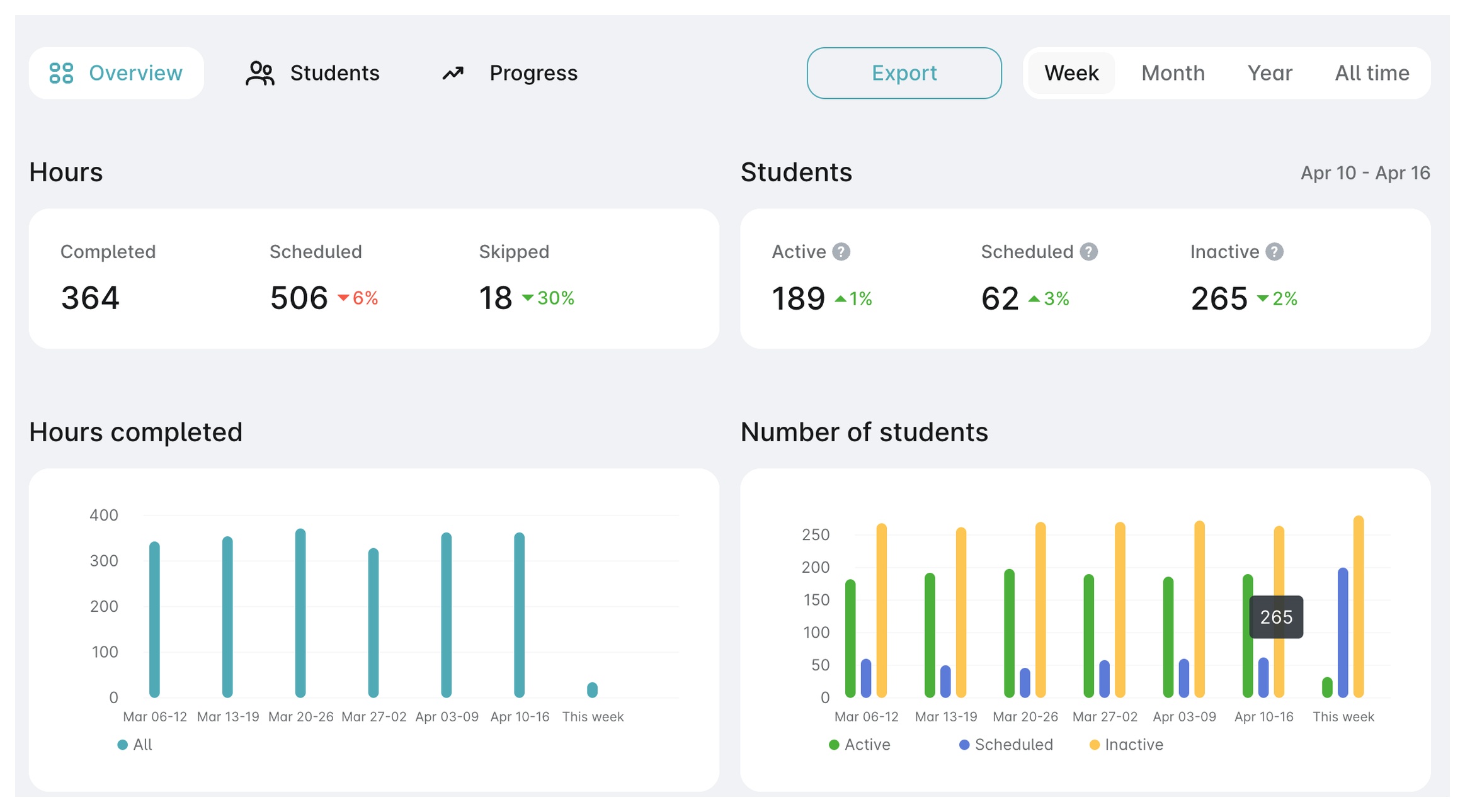
The corporate dashboard from LingualNeeds provides you with a comprehensive overview of your employees’ progress. You can easily monitor the number of completed progress tests, track their language proficiency levels, and see their attendance in lessons—all in one convenient place.
5. Know how to measure training ROI
Evaluating the return on investment (ROI) of language training programs can be quite complex. Since language skills influence nearly every aspect of an employee’s performance, pinpointing the specific effects of the training can be difficult.
Although it may be challenging to precisely evaluate the cost-to-gain ratio of your language training program, there are effective strategies you can implement to ensure you’re reaping the benefits of your investment.
- Define goals and objectives. Consider why you’re introducing your language training program and create concrete and measurable objectives.
- Measure employee participation. For language training to be a good investment, employees must actively use the resources you’ve provided.
- Monitor Language Progress: Regularly assess and track your employees’ language improvements through consistent progress testing.
Overcome language barriers in online communication
Remote workers frequently encounter unique language barriers that their in-office colleagues may not face. We’ve all experienced the frustration of struggling to hear someone clearly during a Zoom call due to internet issues. For employees communicating in a second language, these challenges can be significantly magnified, making effective communication even more difficult.
Implementing a language training program can greatly diminish language barriers in the workplace, but there are additional strategies we can adopt to further support our employees.
Use subtitles in Zoom meetings
Zoom offers an impressive feature that generates real-time subtitles during conversations. This capability is especially beneficial for employees who are non-native speakers, as it allows them to read along while listening, significantly enhancing their understanding and engagement.
Avoid idioms
Idioms are a common feature of daily conversation, yet they can present significant challenges for those learning or using a foreign language. Understanding these expressions often requires a deeper cultural insight, making them tricky for language learners to navigate.
These phrases often carry non-literal meanings, which means that even if someone knows the individual words, they might not grasp the overall significance of the term.
Enunciate
When speaking our native language, we might get lazy with pronunciation and mumble or merge words.
While skilled speakers often navigate this issue effortlessly, it can be quite challenging for those with limited language skills to keep up. Clear and accurate pronunciation of each word can significantly enhance understanding and facilitate better communication.
Final thoughts
With the business landscape becoming ever more global and the demand for multilingual employees on the rise, now is the perfect opportunity for companies to implement a contemporary language training program. This initiative can enhance communication, foster collaboration, and drive success in a diverse workforce.
Language providers are ready to meet the growing demand for effective language training tailored for hybrid and fully remote workforces. They have developed specialized programs that enable companies to maintain high-quality language instruction, ensuring employees can thrive in diverse work environments.
Having options is great, but it’s crucial to clearly identify your specific needs when selecting a language training program for remote employees. Understanding these requirements will help you choose the most effective solution.
From precise skill evaluations to consistent progress monitoring, we’ve explored essential factors to keep in mind when training employees in a remote setting.
Are you looking to cultivate a multilingual workforce through corporate training tailored for remote and hybrid employees? Schedule a free demo with our team to explore how LingualNeeds can meet your needs!
Frequently Asked Questions
Why is foreign language proficiency important in today’s workplace?
Foreign language proficiency is vital as companies increasingly operate globally, enhancing communication and opening doors to new opportunities in diverse markets.
What challenges do companies face when building a multilingual workforce?
Strict language demands can decrease job applications and fail to support current employees needing language assistance.
How can organizations effectively implement language training for remote employees?
Organizations can select online language learning providers that offer customized lessons and track employee progress, ensuring a personalized learning experience.
What role does technology play in language training programs?
Technology enhances accessibility and engagement in language learning, providing interactive and gamified experiences that make learning more enjoyable.
How can companies measure the ROI of their language training programs?
Companies can define clear goals, measure employee participation, and monitor language progress through consistent assessments to evaluate the effectiveness of their training investment.


