- What are the most commonly used words on TV?
- What were the most common types of words?
- What are the most loving words used on TV?
- What are the angriest words used on TV?
- What are the friendliest words used on TV?
- What are the most offensive words used on TV?
- Conclusion
- Frequently Asked Questions
- What are the most commonly used words on TV?
- How does language vary across different TV genres?
- What percentage of words used on TV are positive?
- Which shows feature the most loving dialogue?
- What are the angriest words used on TV?
Many of us can relate to spending hours glued to the television, often adopting the catchphrases from our favorite shows. Take ‘Love Island,’ for instance—how often do we find ourselves using terms like ‘melt,’ ‘my type on paper,’ or ‘buzzing’ multiple times a day after binge-watching a season?
Have you ever noticed that specific words tend to pop up more often in different genres, like game shows, drama series, or comedy sketches? This phenomenon highlights how language evolves to suit the unique style and tone of each genre.
To tackle this question, we scoured the internet to uncover the most frequently used words on television. Our exploration delved into a variety of categories, including expressions of anger, love, humor, and even controversial language.
Thanks to the collaboration with OfCom, DigitalTrends, and a curated list of commonly used words, we delved into the data to analyze the language featured in popular shows such as ‘Euphoria’, ‘Bridgerton’, and the fan-favorite ‘Benidorm’ for those who adore the Solana Hotel.
What are the most commonly used words on TV?
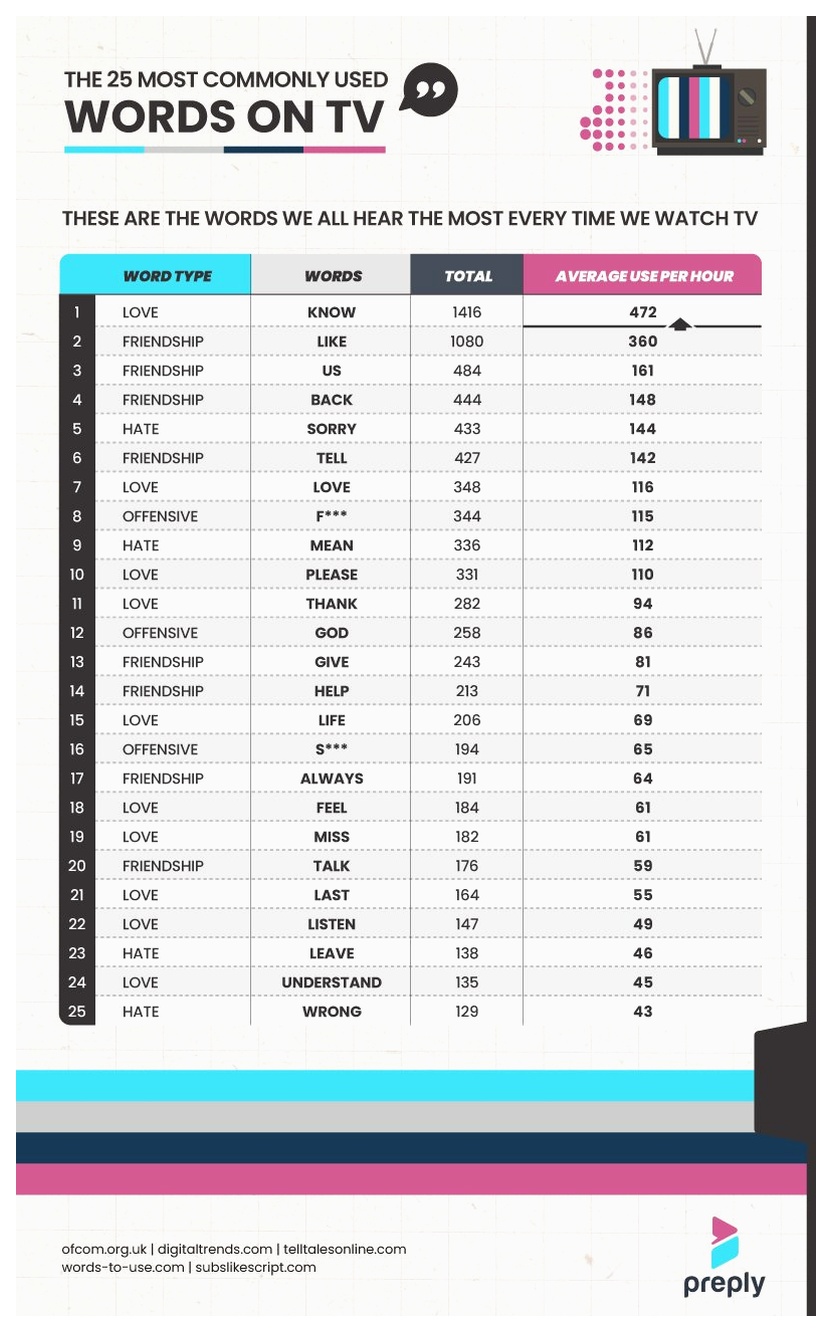
In our analysis of 2022 shows, we examined scripts across multiple genres, focusing on those with running times of 30, 45, and 60 minutes. We calculated the frequency of word usage in these scripts and assigned a usage score out of 15,780 to each word. This allowed us to uncover average usage patterns and gain insights into language trends across different formats.
The words most frequently used in various programs centered around themes of love and compassion. At the forefront was the word “know,” which appeared a remarkable 1,416 times across a diverse range of shows. On average, it was mentioned 472 times each hour, with a notable frequency of 204 mentions every three hours in the popular series “Top Boy.”
Following that, the word “like” emerged, appearing a total of 1,080 times across all the analyzed shows. This translates to an impressive 360 uses per hour. However, the period drama “Bridgerton” stood out with only 46 instances, likely due to its more traditional language style.
In our research of various shows, the term “wrong” appeared just 129 times overall, averaging 43 mentions per hour. Interestingly, it was used only twice in both “The Queen’s Gambit” and “Emily in Paris.” The most frequently discussed themes were “friendship” and “love,” underscoring that even amidst dramatic and sometimes troubling storylines, a sense of positivity shines through.

Learn a language with personalised 1-on-1 classes with our expert tutors from all over the world
French lessons online
Spanish lessons online
What were the most common types of words?
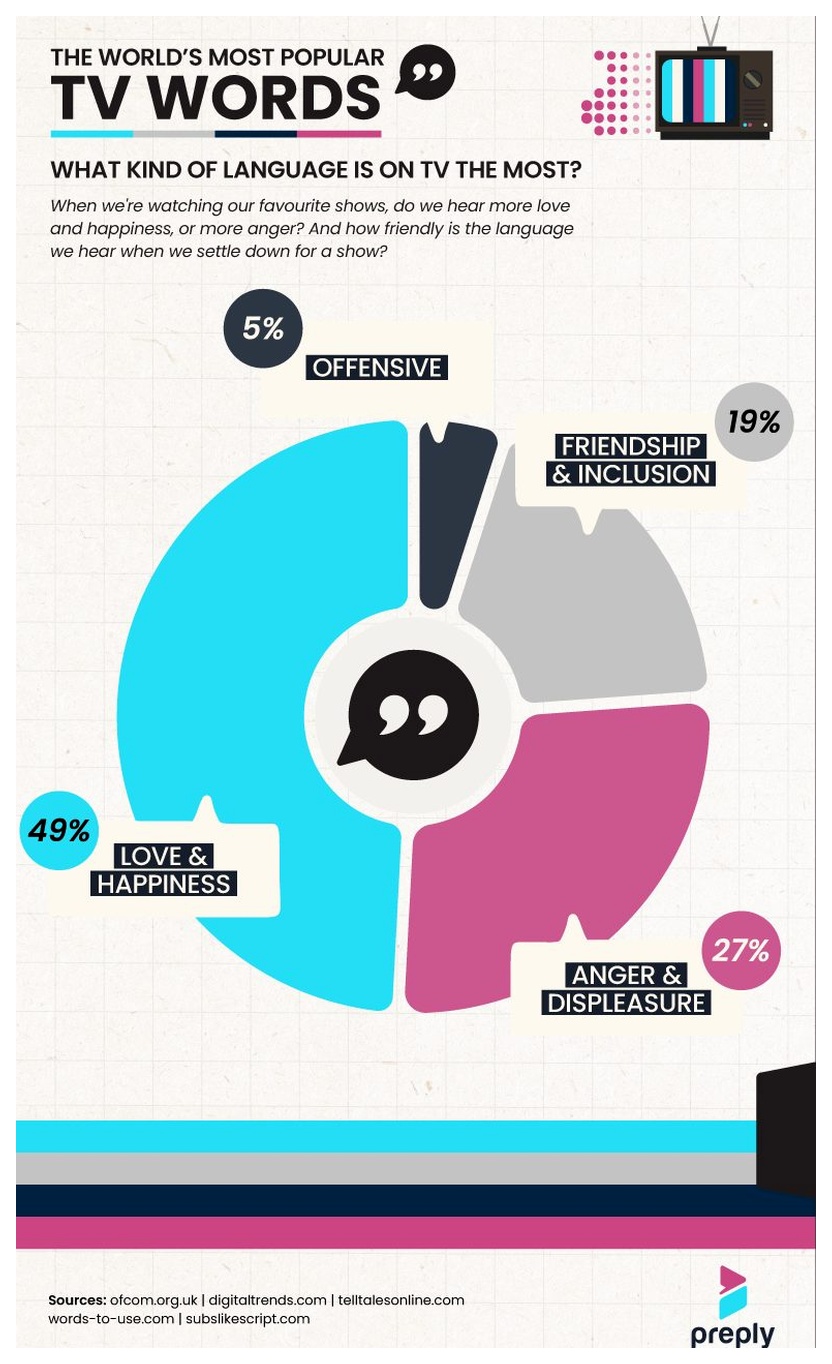
Our research revealed that across all genres, words expressing love and happiness dominated the language used. In fact, a remarkable 49% of the words we analyzed were positive, including terms like “please,” “thank,” “give,” and “help.” In contrast, only a small fraction—just 5%—were considered offensive.
Offensive language can alienate viewers, particularly when it targets minorities through derogatory terms, misgendering, or racism. A recent article emphasized that young audiences are especially sensitive to such language, underscoring the importance for directors and writers to steer clear of it in their work.
Building on this, messages promoting friendship and inclusion accounted for 19% of the overall sentiment, a figure that highlights the significant influence of language on individuals, particularly children. Recently, many parents have chosen to restrict their children’s viewing of “Peppa Pig,” a popular animated series featuring a family of pigs, due to concerns that the character’s language is perceived as “rude” and “disrespectful.”
Interestingly, terms that convey anger and dissatisfaction ranked second highest, accounting for 27% of the vocabulary used. Words like ‘wrong’, ‘leave’, and ‘sorry’ stood out in our analysis of popular shows like ‘Peaky Blinders’, ‘The Handmaid’s Tale’, and ‘Tiger King’, highlighting a common theme of conflict and emotional turmoil.
Each of these shows features a central conflict, whether it’s a disagreement, a dramatic tension, or a hint of danger, which ultimately reaches a resolution. Even popular series like *Bridgerton* and *Emily in Paris* incorporate elements of drama. However, the prevalence of positive language throughout these narratives highlights that reconciliation and harmony often take precedence over conflict.
What are the most loving words used on TV?
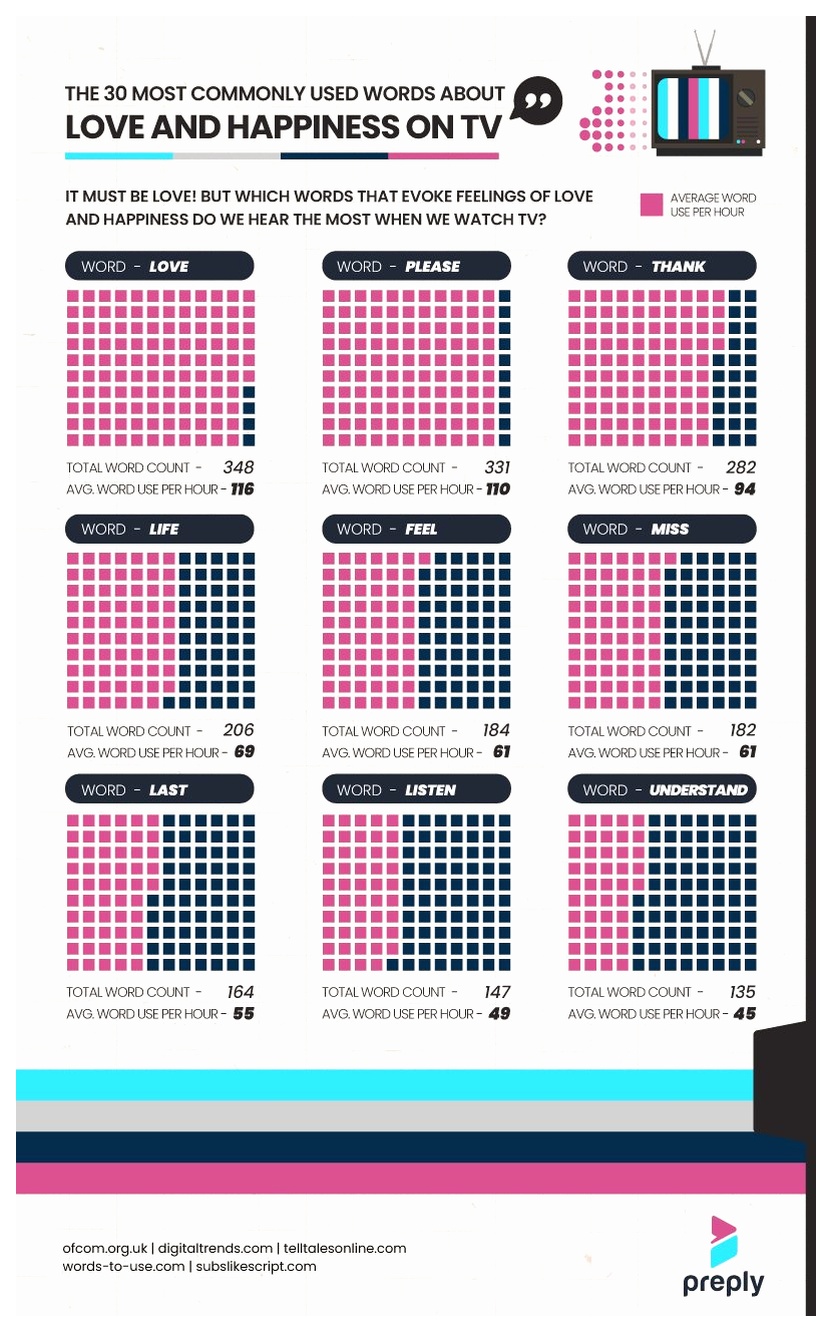
Our exploration into the use of heartfelt and compassionate language in our favorite shows uncovered that ‘And Just Like That,’ ‘Bridgerton,’ and ‘Sex Education’ topped the list. These series are celebrated for their engaging romantic narratives, making them a treasure trove of loving dialogue.
The term ‘love’ appeared 348 times across 6,596 instances in the shows, averaging 116 mentions every three hours. Notably, ‘And Just Like That’ prominently featured the word 44 times, while ‘Sex Education’ included it 39 times, showcasing their thematic focus on relationships.
The captivating period drama ‘Bridgerton’ features the word a striking 25 times, in stark contrast to ‘Peaky Blinders,’ which employs it just 6 times. This research highlights how plot and genre significantly influence language choices, reflecting the more violent and intense nature of ‘Peaky Blinders’ compared to the romantic and dramatic flair of ‘Bridgerton.’
In our analysis, the word ‘feel’ appeared 184 times, while ‘listen’ was mentioned 147 times. Interestingly, both ‘The Handmaid’s Tale’ and ‘The Queen’s Gambit’ featured very few expressions of love and care in their scripts. This scarcity of tender language underscores how such words might lighten the otherwise dark themes of these series.
“The Queen’s Gambit” utilizes a more systematic and pragmatic style of dialogue, whereas “The Handmaid’s Tale” employs a formal tone that is reserved for crucial moments. Interestingly, “Peaky Blinders” stands out for having the fewest words spoken throughout the series, showcasing a unique approach to storytelling.
Learn a language online with our free learning materials.
Learn English online
Learn French online
What are the angriest words used on TV?
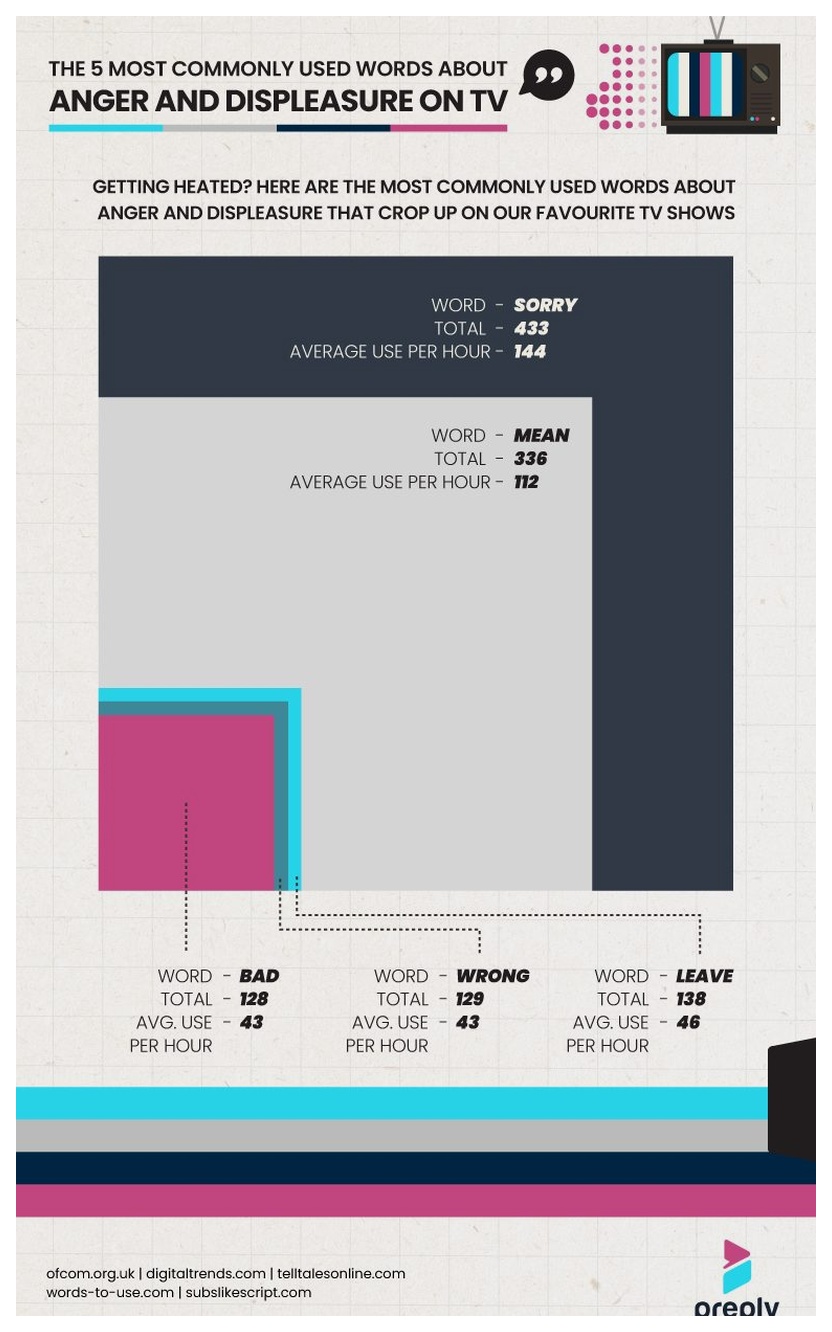
When tensions rise on television, characters often rely on specific words to convey their feelings. A recent study identified the most frequently used words in moments of anger, revealing some intriguing insights. Topping the list is the word “sorry,” which appeared 433 times out of a total of 3,614 instances analyzed. On average, it was used 144 times per hour, highlighting its significance in expressing conflict and emotion on screen.
While the word “sorry” itself isn’t inherently negative, it plays a crucial role in mending toxic or uncomfortable situations. This highlights the numerous challenges encountered in the shows we examined.
The series that featured the highest number of angry words was ‘Sex Education,’ totaling an impressive 374 frustrated words over the three-hour analysis. Given its blend of intense drama, heated arguments, and the trials of growing up, this finding is hardly unexpected. In fact, during our examination, a notable 10.35% of the dialogue was filled with frustration.
The word ‘mean’ ranked second among the most frequently used angry terms, appearing 336 times out of 3,614—an average of 112 times per hour. The intense teen drama ‘Euphoria’ led the pack in angry language, with a total of 346 instances. Over three hours, 9.57% of the dialogue in ‘Euphoria’ was classified as dark or angry, likely reflecting the show’s focus on characters struggling with drug addiction and their attempts to escape destructive patterns.
The third word on our list is “leave,” which earned an impressive score of 138 out of 3,614. This word appeared 46 times each hour, suggesting that numerous characters were either telling someone to get lost or expressing their own desire to exit the situation.
In our analysis, ‘Benidorm’ ranked third for the highest number of angry words among all the shows we examined, with a notable 399 instances of negativity appearing in just three hours—accounting for 9.38% of the script. This might come as no surprise to viewers familiar with the series, as its portrayal of run-down hotels, abrasive staff, and lackluster entertainment leads to a constant stream of on-screen conflicts.
What are the friendliest words used on TV?
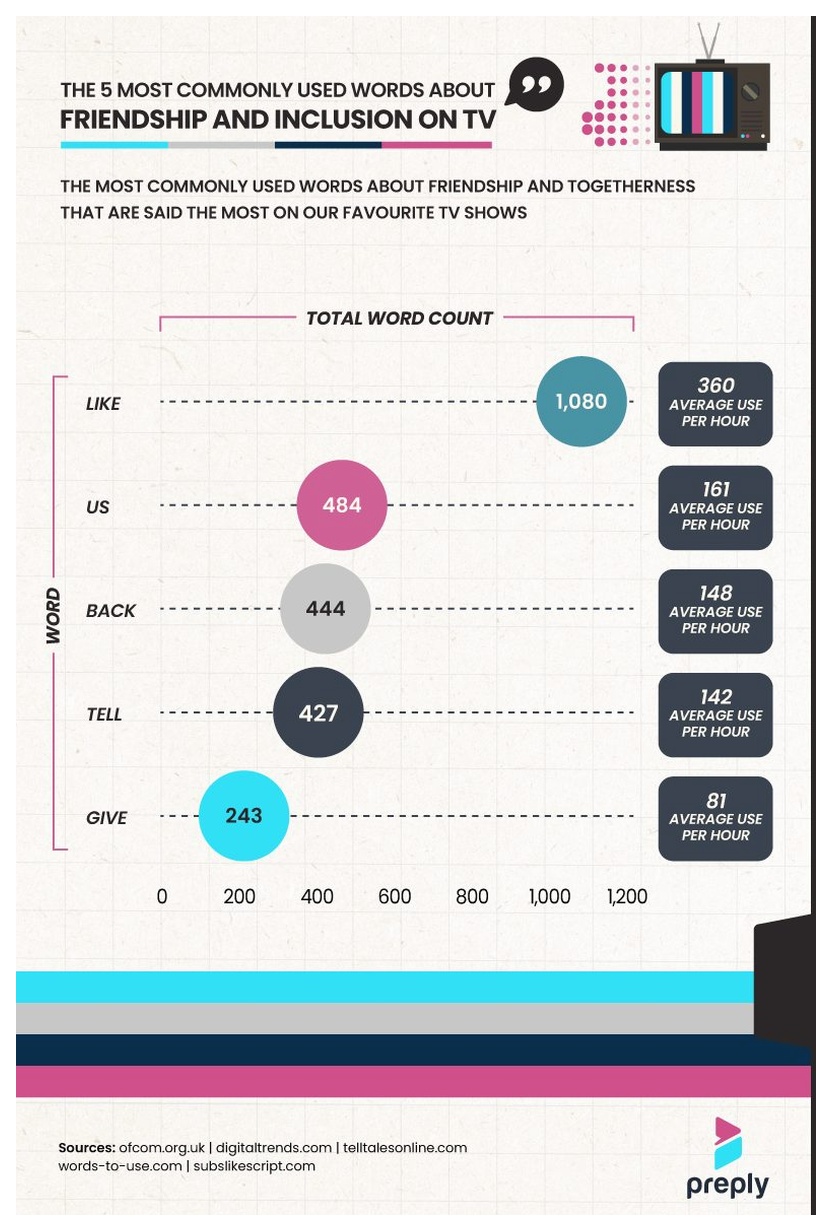
When our beloved characters express their affection more openly, you might be intrigued to know there’s a list of the most frequently used ‘friendly’ words across popular TV shows. By employing a scoring system that evaluates each show out of 4,497 based on three-hour segments, we identified the friendliest series with the most engaging scripts.
The word “like” topped the charts, appearing an impressive 1,080 times across all the programs we analyzed, averaging 360 instances per hour! This incredibly versatile term serves various purposes, from describing platonic and romantic relationships to conveying emotions about cherished objects and memorable moments. Its widespread use highlights its significance in everyday communication.
Surprisingly, the TV series with the highest count of friendly words is ‘Top Boy,’ boasting an impressive 440 friendly terms and an overall friendliness rate of 9.78%. While the show delves into the complexities of inner-city culture and the tensions between various groups, it also highlights the strength of solid, loyal friendships that span across its seasons, showcasing the warmth amid the challenges faced by its characters.
The word “us” ranked as the second most frequently used friendly term, appearing 484 times and averaging 161 uses per hour. Its versatility allows it to represent friendships, romantic connections, and even the special bonds between pets and their owners. This widespread applicability explains its popularity throughout the series we analyzed.
“Sex Education” boasts an impressive count of 387 friendly words in its script, making up 8.61% of the dialogue over three hours. This engaging series explores the complexities of parental relationships, friendships, and the journey of first sexual experiences, which naturally leads to a rich tapestry of affectionate language throughout its narrative.
What are the most offensive words used on TV?
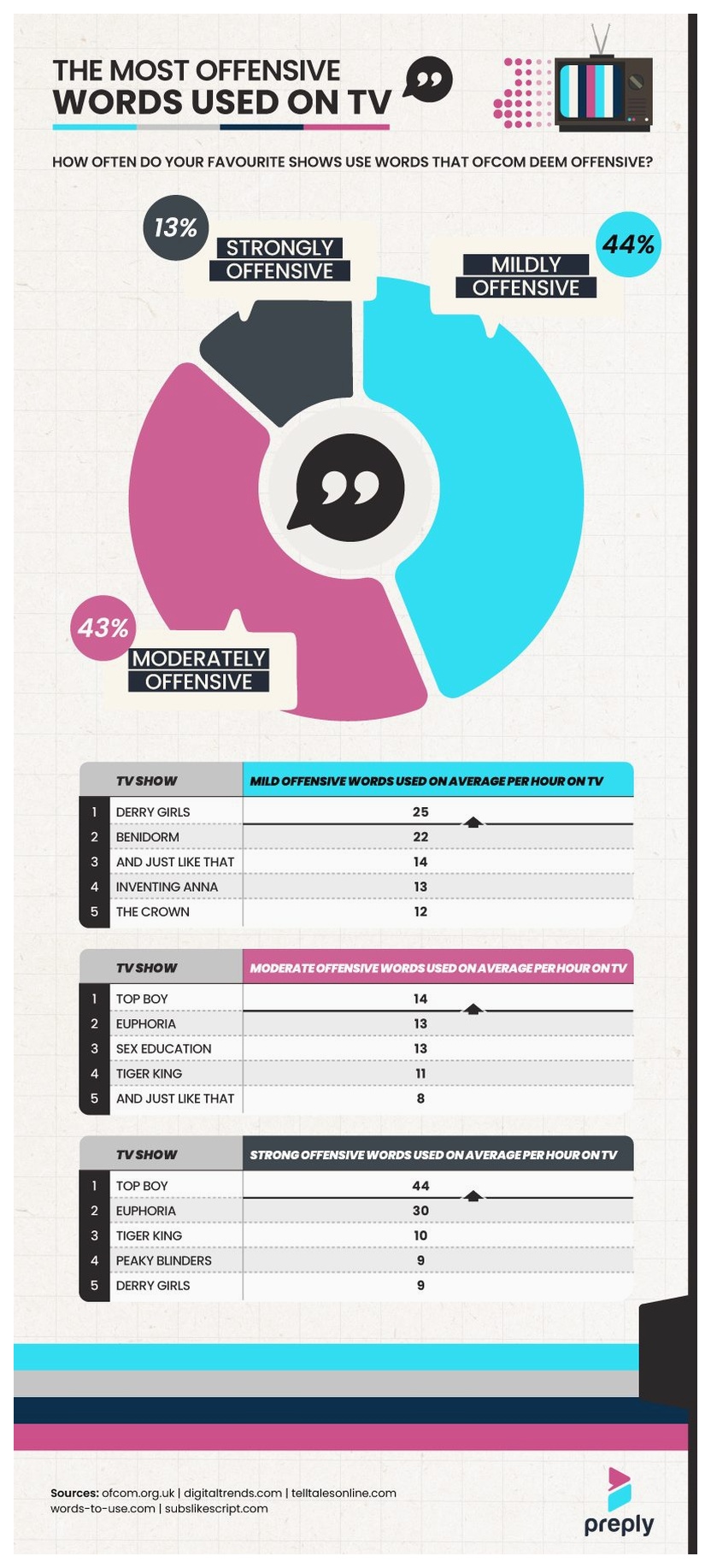
In our exploration of the most shocking and offensive language found in our selected television shows, we uncovered some startling findings. While we can’t share the specific words due to our commitment to family-friendly content—and trust us, you wouldn’t want to hear them anyway—we can provide insights into the frequency of mild versus strong offensive language. Additionally, we’ll break down the number of hurtful terms used per hour in these programs.
In our analysis, we found that 43% of the shows featured a significant number of ‘moderately’ offensive words, while only 13% included what are considered ‘strong’ offensive terms. Notably, the characters in ‘Top Boy’ averaged an astonishing 63 offensive words per hour, while ‘Euphoria’ followed closely behind with 51.
“Derry Girls,” a captivating dramedy that explores the challenges of growing up in 1990s Ireland amid political turmoil, topped the list with 41 instances of offensive language. In contrast, the sensational documentary “Tiger King,” which chronicles the tumultuous life of controversial zoo owner Joe Exotic and his feud with Carole Baskin—complete with a tangled narrative involving hitmen and the FBI—recorded only 31 instances. Meanwhile, “Sex Education” came in last, with just 29 offensive words noted in our analysis.
While it may not be the most vulgar series, the ‘Sex and the City’ spin-off ‘And Just Like That’ ranked third for the highest frequency of mild offensive language, averaging 14 instances per hour. This statistic aligns with the show’s reputation for its candid and explicit portrayals of sexual encounters and relationships.
Attention, Royalists! The crown jewels of the UK might not be as glamorous as they appear in the tabloids. In fact, the acclaimed drama “The Crown” has been noted for its use of language, scoring a surprising 12 on the scale of ‘mild’ hateful words per hour. This reveals a more complex and nuanced portrayal of royal life than many might expect.
Cyril Connolly, the renowned English literature critic, once eloquently compared the English language to a vast river. He suggested that while a few dedicated anglers patiently fish along its banks, upstream, the waters are tainted by refuse barges dumping their waste. This vivid imagery highlights the contrast between the beauty of the language and the challenges it faces from degradation.
Language constantly evolves, influencing our entertainment in fascinating ways. While not every ‘violent’ TV drama resorts to the most offensive language, and romantic comedies don’t always overflow with tender words, it’s noteworthy that many writers still lean on harmful and offensive terms to convey negative emotions. This trend persists even as society increasingly rejects certain words for their unacceptability.
Conclusion
Television significantly influences our language, shaping the words we use from our favorite shows. By examining TV scripts, we uncovered fascinating trends in vocabulary that vary across genres, capturing everything from love and positivity to anger and offense.
Positive themes shine through, with love-centric language taking the forefront. Even in gripping dramas such as ‘Top Boy,’ sentiments of friendship and affection are prominent. Overall, positive language makes up 49% of the dialogue across various genres, reflecting a strategy to engage broader audiences while steering clear of controversy.
Conflict and resolution strike a delicate balance in storytelling. The powerful expressions of anger and distress resonate deeply, particularly in series like ‘Euphoria.’ In contrast, romantic shows such as ‘And Just Like That,’ ‘Bridgerton,’ and ‘Sex Education’ highlight the beauty of affectionate language, enriching their narratives with emotional depth.
The choice of language plays a crucial role in shaping characters and their stories. As societal norms evolve, creators carefully craft their narratives to reflect these changes. Online platforms like LingualNeeds provide English lessons that enhance understanding and build connections, much like the way transformative television narratives resonate with audiences.
Methodology
We took a seed list of popular TV shows from 2022 and recent years, compiled from telltalesonline.com and digitaltrends.com.
We found scripts for the shows from online script libraries, cross-referencing for accuracy.
We gathered a variety of word lists that capture fundamental human emotions such as love, happiness, anger, and friendship from words-to-use.com. Additionally, we included a compilation of offensive terms drawn from the 2021 Ofcom report, which examines public attitudes towards inappropriate language on television.
Next, we analyzed the frequency of each word from every category, tracking how often they appeared during three hours of each show.
This duration was chosen to effectively fit episodes ranging from 30 to 60 minutes, making it suitable for various show formats. Additionally, it allows flexibility for series that may have shorter seasons.
To ensure a fair comparison of word usage, it’s essential to allocate equal airtime to each TV show rather than simply counting the number of episodes. This approach allows for a more accurate assessment of the opportunities to use the specified words.
Frequently Asked Questions
What are the most commonly used words on TV?
The most frequently used words on TV include ‘know’ and ‘like’, with ‘know’ appearing 1,416 times and ‘like’ 1,080 times across various shows.
How does language vary across different TV genres?
Language tends to evolve to suit the unique style and tone of each genre, resulting in different word frequencies and themes, such as love and anger.
What percentage of words used on TV are positive?
Approximately 49% of the words analyzed were positive, while only 5% were considered offensive.
Which shows feature the most loving dialogue?
‘And Just Like That,’ ‘Bridgerton,’ and ‘Sex Education’ are noted for having the most loving language, with ‘love’ mentioned 348 times across the analyzed shows.
What are the angriest words used on TV?
The angriest words identified include ‘sorry’ (433 times), ‘mean’ (336 times), and ‘leave’ (138 times), particularly in shows like ‘Sex Education’ and ‘Euphoria’.