While you may be familiar with the basic meaning of the word “CUT” in English, which refers to creating an opening or incision with a sharp tool, its significance extends far beyond that.
In this article, we’ll explore seven intriguing phrasal verbs that incorporate the word “cut” in English. If you’re unfamiliar with phrasal verbs, don’t worry—I’ve included a link for you to learn more about them here!
Interested? Read on!
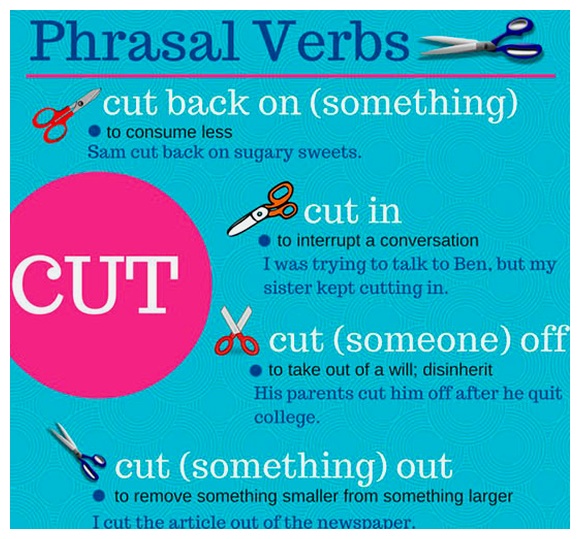
1. Cut back on something
Our first phrasal verb using the word cut means “to consume less of something; to do something less.”
For example, your friend decided to go on a diet, and now she is eating less sugar.
- My friend Jessica has to cut back on sugary sweets as she’s on a diet now.
- I cut back on meat. I’m eating more fruits and vegetables.
2. Cut in
This phrasal verb means “to interrupt someone’s conversation.”
For example:
- I was trying to talk to Ben, but my sister kept cutting in.
- He’s always cutting in! I’m sick and tired of it.
Phrasal verbs often come with specific expressions that enhance their meaning. For instance, “cut in line” refers to the act of bypassing others in a queue. Another common phrase, “Cut it out!” serves as a firm request for someone to stop an annoying or inappropriate behavior. For example, if children are being too noisy while you’re trying to sleep, you might exclaim, “Cut it out!” to signal your frustration.
3. Cut someone off
This English phrasal verb refers to the act of excluding someone from receiving an inheritance, essentially meaning “to cut someone out of a will.”
For example:
- His parents cut him off after he quit college.
- Jason’s family cut him off when he left home.
4. Cut something out
This phrasal verb means “to extract something small from something big by cutting.” For example:
- I cut the article out of the newspaper.
- My younger brother likes to cut colourful pictures of cars out of magazines.
5. Cut up
This phrasal verb means “to cut into pieces.” For example:
- I saw as he was cutting her photo up into pieces.
- The teacher asked me to cut the paper up into squares.
6. Cut down
Just as the first phrasal verb, cut down means “to reduce the quantity of something.”
It can also mean “to cut a tree or plant to the ground.” For example:
- My article was too long, so I had to cut it down to fit the space.
- Our father cut down the old tree in the garden because it blocked all the light.
7. Cut across
Our last phrasal verb means “to take a shorter route to get to a destination.” For example:
- He quickly cut across the park to chase that man in black.
In order to remember these phrasal verbs, make sentences with them that you can use, and learn them.
If you would like to learn English using Skype, you can find an excellent tutor here.
Good luck!
Frequently Asked Questions
What does the phrasal verb ‘cut back on’ mean?
‘Cut back on’ means to consume less of something or to do something less.
What is the meaning of ‘cut in’?
‘Cut in’ refers to interrupting someone’s conversation.
What does it mean to ‘cut someone off’?
‘Cut someone off’ means to exclude someone from receiving an inheritance.
What does the phrasal verb ‘cut something out’ signify?
‘Cut something out’ means to extract something small from something big by cutting.
What is the meaning of ‘cut down’ in this context?
‘Cut down’ means to reduce the quantity of something or to cut a tree or plant to the ground.