

- What is an indirect object pronoun in Spanish?
- List of Spanish indirect object pronouns with examples
- Indirect object pronouns vs. direct object pronouns
- Which Spanish verbs take indirect object pronouns?
- Verbs that naturally take an indirect object
- Verbs for communication
- Verbs that change meaning
- Verbs like gustar
- How to use indirect object pronouns in a sentence
- With a conjugated verb
- With an infinitive
- Using a progressive tense
- With an imperative
- Practice exercise
- Three common mistakes and how to avoid them
- Simplifying the rules
- Translating poorly from English
- Forgetting about regional variations
- Speak Spanish confidently with a LingualNeeds tutor
- Frequently Asked Questions
- What is an indirect object pronoun in Spanish?
- How do you identify the correct indirect object pronoun to use?
- What are some common mistakes learners make with indirect object pronouns?
- Can you give examples of Spanish verbs that require indirect object pronouns?
- How do you use indirect object pronouns with verbs in Spanish?
Mastering indirect object pronouns is essential for anyone learning Spanish, as they can enhance your communication skills and make your speech flow more naturally. In Spanish, these pronouns identify the recipient of an action, clarifying who benefits from or is affected by it. By using them correctly, you’ll not only speak with greater confidence but also engage in conversations more smoothly.
Navigating Spanish pronouns can be tricky, but don’t worry! This guide will demystify indirect object pronouns, complete with clear examples and practical exercises to help you use them confidently in conversation. Dive in to enhance your Spanish skills!
What is an indirect object pronoun in Spanish?
In Spanish, an indirect object pronoun (IOP) identifies the recipient of an action, clarifying to whom or for whom something is done. By using these pronouns, you can simplify your sentences and engage in more fluid, natural conversations.

Although it might seem difficult at first, you frequently use indirect objects in both noun and pronoun forms in everyday conversation. To grasp how the Spanish indirect object pronoun functions, it’s helpful to first understand the role of indirect objects, regardless of whether they are nouns or pronouns.
For example:
- She bought her mother flowers. (Ella compró flores para su madre.)
- For whom did she buy the flowers? The answer, and thus the indirect object, is the noun “mother” (madre).
It’s important to observe that the Spanish sentence incorporates not only the noun but also a preposition, transforming the indirect object into a prepositional phrase: “para su madre” (for her mother). This addition can make the sentence longer and may not always flow naturally in conversation.
Enter the indirect object pronoun! Just as in English, where pronouns replace nouns, Spanish grammar follows the same principle. Understanding how these pronouns function can enhance your grasp of the language and improve your communication skills.
For example:
- She bought her flowers. (Ella le compró flores.)
- For whom did she buy the flowers? The answer, and thus the indirect object, is the pronoun “her” (le).
Observe how the Spanish sentence simplifies the dialogue. Rather than relying on a prepositional phrase, it employs the indirect object pronoun “le” (him). This choice not only adds variety to your speech but also makes it flow more naturally and succinctly.
List of Spanish indirect object pronouns with examples
Here is a list of the six indirect object pronouns in Spanish, each with its corresponding meaning and usage:
- me – to/for me
- te – to/for you (informal, singular)
- le – to/for him, her, you (formal, singular)
- nos – to/for us
- os – to/for you (informal, plural)
- les – to/for them, you (formal, plural)
| Indirect object pronoun | Spanish | English |
| me – to/for me | Mi madre me envió una carta. | My mother sent me a letter. |
| te – to/for you | ¿Te presté mi libro ayer? | Did I lend you my book yesterday? |
| le – to/for him, her, you (formal) | Le di el regalo a Juan. | I gave Juan the gift. |
| nos – to/for us | Nos invitaron a la fiesta. | They invited us to the party. |
| os – to/for you (plural, informal) | ¿Os gustó la película? | Did you all like the movie? |
| les – to/for them, you (plural, formal) | Les compré flores para la ocasión. | I bought them/you flowers for the occasion. |
To choose the correct indirect object pronoun in a sentence, consider who received the action or for whom it was done. Once you identify this, simply refer to the chart to find the corresponding pronoun that fits your answer.
For example:
- Simon served you coffee.
- To whom did Simon serve coffee? The answer is “you.” So you would use te in your sentence. Te serví el café.
Third-person indirect object pronouns can represent “him,” “her,” or “you.” To enhance clarity, you can also include an indirect object noun alongside the pronoun.
For example:
- Le doy a regalo.
- Because le is the indirect object pronoun, this sentence could mean:
- I gave him a gift.
- I gave her a gift.
- I gave you a gift.
In certain conversations, it might be obvious who received your gift. However, when using a third-person indirect object pronoun, including the indirect object noun can enhance clarity in your communication.
For example:
- Le doy a regalo a Juan.
- By adding a Juan, you show that le means “him” in this instance.
Indirect object pronouns vs. direct object pronouns
Navigating the various types of pronouns in Spanish can be daunting, especially when it comes to distinguishing between direct object pronouns (DOP) and indirect object pronouns. However, each serves a unique purpose within a sentence, making it essential to understand their distinct roles.
Indirect object pronouns tell us to whom or for whom an action is performed, while direct object pronouns reveal what or who is directly impacted by that action. To identify a direct object pronoun, focus on the verb’s action, as it indicates who receives the effect of the action.
First, you can see how direct objects function by identifying a direct object that is a noun.
For example:
- I read the book. (Leo el libro.)
- The action verb is “read.”
- So what did I read? The answer is the direct object “book.”
You can enhance your sentences by replacing a direct object noun with a pronoun, making your speech more concise and avoiding repetition. This technique will help you sound more natural in conversations with native speakers by adding variety to your language.
For example:
- I read it. (Lo leo.)
Below is a comprehensive table showcasing direct and indirect object pronouns in Spanish, highlighting their forms and corresponding meanings.
| Direct object pronouns | Indirect object pronouns | |||
| Singular | Plural | Singular | Plural | |
| First person | me – me | nos – us | me – to/for me | nos – to/for us |
| Second person | te – you (informal) | os – all of you (informal) | te – to/for you (informal) | os – to/for you (informal) |
| Third person |
lo – him, it, you (formal) la – her, it, you (formal) |
los – them, you las – them, you |
le –to/for him, her, you (formal) | les – to/for them, you (formal) |
Direct object pronouns mirror indirect object pronouns, with a key distinction in the third person. For both “him” and “her” in the singular form, the indirect object pronoun is “le,” while in the plural, it changes to “les.”
Direct object pronouns in the third person have specific gender distinctions. For singular pronouns, “him” translates to “lo” (masculine) and “her” to “la” (feminine). When referring to multiple subjects, “them” becomes “los” (masculine) and “las” (feminine). Understanding these nuances is essential for proper usage in Spanish.
Indirect and direct object pronouns can both come before the conjugated verb, making them similar in many ways—except when it comes to the third person, where they differ. This distinction can lead to confusion in your sentences, so it’s crucial to correctly identify the direct and indirect objects. The choice of pronoun hinges on this identification, so honing your skills in spotting these elements is essential for clear communication.
In Spanish, when you pair the indirect object pronouns “le” or “les” with a direct object pronoun, they transform into “se” for smoother pronunciation. This adjustment enhances the flow of the sentence, making it easier to say and understand.
For example:
- He/she gave it to her. Se la dio.
Changing le to se simplifies the pronunciation and sounds more fluid when using multiple pronouns in a conversation.
Which Spanish verbs take indirect object pronouns?
In Spanish, certain verbs use indirect object pronouns, even when they seem to correspond to direct object pronouns in English. For example, the phrase “No le comprendo” translates to “I don’t understand him.” Although “him” looks like a direct object in English, it is actually represented by the indirect object pronoun “le” in Spanish.
By incorporating a direct object pronoun, “No lo comprendo,” the meaning shifts to “I don’t understand it.” This example highlights the subtle distinctions in pronoun usage across the two languages.
Check out this informative table showcasing both regular and irregular Spanish verbs that require indirect objects. Each verb is paired with examples and their English translations, making it easier for you to understand their usage.
| Verb + Meaning | Example in Spanish | Meaning in English |
| dar (to give) | Le di el libro a María. | I gave the book to María. |
| enviar (to send) | Te envié un mensaje. | I sent you a message. |
| prestar (to lend) | Les presté dinero. | I lent them money. |
| regalar (to gift) | Nos regaló un presente. | He/she gifted us a present. |
| decir (to tell) | Le dije la verdad a Juan. | I told Juan the truth. |
| explicar (to explain) | Me explicó el problema. | He/she explained the problem to me. |
| responder (to respond) | Les respondí a todos. | I responded to all of them. |
| mostrar (to show) | Te mostré la foto. | I showed you the photo. |
| ofrecer (to offer) | Les ofrecí ayuda. | I offered them help. |
| enviar (to send) | Le envié una carta a mi abuela. | I sent a letter to my grandmother. |
Verbs that naturally take an indirect object
In Spanish, numerous verbs, especially those related to instruction or understanding, naturally involve indirect objects. For example, consider the verb “dar,” which translates to “to give.” When you give, you not only provide a direct object (the item being given) but also direct that item to someone or something—this recipient serves as the indirect object.
For example:
- I gave Juan a gift. Le di un regalo a Juan.
The indirect object pronoun in this context is “le” (him). To clarify any potential confusion with the third-person indirect object pronoun, the name Juan is also used.
Verbs for communication
In Spanish, communication verbs such as *hablar* (to speak) and *decir* (to tell) frequently use indirect object pronouns, even in the absence of a direct object. While some sentences may not explicitly contain a direct object, it is often understood or implied within the context.
In the context of communication verbs, it’s typically understood that you will convey information, which serves as the direct object. Meanwhile, the individual you are speaking to is regarded as the recipient, or the indirect object, of that message.
For example:
- I am going to call him/her immediately. Le voy a llamar de inmediato.
The implication is that whoever is talking will give information (the direct object) to him/her when they call.
Verbs that change meaning
In Spanish, the choice between direct and indirect object pronouns is shaped by the context and the specific meaning of the verb in a sentence. Take the verb “recordar,” for example; it can translate to either “to remember” or “to remind,” depending on how it’s used.
When you remember, you are recalling a specific memory, which serves as the direct object of your thought. In contrast, when you remind someone, you are providing them with a prompt or reminder, making that person the indirect object in the interaction.
For example:
- We remind you many times. Le recordamos muchas veces.
Since “you” receives the action of being reminded, le is used as the indirect object pronoun.
Verbs like gustar
In Spanish, some verbs, like “gustar” (meaning “to like”), can be puzzling for English speakers. Unlike English, which typically uses direct object pronouns, Spanish employs indirect object pronouns for these verbs, creating a unique structure that can take some getting used to.
In English, when you say you like something, that “something” acts as a direct object. However, in Spanish, the concept of liking transforms into a notion of giving pleasure. This means the subject is associated with an indirect object, as the pleasure is directed towards someone or something else.
For example: A Juan le gusta el chocolate.
In a literal translation, the phrase means “Juan likes chocolate,” where “chocolate” serves as the direct object, answering the question, “What does Juan like?” However, for Spanish speakers, this conveys a deeper meaning: “Chocolate is pleasing to Juan.” This is why the sentence employs the indirect object pronoun “le,” highlighting to whom the pleasure is directed.
How to use indirect object pronouns in a sentence
Having grasped the concept of indirect object pronouns and the verbs that typically accompany them, you’re now ready to learn how to incorporate them effectively into your sentences. In the following sections, we’ll guide you on achieving the correct word order, ensuring you position these pronouns accurately for clear communication.
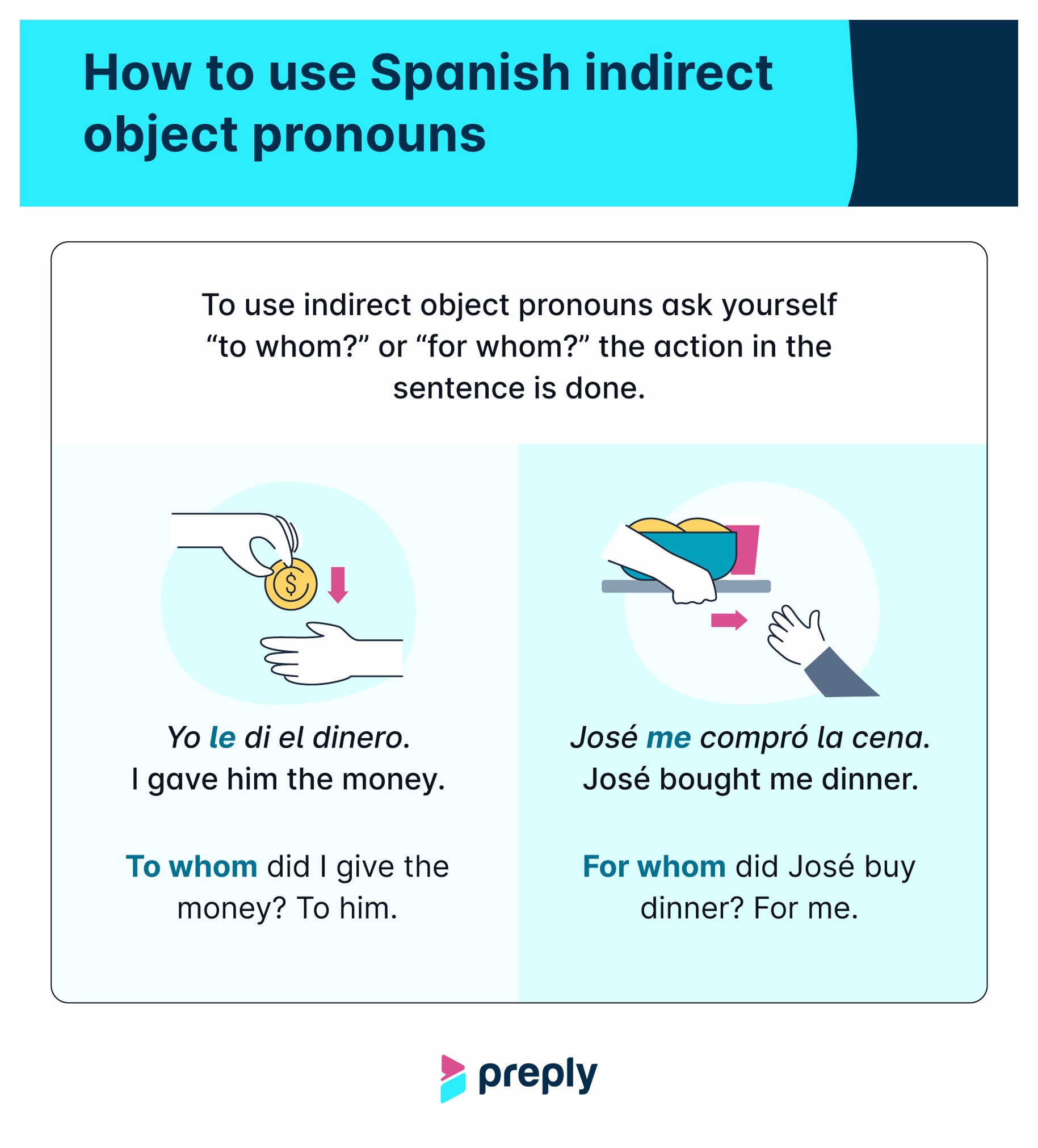
With a conjugated verb
Typically, indirect object pronouns are positioned before the conjugated verb in Spanish sentences.
For example: Yo te compro el libro. (I buy you the book.)
The indirect object pronoun te (you) is placed before the verb compro.
With an infinitive
When you pair a conjugated verb with an infinitive (to + verb), you have the flexibility to place the indirect object pronoun either before the conjugated verb or attached to the infinitive itself. For example:
For example: Necesito explicarte el plan. (I need to explain the plan to you.)
The indirect object pronoun “te” (meaning “to you”) is seamlessly combined with the infinitive “explicar” (to explain), which conveys the same message as saying, “I need to explain the plan to you.”
Alternatively, the indirect object pronoun can also be placed before the conjugated verb.
For example: Te necesito explicar el plan. (I need to explain the plan to you.)
When two verbs appear together in a verb phrase, only the first verb is conjugated (for example, “is”), while the second verb, such as “escribir” (to write), stays in its infinitive form. This structure allows the indirect object to either be attached to the end of the infinitive or positioned before the conjugated verb.
For example: Es importante escribirle agradeciéndole por su ayuda. (It’s important to write to him/her thanking him/her for their help.)
Typically, the indirect object pronoun appears right before the conjugated verb. However, when a verb phrase includes multiple verbs that are not separated by a comma or conjunction, you can attach the indirect object pronoun to the second verb in its infinitive form.
Using a progressive tense
In the progressive tense, which combines an auxiliary verb with a participle, you have the flexibility to position the indirect object either before the auxiliary verb or directly attached to the participle. This allows for variations in sentence structure while conveying the same meaning.
For example: Estaba contándole un cuento. (I was telling him/her a story.)
In this example, the auxiliary verb “estaba” (I was) pairs with the participle “contando” (telling) to form the progressive tense. Additionally, the indirect object pronoun “le” (to him/her) is seamlessly attached to the participle “contando.”
With an imperative
In Spanish, when you issue a command or give someone instructions, simply add the indirect object pronoun to the end of the verb. This small adjustment helps convey your message clearly and effectively!
For example: ¡Llámame mañana! (Call me tomorrow!)
In this sentence, the imperative verb “lláma” (meaning “you call”) is a direct command for you to call me. By attaching the indirect object pronoun “me” to the end of the verb, it clarifies that the listener is expected to take action.
On the other hand, when instructing someone not to do something in Spanish, the object pronouns are placed before the verb.
For example: No se lo digas a nadie. (Don’t tell it to anyone.)
In this sentence, the speaker is advising the listener against taking a specific action, which is why the indirect object pronouns (him/her) appear before the verb. It’s also important to note that when Spanish speakers use the third-person pronoun “le” alongside a direct object pronoun, they modify “le” to “se” for smoother pronunciation.
Practice exercise
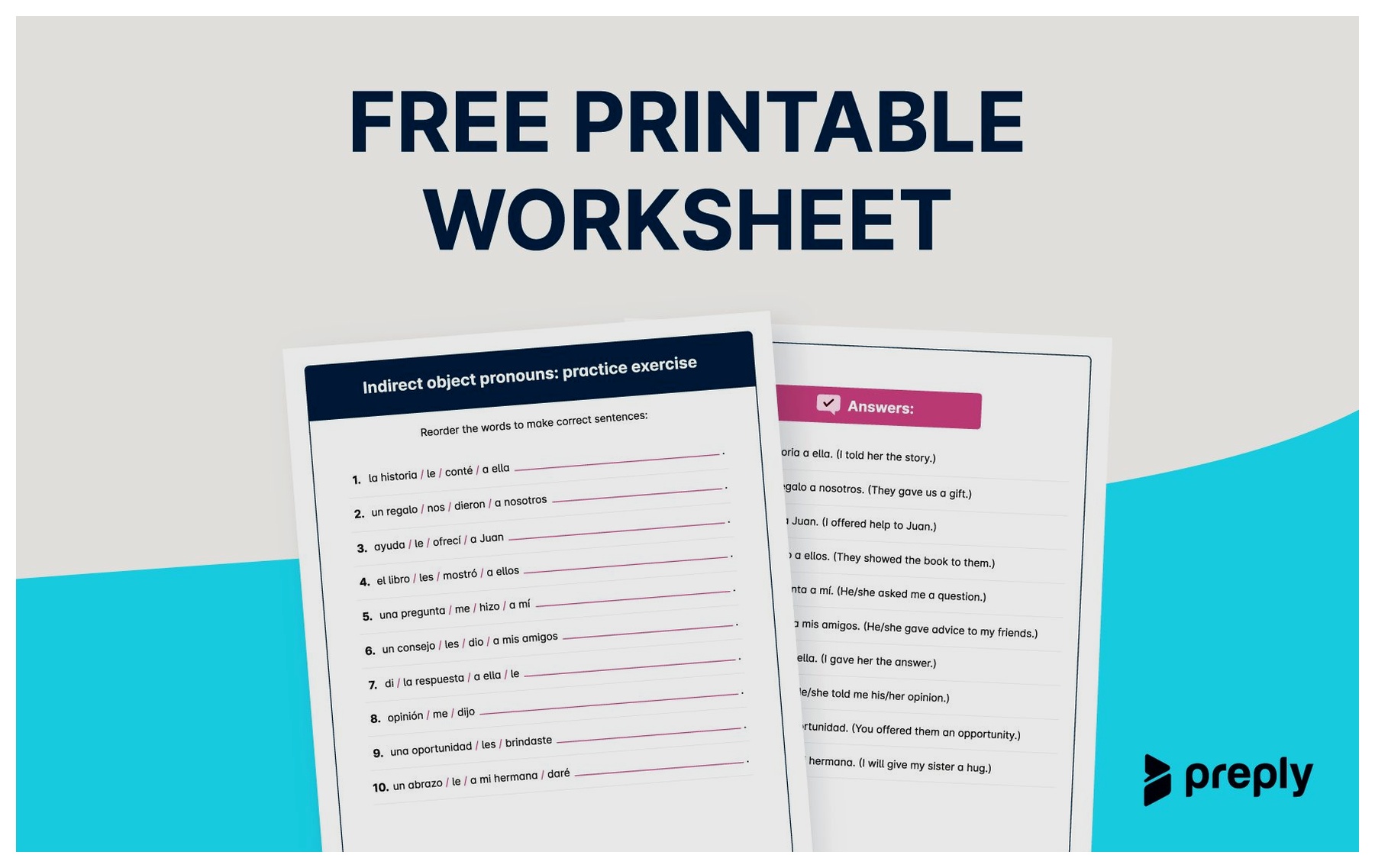
Put your Spanish skills to the test with these 10 sentences designed to help you master indirect object pronouns. Rearrange the words to create meaningful sentences while applying the grammar rules you’ve just studied.
Keep in mind that third-person pronouns can sometimes create confusion. To ensure your message is clear, you might need to restate the indirect object. Answers are available below each sentence for your reference:
1. la historia/le/conté/a ella
Answer: Le conté la historia a ella. (I told her the story.)
2. un regalo/nos/dieron/a nosotros
Answer: Nos dieron un regalo a nosotros. (They gave us a gift.)
3. ayuda/le/ofrecí/a Juan
Answer: Le ofrecí ayuda a Juan. (I offered help to Juan.)
4. el libro/les/mostró/a ellos
Answer: Les mostró el libro a ellos. (They showed the book to them.)
5. una pregunta/me/hizo/a mí
Answer: Me hizo una pregunta a mí. (He/she asked me a question.)
6. un consejo/les/dio/a mis amigos
Answer: Les dio un consejo a mis amigos. (He/she gave advice to my friends.)
7. di/la respuesta/a ella/le
Answer: Le di la respuesta a ella. (I gave her the answer.)
8. opinión/me/dijo
Answer: Me dijo su opinión. (He/she told me his/her opinion.)
9. una oportunidad/les/brindaste
Answer: Les brindaste una oportunidad. (You offered them an opportunity.)
10. un abrazo/le/a mi hermana/daré
Answer: Le daré un abrazo a mi hermana. (I will give my sister a hug.)
Three common mistakes and how to avoid them
In this guide, we’ll highlight three frequent mistakes learners make with indirect object pronouns in Spanish. By understanding these pitfalls, you’ll enhance your fluency and confidence in speaking Spanish!
Simplifying the rules
While it may be tempting to rely exclusively on labels for things and people, this approach oversimplifies complex realities and overlooks crucial details.
You might think that “lecovers” a wide range of uses and is common enough that you could rely solely on that pronoun for indirect objects. However, it’s important to note that indirect objects can take on other pronouns beyond just “him” and “her.”
For example:
- Maria lent me the car. María me prestó el coche.
- To whom did Maria lend her car? The answer is, to me, making me the indirect object.
It’s common to think of direct objects as just things, and you might believe that using “lo” or “la” will suffice. However, it’s important to remember that people can also function as direct objects in sentences.
For example:
- Andrew saw him worried. Andrew lo vio preocupado.
- Who did Andrew see? The answer, him, means a person is the direct object so lo must be the direct object pronoun.
Translating poorly from English
When you’re in a rush, it’s easy to overlook grammar rules, particularly when translating. To ensure you choose the correct pronoun, take a moment to pause and reflect on your word choices. This extra attention can greatly enhance the clarity of your writing.
For example: Peter gave his dog a treat.
To identify the direct object in a sentence, ask yourself, “What did Peter give?” Initially, you might assume that “his dog” is the direct object, which could lead you to select “lo,” the direct object pronoun in Spanish.
In this sentence, the direct object is “a treat,” while “his dog” serves as the indirect object, responding to the question “to whom?” To correctly express this, replace “lo” with “le” for “his dog.”
The correct result: Pedro le dio un premio.
Forgetting about regional variations
The Spanish language features intriguing regional variations in the use of the articles le, la, and lo, which can complicate learning. For instance, in certain Spanish dialects, particularly in Spain, the indirect object pronoun le is often used in place of the masculine direct object pronoun lo when referring to a male individual.
For example: Elena visited her grandfather. Elena visitó a su abuelo.
When simplifying the sentence and replacing “grandfather” with pronouns, regional variations come into play. In Standard Spanish, “grandfather” is treated as the direct object, leading to the use of “uselo,” the corresponding direct object pronoun. However, in Spain, it’s common to use “le,” an indirect object pronoun, even in this context.
- Standard Spanish: Lo visitó.
- Accepted in Spain: Le visitó.
Speak Spanish confidently with a LingualNeeds tutor
Are you finding the intricacies of indirect object pronouns in Spanish challenging? Look no further than LingualNeeds! Our platform pairs you with skilled tutors who offer customized support designed to address your specific learning requirements.
Our tutors are here to help you navigate the intricacies of the Spanish language, from mastering grammar to understanding regional dialects and their unique usages. They provide valuable insights into language exceptions and real-world nuances, preparing you for genuine conversations and local slang. Connect with a tutor and begin your online Spanish lessons today!
Frequently Asked Questions
What is an indirect object pronoun in Spanish?
An indirect object pronoun (IOP) identifies the recipient of an action, clarifying to whom or for whom something is done.
How do you identify the correct indirect object pronoun to use?
To choose the correct indirect object pronoun, consider who received the action or for whom it was done, and then refer to the pronoun chart.
What are some common mistakes learners make with indirect object pronouns?
Common mistakes include oversimplifying pronoun usage, poorly translating from English, and forgetting about regional variations in pronoun use.
Can you give examples of Spanish verbs that require indirect object pronouns?
Examples include ‘dar’ (to give), ‘enviar’ (to send), ‘prestar’ (to lend), and ‘decir’ (to tell), which typically involve an indirect object.
How do you use indirect object pronouns with verbs in Spanish?
Indirect object pronouns are generally placed before the conjugated verb, or they can be attached to the end of an infinitive or gerund.


