

- The 10 standard parts of a business letter
- 1. Letterhead
- 2. Recipient’s address
- 3. Return address
- 4. Today’s date
- 5. Heading
- 6. Greeting
- 7. Body text
- 8. Closing sentence
- 9. Sign-off
- 10. Signature
- 5 Most common business letter formats + examples
- Cover letters
- Resignation letters
- Recommendation letters
- Sales letters
- Payment request letters
- Conclusion
- Frequently Asked Questions
- Why is sending a physical letter important in business communication?
- What are the standard parts of a business letter?
- How should I format the date in a business letter?
- What should I include in the body text of a business letter?
- What are some effective sign-off options for a formal business letter?
Almost all business communication takes place over email these days. But there’s something special about a physical letter.
While sending emails is quick and convenient, it’s all too easy for them to be overlooked. In contrast, crafting a letter to a business associate demonstrates your commitment to formal communication. It conveys a strong message: “I value this communication, and I hope you do too.”
Physical business letters serve as a formal means of communication, making it crucial to adhere to proper formatting and utilize appropriate business English vocabulary. For those learning English as a second language, mastering this can be challenging. In this article, we will break down the key components of a business letter format and offer helpful templates for you to customize.
The 10 standard parts of a business letter
Almost all business letters are made up of the following parts. Use these and you can’t go far wrong!
1. Letterhead
A letterhead is a specially designed piece of paper for correspondence that features a company’s logo and contact details prominently at the top. This branding element signifies that the content below is an official communication from the business, enhancing its professionalism and credibility.
If you’re drafting a letter for a company, check with a colleague to see if they have any official letterhead available. However, if you’re writing as an individual, you can skip this step entirely!
2. Recipient’s address
“The recipient” refers to the individual who will receive your letter. In business correspondence, their address is typically placed in the top left corner of the page, known as the “inside address.” Here’s how it should be formatted:
- Mr./Mrs./Ms./Dr. Firstname Surname
- Company name
- Street address
- City, state, zip code
- Country (optional)
If you’re unsure of the recipient’s name, consider addressing your letter to the relevant job title or titles of those who can assist you. Here are some effective alternatives to start your correspondence:
- The Hiring Manager: if you are writing about a job advertisement
- The Customer Support Team: if you are sending a complaint
- The Accounts Team: if you are writing about a payment
If you’re unsure who will respond to your letter, you can simply address it to the business name. Alternatively, using the phrase “To Whom It May Concern” is a professional way to indicate that the message is intended for anyone who finds it relevant.
Unsure about whom to address in your business letter? Explore our comprehensive guide on formal greetings for letters and emails to find the perfect salutation.
3. Return address
The “return address” refers to your address or the location where any responses should be sent back. It is placed right below the recipient’s address and follows the same formatting style.
Including your email address and/or phone number on a separate line beneath your address is a smart move. This approach demonstrates your willingness to facilitate communication, making it effortless for the reader to reach out to you.
Don’t be concerned if the letterhead and two addresses occupy a large portion of the page. While it may appear to be excessive, this format is essential for maintaining professionalism. Rest assured, you’re following the right guidelines!
4. Today’s date
Right below your address, make sure to include today’s date. In formal letters, it’s important to spell out the full name of the month and include the year for clarity and professionalism.
Tip of the day: When addressing a business letter to recipients in the US or Canada, remember to format the date by placing the month before the day. This small adjustment can enhance clarity and professionalism in your correspondence.
- May 3, 2021
When addressing a business letter to recipients in the UK, New Zealand, or Australia, remember to format the date by placing the day before the month. This small adjustment ensures clarity and adherence to local conventions.
- 3rd May 2021
5. Heading
This step is optional, but many individuals choose to include a heading at the top of a business letter to clearly indicate the topic at hand. Think of it as akin to a subject line in an email, helping the reader quickly grasp the letter’s purpose.
This approach is typically reserved for formal occasions, especially when addressing someone you haven’t met before. It draws inspiration from legal practices, where precise language and professionalism are essential.
You might find this helpful:
- When applying for a job
- When writing on behalf of a company
Headings should be centered on the page and can be either underlined or bolded for emphasis. Here are some effective examples:
- Application for the Position of Sous-Chef
- Request for Payment: Overdue Notice
- Prospective Sales Enquiry: Optima Oils
- Official Letter of Recommendation
Reserve headings for formal contexts only. If you’re uncertain about their necessity, it’s advisable to omit them altogether.
6. Greeting
Leave a blank line or two below the date, then greet your reader.
When crafting your greeting, ensure it aligns with the opening line of your address. If you know the recipient’s name, your greeting will typically follow this format:
- Dear Mr./Mrs./Ms./Dr. Firstname Surname
If you know the reader’s job title, you can address them directly by writing “Dear Sir/Madam,” or by using their specific title again. This adds a personal touch to your communication.
When using a job title, make sure to capitalize the first letter of each word, treating it like a proper name. Additionally, if you’re addressing a group or an individual with a specific title, opt for “to” instead of “dear” for a more natural tone.
- To the Hiring Manager
- To the Customer Support Team
- Dear Sir / Madam
When addressing a letter to a company or using the phrase “To Whom It May Concern,” you have several options to consider:
- To the staff of [the company]
- Dear Sir / Madam
- To Whom It May Concern
7. Body text
Let’s get to the heart of this letter! The key takeaway for writing business letters is to keep them brief and focused. This approach not only shows that you value the recipient’s time but also reinforces the message you want to convey.
When reaching out to someone you already know, it’s courteous to begin with a warm, friendly greeting before diving into the main topic. Here are some great examples to consider:
- I hope this letter finds you well.
- It was a pleasure to meet you last week.
- I hope you are having a productive start to the year.
If you’re not yet familiar with the recipient to offer a friendly greeting, don’t hesitate to dive right in! Whether it’s your opening line or the second line following a warm introduction, make sure to clearly state the purpose of your message right away.
- I am writing to complain about a product I bought from one of your stores last week.
- I am writing to apply for the Digital Analyst position that LingualNeeds has advertised for.
- I am writing to recommend Lindsay Green to your company.
Elaborate on your motivations for writing using precise and formal language. For assistance with vocabulary, consider consulting this guide to English business terms and phrases. It’s important to focus on a single main idea in each paragraph, and be sure to leave a blank line between paragraphs for clarity.
When crafting an important business letter, having a second set of eyes can make a significant difference. Consider scheduling an hour with one of our Business English tutors to receive expert feedback at a budget-friendly rate. It’s a smart way to ensure your message is clear and impactful before you hit send!
8. Closing sentence
After conveying your message, conclude with one or two closing sentences that encapsulate the key takeaway from your letter. This is an opportunity to outline any next steps or actions to be taken.
You should clearly outline the action you want the reader to take after reading your letter, which often involves replying. Here are some effective phrases to encourage a response:
- I look forward to hearing from you soon.
- Thank you for your consideration. I hope to hear from you soon.
- I look forward to receiving your thoughts on this matter.
- Do let me know how this sounds from your perspective.
- Do let me know if you have any questions.
- If there is anything further I can help you with, please do not hesitate to get in touch.
It could state the action that you will take on the issue in the message:
- If payment is not received within two weeks, I will follow up with a phone call.
- I will no longer be purchasing products from your company.
It might simply summarize the main point of the letter:
- I have no doubts that Paula Roberts would be an asset to your company and offer my enthusiastic recommendation.
- I appreciate the opportunity to work with M&A Light Solutions and wanted to extend my heartfelt thanks.
If the matter addressed in the letter doesn’t necessitate any further action, it can wrap up with an upbeat conclusion.
- I wish you the greatest success going forward.
- Thank you for your cooperation, I hope to work with you again at some point in the future.
- Thank you again for your time and consideration.
9. Sign-off
To conclude your letter, start a new line for your sign-off. Traditionally, the way you signed off depended on your relationship with the recipient, with strict guidelines in place. However, the rise of email has blurred the distinctions between formal and informal communication, making those rules less relevant in today’s world.
Looking to showcase your mastery of traditional English etiquette? When crafting a formal letter in the USA, here are some essential guidelines to follow:
- Use “Yours truly,” with someone whose name you don’t know.
- Use “Sincerely yours,” with someone whose name you do know.
If you are sending a formal letter in the UK:
- Use “Yours faithfully,” with someone whose name you don’t know.
- Use “Yours sincerely,” with someone whose name you do know.
Prefer a modern approach? Then any of these options are fine:
- Yours truly,
- Yours sincerely / Sincerely yours,
- Best regards,
- Warm regards,
- Many thanks, (this is a little less formal)
Whichever sign off you go for, remember to capitalize the first letter and end in a comma.
10. Signature
While including your signature on a letter isn’t strictly necessary, it enhances the formality of your message. A signature signifies that you personally authored the letter, underscoring its importance. This thoughtful touch indicates that the content carries significant weight and deserves attention.
After typing your letter, remember to leave space for your signature. Create three to four blank lines after your sign-off, and then type your name. Your signature should be placed in the blank area above your typed name. Nowadays, many people opt for digital signatures, which can enhance the professionalism of your business letter. Learning how to sign a PDF can elevate your correspondence to a whole new level.
5 Most common business letter formats + examples
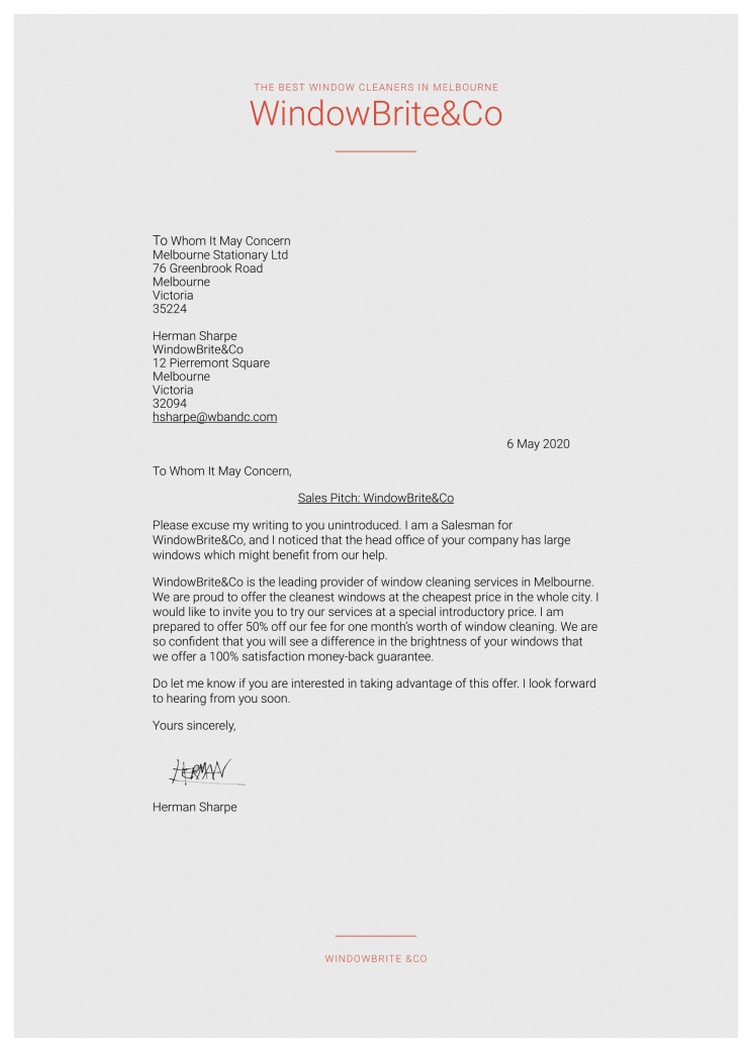
While each business letter will have its unique characteristics, here are some examples to illustrate the tone and style you should strive for. Before diving into those examples, let’s first visualize the ideal layout for your correspondence:
Cover letters
To the Hiring Manager,
Application for the position of Sous Chef
I am excited to apply for the Sous Chef position at the Nottingham branch of Little Chef, as advertised on LinkedIn. This opportunity perfectly aligns with my skills and experience, and I am eager to contribute to your team.
With five years of experience in the catering industry, I have honed my skills in various chef positions, including my most recent role as Sous Chef at The Green Elephant, a bustling restaurant in Nottingham’s city center. In this fast-paced environment, I took charge of the kitchen in the head chef’s absence, which greatly enhanced my ability to cook under pressure. This dynamic experience has equipped me well for the challenges of this role, and I am eager to bring my expertise to your team.
I’ve included my CV with this letter for your review. Thank you for considering my application; I look forward to the opportunity to discuss my qualifications with you soon.
Yours sincerely,
Resignation letters
Dear Mrs. Mariela Ibarra,
I am reaching out to share the bittersweet news of my resignation. My two years at Rings & Things have been incredibly rewarding, and I truly appreciate the mentorship and support you have provided along the way. In accordance with my contract’s two-month notice period, I will wrap up my time here on September 17, 2021. Thank you for everything!
It was a pleasure working with you and your team, and I do hope that we will stay in touch.
Yours truly,
Recommendation letters
Dear Prof. Bilibin,
Letter of Recommendation: Suzy Darton, MA Illustration candidate
I wholeheartedly recommend Suzy Darnton for the Illustration MA program at Kazan State University. As her personal tutor during her BA in Fine Art at Arizona State University, I had the pleasure of working closely with her for three years. Suzy stands out as a remarkably creative and intelligent student, consistently demonstrating an exceptional work ethic. She frequently dedicated her evenings to honing her illustration skills in the studio. I have no doubt that she would be a valuable addition to any arts higher education program.
If you require any further information from me, please do not hesitate to get in touch.
Yours sincerely,
Sales letters
To Whom It May Concern,
Sales Pitch: WindowBrite&Co
I hope you don’t mind my reaching out without a prior introduction. I’m a Salesman with WindowBrite&Co, and I’ve observed that your company’s head office features expansive windows that could greatly benefit from our services.
Discover the sparkling difference with WindowBrite&Co, Melbourne’s premier window cleaning service! We take pride in delivering the clearest windows at the most competitive prices in the city. To celebrate your first experience with us, we’re excited to offer an exclusive 50% discount on one month of window cleaning services. We’re so confident you’ll love the brightness of your windows that we back our promise with a 100% satisfaction money-back guarantee. Don’t miss out on this opportunity to transform your view!
If you’re interested in seizing this offer, please let me know! I’m eager to hear from you soon.
Yours sincerely,
Unlock your potential with LingualNeeds’ free online Business English courses! Designed by language experts, this brand-new program equips you with the skills to confidently handle everyday business situations. Enroll now and elevate your professional communication!
Payment request letters
To the Accounts Team,
Request for payment: Overdue notice
I am contacting you on behalf of Paintstripper New York with regard to the following outstanding invoice:
Invoice number #340 / $1,045
According to our original agreement, the payment was due on February 23, 2021, and it is now two weeks overdue. For your convenience, I’ve included a copy of the invoice with this letter.
If you encounter any problems with the payment of this invoice, please reach out to me right away. Otherwise, I kindly ask for your prompt attention in settling this balance. I’m eager to resolve this matter quickly so we can maintain our collaborative relationship. Thank you!
Thank you in advance for your cooperation.
Yours faithfully,
Conclusion
While emails dominate today’s communication landscape, mastering the art of formal letter writing remains a vital skill for effective business interactions. By following these tips, you can ensure your letters are professionally formatted and make a lasting impression.
Before sending an important letter, it’s wise to have a second pair of eyes review it. Consider booking an hour with one of our Business English tutors for expert feedback. Not only will they help refine your writing, but they can also assist you in improving your English skills!
If you’re eager to enhance your skills alongside your colleagues, explore LingualNeeds Business. We offer specialized English language training for employees and a comprehensive business English writing course designed to elevate your professional communication.
Frequently Asked Questions
Why is sending a physical letter important in business communication?
Sending a physical letter demonstrates commitment to formal communication and conveys the message that you value the interaction.
What are the standard parts of a business letter?
A business letter typically includes a letterhead, recipient’s address, return address, date, heading, greeting, body text, closing sentence, sign-off, and signature.
How should I format the date in a business letter?
In the US or Canada, format the date as Month Day, Year (e.g., May 3, 2021). In the UK, format it as Day Month Year (e.g., 3rd May 2021).
What should I include in the body text of a business letter?
The body text should be brief and focused, clearly stating the purpose of your message and elaborating on your motivations using precise and formal language.
What are some effective sign-off options for a formal business letter?
Effective sign-offs include ‘Yours sincerely,’ ‘Yours truly,’ ‘Best regards,’ and ‘Warm regards,’ depending on the relationship with the recipient.


