- Quick view: Spanish Vs Catalan
- Catalan is not a dialect of Spanish
- History & Context
- Catalan Suppression
- Similarities between Catalan and Spanish
- Grammar
- Pronunciation
- Vocabulary
- Main Differences between Catalan and Spanish
- Grammar
- Pronunciation
- Vocabulary
- What about Valenciano and Mayorquin?
- Spanish or Catalan: Your next steps
- Frequently Asked Questions
- What are the main similarities between Spanish and Catalan?
- Is Catalan a dialect of Spanish?
- How many native speakers does Catalan have?
- What are some key differences between Spanish and Catalan pronunciation?
- What should I consider when deciding whether to learn Spanish or Catalan?
On the stunning shores of Platja D’aro in Catalonia, a French mother strolled barefoot along the beach, prompting her daughter to brush up on her Spanish skills.
“Un, dos, tres, quatre, cinc!” the little girl said confidently.
With a cheerful clap, the mother encouraged her daughter to share all the exciting things she had learned during her holiday with her Spanish teacher at school.
However, the little girl had just counted to five in Catalan, not Spanish.
At first glance, Catalan might sound similar to Spanish, leading some to mistakenly think they are the same. Although both languages share many similarities, distinct differences set them apart, firmly establishing Catalan as its own unique language.
Are you planning a move to Catalonia or another Catalan-speaking region of Spain? You might be contemplating whether to invest your time in learning Catalan (and we strongly recommend you do!) or if you should simply focus on Spanish.
Or if you speak Spanish, you might be wondering how easy it would be to learn Catalan.
Perhaps you’re intrigued by the second most spoken language in Spain and want to explore how it contrasts with the country’s official language, Castilian Spanish.
Either way, once you read this article, you’ll have a fair idea of the following:
- The main similarities and differences between Spanish and Catalan
- The history and evolution of Catalan
- Other varieties of Catalan found in Valencia and the Balearic islands
- Which you should learn: Spanish or Catalan
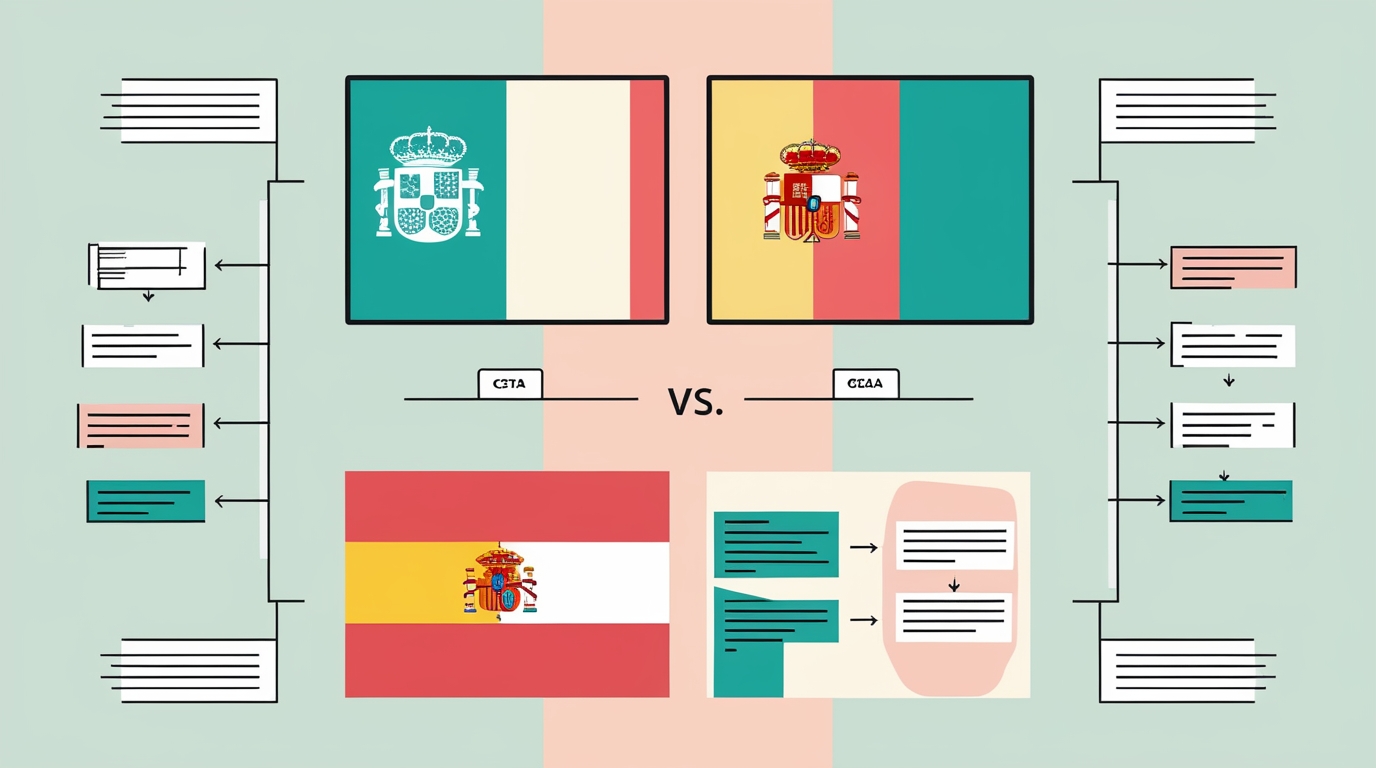
Quick view: Spanish Vs Catalan
|
Spanish |
Catalan |
|
|
Language family |
Romance |
Romance |
|
Is it phonetic? |
Yes |
No |
|
Number of native speakers |
486 million |
10 million |
|
Where is it spoken? |
Spain and multiple countries in Central and South America |
Spain (Catalonia, Valencia, and the Balearic Islands), Andorra, and Alghero, Italy |
|
Are the two languages mutually intelligible? |
Spanish speakers do not automatically understand Catalan |
All Catalan speakers understand Spanish |
|
How many vowels does the language have? |
5 |
8 |
|
Does the language regularly use consonant clusters? |
No |
Yes |
|
Are nouns, articles, and adjectives inflected by gender and number? |
Yes |
Yes |
Catalan is not a dialect of Spanish
“Catalan is not a dialect of Spanish, it’s its own language.” – Ash Lamb, native Catalan speaker.
One surefire way to irritate a native Catalan speaker is to suggest that Catalan is merely a dialect of Spanish. But don’t worry—you’re already on the right track by reading this article, which will help you avoid that awkward mistake!
A dialect is a specific variation of a language that maintains most of the standard language’s rules while showcasing unique vocabulary, grammar, or pronunciation. These differences are typically subtle enough that speakers of the standard form can still easily understand it.
Although Spanish and Italian share many similarities, they are distinct languages and speakers of one cannot easily understand the other.
Spanish speakers who are unfamiliar with Catalan can often grasp the general idea of conversations in the language, but may struggle to fully comprehend the details.
Conversely, Catalan speakers are typically bilingual, which means they not only speak Catalan but also understand and use Spanish in various aspects of their daily lives.
History & Context
Catalan boasts a rich history that spans over a thousand years, originating from Vulgar Latin, much like other modern Romance languages, including Spanish. Its influence extends beyond Catalonia, as distinct dialects of Catalan are also spoken in the autonomous regions of Valencia and the Balearic Islands. Additionally, Catalan is the official language of Andorra, showcasing its significance beyond Spanish borders.
In Catalonia, Catalan serves as the primary language in schools and is the official language used in institutions like the Parliament of Catalonia (Parlament de Catalunya). However, its acceptance has not always been as widespread as it is today.
Catalan Suppression
“For two centuries, the use of Catalan was banned in schools, as well as in newspapers, radio, and television during Franco’s regime,” stated Jordi Pujol, the former President of Catalonia. This suppression highlights the enduring struggle for linguistic and cultural identity in the region.
The Catalan language was perceived as a challenge to Spanish unity, prompting efforts to suppress its use in favor of Spanish. In the 19th century, the cultural movement known as *la renaixença* emerged to champion the preservation of Catalan language and heritage. However, this movement faced severe setbacks when Spain descended into dictatorship in 1939, effectively stifling Catalan culture for decades.
Due to the dedication and perseverance of the Catalan people in safeguarding their language and culture, there are now approximately 10 million native speakers of Catalan.
Similarities between Catalan and Spanish
Spanish and Catalan are both Romance languages that evolved from Vulgar Latin, meaning they have some key similarities.
Grammar
In many Romance languages, such as Spanish and Catalan, nouns, adjectives, and articles change form based on gender and number. For instance, in Spanish, you would say “los coches negros” for “the black cars,” while in Catalan, it’s “els cotxes negres.” This inflection adds richness and complexity to the languages.
Both languages have 4 definite and indefinite articles depending on the number and gender of their respective nouns.
|
Masculine Singular |
Feminine Singular |
Masculine Plural |
Feminine Plural |
|
|
Spanish |
el |
la |
los |
las |
|
Catalan |
el |
la |
els |
less |
Feminine nouns typically end in -a in both Catalan and Spanish.
Catalan and Spanish are both pro-drop languages, which means that the subject pronoun can be omitted from sentences when it’s clear from the verb conjugation. This allows for more fluid and concise communication, as the context often makes the subject evident.
Both Catalan and Spanish have 3 categories of regular verbs that influence their conjugations.
|
Spanish |
Catalan |
|
– ar ending |
– ar ending |
|
– ir ending |
– ir ending |
|
– er ending |
– re/er ending |
Pronunciation
Both Spanish and Catalan share some intriguing phonetic features, including the rolled R, a silent H, and the distinctive double LL sound. In both languages, the “LL” is pronounced similarly to the Y in “yes,” adding a unique flair to their pronunciation.
Vocabulary
Given their strong Latin roots, it’s no surprise that these two languages share numerous vocabulary similarities, including many cognates—words that look and mean alike.
You’ll find most similarities in vocabulary related to everyday life and basic greetings.
|
Catalan |
Spanish |
|
La Casa |
La Casa |
|
La Familia |
La Familia |
|
El Gat |
El gato |
|
Bons dies |
Buenos días |
Main Differences between Catalan and Spanish
Grammar
Personal Article
One intriguing aspect of Catalan, which sets it apart from other Romance languages like Spanish and Italian, is the use of a definite article before names, referred to as the personal article. For instance, in Catalan, you would say “el Jordi,” whereas in Spanish, it’s never “El Juán.” This distinctive feature adds a unique flavor to the language!
The Periphrastic Past
One distinctive aspect of Catalan is its use of the periphrastic past (in Catalan: passat perifràstic), a verb form that functions similarly to the past simple in English, indicating completed actions. While the past simple in Catalan primarily appears in literary contexts, akin to the French passé simple, the periphrastic past is more commonly used in everyday conversation.
Contractions
In Catalan, definite articles contract when they come before words starting with a vowel or the letter H, much like in French. This linguistic feature adds a unique flair to the language, making it both efficient and elegant.
Here’s what that looks like in action:
“El automòbil” becomes “l’automòbil”.
Pronunciation
It’s important to recognize that pronunciation varies in both Catalan and Spanish, influenced by regional dialects. Nonetheless, there are distinct differences in how the two languages are spoken that are easy to identify.
/Z/
Spanish lacks the /Z/ sound found in English words like “Zebra.” However, this sound is present in Catalan, showcasing the linguistic diversity within the region.
Vowels
Spanish has only five vowel sounds. Catalan, on the other hand, has a total of eight.
One striking difference is the pronunciation of the letter E. In Spanish, this vowel is pronounced more openly, similar to the E in the English word “elephant.” In contrast, Catalan takes a different approach; for instance, the word “el” is pronounced “ul.”
Consonants
Consonant clusters, which are groups of consonant sounds, are relatively rare in Spanish but are a distinctive characteristic of Catalan. Additionally, Catalan words frequently end in consonants, unlike Spanish words, which typically wrap up with a vowel.
More Silent Letters
Spanish is a phonetic language with just one silent letter: “H.” In contrast, Catalan features several silent letters, including “T” and “R,” which become silent when they appear at the end of a word.
“Molt” (very) is pronounced “mol”.
“Profesor”, (teacher), is pronounced “profesoh”
Finally, D in Catalan can also be silent (or pronounced like a T) when it comes after another consonant.
Vocabulary
In Catalan we can see more similarities in vocabulary with Italian and French words compared to Spanish.
- Woman (EN)/ Mujer (ES) / dona (CA) / donna (IT)
- Speak (EN) / Hablar (ES) / parlar (CA) / Parler (FR)
- Small (EN) / Pequeño (ES) / (CA) petit / petit (FR)
What about Valenciano and Mayorquin?
Adding to the complexity of the Catalan language are its regional varieties: Valenciano, spoken in Valencia, and Mayorquín, used in the Balearic Islands. This has sparked an intriguing debate over whether these varieties should be classified as dialects of Catalan or distinct languages. Nevertheless, one thing is certain: speakers of Catalan, Valenciano, and Mayorquín can communicate effortlessly with one another.
“Valenciano and Catalan are fundamentally the same language, though they do have some distinct differences, particularly in pronunciation, vocabulary, and certain verb endings. Despite these variations, speakers of both can easily understand one another. Interestingly, you’ll encounter more Valenciano speakers in smaller towns and villages than in larger cities.” – Miguel Pérez, native Valenciano speaker.
Spanish or Catalan: Your next steps
So, what’s it going to be? Spanish or Catalan?
By now, we trust you have a solid understanding of the distinctions between Spanish and Catalan, as well as a clearer sense of which language you might want to pursue learning.
If you’ve made a decision, here are your next steps:
- Hire a specialized private tutor for your target language to accelerate your learning with personalized lesson plans. Explore our affordable options for Spanish and Catalan tutors to enhance your language skills effectively.
- Immerse yourself in your target language by exploring podcasts on platforms like Spotify and discovering YouTube channels in Spanish or Catalan.
- Practice, practice, practice! With the help of a language exchange app you can get more speaking practice in.
What are you waiting for? Get started today on your Spanish or Catalan language journey!
Who knows, maybe you’ll even learn both?
Frequently Asked Questions
What are the main similarities between Spanish and Catalan?
Both languages evolved from Vulgar Latin, share grammatical structures, and have similar vocabulary, making them part of the Romance language family.
Is Catalan a dialect of Spanish?
No, Catalan is its own distinct language, not merely a dialect of Spanish, and it has unique grammatical and phonetic features.
How many native speakers does Catalan have?
Catalan has approximately 10 million native speakers.
What are some key differences between Spanish and Catalan pronunciation?
Catalan has distinct sounds such as the /Z/ sound, more vowels (eight compared to Spanish’s five), and often ends words with consonants, unlike Spanish.
What should I consider when deciding whether to learn Spanish or Catalan?
Consider your personal goals, the relevance of each language to your life or work, and the cultural context of the regions where they are spoken.