
- Conjugating modal verbs
- Conjugating the past perfect
- Navigating the double-infinitive construction
- Making statements with modal verbs
- Dropping the main verb
- Forming questions with modal verbs
- The 6 German modal verbs
- 1. Ability: Können
- Talking about abilities:
- Making polite requests:
- Asking for and giving permission:
- Talking about opportunities:
- 2. Permission: Dürfen
- 3. Obligation: Müssen
- Müssen in the negative
- 4. Suggestions and plans: Sollen
- Future events: Konjunktiv II (imperfect subjunctive)
- 5. Supposedly: Es soll da
- 6. Desire: Wollen
- The seventh modal: Möchten
- Asking politely using mögen
- Final thoughts
- Frequently Asked Questions
- What are German modal verbs used for?
- How many modal verbs are there in German?
- What is the structure for forming questions with modal verbs in German?
- How do you conjugate German modal verbs in the past perfect tense?
- What should you do to master German modal verbs effectively?
German modal verbs are essential tools for expressing a range of concepts, including abilities, opportunities, and possibilities. They not only help articulate wishes but also convey obligations and permissions, enriching our communication in the language.
In this article, we’ll embark on an exciting exploration of German modals, beginning with their present tense conjugations. Next, we’ll cover essential tips for incorporating these modals into your sentences effectively.
In conclusion, we’ll take a closer look at the six German modal verbs and explore their specific uses. Additionally, we’ll clarify why some sources suggest there are seven modal verbs in the German language.
So, let’s get started!
Conjugating modal verbs
While German modal verbs may be irregular, their conjugation is surprisingly straightforward. In many tenses, the first and third person singular forms are identical, meaning you only need to memorize one form for er/sie/es (he/she/it). Likewise, the wir (we) form matches the sie/Sie (they/you [formal]) form. This consistent pattern can be observed in the present-tense conjugations of various modal verbs:
|
Person/Verb |
können (to be able to) |
dürfen (to be allowed to) |
müssen (to have to) |
sollen (to be expected, “should”) |
wollen (to want) |
mögen (to like) |
|
ich (I) |
kann |
darf |
muss |
soll |
will |
mag |
|
du (you [sing. informal]) |
kannst |
darfst |
musst |
sollst |
willst |
magst |
|
er/sie/es (he/she/it) |
kann |
darf |
muss |
soll |
will |
mag |
|
wir (we) |
können |
dürfen |
müssen |
sollen |
wollen |
mögen |
|
ihr (you [plur. informal]) |
könnt |
dürft |
müsst |
sollt |
wollt |
mögt |
|
sie/Sie (they/you [formal]) |
können |
dürfen |
müssen |
sollen |
wollen |
mögen |
The second-person singular and plural forms share similarities, but they’re not exactly the same. Typically, the singular forms end with “st,” while the plural forms conclude with “t.”
Conjugating the past perfect
When you conjugate any German modal verb in the Perfekt (past perfect) form, you will always use haben as the auxiliary verb.
For instance:
- Sie hat diesen Dokumentarfilm gemocht. – She had liked this documentary.
This gets more complicated when we pair modals with other verbs.
Navigating the double-infinitive construction
When employing the future or past perfect tense alongside a German modal verb, you typically end up with two infinitives at the end of your sentence. Notably, the modal verb takes precedence, pushing the main verb to the final position, creating a unique structure in your sentence.
Let’s explore some examples that illustrate how this sentence structure functions with modal verbs in both the past perfect and future tenses:
|
Subject |
Conjugated auxiliary verb (haben: past perfect, werden: future) |
Adverb(s) and/or object(s) |
Main verb (infinitive form) |
Modal verb (infinitive form) |
Translation |
German verb tense |
|
Ich |
hätte |
gestern |
schlafen |
sollen. |
I should have been sleeping yesterday. |
Past perfect |
|
Sie |
hatte |
Videospiele |
spielen |
wollen. |
She had wanted to play video games. |
Past perfect |
|
Er |
wird |
im nächsten Jahr |
reisen |
können. |
He will be able to travel next year. |
Future |
|
Wir |
werden |
im Dezember |
fahren |
dürfen. |
We will be allowed to drive in December. |
Future |
Making statements with modal verbs
To make a statement with a modal verb, follow the standard German sentence structure.
Modal verbs are usually paired with the infinitive of another verb, which goes at the end of the sentence:
| Subject | Conjugated modal verb | Adverb(s) and/or object(s) |
Main verb (infinitive form) |
Translation |
| Du | musst | heute den Kuchen | backen. | You must bake the cake today. |
| Wir | dürfen | in diesem Bett | schlafen. | We are allowed to sleep in this bed. |
| Er | will | nach Deutschland | fliegen. | He wants to fly to Germany. |
You’ll notice that there’s no need to include “zu” before the main verb’s infinitive, as it is implied and understood in the context.
When using an object with a modal verb, it’s essential to choose the correct grammatical case. The two primary cases you’ll encounter in these sentences are the accusative (der Akkusativ) and the dative (der Dativ). Understanding when to use each case will enhance your sentence construction and clarity.
In certain cases, a modal verb can be directly followed by an adverb, like “gut” (well) or “schlecht” (badly), instead of an object. This is particularly common with the modal verb “können,” which expresses ability.
Beispiele (Examples):
- Sie kann sehr gut singen. – She can sing very well.
- Wir können schlecht tanzen. – We can dance badly.
- Du kannst schnell laufen. – You can run quickly.
Dropping the main verb
The infinitive of the main verb can be dropped if the sentence can be easily understood without it.
For example, we could say:
- Er mag Rotwein. – He likes (to drink) red wine.
Since we would assume that he likes to drink red wine, we can drop the verb trinken (to drink).
Another example could be:
- Ich kann gut Französisch. – I can speak French well.
Because we’re discussing my ability to speak French, we don’t need to add sprechen (to speak) at the end of the sentence.
Forming questions with modal verbs
To elicit more detailed responses beyond a simple yes or no, we can combine a conjugated modal verb with a German question word. The fundamental structure for forming such sentences is as follows:
| Question word | Conjugated modal verb | Subject | Adverb(s) and/or object(s) |
Main verb (infinitive form) |
Translation |
| Wann | müssen | Sie | das Formular | ausfüllen? | When must you fill out the form? |
| Warum | sollte | er | dort | studieren? | Why should he study there? |
| Wer | darf | – | diese Kekse | essen? | Who is allowed to eat these cookies? |
If you simply want a ja oder nein (yes or no) answer, you don’t need a question word:
| Conjugated modal verb | Subject | Adverb(s) and/or object(s) |
Main verb (infinitive form) |
Translation |
| Kannst | du | gut | malen? | Can you paint well? |
| Dürfen | wir | hier | parken? | Are we allowed to park here? |
| Wollt | ihr | – | wandern? | Do you (all) want to go hiking? |
The 6 German modal verbs
Having explored the grammar, let’s delve into the meanings of each German modal verb. You’ll soon discover their versatility and how they can be applied in a wide range of situations. German modals enable you to move beyond mere factual statements, allowing you to articulate your wants, needs, and desires. Additionally, you’ll gain the ability to discuss various abilities, possibilities, and opportunities.
We’ll share numerous examples to illustrate the usage of each modal verb clearly. To make it straightforward, we’ll primarily focus on the present tense.
1. Ability: Können
“Können” is one of the most commonly used modal verbs in German, and for good reason. Its versatility makes it essential for expressing ability, permission, and possibility in a variety of contexts.
These include:
Talking about abilities:
- Sie können fließend Deutsch sprechen. – They can speak German fluently.
- Patrik kann 560 Kilogramm heben. – Patrik can lift 560 kilograms (1,230 pounds).
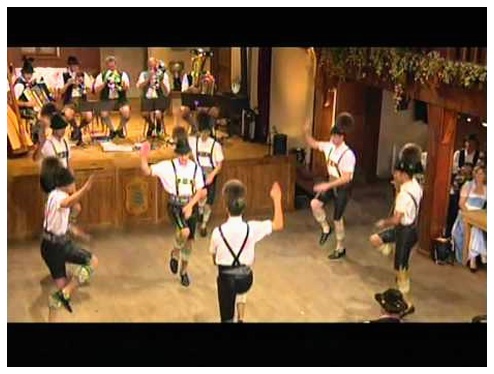
- Wir können den Schuhplattler tanzen. – We can dance the Schuhplattler dance.
Making polite requests:
- Können sie uns morgen helfen? – Can you help us tomorrow?
- Kannst du mir ein bisschen Bargeld geben? – Can you give me a little cash?
- Könnt ihr die Wäsche waschen? – Can you (all) do the laundry?
Asking for and giving permission:
- Kann ich deine Zeitung lesen? – May I read your newspaper?
- Können wir Ihr Auto ausleihen? – Can we borrow your car?
- Du kannst heute Abend ins Kino gehen. – You may go to the movies this evening.
Talking about opportunities:
- Wann kann er nach Hause kommen? – When can he come to the house?
- Ich kann jetzt nicht essen, weil ich Bauchsmerzen habe. – I can’t eat now, because I have a stomachache.
- Sie kann nur vormittags schlafen, weil sie nachts arbeitet. – She can only sleep in the mornings, because she works at night.
- Wir können uns nächste Woche treffen. – We can meet next week.
2. Permission: Dürfen
Dürfen is used to say what is allowed and what is not permitted.
In the positive sense, it gives permission for someone to do something:
- Sie dürfen hier Fotos machen. – You are allowed to take photos here.
- Die Schüler dürfen drei Bücher aus der Bibliothek ausleihen. – The students are allowed to check out three books from the library.
- Darf ich heute Abend lange aufbleiben? – Am I allowed to stay up late tonight?
When coupled with “nicht” (not), “dürfen” transforms its meaning to indicate prohibition, conveying that something is “not allowed” or “should not” happen. In this case, it can also be interpreted as “must not.” The surrounding context of the sentence will clarify the intended meaning.
- Man darf nicht ohne Führerschein fahren. – You are not permitted to drive without a license.
- Sie dürfen die Skulptur nicht berühren. – You are not allowed to touch the sculpture.
- Du darfst nicht so viel Franzbrötchen essen. – You shouldn’t eat so many French rolls.
- Ich darf mich nicht zu schnell entscheiden. – I shouldn’t decide too quickly.
- Sie darf nicht so mit ihm sprechen. – She must not speak to him that way.
3. Obligation: Müssen
The verb müssen expresses a strong obligation. It can be defined as “have to,” “need to,” or “must.”
Some examples include:
- Ich muss jetzt gehen. – I must leave now.
- Wir müssen zur Arbeit gehen. – We have to go to work.
- Sie müssen Lebensmittel einkaufen. – They need to buy groceries.
Müssen in the negative
When the phrase müssen nicht is used, it means “do not have to” or “do not need to.”
Zum beispiel (For example):
- Ich muss nicht zur Arbeit gehen. – I don’t have to go to work.
- Sie müssen nicht versuchen. – You do not need to try.
- Wir müssen nicht kochen. – We don’t have to cook.
4. Suggestions and plans: Sollen
We can use sollen (to be obligated, to be intended) like “should” or “shall” in English.
Beispiele (Examples):
- Du sollst die Modalverben auf Deutsch lernen. (You should learn the modal verbs in German.)
- Was sollen wir morgen tun? (What shall we do tomorrow?)
Future events: Konjunktiv II (imperfect subjunctive)
To discuss future events that are expected to occur, you’ll need to use the Konjunktiv II (imperfect subjunctive) form of the verb “sollen.” This grammatical structure helps express what should happen in a hypothetical or uncertain context.
“Should” in the future: The imperfect subjunctive form of sollen
| ich sollte (I should) | wir sollten (we should) |
| du solltest (you [sing. informal] should) | ihr solltet (you [plur. informal] should) |
| er/sie/es sollte (he/she/it should) | sie/Sie sollten (they/you [formal] should) |
Again, the first- and third-person forms are the same in the singular and plural.
Beispiele (Examples):
- Er sollte nächste Woche hier ankommen. (He should be here next week, He should arrive here next week.)
- Ich sollte heute Abend nicht zu lange aufbleiben. (I shouldn’t stay up too late tonight.)
- Sie sollten mehr Gemüse essen. (They/You [formal] should eat more vegetables.)
5. Supposedly: Es soll da
Es soll da is a set phrase meaning “supposedly.” It can also mean “they say that…” or “I’ve heard that…”
Zum Beispiel (For example):
- Es soll da diese Bäckerei die besten Brötchen hat. (They say that this bakery has the best rolls.)
- Es soll da er kocht gern. (I’ve heard that he likes to cook.)
- Es soll da Lorelei singt auf den Klippen am Rhein. (Supposedly, Lorelei sings on the cliffs near the Rhine River.)
6. Desire: Wollen
Wollen is the German modal we use to say what we want – whether it’s an object or an activity.
- Ihr wollt ein neues Auto. – You (all) want a new car.
- Willst du zum Rockkonzert mitkommen? – Do you want to come along to the rock concert?
The seventh modal: Möchten
The present indicative tense of “mögen” (to like) serves a straightforward purpose: it allows us to express our fondness for someone or something and to politely convey our desires.
- Ich mag Kaffee. – I like coffee.
- Magst du auch Kaffee? – Do you also like coffee?
- Sie mag diesen Musiker. – She likes this musician.
In German, instead of using the verb “mögen” to express enjoyment of activities, we typically use “gern” (or “gerne”) following the main verb. This term conveys a sense of pleasure, willingness, and enthusiasm for what we enjoy doing.
- Wir singen gern. – We like to sing.
- Er klettert gerne in die Berge. – He likes to climb the mountains.
Asking politely using mögen
We use mögen in the subjunctive imperfect mood to express wants, needs, and wishes politely.
In this form, mögen changes to möchten. This is why you’ll sometimes see “möchten” listed as a seventh German modal verb:
“Would like” in German: mögen in the subjunctive imperfect
| ich möchte (I would like) | wir möchten (we would like) |
| du möchtest (you [sing. informal] would like) | ihr möchtet (you [plur. informal] would like) |
| er/sie/es möchte (he/she/it would like) | sie/Sie möchten (they/you [formal] would like) |
Again, the first- and third-person verb forms (in bold in the table, above) match each other in the singular and plural, respectively.
Beispiele (Examples):
- Ich möchte einen Salat. – I would like a salad.
- Sie möchte gerne ein Haselnusseis. – She would like a hazelnut ice cream. [Here, gerne is used for extra politeness.]
- Möchtest du heute Abend einen Film sehen? – Would you like to watch a movie tonight?
- Möchten Sie ein zusätzliches Kopfkissen? – Would you like an extra pillow?
- Sie möchte Tierärztin werden. – She would like to become a veterinarian.
Final thoughts
Now that you have a better understanding of German modal verbs, you can appreciate their versatility and how essential they are in various daily conversations.
Here are a few ways to practice them:
- Memorize the modal verb conjugations. Even though all of the German modal verbs are irregular, their conjugations follow predictable patterns.
- Concentrate on mastering one meaning of German modals at a time. Start with the fundamental concepts like permission, desire, and obligation. After grasping these basics, explore the nuanced expressions of modal verbs to deepen your understanding.
- Create your own sentences using modal verbs. Utilize the templates and examples provided in this article to craft sentences with familiar German vocabulary. Begin with simple structures and progress to more complex sentences as you gain confidence in using modal verbs.
To master German modal verbs and use them effortlessly, try personalized 1-on-1 tutoring. At LingualNeeds, our experienced tutors offer tailored lessons and interactive conversation practice to enhance your learning experience. Plus, you can schedule sessions at times that suit your busy lifestyle.
You can even find German courses and classes for specific learning levels, age groups, or topics.
Frequently Asked Questions
What are German modal verbs used for?
German modal verbs are used to express abilities, opportunities, possibilities, obligations, and wishes, enriching communication in the language.
How many modal verbs are there in German?
There are six primary German modal verbs, but some sources suggest a seventh, which is ‘möchten’.
What is the structure for forming questions with modal verbs in German?
To form questions with modal verbs, combine a question word with a conjugated modal verb, followed by the subject, any adverbs or objects, and the main verb in its infinitive form.
How do you conjugate German modal verbs in the past perfect tense?
When conjugating German modal verbs in the past perfect tense, you always use ‘haben’ as the auxiliary verb.
What should you do to master German modal verbs effectively?
To master German modal verbs, memorize their conjugations, focus on one meaning at a time, and practice creating sentences using those verbs.


