

- What is thank you in German?
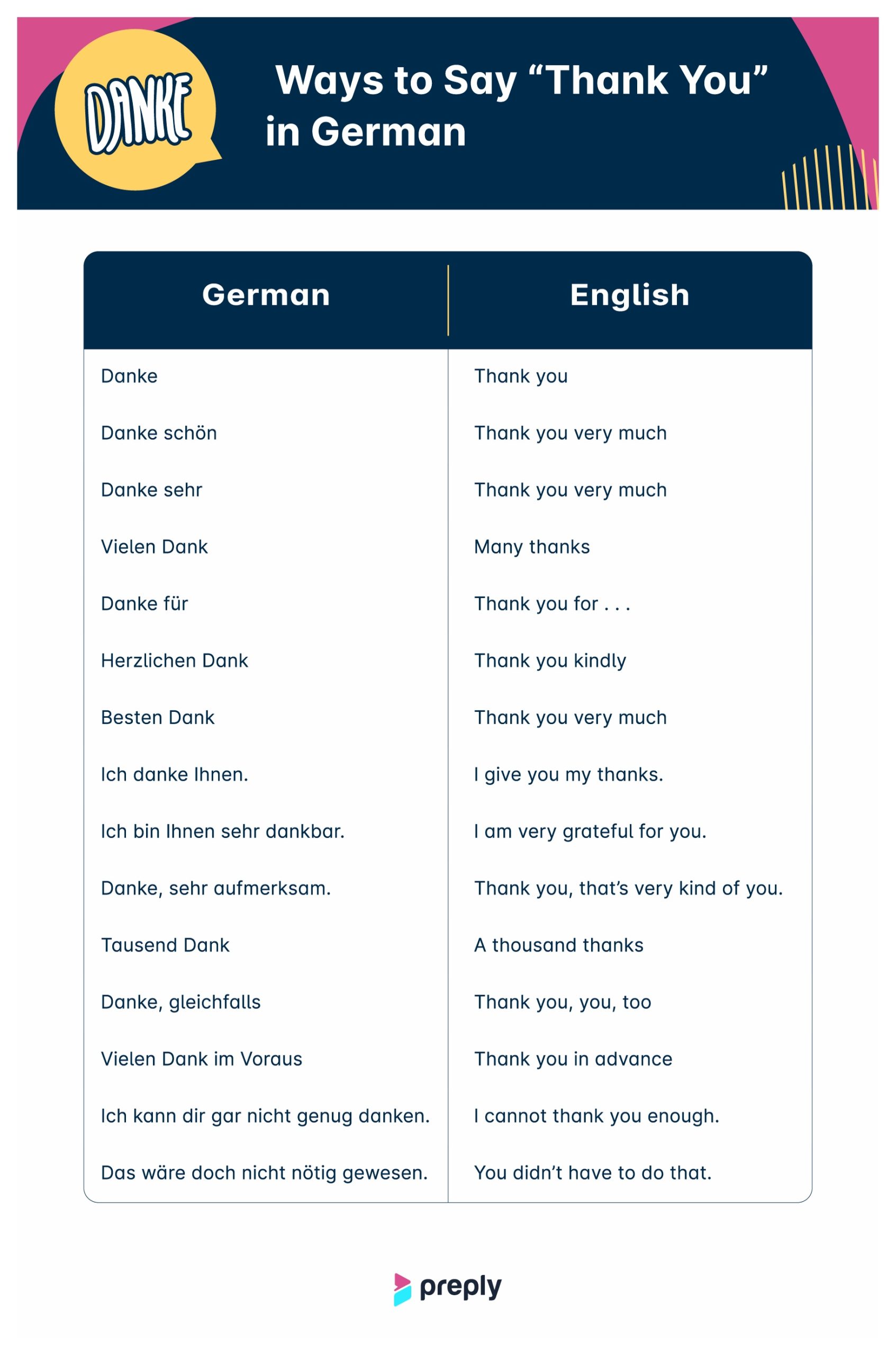
- 1. Danke schön (“Thank you very much”)
- 2. Danke sehr (“Thank you very much”)
- 3. Vielen Dank (“Many thanks”)
- 4. Danke für (“Thank you for…”)
- 5. Herzlichen Dank (“Thank you kindly”)
- 6. Besten Dank (“Thank you very much”)
- 7. Ich danke Ihnen (“I give you my thanks”)
- 8. Ich bin Ihnen sehr dankbar (“I am very grateful for you”)
- 9. Danke, sehr aufmerksam (“Thank you, that’s very kind of you”)
- 10. Tausend Dank (“A thousand thanks”)
- 11. Danke, gleichfalls (“Thank you, you, too”)
- 12. Vielen Dank im Voraus (“Thank you in advance”)
- 13. Ich kann dir gar nicht genug danken. (“I cannot thank you enough.”)
- 14. Das wäre doch nicht nötig gewesen. (“You didn’t have to do that.”)
- How do you respond to “thank you” in German?
- Conclusion
- Frequently Asked Questions
- What is the most common way to say ‘thank you’ in German?
- What does ‘Danke schön’ mean?
- How can I express gratitude for a specific gift in German?
- What is a heartfelt way to say thank you in German?
- What is the appropriate response to someone saying thank you in German?
Curious about how to say “thank you” in German? You’ve arrived at the perfect spot! In this blog, we’ll explore fourteen unique expressions of gratitude in the German language, helping you convey your appreciation in a variety of contexts.
Whether you’re traveling to Germany, learning the language, or simply looking to enrich your vocabulary, these phrases will prove useful in a variety of contexts. Join us as we delve into the German language and discover the many ways to express gratitude!
What is thank you in German?
In German, the most frequent way to express gratitude is by saying “danke.” However, similar to English, there are numerous variations of “danke” and alternative phrases to convey appreciation.
German culture places a high value on politeness, making it essential to express gratitude when learning the language. To help you navigate various social situations, we’ve compiled a list of 14 alternative ways to say “thank you” in German. This will ensure you’re always ready to show your appreciation!
Keep reading to learn more or discover online German classes on LingualNeeds.

1. Danke schön (“Thank you very much”)
“Danke schön,” a more formal way to express gratitude than just “danke,” translates to “thank you very much.” It’s a perfect phrase to use when someone shows you kindness or when you want to convey politeness in any situation.
Whether it’s a casual family dinner or a quick trip to the store, this phrase fits perfectly whenever you want to show a little extra appreciation. Did your dad pass you the butter at the dinner table? Just say, “Danke schön!” Did the cashier return your change? A heartfelt, “Danke schön!” will brighten their day!
- Example: Wie spät ist es? – Es ist 17 Uhr. – Danke schön!
- Translation: What time is it? – It’s 5 o’clock. – Thank you very much!
The phrase “danke schön” is a complete sentence in German, but it’s not typically used to express gratitude for something specific, like saying “thank you very much for . . .” We’ll explore how to convey that sentiment in a later section.
2. Danke sehr (“Thank you very much”)
“Danke sehr” serves a similar purpose to “danke schön,” functioning as a polite way to express gratitude in both formal and informal settings. While it carries a slightly more formal tone than “danke schön,” you can easily use both phrases interchangeably in casual conversations.
When you accidentally drop something and a kind stranger picks it up for you, what do you say? Danke sehr! And when the delivery driver arrives with your pizza just thirty minutes after placing the order, it’s another perfect moment to express gratitude. Danke sehr!
- Example: Wo ist das Badezimmer? – Hinten links. – Danke sehr!
- Translation: Where is the bathroom? – In the back on the left. – Thank you very much!
3. Vielen Dank (“Many thanks”)
“Vielen Dank” conveys a deeper sense of gratitude compared to the more common “danke schön.” This phrase is often used in heartfelt moments, such as when receiving a gift. You might also hear it in the expression “Vielen Dank für alles!” which means “Thank you for everything!”—a widely used sentiment in German culture.
- Example: Vielen Dank für die Blumen. Vielen Dank, wie lieb von dir!
- Translation: Many thanks for the flowers. Thank you so much, how sweet of you!
4. Danke für (“Thank you for…”)
“Danke für…” is a widely used expression in German that translates to “thank you for…”. This phrase is suitable for both formal and informal contexts, making it perfect for expressing gratitude for specific gifts or services. Although you’ll need to learn a few additional German words to complete the phrase, you don’t need to be fluent in the language to show your politeness.
- Example: Danke für das Geschenk! Das ist genau, was ich wollte.
- Translation: Thank you for the present! It’s exactly what I wanted.
5. Herzlichen Dank (“Thank you kindly”)
“Herzlichen Dank” is a heartfelt way to say thank you in German. The word “Herz,” meaning “heart,” emphasizes that your gratitude is genuine and sincere, ensuring the recipient feels the depth of your appreciation beyond mere obligation.
Often, when the phrase is written, people creatively substitute the first four letters with a heart symbol, transforming it into “❤️lichen Dank!” This playful twist adds a touch of warmth to the expression of gratitude.
- Example: Herzlichen Dank für deine Unterstützung!
- Translation: Thank you very much for your support!
6. Besten Dank (“Thank you very much”)
To express gratitude without being overly sentimental, consider using the phrase “Besten Dank.” This German expression translates to “best of thanks” or “thank you very much,” making it a perfect choice for a sincere yet balanced acknowledgment.
- Example: Besten Dank für Ihr Verständnis!
- Translation: Thank you very much for your understanding!
7. Ich danke Ihnen (“I give you my thanks”)
The phrase “Ich danke Ihnen” is a formal expression of gratitude in German. It’s typically employed in situations where politeness is essential, such as when addressing someone you respect or don’t know well, like an elder family member or a colleague. This phrase conveys appreciation while maintaining a respectful tone.
- Example: Ich danke Ihnen für Ihre Hilfe! Ohne Sie hätte ich es nicht geschafft.
- Translation: I thank you for your help! I could not have done it without you.
If you’re speaking to a friend, you might instead say, “Ich danke dir.”
8. Ich bin Ihnen sehr dankbar (“I am very grateful for you”)
This phrase can be formal or informal, depending on the pronoun used:
- Formal: Ich bin Ihnen sehr dankbar
- Informal: Ich bin dir sehr dankbar
This phrase shines in personal interactions, especially when you genuinely appreciate someone and want to convey that sentiment. It also serves as a great conversation starter, allowing you to share the reasons behind your gratitude and deepen your connection.
- Thank you for everything you did for me yesterday; your support was invaluable and truly appreciated.
- Thank you for your kindness yesterday; I truly appreciate all you did for me.
9. Danke, sehr aufmerksam (“Thank you, that’s very kind of you”)
When someone goes out of their way to help you and make your life easier, a heartfelt way to express your gratitude is by saying, “Danke, sehr aufmerksam.” You can also simply say “sehr aufmerksam” as a standalone compliment, with or without the “danke.” This phrase beautifully acknowledges their thoughtfulness.
- Example: Your friend helps you clean up the dishes after a dinner party without being asked. Danke, sehr aufmerksam!
- Translation: Thank you, that’s very kind!
10. Tausend Dank (“A thousand thanks”)
The phrase “Tausend Dank!” is the German equivalent of saying “thanks a million.” It’s a casual expression commonly used among friends or acquaintances to show appreciation for their help. Whether they stepped in to cover your work shift or gave you a ride to the grocery store while your car was being repaired, a heartfelt “Tausend Dank!” is a fitting way to acknowledge their kindness.
- Example: Tausend Dank für deine Hilfe! Menschen wie dich gibt es nicht so oft.
- Translation: A thousand thanks for your help! There are not many people like you.
11. Danke, gleichfalls (“Thank you, you, too”)
When someone expresses their good wishes, shows kindness, or offers encouragement, you can reciprocate with a heartfelt “Danke, gleichfalls!” This phrase works perfectly in both formal and informal contexts. For instance, if your friend wishes you luck before an exam, you can respond with “Danke, gleichfalls!” to show your appreciation and send good vibes back her way.
- Example: Your whole family gets together for Sunday lunch and your dad says: – Guten Appetit! Everyone else would reply: Danke, gleichfalls!
- Translation: Enjoy your food! – Thank you, you too!
12. Vielen Dank im Voraus (“Thank you in advance”)
The phrase “Vielen Dank im Voraus” translates to “Thank you in advance” and expresses gratitude for something that is yet to occur. However, it’s important to note that this expression is typically reserved for written communication, particularly in formal letters and emails directed at authorities, educators, or individuals in positions of higher status.
This phrase conveys your appreciation for something anticipated in the future, such as someone’s attention to a significant matter, their efforts, or a forthcoming reply.
- Example: Über eine Einladung zum Bewerbungsgespräch würde ich mich freuen. Vielen Dank im Voraus!
- Translation: I would appreciate an invitation to the interview. Many thanks in advance!
13. Ich kann dir gar nicht genug danken. (“I cannot thank you enough.”)
There are moments when someone’s support, effort, or assistance profoundly impacts your life, leaving you overwhelmed with gratitude. In such occasions, expressing your appreciation with the phrase “Ich kann dir gar nicht genug danken!” is a wonderful way to convey your heartfelt thanks.
Did a friend leverage their professional network to land you your dream job? “I can’t thank you enough!” Or perhaps a doctor performed a life-saving procedure on a family member after a serious accident? “I can’t thank you enough!” Gratitude in these moments is immeasurable.
- Example: Dank dir kann ich endlich wieder Geld verdienen. Ich kann dir gar nicht genug danken!
- Translation: Thanks to you, I can finally earn money again. I cannot thank you enough!
14. Das wäre doch nicht nötig gewesen. (“You didn’t have to do that.”)
The expression “das wäre doch nicht nötig gewesen” is used to convey your surprise and gratitude when someone unexpectedly does something kind for you. Whether it’s receiving a thoughtful surprise gift from a loved one or a neighbor clearing your walkway after a heavy snowfall, this phrase beautifully acknowledges their generosity. It’s a heartfelt way to say thank you while also recognizing the thoughtfulness behind their actions.
- Example: When hosting friends for dinner, if one brings a bottle of wine, you might say, “Oh, that wasn’t necessary!”
- Translation: Aww, you didn’t have to do that.
How do you respond to “thank you” in German?
The common response to “thank you” in German is “bitte,” meaning “you’re welcome.”
In German, expressing gratitude goes beyond just saying “thank you”—there are various ways to say “you’re welcome” depending on the context. Here are several phrases you can use to respond to thanks in German, along with tips on when to use each one in conversation.
- **Bitte (“You’re Welcome”):** In German, the standard reply to “thank you” is “bitte,” meaning “you’re welcome.” Germans value politeness, so failing to respond appropriately can be seen as rude. For instance, if someone says “Danke” after you pass the salt, it’s your cue to say “bitte.” Additionally, “bitte” translates to “please,” which explains why you might hear Germans respond to your English thanks with “please.”
- **Bitte schön (“You’re Very Welcome”)**: Respond to “Danke schön” with “Bitte schön,” which means “You’re very welcome.” For a similar response to “Danke sehr,” use “Bitte sehr.” Both phrases acknowledge the gratitude expressed by the other person.
- Gern geschehen (“my pleasure”): This German phrase is a warm response to “thank you,” indicating that it was no trouble at all and a pleasure to assist.
- Jederzeit (“Any Time”): This friendly phrase is a versatile response to “thank you,” suitable for both formal and informal contexts. It conveys a willingness to help again at “any time.”
- **Kein Problem (“No Problem”):** Respond with “Kein Problem!” when someone thanks you to express that you were happy to help and that it caused you no inconvenience. This phrase is particularly effective after doing a significant favor, reassuring the other person that they are not a burden.
Conclusion
You’ve just discovered some of the most popular ways to express “thank you” in German! Regardless of the language, expressing gratitude is essential in any conversation. Familiarizing yourself with both informal and formal expressions of thanks equips you to handle a variety of social situations with confidence.
Are you eager to embark on your journey to learn German, enhance your existing skills, or explore a different language? Look no further than LingualNeeds! We offer a wealth of resources tailored to all your language-learning aspirations. Why not kickstart your progress today by scheduling a session with an online German tutor? Take that important step towards achieving your language goals!
Frequently Asked Questions
What is the most common way to say ‘thank you’ in German?
The most common way to say ‘thank you’ in German is ‘danke.’
What does ‘Danke schön’ mean?
‘Danke schön’ translates to ‘thank you very much’ and is a more formal way to express gratitude.
How can I express gratitude for a specific gift in German?
You can use the phrase ‘Danke für…’ which translates to ‘thank you for…’ to express gratitude for a specific gift.
What is a heartfelt way to say thank you in German?
‘Herzlichen Dank’ is a heartfelt way to say thank you, emphasizing genuine and sincere gratitude.
What is the appropriate response to someone saying thank you in German?
The standard response is ‘bitte,’ which means ‘you’re welcome.’


