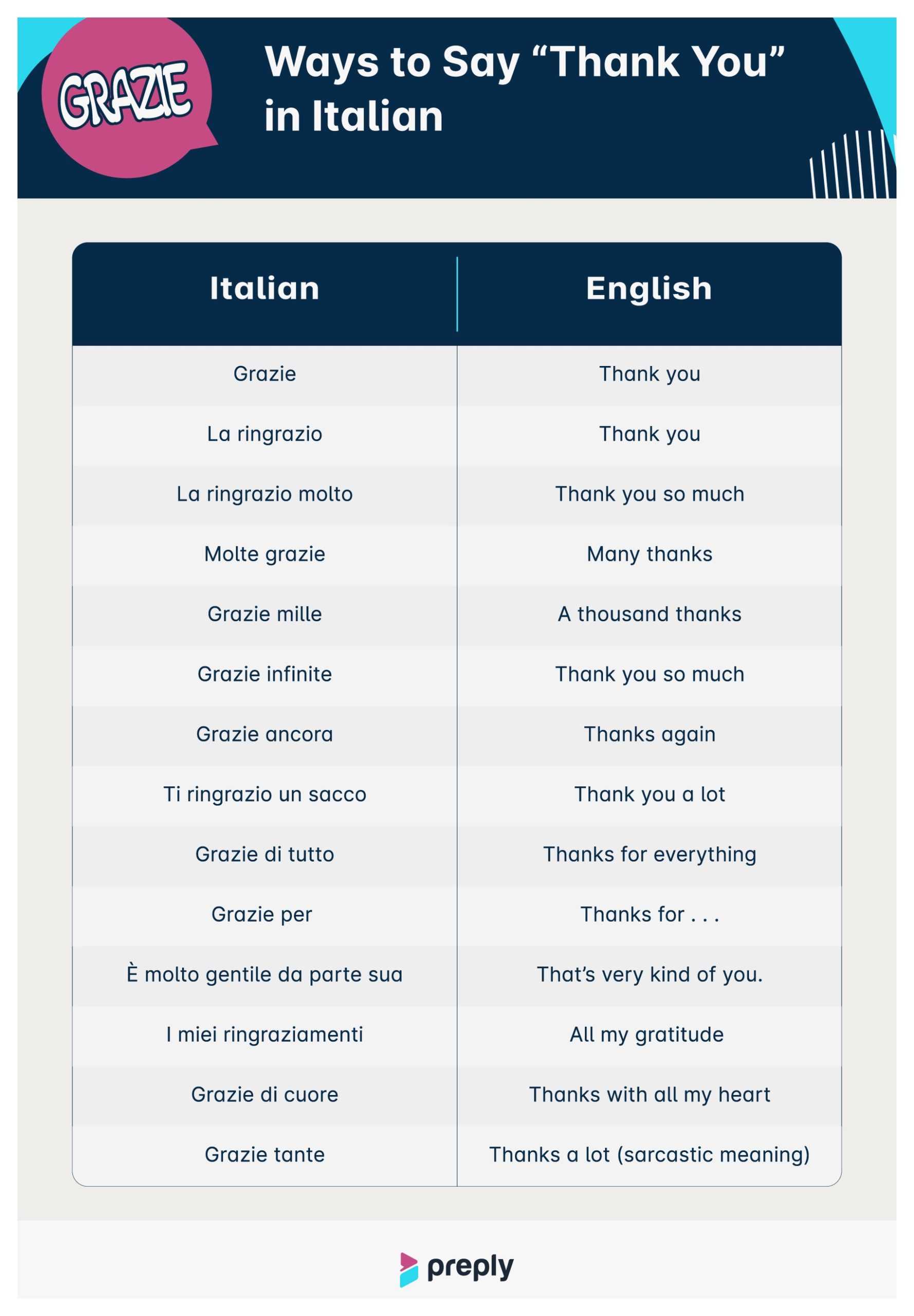
- 1. La ringrazio (“thank you”)
- 2. La ringrazio molto (“thank you so much”)
- 3. Molte grazie (“many thanks”)
- 4. Grazie mille (“a thousand thanks”)
- 5. Grazie infinite (“thank you so much”)
- 6. Grazie ancora (“thanks again”)
- 7. Ti ringrazio un sacco (“thank you a bag”)
- 8. Grazie di tutto (“thanks for everything”)
- 9. Grazie per and Grazie di (“thanks for . . .”)
- 10. È molto gentile da parte sua (“that’s very kind of you”)
- 11. I miei ringraziamenti (“all my gratitude”)
- 12. Grazie di cuore (“thanks with all my heart”)
- 13. Grazie tante (“thanks a lot” sarcastically)
- How to respond to “thank you” in Italian
- What’s the difference between “grazie” and “grazia”?
- Common pronunciation mistakes
- Conclusion
- Frequently Asked Questions
- What is the simplest way to say thank you in Italian?
- How do you express deeper gratitude in Italian?
- What is the difference between ‘grazie mille’ and ‘grazie infinite’?
- How should you respond to someone saying thank you in Italian?
- What common mistake do English speakers make when pronouncing Italian words?
In Italian, the simplest and most widely used way to express gratitude is by saying “grazie.” This fundamental word serves as the foundation for all expressions of thanks in the language.
Expressing gratitude is a universal gesture, and the Italian language, much like English, provides numerous ways to say “thank you.” Whether for minor favors or significant acts, knowing these phrases can enhance your conversations. Here’s a list of expressions to help you convey your appreciation in various contexts as you learn Italian.

1. La ringrazio (“thank you”)
“La ringrazio” is a courteous alternative to “grazie,” offering a more formal expression of gratitude. This phrase is especially useful when addressing someone you wish to respect, such as a stranger or an elder.
In Italian, it’s essential to adjust your pronouns based on your familiarity with the person you’re addressing or the level of politeness required by the situation. Specifically, when using this particular phrase, you switch the pronoun from “you” to “her,” which applies to both men and women. This respectful form of communication is known as “forma di cortesia.”
The phrase “la ringrazio” translates directly to “I thank her.” In a more casual context, you might use “ti ringrazio,” which means “I thank you.”
- Example:
“Potrebbe portarci un’altra tazza di caffè, per cortesia?”
“Certo, arrivo subito.”
“La ringrazio.”
- Translation:
“Could you bring us another cup of coffee, please?”
“Sure, I’ll be right there.”
“Thank you.”
2. La ringrazio molto (“thank you so much”)
When someone you’re not well-acquainted with goes out of their way to assist you, saying “La ringrazio molto” conveys a deeper sense of appreciation than a standard “thank you.” This phrase offers a heartfelt touch to your gratitude. Similarly, you can express even more warmth with the variation “la ringrazio tanto,” which serves the same purpose of showing sincere thanks.
- Example:
“Mi scusi, può indicarmi la strada per raggiungere la torre?”
“Deve andare verso via Garibaldi.”
“La ringrazio molto.”
- Translation:
“Excuse me, can you show me the way to reach the tower?”
“You need to go towards Garibaldi Street.”
“Thank you so much.”
3. Molte grazie (“many thanks”)
This Italian expression, akin to “la ringrazio molto,” serves as a formal means of conveying appreciation, translating directly to “many thanks.”
- Example:
“Ecco la chiave della sua camera, ci faccia sapere se le serve altro.”
“Molte grazie.”
- Translation:
“Here’s the key to your room, let us know if you need anything else.”
“Many thanks.”
4. Grazie mille (“a thousand thanks”)
While “grazie mille” can be used in formal settings or with strangers, it’s a favorite among friends and family. Often expressed as “mille grazie,” this phrase means “a thousand thanks,” akin to the English expression “thanks a million.” It’s a heartfelt way to show just how much you value someone’s kindness or gesture.
- Example: “Il tuo regalo è stato molto apprezzato. Grazie mille!”
- Translation: “Your present was greatly appreciated. A thousand thanks!”
5. Grazie infinite (“thank you so much”)
The Italian expression “grazie infinite” means “endless thanks” or “infinite thanks.” While it shares a similar sentiment with “grazie mille,” this phrase carries an even deeper emotional resonance. It’s versatile enough to be used in both formal and casual contexts, making it a wonderful way to express genuine gratitude.
- Example: “Grazie infinite per il tuo prezioso aiuto. Non ce l’avrei fatta altrimenti.”
- Translation: “Thank you so much for your precious help. I couldn’t have done it otherwise.”
6. Grazie ancora (“thanks again”)
“Grazie ancora” means “thanks again.” This phrase expresses a deeper level of gratitude, suggesting that a single “thank you” doesn’t capture how much you appreciate someone’s kindness or support.
- Example: “La cena era deliziosa. Spero di rivedereci presto. Grazie ancora!”
- Translation: “Dinner was delicious. Hope to see you again soon. Thanks again!”
7. Ti ringrazio un sacco (“thank you a bag”)
In Italy, you’ll often hear the informal phrase “ti ringrazio un sacco,” especially among friends. This charming expression translates to “thank you a lot,” with “un sacco” literally meaning “a bag.” It serves as a colorful way to convey deep gratitude in everyday conversation.
- Example: “Ti ringrazio un sacco per gli appunti che mi hai prestato, non capisco nulla di matematica.”
- Translation: “Thank you so much for the notes you lent me. I don’t understand math at all.”
8. Grazie di tutto (“thanks for everything”)
“Grazie di tutto” is a heartfelt expression used to convey gratitude at the end of an experience. It’s the perfect way to thank someone for their kindness, whether they hosted you for a delightful dinner or took you on an unforgettable trip. This phrase encapsulates appreciation for the entire experience, making it a meaningful way to acknowledge the effort someone put into making your time special.
- Example: “Lavorare con voi è stata una fantastica esperienza e mi mancherete. Grazie di tutto.”
- Translation: “Working with you was a fantastic experience, and I’ll miss you. Thanks for everything.”
9. Grazie per and Grazie di (“thanks for . . .”)
When expressing gratitude in Italian, you can use “Grazie per . . .” or “Grazie di . . .” to thank someone for something specific. Both phrases are versatile and suitable for formal or informal contexts. The choice between “per” and “di” hinges on the nature of your gratitude: use “per” when referring to a noun and “di” when acknowledging an action.
- Example: “Grazie per essere qui oggi.”
- Translation: “Thank you for being here today.”
- Example: “Grazie di aver chiamato.”
- Translation: “Thank you for calling.”
10. È molto gentile da parte sua (“that’s very kind of you”)
This phrase goes beyond a basic “thank you,” offering a heartfelt expression of gratitude. It’s perfect for moments when someone has done something kind for you, such as a favor, and you want to convey your genuine appreciation.
In Italian, the term “sua” indicates a formal context, conveying respect and politeness. In contrast, using “tua” reflects a more casual tone, translating to “it’s very kind of you.”
- Example: “La ringrazio per avermi aiutato ad organizzare la festa, è molto gentile da parte sua.”
- Translation: “Thank you for helping me organize the party; that’s very kind of you.”
11. I miei ringraziamenti (“all my gratitude”)
This Italian idiom is primarily employed in formal contexts to express gratitude, whether addressing the public, a distinguished individual, or a collective audience.
- Example: “I miei ringraziamenti vanno a tutti i membri dello staff, che hanno reso questo evento possibile.”
- Translation: “All my gratitude goes to all the staff members who made this event possible.”
12. Grazie di cuore (“thanks with all my heart”)
“Grazie di cuore” means “thanks with all my heart,” akin to the English expression “from the bottom of my heart.” This heartfelt phrase conveys deep appreciation and can be used in both formal and casual contexts, making it versatile for any occasion.
- Example: “Luca, grazie di cuore per le tue parole. È un periodo difficile ed apprezzo ciò che dici.”
- Translation: “Thank you, Luca, for your heartfelt words. I’m going through a tough time and truly appreciate your support.”
13. Grazie tante (“thanks a lot” sarcastically)
The Italian expression “grazie tante” is often employed sarcastically, implying that you actually don’t value the person’s actions or words. If you genuinely wish to convey your gratitude, it’s best to avoid using this phrase.
The phrase “tante grazie” can sometimes be used sarcastically, but it generally conveys the same sentiment as “molte grazie,” meaning “thank you very much.” To avoid any potential misunderstandings or unintentional offense, be careful not to confuse “grazie tante” with “tante grazie.”
- Example: “Non mi serve la tua pietà, ma grazie tante.”
- Translation: “I don’t need your pity, but thanks a lot.”
How to respond to “thank you” in Italian
Similar to the English phrase “thank you,” Italian offers a variety of expressions for saying “you’re welcome.” The most widely used term is “prego,” which means “you are welcome” and fits any context. However, Italian has a rich vocabulary for expressing welcome in different ways. Here’s a quick list to enhance your Italian language skills:
- Di niente (“not at all”): This phrase translates to “(thank you) of nothing,” indicating that your action or comment was minor and done with enthusiasm.
- Figurati (“no problem”): This word translates into “forget about it,” and is similar to “no problem” in its meaning.
- Non c’è problema (“no problem”): An Italian phrase signifying that your assistance posed no inconvenience, conveying a sense of ease and willingness to help.
- **Ci mancherebbe (“don’t mention it”)**: This Italian phrase is equivalent to the English expression “don’t mention it.” Use it to convey that no thanks are necessary, emphasizing that your actions or words were genuine and offered without expectation of reciprocation. It is typically used in informal contexts.
- **”È stato un piacere” (“It was a pleasure”)**: This phrase expresses appreciation and delight in response to someone’s gratitude, suitable for both formal and informal contexts.
What’s the difference between “grazie” and “grazia”?
The Italian verb “ringraziare,” meaning “to thank,” is the source of the word “grazie.” Meanwhile, “grazia” translates to “grace” in English. It’s important to note that these are distinct words with different meanings and should not be used interchangeably.
Common pronunciation mistakes
English speakers often overlook the pronunciation of the final “e” in Italian words, as it tends to be silent in English. A frequent error is mispronouncing “grazie” as “graht-see,” when it should actually be pronounced as “GRAHT-see-eh.” Emphasizing that final “e” can greatly enhance your Italian pronunciation!
This also applies to words like “mille,” “molte,” “infinite” and “tante.”
Conclusion
No matter what language you use, good manners are essential. With your newfound knowledge of how to say “thank you” in Italian, you can now show appreciation to Italian speakers in any context.
Whether you’re starting your journey to learn Italian, advancing your existing skills, or exploring a different language altogether, LingualNeeds offers a wealth of resources tailored for learners at every level. Book a session with one of our online tutors today and take a significant step toward unlocking the vibrant world of languages!
Frequently Asked Questions
What is the simplest way to say thank you in Italian?
The simplest way to say thank you in Italian is ‘grazie.’
How do you express deeper gratitude in Italian?
‘La ringrazio molto’ means ‘thank you so much’ and conveys a deeper sense of appreciation.
What is the difference between ‘grazie mille’ and ‘grazie infinite’?
‘Grazie mille’ means ‘a thousand thanks,’ while ‘grazie infinite’ translates to ‘endless thanks’ and carries a deeper emotional resonance.
How should you respond to someone saying thank you in Italian?
You can respond with ‘prego,’ which means ‘you are welcome,’ or use other expressions like ‘di niente’ or ‘figurati.’
What common mistake do English speakers make when pronouncing Italian words?
English speakers often overlook the pronunciation of the final ‘e’ in Italian words, which should be pronounced clearly.