
- Will vs. Would: How They’re Different (and How to Use Each)
- When to usewill
- When to usewould
- Frequently Asked Questions
- What is the main difference between ‘will’ and ‘would’?
- When should I use ‘will’?
- In what situations is ‘would’ preferred over ‘will’?
- Can ‘will’ and ‘would’ be used interchangeably?
- How can I practice using ‘will’ and ‘would’ effectively?
Understanding modal verbs is crucial for mastering English, as they play a significant role in everyday communication and are fundamental to English grammar. Giving them the attention they deserve will enhance your language skills and fluency.
“Will” and “would” are essential English modal verbs, and mastering their use is key to effective communication. To ensure you’re using them correctly, it’s crucial to grasp the distinctions between “will” and “would.” Let’s explore some helpful guidelines to clarify their proper usage in English.
Will vs. Would: How They’re Different (and How to Use Each)
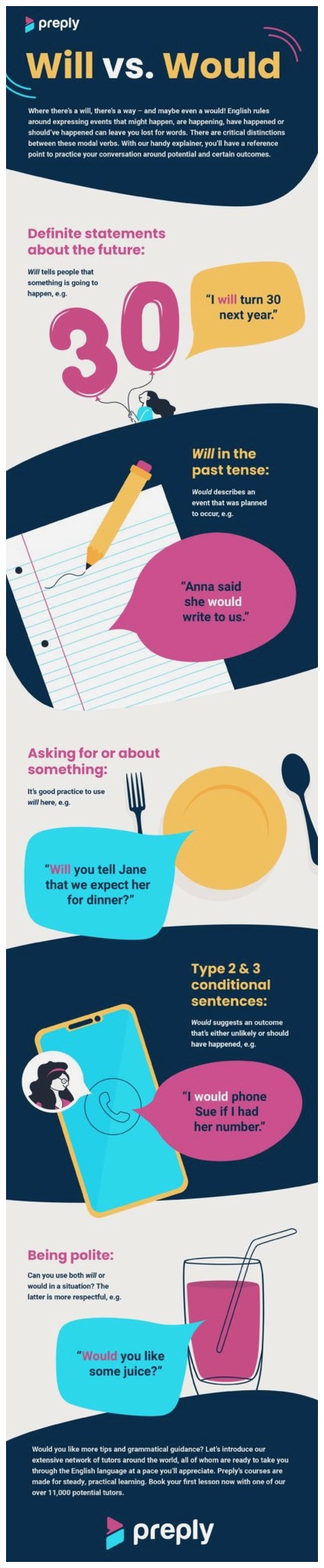
The key distinction between “will” and “would” lies in their tense usage. “Would” can be employed in the past tense, while “will” is strictly future-oriented. Additionally, “would” often describes a potential future event that depends on certain conditions, whereas “will” is used to make straightforward predictions about future occurrences.
Let’s get into more detail below to illustrate these differences.
When to use will
The word “willis” is often employed when talking about scenarios involving the simple future verb form. It specifically appears in statements that pertain to future events or actions.
- They will have two extra meetings this afternoon.
- I will be thirty next year.

We also use this modal verb to discuss immediate or spontaneous decisions or actions.
- Somebody is ringing the bell. I’ll (I will) go and see.
- What will you drink? Well, I’ll have a cup of coffee.
When you request a favor or seek information about what lies ahead, the word “will” is an effective choice to convey your intentions.
- Will you tell Jane that we expect her for dinner?
- Will you copy these files and print them for all the students, please?
For promises, sentences, and predictions, use will.
- I will always remember you.
- Can’t you do this task? Don’t worry, dad will soon come and help you.
- Those people won’t (will not) tell you the truth.
The word will is used in Type 1 conditional sentences.
- We will go fishing at the weekend if the weather is good.
- You will pass the exam if you study well.
When to use would
Firstly, the word would is the past tense form of the word will.
- Jack said he would finish the work the next day.
- Ann said she would write us soon.
- He hoped she would come.
Would is used in Type 2 and Type 3 conditional sentences.
- I would phone Sue if I had her number.
- We would have gone fishing on the weekend if the weather had been good.
In cases where both will and would can be used, it is considered more polite to use would.
- Would you like some juice?
- It’s hot in here, would you mind opening the window?
A few more examples of the modal verb would:
- Would you like a piece of apple pie? (question)
- I’d (I would) like to have some milk. (request)
- I’d like to learn French very well. (desire or plan)
- I’d rather have a glass of water than juice now. (preference)
Now practice!
Your task is to explore the question, “If you had the power to change the world, what would you do?” Share your ideas and envision the impact of your changes on society and the planet.

Frequently Asked Questions
What is the main difference between ‘will’ and ‘would’?
‘Will’ is used for future predictions, while ‘would’ is often used for potential future events that depend on certain conditions and can indicate past tense.
When should I use ‘will’?
‘Will’ is used for making predictions about the future, spontaneous decisions, requests, promises, and in Type 1 conditional sentences.
In what situations is ‘would’ preferred over ‘will’?
‘Would’ is used for polite requests, when discussing hypothetical situations, and in Type 2 and Type 3 conditional sentences.
Can ‘will’ and ‘would’ be used interchangeably?
In some cases, yes, but ‘would’ is generally considered more polite when both can be used.
How can I practice using ‘will’ and ‘would’ effectively?
You can practice by exploring conditional sentences and using them in questions or requests, such as asking ‘Would you like some juice?’.