
- How to form plural nouns
- Plural rule #1: -s and -es suffixes
- Plural rule #2: -y and -ie suffixes
- Plural rule #3: -o endings
- Plural rule #4: -f and -fe endings
- Plural rule #5: some ‘-s’ and ‘-z’ endings
- Irregular plural nouns in English
- Singular and plural nouns that are the same
- Nouns and plural forms: Conclusion
- Frequently Asked Questions
- What are the basic forms of nouns in English?
- How do you generally form the plural of a noun?
- What is the pluralization rule for nouns ending in ‘y’?
- Are there exceptions to the pluralization rules?
- What are irregular plural nouns?
In English, nouns serve as the building blocks for identifying people, places, and things, such as “the dog” or “the beach.” But what’s the trick to turning these nouns into their plural forms?
This article will explain some simple rules for plural nouns in English and how to use them in sentences.
If you’re diving into the world of English, continue reading to uncover all you need to know about plural nouns, complete with examples. Alternatively, explore online English grammar classes at LingualNeeds to enhance your learning experience!
How to form plural nouns
Nouns come in two distinct forms: singular and plural. Singular nouns denote a single person, place, or object, making them straightforward to grasp. For instance:
‘Where is the piano?’
In this sentence, the noun “piano” is singular, indicating there is just one. If there were multiple pianos, the sentence would change to reflect that.
‘Where are the pianos?’
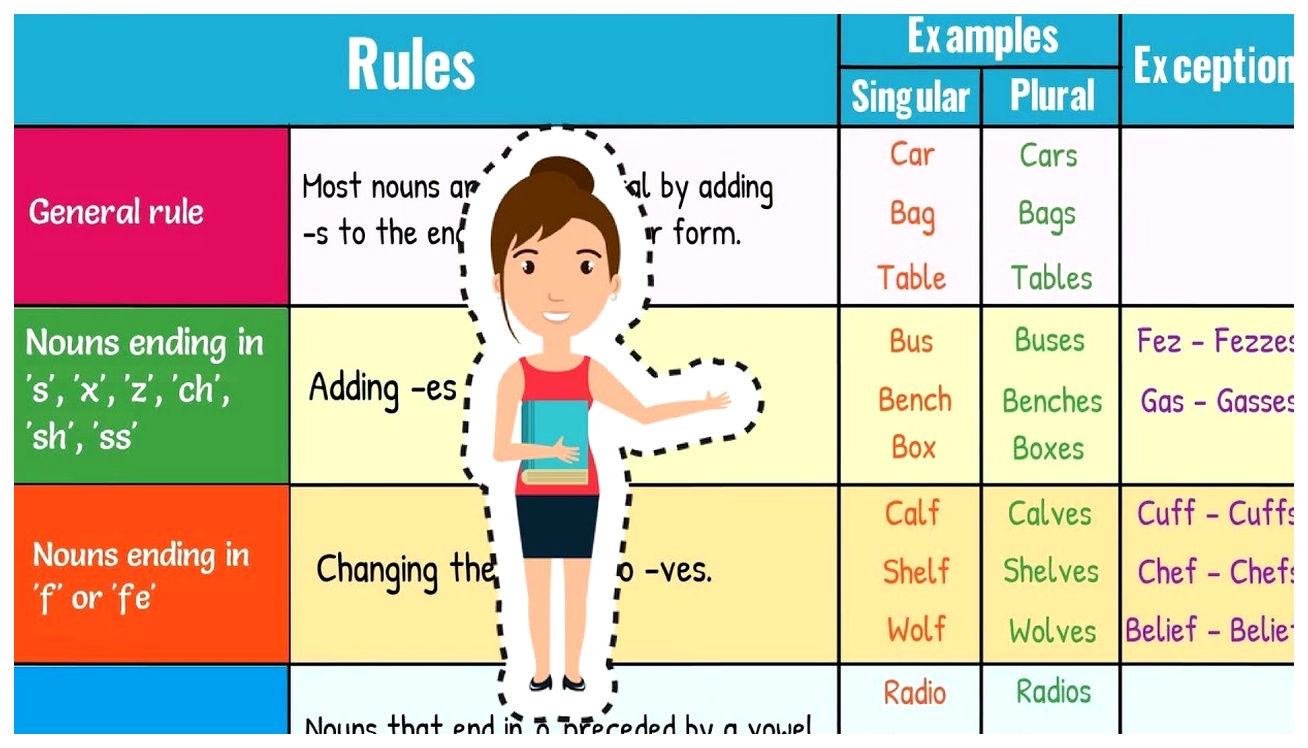
To transform a singular noun into its plural form, simply add an ‘-s’. However, this isn’t a universal rule for all nouns. Let’s explore the various pluralization rules for different types of nouns in more detail below.
Plural rule #1: -s and -es suffixes
The first rule is quite straightforward and mirrors the piano example mentioned earlier. For most nouns, you can easily create the plural form by simply adding the suffix ‘-s.’ For instance:
- orange – oranges
- pen – pens
Or, if the word ends with –ss, -x, -ch, or –sh, add the suffix ‘-es’. For example:
- dress – dresses
- fox – foxes
- bench – benches
- dish – dishes
Plural rule #2: -y and -ie suffixes
The next rule for forming plurals involves nouns that end in ‘-y’ and are preceded by a consonant. In this case, you change the ‘-y’ to ‘-i’ and add ‘-es.’ For instance:
- cherry – cherries
- puppy – puppies
If a vowel precedes the letter ‘-y’ (as in ‘ey,’ ‘ay,’ or ‘oy’), just add ‘–s’ without making any other changes. For instance:
- monkey – monkeys
- toy – toys
- day – days
Ready to practice? Write the plurals of the examples below:
- strawberry ______________________
- picture ______________________
- tux _________________________
- pillow ______________________
- swatch ______________________
- cowboy ______________________
Plural rule #3: -o endings
The next rule is when a noun ends with a vowel, then an ‘-o’, you only add an ‘-s’. For example:
- pistachio – pistachios
- stereo – stereos
However, if there is a consonant before the ’-o’, in general, you add ‘-es’. For example:
- hero – heroes
- veto – vetoes
There are some cases where just an ‘-s’ is added, for example:
- piano – pianos
There are exceptions to rules in many parts of English grammar, so check in a dictionary if you’re in doubt.
Plural rule #4: -f and -fe endings
Nouns that end in ‘-f’ or ‘-fe’ follow a specific rule when pluralized. To form the plural, simply change the ‘-f’ or ‘-fe’ to ‘-v’ and add ‘-es’. For instance:
- wife – wives
- knife – knives
- loaf – loaves
Exercise caution, as there are exceptions to this rule. Not every word that ends with ‘-f’ follows the same pattern. For instance:
- chef – chefs
For nouns that end ‘-ff’, just add ‘-s’. Nothing else changes. For example:
- cliff – cliffs
- puff – puffs
Plural rule #5: some ‘-s’ and ‘-z’ endings
Certain nouns that end with ‘-s’ or ‘-z’ require you to double the final ‘-s’ or ‘-z’ before adding ‘-es’ to form the plural. For instance:
- fez – fezzes
- gas – gasses
Irregular plural nouns in English
Irregular nouns, as their name implies, do not adhere to the typical rules for creating plurals. Unlike regular plural nouns, which follow established guidelines, irregular nouns take on unique forms when they change from singular to plural.
These are known as “irregular plurals.” Unlike regular plurals, they don’t follow a specific pattern, which means the best way to master them is through memorization and practice.
Here is a list of some of the most common irregular verbs:
- child – children
- person – people
- man – men
- woman – women
- tooth – teeth
- foot – feet
- mouse – mice
- goose – geese
- ox – oxen
The English language is rich with words borrowed from Latin, French, and Greek, many of which feature irregular plural forms. For instance:
- basis – bases
- radius – radii
- syllabus – syllabi
Singular and plural nouns that are the same
Lastly, the simplest nouns are those that remain unchanged in both their singular and plural forms. Here are some of the most frequently used examples:
- sheep
- fish
- means
- species
- series
- ice
- deer
Nouns and plural forms: Conclusion
This guide provides valuable insights into the use of nouns and the rules for forming plurals, but remember, practice is essential for mastering these concepts!
As highlighted in our article, some nouns defy the usual rules of grammar. To master these exceptions, it’s essential to actively learn them and apply this knowledge in practice.
Don’t worry, it’s not the end of the road! You can kickstart your learning journey by using this article for self-assessment or by downloading free worksheets available online.
We highly encourage you to practice speaking one-on-one with an English tutor. This personalized approach allows you to apply grammar rules in real-life conversations, making it easier to retain what you learn.
Frequently Asked Questions
What are the basic forms of nouns in English?
Nouns in English come in two forms: singular and plural.
How do you generally form the plural of a noun?
To form the plural of most nouns, you simply add an ‘-s’ at the end.
What is the pluralization rule for nouns ending in ‘y’?
If a noun ends in ‘y’ preceded by a consonant, change the ‘y’ to ‘i’ and add ‘-es’; if preceded by a vowel, simply add ‘-s’.
Are there exceptions to the pluralization rules?
Yes, there are exceptions for several rules, so it’s advisable to check a dictionary if in doubt.
What are irregular plural nouns?
Irregular plural nouns do not follow standard pluralization rules and often require memorization to master.