
- Either/orand neither/nor explained
- What’s the difference betweeneither/orand neither/nor?
- ▶
- How to useeither/orand neither/nor
- Use 1:Adverb
- Use 2: Adjective
- Use 3:Determiner
- Use 4: Pronoun
- Use 5: Conjunction
- Either/or and neither/nor summary
- Frequently Asked Questions
- What are the main uses of either/or and neither/nor?
- How do I ensure correct verb agreement when using either/or and neither/nor?
- What is the difference between either/or and neither/nor?
- Can you provide an example of either used as a determiner?
- What is a practical way to practice mastering either/or and neither/nor?
Are you struggling with the use of either/or and neither/nor? You’re not alone! Many learners find these pairs challenging when studying English online. But don’t worry—mastering them is within your reach!
In this article, we’ll guide you on the correct usage of these words, highlighting essential English grammar rules and providing illustrative example sentences. Are you ready to dive in? Continue reading to enhance your understanding, or explore online English grammar classes at LingualNeeds for further learning opportunities!
Either/or and neither/nor explained
Either and neither can be used in various ways. They can be used as adverbs, adjectives, determiners, pronouns, or correlative conjunctions. For example:
- “Do either of you speak Spanish?”
In this sentence, either is a pronoun.
- “Neither shirt fits me properly.”
In this sentence, neither is an adjective.
“Either” is used in the same sentence as “or” to show two or more possibilities or choices. For example:
- “You can choose either the red car or the blue car.”
The word “neither” is paired with “nor” to indicate that something is not true or does not occur among two or more entities—be it people, actions, objects, concepts, or qualities. For instance:
- “Neither Mr Smith nor Mrs Jones came to the meeting.”
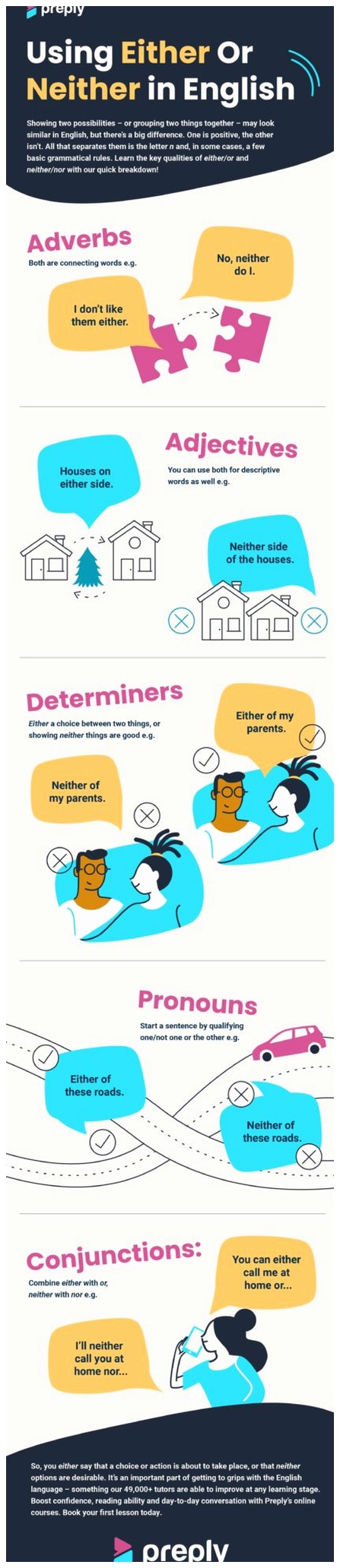
What’s the difference between either/or and neither/nor?
The key distinction between these two sets of words lies in the use of “either” and “or,” which convey a positive choice or action. For instance, when you say, “I will either walk or run,” you’re clearly presenting options for what you might do.
The terms “neither” and “nor” are employed in a negative context to indicate a refusal to select any of the given options. For instance, you might say, “I will do neither this nor that,” clearly expressing that neither choice is acceptable.

How to use either/or and neither/nor
As previously discussed, there are four main ways these common English words can be utilized. Let’s explore each of these uses in detail, complete with examples for clarity:
Use 1: Adverb
When these words function as adverbs, then both either and neither act as connecting words. For example:
- “I don’t like to eat too much.” “No, neither do I.”
- “I don’t like fried foods.” “No, I don’t like them either.”
Use 2: Adjective
Both either and neither can also be used as an adjective. For example:
- “There were houses on either side of the road.”
Here “either” describes both sides of the road, so is an adjective.
Use 3: Determiner
In some cases, either and neither are used as determiners. When used in this way, either indicates a choice between two possibilities. For example:
- “Either of my parents can come to the party.”
As a determiner, “neither” enables us to express a negative statement about two items or individuals at the same time. For instance:
- “Neither of my parents can come to the party.”
Use 4: Pronoun
In all instances where either and neither are used as pronouns, the sentence structure will be as follows:
- either/neither + of + noun phrase
When they act as pronouns, either means “one or the other,” while neither means “not one or the other.”
For example:
- “Either of these roads go to London.”
- “Neither of my kids are strong enough to lift this.”
Use 5: Conjunction
When either and neither are used together with the words or and nor they become as correlative conjunctions. Either/or are used together to offer a choice between two things. For example:
- You can either call me at home or at the office.
- Either mom or dad will come to pick you up.
Neither/nor are used together to state 2 or more things are untrue or won’t happen. For example:
- Neither the blue one nor the red one is available in size 4.
- I will neither call you nor send you a message before midday.
Either/or and neither/nor summary
Mastering the use of “either,” “or,” “neither,” and “nor” can be tricky, much like other elements of English grammar. This article serves as a handy reference, allowing you to revisit it whenever you need clarification or guidance.
Practicing new grammar through conversation is essential for mastering it. One effective way to achieve this is by working with a native English tutor on LingualNeeds. With thousands of tutors specializing in various aspects of the English language, you can easily find the perfect match for your learning needs. Take the time to explore your options and select the tutor who best suits you!
Frequently Asked Questions
What are the main uses of either/or and neither/nor?
Either and neither can be used as adverbs, adjectives, determiners, pronouns, or correlative conjunctions.
How do I ensure correct verb agreement when using either/or and neither/nor?
If both subjects are singular, use a singular verb. If one or both subjects are plural, use a plural verb.
What is the difference between either/or and neither/nor?
Either/or conveys a positive choice or action, while neither/nor indicates a refusal to select any of the given options.
Can you provide an example of either used as a determiner?
An example is: ‘Either of my parents can come to the party.’
What is a practical way to practice mastering either/or and neither/nor?
Practicing through conversation with a native English tutor on platforms like LingualNeeds can be very effective.