
- List of sports in Spanish
- Other Spanish sports vocabulary
- Basic phrases and questions
- Venues
- Equipment
- Useful verbs
- Why you should learn Spanish sports vocabulary
- Practice Spanish sports vocabulary with LingualNeeds
- Final thoughts
- Frequently Asked Questions
- What benefits does engaging in sports provide for language learning?
- How can mastering sports vocabulary boost my confidence?
- What are some basic phrases to use when discussing sports in Spanish?
- Why is it important to learn Spanish sports vocabulary?
- How can I practice Spanish sports vocabulary effectively?
Engaging in sports offers numerous benefits, from keeping you physically fit and providing opportunities for social interaction to enhancing your Spanish language skills. By immersing yourself in sports vocabulary in Spanish, you can significantly boost your overall fluency while having fun!
Mastering Spanish sports vocabulary can significantly boost your confidence and enhance your communication skills. Engaging with native Spanish speakers in various settings not only allows you to practice but also helps you refine your language abilities.
To help you get started, we’ve put together a list of sports in Spanish alongside other useful vocabulary.
Stay hydrated and don’t forget to warm up! Here’s everything you need to know about Spanish vocabulary for sports.
Keep reading to learn more or discover online Spanish classes on LingualNeeds.
List of sports in Spanish
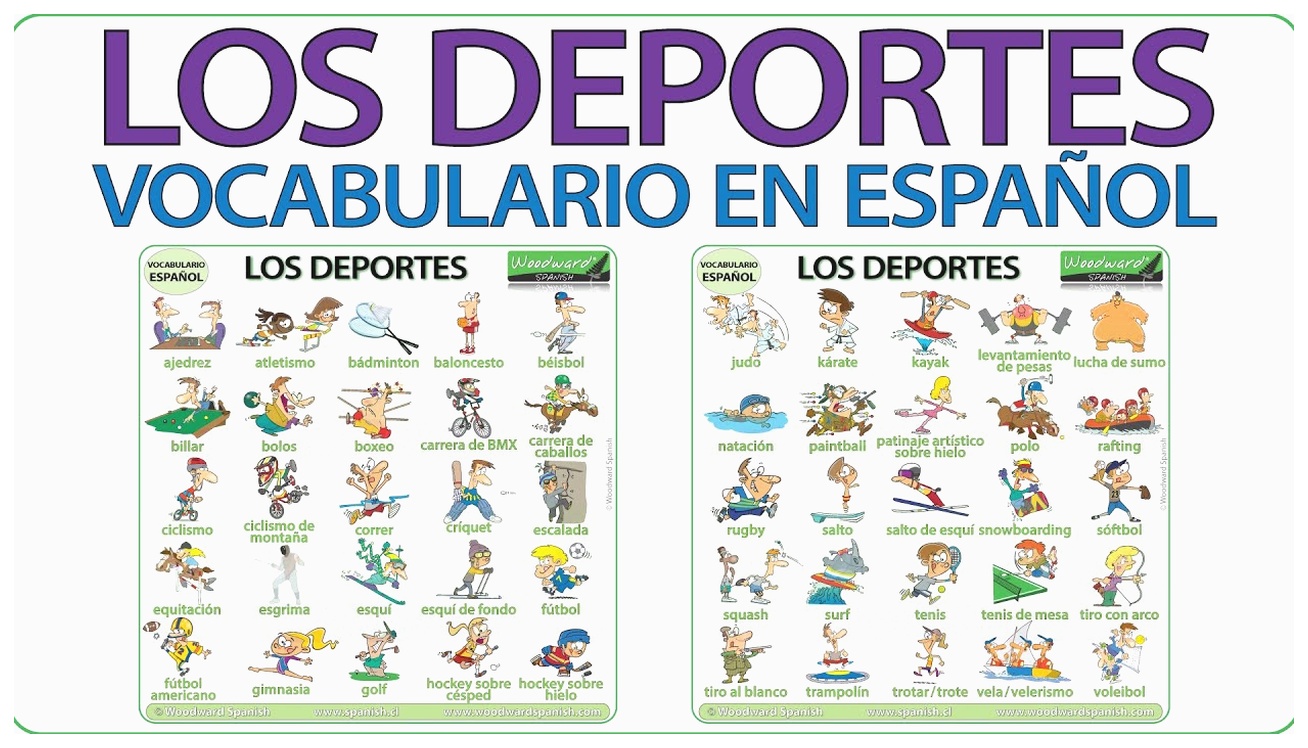
- Atletismo – Athletics
- Bádminton – Badminton
- Baloncesto – Basketball
- Balonmano – Handball
- Béisbol – Baseball
- Bolos – Bowling
- Boxeo – Boxing
- Carrera de BMX – BMX racing
- Carrera de caballos – Horse racing
- Ciclismo – Cycling
- Correr – Running
- Críquet – Cricket
- Escalada – Rock climbing
- Equitación – Horse riding
- Esgrima – Fencing
- Esquí – Skiing
- Esquí de fondo – Cross-country skiing
- Fútbol – Football/Soccer
- Fútbol americano – American football
- Gimnasia – Gymnastics
- Golf – Golf
- Hacer snow – Snowboarding
- Hockey sobre césped – Field hockey
- Hockey sobre hielo – Ice hockey
- Judo – Judo
- Kárate – Karate
- Kayak – Kayaking
- Levantamiento de pesas – Weightlifting
- Sumo – Sumo wrestling
- Natación – Swimming
- Paintball – Paintball
- Patinaje artístico sobre hielo – Figure skating
- Ping Pong/Tenis de mesa – Table tennis
- Polo – Polo
- Rafting – Rafting
- Rugby – Rugby
- Salto – Diving
- Sóftbol – Softball
- Squash – Squash
- Surf – Surfing
- Tenis – Tennis
- Tiro con arco – Archery
- Trampolín – Trampoline
- Vela – Sailing
- Voleibol – Volleyball
- Water polo – Waterpolo
Other Spanish sports vocabulary
Spanish is rich with sports terminology that goes beyond just the names of the games. To enhance your ability to discuss sports in Spanish more fluidly and naturally, here’s a selection of additional vocabulary, including terms for venues, equipment, action verbs, useful phrases, and relevant questions.
Basic phrases and questions
- El deporte – The sport (singular)
- Los deportes – The sports (plural)
- Jugador/Jugadora – Player (masculine/femenine)
- Equipo/Equipa – Team (masculine/femenine)
- ¿Cuál es tu deporte favorito? – What is your favorite sport?
- ¿Cuál es tu equipo (deportivo) favorito? – What is your favorite (sports) team?
- ¿Por qué no jugamos a…? – Why don’t we play…?
- ¿Quién ganó el partido? – Who won the game?
- ¿Qué deportes practicas habitualmente? – What sports do you play regularly?
- ¿A qué quieres jugar? – What do you want to play?
- ¿Qué estás viendo/haciendo? – What are you watching/doing?
- ¿Con qué equipo vas? – Which team are you rooting for?
- ¿Quién va ganando? – Who is winning?
- ¡Yo gané! – I won
- ¡Mal perdedor! – Sore/bad loser
- Hago deporte todas las semanas – I do sports every week.
- Juego (al deporte) todas las semanas – I play (sports) every week
- ¡Vamos! ¡Sí se puede! – Let’s go/come on! You can do it!
- A mí me gusta jugar a/al… – I like playing…
Venues
The venue where you engage in sports is just as crucial as the sport itself. Here are some of the most popular locations for sporting events, presented in Spanish.
- El campo de golf – The golf course
- El campo de fútbol – The football/soccer field
- La cancha de baloncesto – The basketball court
- El polideportivo – The sports center
- El estadio – The stadium
- El gimnasio – The gym
- La pista de tenis – The tennis court
- La pista – The track/rink
- La piscina – The pool
When discussing sports in a specific location, it’s important to use the verb “estar” with the present participle. For instance, you would say, “Yo estoy jugando a voleibol en el estadio,” which translates to “I am playing volleyball in the stadium.” This structure helps convey both the action and its location clearly.
Similarly, when using words like these, you can choose between the prepositions “in” or “at,” just as you would in English. For instance, you might say, “¿Tú estarás jugando a fútbol en el estadio esta noche?” which translates to, “Are you playing football in the stadium tonight?”
Equipment
To actively participate in sports and communicate effectively in Spanish, it’s essential to understand the terminology related to various sports equipment and facilities.
It also provides you with useful terminology for items that share the same name in contexts beyond sports. Here are some of the most frequently encountered sporting goods:
- La canasta – The hoop
- La portería – The goal
- El bate – The bat
- La bicicleta – The bicycle
- La caña de pescar – The fishing rod
- El casco – The helmet
- El coche de carreras – The racing car
- El disco – The disc/puck
- El esnórquel – The snorkel
- Las espinilleras – The shin guards
- Las gafas – The goggles
- Los guantes – The gloves
- La raqueta – The racket
- La red – The net
- La tabla de surf – The surfboard
- El traje/vestido de baño – The bathing suit
- La pelota/el balón – The ball
- Los palos de golf – The golf clubs
- Los zapatos de fútbol – The soccer cleats
Useful verbs
To effectively convey the excitement of sports in Spanish, it’s essential to master the verbs that bring your sports vocabulary to life.
The infinitive verb ‘to play’ in Spanish is ‘jugar’. Here’s the conjugation:
- Yo juego – I play
- Tú juegas – You play
- Él/ella/usted juega – He/she/you (singular, formal) plays
- Nosotros/nosotras jugamos – We play
- Vosotros jugáis – You play (plural, informal)
- Ellos/ellas/ustedes juegan – They/you play (plural, formal)
Here are some other important Spanish verbs for speaking about sports with example sentences:
- Empatar – To tie
Los dos equipos empataron. The two teams tied.
- Esquiar – To ski
Me gusta esquiar. I like to ski.
- Ganar – To win
Ella cree que el otro equipo ganará. She believes the other team will win.
- Hacer – To do
Ellos hacen deporte por las mañanas. They do sports in the morning.
- Jugar – To play
El futbolista está jugando bien. The soccer player is playing well.
- Montar – To ride
Montamos las bicicletas a la bandera final. We ride the bikes to the final flag.
- Pelear – To fight
Ella quería pelear con su oponente. She wanted to fight her opponent.
- Perder – To lose
Ellos iban a perder este juego. They were going to lose this game.
- Practicar – To practice
Estoy practicando mi técnica todos los días. I’m practicing my technique every day.
- Saltar – To jump
Él saltó por encima de la red. He jumped over the net.
- Tirar – To throw/shoot
Me tiraste la pelota. You threw the ball to me.
- Chutar – To kick (a ball)
Necesita chutar más fuerte para marcar. He/She needs to kick harder to score.
- Devolver – To give back
El jugador devolvió la pelota a través del campo. The player gave back the ball
across the field.
- Marcar – To score
Ella marcó el primer gol. She scored the first goal.
Why you should learn Spanish sports vocabulary
Language acquisition unfolds in distinct stages. After mastering basic greetings and common questions, you can advance to more specialized topics, such as sports, to deepen your conversational skills.
Grasping the names and vocabulary associated with sports can significantly enhance your fluency. Many of these terms and verbs are not only useful in discussions about athletics but can also be seamlessly integrated into everyday conversations and various aspects of life.
If you’re a sports enthusiast, discussing them can be incredibly enjoyable and engaging. This makes sports a fantastic topic to explore with native speakers. Your genuine interest will naturally motivate you to expand your vocabulary and delve deeper into the conversation, enhancing both your knowledge and enjoyment.
Whether or not you’re a die-hard sports enthusiast, learning Spanish sports vocabulary can significantly enhance your pronunciation skills. It also helps you identify patterns in verb conjugation and sentence structure, making your language learning journey more effective and enjoyable.
You can connect with others who share your dislike for sports, turning it into a fun conversation starter. The more vocabulary you acquire in Spanish, the richer your interactions will be!
Practice Spanish sports vocabulary with LingualNeeds
Research indicates that engaging in conversations is essential for enhancing your language skills. These interactions serve as a vital link between your expanding vocabulary, grammar, and punctuation. By weaving these elements together, you can communicate more clearly in your new language and improve your ability to remember words and sentence structures with greater ease.
Learning Spanish sports vocabulary, then, is much like playing sports – the more you practice, the better you become.
With LingualNeeds, you can enhance your Spanish skills through personalized 1-on-1 classes with native-speaking tutors. These engaging 50-minute virtual sessions incorporate presentations, interactive tools, lively dialogue, and games, all designed to make learning enjoyable while applying your knowledge of Spanish and sports. Dive into your language journey and achieve your goals with expert guidance!
Explore a diverse selection of over 4,300 Spanish tutors, allowing you to find the perfect match based on your budget, schedule, preferred dialect, and any additional languages spoken. Whether you’re a total beginner or looking to enhance your skills, there’s a tutor for you. Plus, if your first lesson doesn’t meet your expectations, you can easily switch tutors at no extra cost!
Schedule a trial class with a skilled Spanish tutor at LingualNeeds today! Expand your language skills beyond just sports vocabulary and unlock a world of communication and culture.
Final thoughts
Learning the names of sports in Spanish is a fantastic starting point for enhancing your language skills. Additionally, familiarizing yourself with various verbs, phrases, and questions in Spanish will further accelerate your progress.
Grasping key vocabulary is a crucial part of your language-learning journey. When you’re confident discussing intricate topics like sports, you’ll not only feel more equipped for Spanish conversations but also forge deeper connections with others. This newfound confidence will elevate your enjoyment of conversations, making them more engaging and personal.
Use this article as your launching pad to dive into the world of sports vocabulary! Absorb as much as you can, and don’t wait to put your new knowledge into action. Ready, set, go!
Frequently Asked Questions
What benefits does engaging in sports provide for language learning?
Engaging in sports helps keep you physically fit, provides opportunities for social interaction, and enhances your Spanish language skills through immersion in sports vocabulary.
How can mastering sports vocabulary boost my confidence?
Mastering Spanish sports vocabulary can significantly boost your confidence and enhance your communication skills when engaging with native Spanish speakers.
What are some basic phrases to use when discussing sports in Spanish?
Some basic phrases include ‘¿Cuál es tu deporte favorito?’ (What is your favorite sport?) and ‘¿Quién ganó el partido?’ (Who won the game?).
Why is it important to learn Spanish sports vocabulary?
Learning Spanish sports vocabulary enhances fluency, helps with pronunciation skills, and allows for deeper conversations about sports with native speakers.
How can I practice Spanish sports vocabulary effectively?
You can practice Spanish sports vocabulary through personalized classes with native-speaking tutors, interactive tools, and engaging conversations.


