- What is a preposition?
- Forms of prepositional phrases
- Functions of prepositional phrases
- List of the most common prepositions
- Types of English prepositions (lists with examples)
- Prepositions of time
- Prepositions of place
- Prepositions of movement
- Prepositions with verbs
- Prepositions with adjectives
- Common preposition mistakes
- At
- In
- On
- To
- For
- Common mistakes with prepositional phrases
- Misplacing prepositional phrases
- Overusing prepositional phrases
- Confusing prepositions
- Double prepositions
- Common errors in prepositional phrases
- Preposition practice exercise
- Use English prepositions like a native speaker
- Frequently Asked Questions
- What is a preposition?
- How do prepositional phrases function in a sentence?
- What are some common types of prepositional phrases?
- What are some examples of prepositions of time?
- How can one avoid common mistakes with prepositions?
A preposition is a vital component of the English language that illustrates the connections between people, places, and objects. With more than 100 prepositions available, it’s essential to grasp their usage. Some of the most frequently used prepositions include “at,” “on,” “in,” “above,” and “below.” Understanding these can greatly enhance your communication skills!
Prepositions are a staple of the English language, yet mastering them can be challenging. Using the incorrect preposition can dramatically alter the meaning of a sentence, making it crucial to understand their proper usage.
In this article, we’ll explore English prepositions, providing you with a comprehensive list to enhance your vocabulary. We’ll also include examples to ensure you understand how to use them accurately, helping you elevate your English skills.
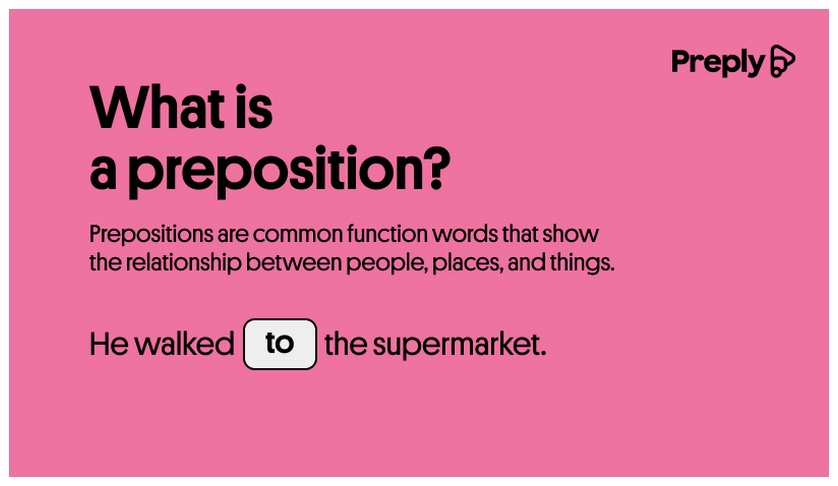
What is a preposition?
Prepositions are words that show direction, location, time, and the spatial relationship between objects.
Prepositions serve as essential connectors in a sentence, linking them to an object, which can be either a noun or a pronoun. Even if other words intervene, a prepositional phrase always starts with a preposition and concludes with its object, providing clarity and context to the sentence.
Understanding parts of speech can be challenging, but prepositions are simply the glue that holds sentences together. They link a preposition to its object, creating meaningful connections within your sentences. Below, you’ll find some common examples showcasing how prepositions work. In each example, the prepositions are highlighted in bold, while the objects they connect to are underscored:
- Direction: “I sent a package to you.”
- Location: “He’s at the theater.”
- Time: “It should be done by suppertime.”
- Spatial relationship: “The ball was placed before the hole.”
- Introducing an object: “We heard the howling of wolves.”
Forms of prepositional phrases
Prepositional phrases come in various forms. Here are some of the most common types:
- Simple prepositional phrases: These include a single preposition followed by its object.
- At the park, on the shelf, during the meeting.
- Compound prepositional phrases: These involve more than one preposition.
- Because of the rain, in front of the house, in addition to the books.
- **Complex Prepositional Phrases:** These consist of a preposition followed by a phrase that includes an additional prepositional phrase, such as “in the middle of the night” or “on top of the cabinet.”
- **Prepositional Phrases with Pronouns:** These phrases begin with a preposition and include a pronoun, such as “sure of herself.” Example: “She was always sure of herself,” and “I’ve been in my new apartment for a week.”
- **Prepositional Phrases Indicating Contrast**: These phrases effectively emphasize differences or oppositions. For example: “Compared to our old system, this one is much easier to use.” and “Despite that, I still have some reservations.”
- **Contextual Prepositional Phrases:** These phrases establish the background for a sentence’s main idea. For example, “In fact, she often appeared to want to lead him into more trouble.” Additionally, “In the long run, we must all confront the consequences of our actions.”
- **Conditional Prepositional Phrases:**
The phrase “but for” indicates a condition. For example: “But for your help, I wouldn’t have finished my proposal on time,” and “Harry believed that but for Paul’s interference, he would have won the game.”
- Using Multiple Prepositional Phrases: Prepositional phrases can work in tandem, with one modifying another. For instance, consider the need for enhanced employee training methods that effectively prepare them for shifting trends. Additionally, it’s crucial to verify the accuracy of turnover statistics from recent years.
Functions of prepositional phrases
Prepositional phrases can function in several ways within a sentence:
- As adjectives: Describing a noun or pronoun.
- The book on the table (which book? The one on the table).
- As adverbs: Modifying a verb, adjective, or another adverb.
- She danced with grace (how did she dance? With grace).
- As noun complements: Following a noun to complete its meaning.
- The fear of heights (what kind of fear? Of heights).
List of the most common prepositions
English boasts more than 100 prepositions, but a select few are used far more frequently. Here’s a list of the most commonly employed prepositions to enhance your understanding and usage of the language.

| Single-word prepositions | |
| about | like |
| above | near |
| across | of |
| after | off |
| against | on |
| along | onto |
| among | opposite |
| around | out |
| as | outside |
| at | over |
| before | past |
| behind | round |
| below | since |
| beneath | than |
| beside | through |
| between | to |
| beyond | towards |
| by | under |
| despite | underneath |
| down | unlike |
| during | until |
| except | up |
| for | upon |
| from | via |
| in | with |
| inside | within |
| into | without |
| Complex prepositions | |
| ahead of | inside of |
| apart from | instead of |
| as for | near to |
| as well as | on account of |
| because of | on top of |
| due to | out of |
| except for | outside of |
| in addition to | owing to |
| in front of | such as |
| in place of | thanks to |
| in spite of | up to |
Types of English prepositions (lists with examples)
With the multitude of prepositions in the English language, categorizing them—such as by time or place—can be incredibly beneficial. It’s important to note, though, that some prepositions are versatile and can fit into multiple categories, adding to their complexity.
Prepositions of time
Prepositions play a crucial role in indicating when events occur, whether at a precise moment, close to a particular time, or throughout a longer duration.
| Prepositions of time | |
| Preposition | Example |
| after | You can go after you’ve done your homework. |
| at | I met my friend at 4pm. |
| before | It’ll be done before lunch. |
| during | I’ll be there sometime during the afternoon. |
| for | He’ll be in New York for two weeks. |
| in | They have dinner in the evening. |
| on | I’m going there on Friday. |
| since | I’ve been up since dawn. |
| until | I’ll wait until tomorrow. |
Prepositions of place
2These prepositions can be used to refer to a place where something or someone is located.
| Prepositions of place | |
| Preposition | Examples |
| above | The cereal is on the shelf above the bread. |
| against | We have to row against the current. |
| along | There are many stores along the main street. |
| around | We all sat around the dinner table. |
| at | He’s at the cafe. |
| behind | The little dog followed behind me. |
| below | We could see the city below us. |
| beside | He sat beside her during the play. |
| between | They put up a fence between the two houses. |
| by | I’m by the lake. |
| in | I’m in the house. |
| in front of | There were two cars in front of me. |
| near | The cat won’t go near the dog. |
| next to | I left the box next to the door. |
| on | She’s on the platform. |
| over | The bird flew over the pond. |
| under | I checked under the bed. |
Prepositions of movement
These prepositions are often used to show the movement of an object from one place to another.
| Prepositions of movement | |
| Preposition | Examples |
| across | I swam across the lake. |
| along | We walked along the shore. |
| from | He just flew in from California. |
| into | I dove into the pool. |
| onto | She jumped onto the bed. |
| over | The fox jumped over the dog. |
| through | I pushed through the crowd. |
| to | He walked to the supermarket |
| toward | He’s walking toward us. |
Prepositions with verbs
Prepositions often accompany verbs to form phrases that convey unique meanings. To master these combinations, it can be helpful to memorize the entire phrase along with its associated preposition.
| Prepositions with verbs | ||
| Preposition | Verb(s) | Examples |
| about |
complain read |
He complained about the delay. They read about the concert. |
| at |
arrive look |
They arrived at the venue. He looked at me. |
| from |
differ suffer |
Her opinions might differ from his. She’s been suffering from a bad cold. |
| for |
account search |
That doesn’t account for the differences in the numbers. I’m searching for my lost dog. |
| in |
result succeed |
Her efforts resulted in a big success for the company. She succeeded in winning the argument. |
| of |
approve smell |
I don’t approve of that choice. The air smells of lilacs. |
| on |
concentrate depend |
It’s hard to concentrate on my homework when there’s so much noise. I have to depend on him for rides while my car is in the shop. |
| to |
contribute lead |
I’m looking for a way to contribute to my community. He led the team to victory. |
| with |
disagree argue |
I disagree with your opinion on that. I don’t want to argue with you. |
Prepositions with adjectives
Prepositions can also pair with adjectives to form phrases that convey distinct meanings. To grasp these nuances effectively, it can be beneficial to memorize these specific phrases alongside the prepositions themselves.
| Prepositions with adjectives | ||
| Preposition | Adjective | Examples |
| about | sorry | They’re so sorry about that. |
| from | different | I’m a little different from them. |
| for | grateful | She’s really grateful for your help. |
| in | disappointed | He’s so disappointed in him. |
| in | interested | I’m interested in learning more. |
| of | aware | I just became aware of that. |
| of | capable | I don’t think I’m capable of lifting something that heavy. |
| of | proud | I’m so proud of you. |
| to | accustomed | He was accustomed to the temperature. |
| with | familiar | I’m familiar with that author. |
Common preposition mistakes
Prepositions can be tricky, especially for non-native English speakers, leading to frequent errors. To help improve your understanding, here are some common mistakes to watch for when using prepositions.
At
At vs. on vs. in:
- “The event starts at 9pm.”
- “The event is on Tuesday.”
- “The event is in May.”
At vs. to:
- Correct: “I was at the movie theater last night.”
- Incorrect: “I was to the movie theater last night.”
At vs. in:
- Correct: “My brother is good at playing board games.”
- Incorrect: “My brother is good in playing board games.”
In
In vs. on:
- Correct: “I read about it in a magazine.”
- Incorrect: “I read about it on a magazine.”
In vs. at:
- Correct: “My brother does well in school.”
- Incorrect: “My brother does well at school.”
In vs. at night:
- Correct: “I like to go for walks at night.”
- Incorrect: “I like to go for walks in night.”
In vs. into:
- Correct: “She went for a walk in the park.”
- Incorrect: “She walked into the park.”
On
On vs. onto:
- Correct: “The dog is on the bed.”
- Incorrect: “The dog jumped onto the bed.”
To
To vs. in:
- Correct: “I went to France last May.”
- Incorrect: “I went in France last May.”
For
For vs. since:
- Correct: “She’s been waiting for six hours.”
- Incorrect: “She’s been waiting since six hours.”
Common mistakes with prepositional phrases
Misplacing prepositional phrases
A common mistake is placing prepositional phrases incorrectly in a sentence, leading to confusion. For example:
- Incorrect: She only talked to the manager in the office. (Did she only talk in the office?)
- Correct: She spoke solely to the manager present in the office.
Always place the prepositional phrase as close as possible to the word it modifies.
Overusing prepositional phrases
While prepositional phrases add detail, overusing them can make sentences clunky and hard to read. Consider the following:
- Overloaded: The book on the desk by the window in the room at the end of the hall was old.
- Simplified: The old book was on the desk by the window at the end of the hall.
Simplifying sentences by reducing the number of prepositional phrases can improve clarity.
Confusing prepositions
English learners often struggle with choosing the correct preposition, especially when similar ones can imply different meanings. Consider:
- On time vs. In time: “On time” means punctual, while “in time” means before a deadline.
- At the weekend (British English) vs. On the weekend (American English).
A solid understanding of common prepositions and their uses can prevent these mix-ups.
Double prepositions
Sometimes learners mistakenly combine prepositions unnecessarily:
- Incorrect: She lives inside of the house.
- Correct: She lives inside the house.
Avoid adding extra prepositions where they aren’t needed.
Common errors in prepositional phrases
- Missing or incorrect nouns/pronouns:
- Incorrect: He talks to new on Mondays.
- Correct: He talks to new members on Mondays.
- **Common Mistake in Contrast Usage:**
**Incorrect:** In despite of that, I have some reservations about it.
**Correct:** In spite of that, I have some reservations about it. - **Missing Prepositions in Context:**
**Incorrect:** Second thought, it’s their world so perhaps they feel even more invested.
**Correct:** On second thought, it’s their world, so they may feel even more invested. - **Common Errors in Conditional Prepositional Phrases**
**Incorrect:** “But the situation, they would have arrived to their final destinations on time.”
**Correct:** “But for the situation, they would have arrived at their final destinations on time.”This highlights the importance of using the correct prepositions in conditional phrases for clarity and accuracy.
- **Misplaced Prepositions:**
Incorrect: “Are these really the turnover numbers of years for the last couple?”
Correct: “Are these really the turnover numbers for the last couple of years?”This highlights the importance of proper preposition placement for clarity.
Preposition practice exercise
Now that you’ve grasped the fundamentals of prepositions, it’s time to put your knowledge to the test! Try your hand at these 10 sentences with missing prepositions and see if you can identify the correct ones to complete them.

- I arrived ___ the office ___ 7am ___ Monday morning. [at/at/on]
- We drove ___ the hill and _____ the woods __ get here. [over/through/to]
- The dog was following _____ me when I went __ the house. [behind/in]
- We took the boat ____ the lake and left it __ the shore. [across/on]
- He pulled a letter ___ __ the bag and handed it __ her. [out of/to]
- We’re driving __ a busy road with two cars __ ____ __ us. [on/in front of]
- I’m going ___ her __ the supermarket. [with/to]
- I looked __ the cupboards and ____ the sink. [in/under]
- We’re meeting __ the cafeteria __ two o’clock. [in/at]
- She was laying __ the bed when the dog tried to jump __ it. [in/on]
Use English prepositions like a native speaker
Prepositions play a crucial role in English grammar, yet they can be quite complex. Unlike many other grammatical elements, there’s no fixed rule for which prepositions pair with specific nouns, verbs, or adjectives. The most effective way to master them is by memorizing complete words and phrases. To simplify your learning experience, consider using the categories outlined in this post to help you remember prepositions more easily.
Remember, prepositions play a crucial role in sentences by illustrating the connections between people, places, and things. Once you grasp their function, you’ll find it much easier to understand when and how to use them effectively.
Tuning in to native English speakers can greatly enhance your understanding of how prepositions function in conversation. Mastering the use of prepositions is essential if you aim to reach a conversational level in English.
For personalized support in your English learning journey, LingualNeeds offers the opportunity to connect with a dedicated tutor for one-on-one lessons. Whether you’re just starting out or looking to refine your skills, our tutors can customize their lessons to align with your specific goals, ensuring a tailored and effective learning experience.
Find a tutor who aligns with your requirements, budget, and availability, and schedule a trial lesson. If you’re not completely satisfied, you can receive a full refund or opt for a free session with a different tutor.
Frequently Asked Questions
What is a preposition?
A preposition is a word that shows direction, location, time, and the spatial relationship between objects.
How do prepositional phrases function in a sentence?
Prepositional phrases can function as adjectives, adverbs, or noun complements within a sentence.
What are some common types of prepositional phrases?
Common types of prepositional phrases include simple, compound, complex, and those indicating contrast or condition.
What are some examples of prepositions of time?
Examples of prepositions of time include ‘after,’ ‘at,’ ‘before,’ ‘during,’ and ‘since’.
How can one avoid common mistakes with prepositions?
To avoid common mistakes, ensure proper placement of prepositional phrases, avoid overuse, and be mindful of using the correct preposition.