

- What are French adverbs?
- French adverbs list: 135 most common adverbs in French
- What are the different types of French adverbs?
- How to form French adverbs?
- 1. When the masculine adjective ends with a consonant or a silent -e
- 2. When the masculine adjective ends with a vowel
- 3. When masculine adjectives end in -ant or -ent
- How and where are French adverbs used in the sentence?
- 1. When the adverb modifies a verb
- 2. When the adverb modifies another adverb or an adjective
- French adverb exceptions
- Ready to start practicing French?
- Frequently Asked Questions
- What are French adverbs?
- How are French adverbs formed?
- What types of information do French adverbs provide?
- Where should adverbs be placed in a French sentence?
- What is the importance of engaging content in language learning?
Imagine how bland our conversations would be without words like “very,” “never,” or “passionately.” The result? A rather monotonous exchange! Notice how we playfully combined those words? It highlights their importance in adding depth and excitement to our language.
Adverbs like “very,” “never,” and “passionately” play a crucial role in enhancing our sentences. While they are sometimes essential for clarity—like in the question “Quandrentrez-vous ?” (When are you coming back?)—they also add depth and vibrancy to our communication. For instance, the phrase “Elle l’a regardé intensément” (She looked at him intensely) conveys a far more vivid emotion than simply saying “Elle l’a regardé” (She looked at him).
Let’s explore the fascinating world of French adverbs—those little words that significantly enhance our communication. If you’re looking to learn French online, you’ve come to the right place! This straightforward guide will introduce you to French adverbs and provide you with a handy list to get you started.
What are French adverbs?
Adverbs are powerful words that enhance our language by describing and modifying verbs, adjectives, or even other adverbs. When an adverb modifies a word, it fine-tunes its meaning, adding clarity and detail. Remarkably, adverbs can also refine the meaning of entire sentences, making our communication more precise and expressive.
Adverbs play a crucial role in the French language by providing details on how, when, where, why, how often, and to what extent actions occur. They can enhance verbs, adjectives, and other adverbs, but it’s important to note that they do not modify nouns, as that function is reserved for adjectives.
Unlike adjectives, adverbs remain constant in their form, meaning they don’t change based on the number or gender of the words they modify.
In French, most adverbs are formed by adding -ment to adjectives. However, there are several exceptions that don’t follow this pattern and must be memorized. To assist you, we’ve compiled a table of these unique adverbs at the end of this guide for easy reference.
Let’s take a look at a few examples of how French adverbs work:
- Modifying a verb: Il mange lentement. (He eats slowly.)
- Modifying an adjective: Je suis vraiment intéressé par l’art moderne. (I’m really interested in modern art.)
- Modifying another adverb: Marina est très en retard à son rendez-vous. (Marina is very late for her appointment.)
- Modifying a whole sentence: Malheureusement, j’ai raté mon vol. (Unfortunately, I missed my flight.)
French adverbs list: 135 most common adverbs in French
| French Adverb | English Translation | |
|
List of French adverbs that end in -ment |
||
| 1 | actuellement | currently |
| 2 | assurément | surely, definitely |
| 3 | autrement | differently, otherwise |
| 4 | calmement | calmly |
| 5 | certainement | certainly |
| 6 | clairement | clearly |
| 7 | complètement | completely |
| 8 | couramment | fluently |
| 9 | doucement | gently, quietly |
| 10 | également | also, equally |
| 11 | énormément | enormously |
| 12 | facilement | easily |
| 13 | fortement | strongly |
| 14 | franchement | frankly |
| 15 | fréquemment | frequently |
| 16 | habituellement | usually |
| 17 | heureusement | fortunately |
| 18 | honnêtement | honestly |
| 19 | joliment | prettily, nicely |
| 20 | largement | greatly, well |
| 21 | légèrement | lightly, slightly |
| 22 | lentement | slowly |
| 23 | malheureusement | unfortunately |
| 24 | poliment | politely |
| 25 | précisément | precisely |
| 26 | probablement | probably |
| 27 | profondément | deeply |
| 28 | rapidement | quickly |
| 29 | rarement | rarely |
| 30 | récemment | recently |
| 31 | seulement | only |
| 32 | suffisamment | sufficiently |
| 33 | sûrement | surely |
| 34 | tellement | so much, so many |
| 35 | vraiment | really, truly |
|
Adverbial phrases |
||
| 36 | à côté | next to, beside |
| 37 | à droite | to the right |
| 38 | à gauche | to the left |
| 39 | à l’intérieur | on the inside |
| 40 | d’abord | first, firstly |
| 41 | en dehors de | outside, apart from |
| 42 | au-delà de | beyond |
| 43 | en bas | below, down |
| 44 | en effet | indeed, as a matter of fact |
| 45 | en face | opposite |
| 46 | en haut | up |
| 47 | en même temps | at the same time |
| 48 | en revanche | however, in contrast |
| 49 | là-bas | over there |
| 50 | là-dedans | in here, in there |
| 51 | là-dessus | on here, on there |
| 52 | lors de | during |
| 53 | nulle part | nowhere |
| 54 | par contre | in contrast |
| 55 | pas du tout | not at all |
| 56 | sans doute | without a doubt |
|
Other adverbs |
||
| 57 | ailleurs | elsewhere |
| 58 | ainsi | thus, so |
| 69 | alors | then, so, at that time |
| 60 | après | afterwards |
| 61 | après-demain | the day after tomorrow |
| 62 | aujourd’hui | today |
| 63 | assez | enough |
| 64 | avant-hier | on the day before yesterday |
| 65 | aussi | also |
| 66 | aussitôt | straight away |
| 67 | autant | as many / as much |
| 68 | autrefois | in the past |
| 69 | beaucoup (de) | much, many |
| 70 | bien | well |
| 71 | bientôt | soon |
| 72 | cependant | however |
| 73 | certes | admittedly, of course |
| 74 | ci-dessous | below |
| 75 | combien (de) | how much, many |
| 76 | comment | how |
| 71 | davantage | more, longer |
| 78 | debout | standing, up |
| 79 | dedans | inside |
| 80 | déjà | already |
| 81 | demain | tomorrow |
| 82 | depuis | since |
| 83 | derrière | behind |
| 84 | désormais | from now on |
| 85 | dessous | below |
| 86 | dessus | above |
| 87 | devant | ahead, in front |
| 88 | d’habitude | usually |
| 89 | donc | therefore, so |
| 90 | encore | again, still |
| 91 | enfin | at last, finally |
| 92 | ensemble | together |
| 93 | ensuite | then, next |
| 94 | environ | about |
| 95 | hélas | alas |
| 96 | hier | yesterday |
| 97 | ici | here, now |
| 98 | jadis | once, formerly |
| 99 | jamais | never, ever |
| 100 | là | there |
| 101 | longtemps | a long time |
| 102 | loin | far |
| 103 | maintenant | now |
| 104 | mal | badly, wrongly |
| 105 | même | even |
| 106 | mieux | better |
| 107 | moins | less, least |
| 108 | néanmoins | nevertheless |
| 109 | où | where |
| 110 | parfois | sometimes |
| 111 | partout | everywhere |
| 112 | peu | little |
| 113 | peut-être | perhaps |
| 114 | plus | more |
| 115 | plutôt | rather |
| 116 | pourquoi | why |
| 117 | pourtant | yet |
| 118 | près | close |
| 119 | presque | almost |
| 120 | puis | then |
| 121 | quand | when |
| 122 | quelque | approximately |
| 123 | quelquefois | sometimes |
| 124 | si | yes, so, however, as |
| 125 | soudain | suddenly |
| 126 | souvent | often |
| 127 | surtout | above all |
| 128 | tant | so much |
| 129 | tard | late |
| 130 | tôt | soon, early |
| 131 | toujours | still, always |
| 132 | tout | very, quite |
| 133 | très | very |
| 134 | trop | too many, too much |
| 135 | vite | quickly |
What are the different types of French adverbs?
French adverbs can be organized in ten main types:
- French adverbs of place (les adverbes de lieu) answer the question “where?”
For example: devant (in front of), ici (here), quelque part (somewhere)
- French adverbs of time (les adverbes de temps) answer the question “when?”
For example: plus tard (later), parfois (sometimes), hier (yesterday)
- French adverbs of amount (les adverbes de quantité) answer the question “how much?”
For example: encore plus (even more), peu (few), tant (so much)
- French causal adverbs (les adverbes de relation logique) answer the question “why?”
For example: pourtant (yet, however), quand même (still, anyway), aussi (also)
- French adverbs of manner (les adverbes de manière) answer the question “how?”
For example: mal (badly), vite (quickly), ensemble (together)
- French modal adverbs (les adverbes modaux) indicate the speaker’s opinion about the topic.
For example: heureusement (fortunately), certainement (certainly), par bonheur (luckily)
- French adverbs of affirmation (les adverbes d’affirmation) can reinforce statements or can soften the impact of a statement.
For example: précisément (precisely), sans doute (without a doubt), probablement (probably)
- French adverbs of negation (les adverbes de négation) are used to negate a sentence.
For example: pas du tout (not at all), ne…rien (nothing), ne…jamais (never)
- French interrogative adverbs (les adverbes d’interrogation) are French question words.
For example: combien (how much), qui (who), comment (how)
- French conjunctional adverbs (les adverbes de liaison) connect phrases together.
For example: alors (then), ensuite (next), enfin (finally)
How to form French adverbs?
In French, adverbs are typically built from adjectives. To form a French adverb, follow these rules:
1. When the masculine adjective ends with a consonant or a silent -e
In French, when a masculine adjective ends in a consonant or a silent ‘e’, adverbs are typically formed by adding “-ment” to the feminine version of the adjective. This method is the most widely used for creating adverbs in the language.
Examples:
- Normal (masculine form of the adjective) → normale (feminine form of the adjective) → normalement (adverb) [normal; normally]
- Lent (masculine form of the adjective) → lente (feminine form of the adjective) → lentement (adverb) [slow; slowly]
- Long (masculine form of the adjective) → longue (feminine form of the adjective) → longuement [long; long]
Note:
With some adjectives that end with a silent -e in the singular feminine form, the -e is replaced with an é for phonetic reasons.
Examples:
- Énorme (enormous) → Énorm*é*ment (enormously)
- Précise (precise) → Précis*é*ment (precisely)
- Uniforme (uniform) → Uniform*é*ment (uniformly)
Exceptions:
There are two notable exceptions to this rule. For the adjective **gentil** (nice), the corresponding adverb is **gentiment**, rather than the expected **gentillement**. Similarly, with the adjective **bref** (brief), the adverb takes the form **brièvement**, which comes from the feminine singular **briève**.
2. When the masculine adjective ends with a vowel
When the masculine adjective ends with a vowel, add –ment straight to the adjective:
Grave (serious) → Gravement (seriously)
Riche (rich) → Richement (richly)
Résolu (resolved, determined)→ Résolument (resolutely)
Here are the exceptions to this rule:
- Beau (beautiful) → bellement (beautifully)
- Gai (happy) → gaiement (happily)
- Traître (treacherous) → traîtreusement (treacherously)
Furthermore, In some adverbs formed from adjectives ending with -u, a circumflex is added. For example, cru (raw) becomes cr*û*ment (crudely).
3. When masculine adjectives end in -ant or -ent
When masculine adjectives end in -ant, -or, or -ent in their singular form, you can create an adverb by replacing the final -nt with -mment. This transformation results in adverbs that typically end in either -amment or -emment, both of which are pronounced as -amment.
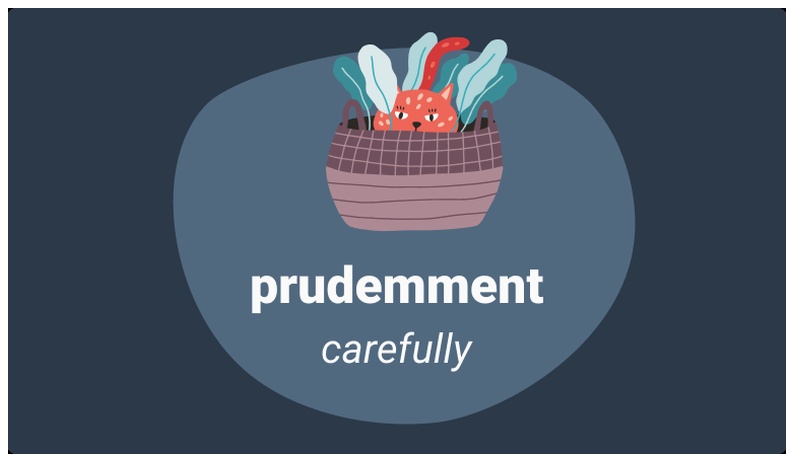
Prudent (careful) → prudemment (carefully)
Élégant (elegant) → élégamment (elegantly)
Two exceptions ending in -ent do not construct their adverb with -emment.
Examples:
- lent, lente (slow) → lentement (slowly)
- présent, présente (present) → présentement (presently)
How and where are French adverbs used in the sentence?
Unlike many other grammar rules in French, rules regarding placement of French adverbs are rather simple.
There are two cases:
1. When the adverb modifies a verb
In this scenario, the adverb follows the verb when the tense or mood is simple, such as in the present, imperfect, or future forms.
For example:
- Ils courent rapidement. (They are running fast.)
The adverb “rapidement” (fast) modifies the verb “courent”, so it is placed after it.
French is full of intriguing exceptions! When it comes to compound tenses like the passé composé, adverbs can be positioned in two ways: either nestled between the auxiliary verb and the past participle, or placed after the past participle itself.
In compound tenses, you’ll often find that shorter adverbs like “bien” and “mal,” along with adverbs that describe manner and quantity such as “beaucoup,” “trop,” and “assez,” typically come before the past participle. Additionally, certain indefinite adverbs of time, including “souvent,” “toujours,” “trop,” and “quelques fois,” also follow this pattern.
For example:
- J’ai trop mangé pour le dîner. (I ate too much for dinner.)
On the other hand, some adverbs which are placed after the past participle are avant, vite, lentement, and tard.
For example:
- Elle est arrivée tard à son premier cours. (She arrived late to her first class.)
Helpful tip: When using adverbs that modify an entire sentence, it’s best to place them either at the beginning or the end of that sentence. This positioning enhances clarity and impact.
- Demain, elle ira au musée. (Tomorrow, she will go to the museum.)
2. When the adverb modifies another adverb or an adjective
In this case, adverbs come after the verb and before the adjective/adverb.
Examples:
- C’est vraiment intéressant. (It’s really interesting.)
- Ils sont souvent occupés. (They are often busy.)
- Elle est très gentille. (She is very kind.)
French adverb exceptions
The following adjectives have irregular adverbs, and should, therefore, be memorized.
- Bon/Bonne (good) → Bien (well)
- Meilleur(e) (better) → Mieux (better)
- Mauvais(e) (bad) → Mal (badly)
- Petit(e) (small) → Peu (little)
Ready to start practicing French?
Et voilà, just like that, you just took a big step on your French learning journey!
Language experts widely concur that the most effective way to learn a language is by using it in contexts that are meaningful to the learner.
Adult learners seek engaging and relevant content that resonates with their real-life experiences. They are unlikely to stay focused on lessons that emphasize grammar rules in isolation or present dull material. Instead, they require resources that introduce structures and vocabulary applicable to their everyday situations, ensuring they can immediately utilize what they learn in practical contexts.
Engaging and relevant content plays a crucial role in your learning journey, whether you’re diving into verbs or adverbs. To truly enhance your skills, consider participating in real French conversations through personalized 1-on-1 tutoring or lessons. You’ll be amazed at the significant progress you can achieve!
By learning practical French, you gain the confidence to engage in everyday conversations. This means that when the moment comes to order food in French, you’ll be ready and able to express yourself without hesitation.
Happy practicing!
Frequently Asked Questions
What are French adverbs?
French adverbs are powerful words that enhance our language by describing and modifying verbs, adjectives, or other adverbs.
How are French adverbs formed?
French adverbs are typically formed by adding ‘-ment’ to the feminine version of an adjective, but there are exceptions.
What types of information do French adverbs provide?
French adverbs provide details on how, when, where, why, how often, and to what extent actions occur.
Where should adverbs be placed in a French sentence?
Adverbs typically follow the verb when modifying it, but they can also be placed before adjectives or other adverbs.
What is the importance of engaging content in language learning?
Engaging content helps learners stay focused and allows them to apply what they learn in practical contexts.


