- Understanding verb tenses
- What is a verb tense?
- Past verb tenses
- Simple past tense
- Past participle tense
- Examples of past verb tenses
- When to use began
- Simple past tense
- Example sentences
- Tips for identifying when to use began
- When to use begun
- Definition
- Present perfect tense
- Past perfect tense
- Passive verb construction
- Example sentences
- Tips for identifying when to use begun
- Common mistakes and misconceptions when using began and begun
- Using “began” instead of “begun”
- Leaving out the auxiliary verb
- Overusing the present perfect tense
- Forming passive constructions incorrectly
- Avoiding “began” when describing all actions or events in the past
- Comparing when to use began vs. begun
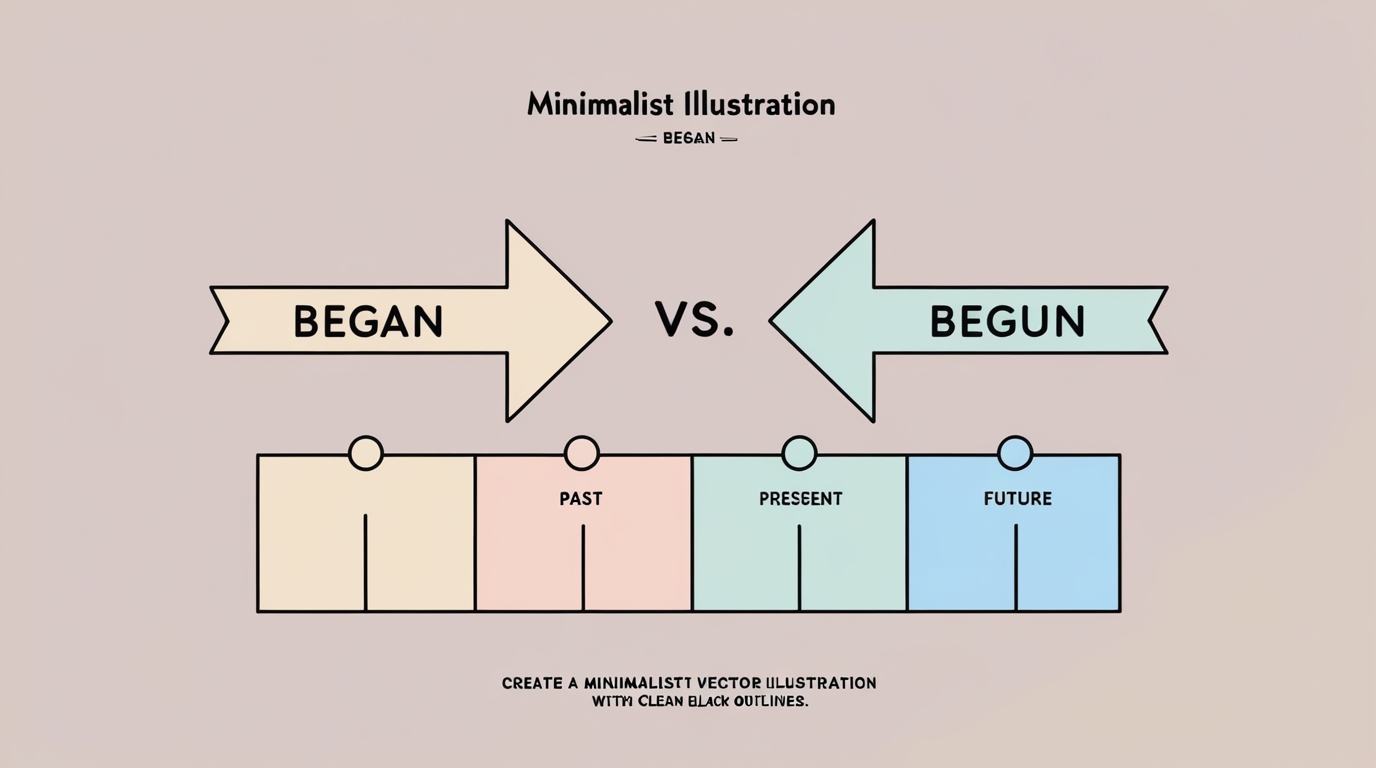
- Key differences
- Context:
- Auxiliary verbs:
- Example sentences with began
- Example sentences with begun
- Practice using began and begun
- Recommended reading
- Conclusion
- Frequently Asked Questions
- What is the difference between ‘began’ and ‘begun’?
- When should I use ‘began’?
- How do I use ‘begun’ correctly?
- What are some common mistakes people make with ‘began’ and ‘begun’?
- Can you provide examples of ‘began’ and ‘begun’ in sentences?
English grammar can be challenging, especially when it comes to distinguishing between “began” and “begun.” Both forms stem from the verb “begin,” yet they serve different purposes in a sentence. Misusing them can lead to confusion in communication, making it essential for learners to grasp their correct applications.
In this article, we will dive deep into each verb form, offering clear definitions, insightful comparisons, and practical examples to help you master their usage with confidence.
So, scroll down and let’s begin!
Understanding verb tenses
A key distinction between “began” and “begun” lies in their verb tenses. Before diving deeper into each term, let’s first clarify what verb tense means and outline the specific tenses we will explore.
What is a verb tense?
Verb tenses are essential tools in language that show when an action occurs—whether in the past, present, or future. In English, the verb you choose changes depending on the timing of the action; for instance, the verb for a past event is distinct from that of a current one. Understanding these variations helps convey your message clearly and accurately.
Past verb tenses
When discussing past events or actions, two key verb tenses come into play: the simple past tense and the past participle tense. Understanding these tenses is essential for effectively conveying when something occurred.
Simple past tense
The simple past tense is a verb form used to express actions or events that have been completed in the past. You can typically create it by adding “-ed” to regular verbs, while irregular verbs take on unique forms. This tense helps us convey experiences and events clearly and effectively.
For instance, the regular verb “talk” transforms into “talked” in the simple past tense. In contrast, the irregular verb “go” changes to “went.”
“Begin” is an irregular verb, so the simple past tense is “began.”
Past participle tense
In English grammar, the past participle plays a crucial role in constructing perfect tenses. These tenses highlight actions that relate to other events in time. For instance, the past perfect tense refers to actions completed before another past event, while the present perfect tense describes actions that started in the past and continue to the present. This article will delve into both the past perfect and present perfect tenses.
The perfect tenses are formed by combining the past participle with an auxiliary verb (e.g., “has,” “had,” or “have”).
Similar to the simple past tense, the past participle is created by adding “ed” to regular verbs or utilizing the unique forms of irregular verbs. For example, the past participle of the regular verb “talk” becomes “talked,” while the irregular verb “go” changes to “gone.”
The past participle of “begin” is “begun.”
Examples of past verb tenses
Below are some examples of the simple past tense and the perfect tense in action:
Simple past:
- Last year, she began her studies at the university.
- They talked about their neighbor for hours.
- Kim went to the show yesterday.
- They began the project together.
In these examples, we used the simple past tense to describe actions that started and ended in the past.
Perfect tense:
- The race has begun. (present perfect tense)
- She has gone to the mall. (present perfect tense)
- By the time I arrived, the game had already begun. (past perfect tense)
- She had talked about this issue before. (past perfect tense)
In these examples, the past participle combines with an auxiliary verb—often called a “helping verb”—to create the perfect tense. This structure allows us to express actions that have been completed in relation to the present or another time frame.

When to use began
Now that you understand the relevant verb tenses, let’s explore when we use the verb form “began.”
Simple past tense
The word “began” is the simple past tense of the verb “begin.” We use this tense to describe actions that started and concluded in the past, marking a clear timeframe for events that have already occurred.
- For example: The movie began promptly at 7:00 PM and ended at 9:30 PM.
Example sentences
Below are a few more examples of the simple past tense:
- She began reading the book yesterday.
- They began their road trip early in the morning.
- He began cooking dinner in the kitchen.
- We began our hike at sunrise.
- The teacher began the class by introducing the topic.
- I began learning to play the guitar when I was a child.
- She began her presentation confidently, captivating the audience from the start.
Tips for identifying when to use began
When talking about an action or event that started and finished in the past, it’s best to use the word “began” to convey that moment clearly. This choice employs the simple past tense, making your message straightforward and effective.
For example: “She began her presentation with an introduction.”
2. Take into account the context and time frame to identify whether the action is a completed event or still in progress. If it refers to a simple past action that has already concluded, use the word “began.”
For example: “They began their journey early in the morning.”
When to use begun
Now that we’ve learned when to use “began,” let’s take a look at the verb form “begun.”
Definition
The word “begun” is the past participle of the verb “begin.” It combines with auxiliary verbs like “has,” “have,” or “had” to create perfect tenses or construct passive sentences. Understanding its usage can enhance your grammar skills and improve your writing.
Let’s look at the present perfect tense, past perfect tense, and passive constructions in more detail.
Present perfect tense
The word “begun” pairs with the auxiliary verbs “has” or “have” to create the present perfect tense. This tense is essential for expressing actions that originated in the past and are still ongoing in the present.
For example:
- He has begun the interview for the upcoming project.
- They have begun their research.
Past perfect tense
The past perfect tense allows us to describe an action that was completed before another event in the past. To construct this tense, we combine the auxiliary verb “had” with the past participle “begun.” This helps clarify the sequence of events in a narrative.
For example:
- By the time she arrived, the meeting had already begun.
Passive verb construction
Passive verb construction is a grammatical style in which the subject of the sentence is acted upon rather than performing the action. To form the passive voice, you use a form of the auxiliary verb “be” (such as be, am, is, are, was, were, being, or been) followed by the past participle of the main verb. This structure emphasizes the action or the recipient rather than the doer, making it a useful tool in writing.
“Begun” is the past participle of “begin,” so that’s what we use in passive verb constructions.
For example:
- Sandra began the work. (simple past tense)
- The work was begun by Sandra. (passive verb construction)
In the second sentence, the subject “Sandra” became the receiver of the action.
Passive voice is often employed when the emphasis is on the action itself rather than who is performing it. This construction is particularly useful when the identity of the doer is unknown or irrelevant.
Example sentences
- The movie has begun. (present perfect tense)
- She has begun her workout routine. (present perfect tense)
- By the time I arrived, the party had already begun. (past perfect tense)
- He realized he had begun reading the wrong book. (past perfect tense)
- The novel was begun many years ago. (passive verb construction)
- A new chapter has been begun in the company’s history. (passive verb construction)
- We have begun the meeting. (present perfect tense)
- The race had begun before the rain started. (past perfect tense)
- The construction work had been begun by a renowned architect. (passive verb construction)
Tips for identifying when to use begun
- Utilize “begun” with an auxiliary verb for actions that started in the past and continue to the present (present perfect) or for actions that occurred before another past event (past perfect).
- Use auxiliary verbs like “have,” “has,” “had,” “be,” “was,” or “were” with the past participle “begun.”
- Remember to use “begun” when you are forming passive constructions.
Common mistakes and misconceptions when using began and begun
Using “began” instead of “begun”
A frequent error people make is using the simple past tense “began” alongside an auxiliary verb, when they should instead use the past participle “begun.”
Incorrect: She has began her new job.
Correct: She has begun her new job.
Some people also use “begun” when they should have used “began.”
Incorrect: She has begun her presentation yesterday.
Correct: She began her presentation yesterday.
Leaving out the auxiliary verb
To use the past participle “begun” correctly, it must be paired with an auxiliary verb such as “have,” “has,” or “had.” Failing to include the right auxiliary verb, or leaving it out altogether, results in grammatically incorrect sentences.
Incorrect: They begun their vacation.
Correct: They have begun their vacation.
Overusing the present perfect tense
Another common mistake is when “has/have begun” is used when the simple past tense “began” would be more appropriate.
Incorrect: She has begun her journey yesterday.
Correct: She began her journey yesterday.
Forming passive constructions incorrectly
In sentences using the passive voice, the past participle “begun” signifies that the action has been performed on the subject. However, a frequent error is substituting it with “began.”
Incorrect: The book was began by the author.
Correct: The book was begun by the author.
Avoiding “began” when describing all actions or events in the past
Many people mistakenly believe that the past participle “begun” is suitable for all past actions. However, that’s not true. The correct term to use for simple past actions that have a definite start and finish is “began.”
Incorrect: They have begun their journey early in the morning.
Correct: They began their journey early in the morning.

Comparing when to use began vs. begun
While “began” and “begun” are both past forms of the verb “begin,” they serve distinct purposes in English grammar. We’ve touched on some differences already, but let’s dive deeper into their specific uses and contexts.
Key differences
Context:
- “Began” is the simple past tense of “begin,” used to describe actions or events that started and concluded in the past.
- “Begun” is the past participle of “begin,” used to create the present perfect tense for ongoing actions that began in the past, the past perfect tense for actions that are completed, and in passive constructions.
Auxiliary verbs:
- “Began” doesn’t need an auxiliary verb.
- “Begun” is used with auxiliary verbs to form perfect tenses or as part of passive verb constructions.
Example sentences with began
Simple past tense
- She began her presentation with an introduction.
- They began their journey early in the morning.
- The team began their practice session promptly at 9 AM.
Example sentences with begun
Past participle tense:
- She has begun her new job.
- They have begun planning for the event.
Past perfect tense:
- By the time we arrived, the concert had already begun.
- The movie had begun before I got there.
Passive construction:
- The project was begun by a team of experts.
Practice using began and begun
Practice what you have learned about “began” vs. “begun” by trying out the following exercises:
Exercise 1: Fill in the blanks with “began” or “begun” in the correct form:
- The construction work had already ____________ when we arrived.
- She has ____________ her new job at the company.
- They ____________ their journey toward the mountains last week.
- The book was ____________ by the author in 2010.
- By the time I got there, the concert had ____________.
Exercise 2: Rewrite the following sentences, replacing the incorrect usage of “begun” or “began” with the appropriate form:
- I have begun reading the book yesterday.
- The project was began by a team of professionals.
- They have begun their vacation last month.
Recommended reading
To enhance your grasp of the difference between “began” and “begun,” explore our article featuring valuable resources for mastering verb forms. You’ll discover a variety of tools designed to help you practice and refine your English verb usage effectively.
Dive into essential grammar resources like *English Grammar in Use* by Raymond Murphy and *The Blue Book of Grammar and Punctuation* by Lester Kaufman and Jane Straus. These books offer straightforward explanations and practical exercises on a wide range of grammar topics, including verb tenses, making them invaluable for anyone looking to enhance their language skills.
Beyond reading books and articles, exploring online platforms like LingualNeeds can significantly enhance your language skills. This platform provides tailored language learning experiences and group classes led by knowledgeable English tutors, making it an excellent resource for learners at any level.
Practice is essential for boosting your English skills, and working with language tutors can provide valuable guidance to help you improve even faster.

Conclusion
Mastering the correct verb forms can significantly improve your English language abilities and ensure that your message is conveyed clearly. The distinction between “began” and “begun” often confuses learners, but the helpful tips in this guide will clarify how to use them effectively.
We clarified that “began” is the simple past tense of “begin,” indicating actions that occurred in the past. On the other hand, “begun” is the past participle form, typically used alongside an auxiliary verb to express ongoing or completed actions that originated in the past. Additionally, it can function in passive voice constructions.
Practicing the distinction between “began” and “begun” is crucial for enhancing your English fluency. A fantastic way to elevate your language skills is by engaging in one-on-one tutoring, which offers personalized guidance tailored to your learning needs.
Frequently Asked Questions
What is the difference between ‘began’ and ‘begun’?
‘Began’ is the simple past tense of ‘begin,’ while ‘begun’ is the past participle used with auxiliary verbs to form perfect tenses or passive constructions.
When should I use ‘began’?
‘Began’ should be used to describe actions that started and finished in the past.
How do I use ‘begun’ correctly?
‘Begun’ is used with auxiliary verbs like ‘has,’ ‘have,’ or ‘had’ to form perfect tenses or in passive voice constructions.
What are some common mistakes people make with ‘began’ and ‘begun’?
Common mistakes include using ‘began’ with auxiliary verbs and using ‘begun’ for actions that are completed in the past without an auxiliary.
Can you provide examples of ‘began’ and ‘begun’ in sentences?
Examples include ‘She began her presentation’ for ‘began’ and ‘The project was begun by a team’ for ‘begun’.