
- The evolution of audio in language learning
- The benefits of learning a language through podcasts
- Ease of use
- Interesting content
- They are free
- They can actually help you speak
- 2 ideas to learn languages through podcasts
- Final thoughts
- Frequently Asked Questions
- What is the best way to learn a foreign language?
- How can a tutor help in language learning?
- What role do podcasts play in language learning?
- How can podcasts improve speaking abilities?
- What are some effective strategies for using podcasts in language learning?
Let’s get one thing straight. There is no magic bullet or special sauce for language learning.
Learning a foreign language is a rewarding journey that demands dedication and the right balance of skills. To truly master a language, you need to immerse yourself in it through listening and reading, while also practicing speaking and writing. This combination of input and output is essential for developing fluency and confidence.
When it comes to improving your language skills, partnering with an excellent tutor is hard to beat. A tutor not only identifies and corrects your mistakes but also motivates and guides you, helping you to broaden your linguistic abilities and reach new heights in your language journey.
While having a tutor can significantly enhance your learning experience, it’s equally important to dedicate time to self-study. This involves seeking out a wealth of quality resources in your target language and immersing yourself fully in the material.
Diving into reading in your target language—be it a graded reader or the authentic text—is widely recognized as a fantastic way to expand your vocabulary, grasp grammar intuitively (without cracking open a grammar book), and solidify the words and phrases you’ve already mastered.
Another tool gaining traction among language enthusiasts is podcasts, often referred to as the “secret weapon” of polyglots. Listening to podcasts offers an engaging way to immerse oneself in a language while enjoying diverse topics and expert insights.
The evolution of audio in language learning
Learning a language through pre-recorded audio isn’t a novel concept—think Michel Thomas. However, the rise of smartphones and the simplicity of podcast creation have opened up a vast array of opportunities for language learners that were once unimaginable. Now, students can easily access a treasure trove of audio resources at their fingertips.
Imagine a podcast as your personal radio show, available anytime you want, right on your smartphone—and best of all, it’s free! To get started, simply download a podcast app like Apple Podcasts, Google Podcasts, or Spotify. With countless options in nearly every language, you can explore a vast universe of content. In fact, there are over 2 million podcasts featuring a staggering 48 million episodes to enjoy!
Most podcasts cater to native speakers, but a growing number are specifically designed for language learners. These podcasts typically feature slower speech and simpler vocabulary, making them more accessible. Many also provide transcripts, allowing you to follow along easily. While some episodes delve into focused topics like vocabulary and grammar, it’s important to note that “language learning podcasts” cover a broader range of themes beyond just grammar lessons.
Contemporary language learning podcasts have discovered that captivating storytelling is essential for maintaining listener engagement. By weaving intriguing narratives into their episodes, these podcasts not only teach languages but also entertain and inspire their audience.
- Naked French is a podcast for French learners that tells fascinating real-life stories of French people.
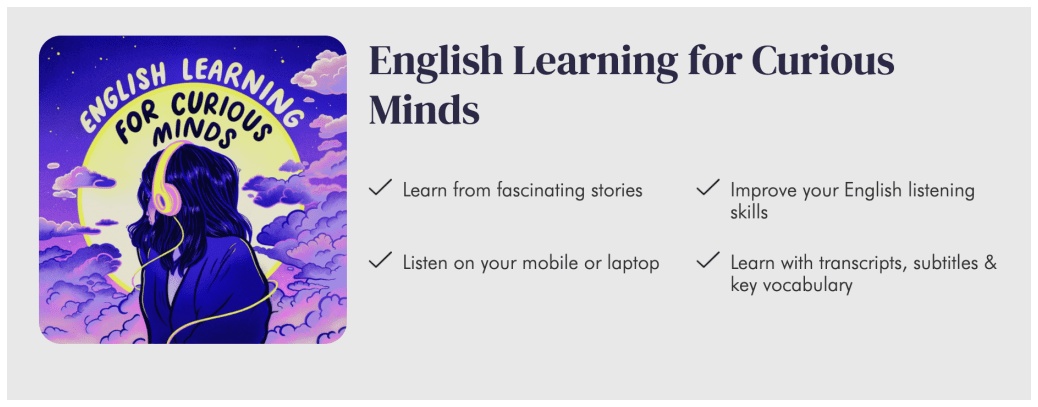
- “English Learning for Curious Minds is a podcast designed for English learners, offering engaging lessons on topics like The Space Race and George Orwell, all while enhancing language skills.”
- The Duolingo Spanish podcast aims to teach grammar and vocabulary through stories from all over the Spanish-speaking world.
If you’re interested in improving your grammar and vocabulary, there are numerous podcasts available to explore. However, podcasts aren’t the only way to enhance your grammar skills, particularly if you’re already at an intermediate level or above.
As Olly Richards says, ,
Engaging with a captivating story activates the emotional centers of your brain, making you feel as if you are part of the narrative. This immersive experience engages multiple areas of your brain, unlike studying grammar, which typically involves only a single region. By learning through storytelling, you stimulate the formation of new synaptic connections, enhancing memory retention and deepening understanding.
The benefits of learning a language through podcasts
The diverse array of podcasts now available has attracted a growing number of language learners. For instance, my podcast, English Learning for Curious Minds, experienced remarkable growth, skyrocketing by 25 times since its launch and amassing over half a million downloads in just the first 18 months.
It’s not hard to imagine why, as podcasts have many advantages for language learners, such as the following.
Ease of use
Having your phone at your fingertips around the clock makes it effortless to tune into a podcast anytime you want.
No matter if you’re waiting for a bus, winding down in bed at night, or taking a leisurely stroll, you can easily tap into valuable language resources right from your phone. There’s no need for advance planning or a speaking partner—simply plug in your headphones, hit play, and immerse yourself in the experience!
You can easily multitask by listening to podcasts in your target language while tackling everyday activities like washing dishes, jogging, or cleaning your home. This way, you can absorb language input without needing to set aside extra time in your busy schedule.
Before the rise of podcasts, accessing audio content in less common languages was a challenge, especially if you lived outside the country. Many people had limited options, often relying on pre-recorded talks or searching for language exchange partners through apps and websites. Thankfully, podcasts have transformed this experience, allowing you to enhance your learning by combining conversations with a speaking partner or tutor with diverse audio input from various sources.
If you’re in the mood for a challenge, consider trying “Shadowing.” This engaging technique involves mimicking the speaker’s words and intonation in real-time, transforming your listening skills into active practice. It’s a fun way to enhance your language abilities while keeping your brain engaged!
Interesting content
The era of relying solely on lengthy textbooks filled with vocabulary and grammar rules, or memorizing the same scripted role-play phrases like “Do you have a table for two tonight at 8pm?” is over. Today, language learning is more dynamic and engaging, offering diverse and practical input that truly reflects real-life conversations.
With an overwhelming variety of podcasts available, particularly in languages like English, French, and Spanish, you have countless options at your fingertips. The exciting part? You don’t have to limit yourself to just one—you can explore as many as you like!
Podcasts offer a fantastic opportunity to explore a diverse range of topics. One day, you could dive into a captivating history episode, the next, unravel a gripping true-crime story. You might even squeeze in a discussion on grammar before wrapping up your week with an exciting sports show. The variety is endless, making it easy to learn something new every day!
Since they’re free, you can easily explore a variety of options that catch your eye. Try out a few episodes, hold on to the ones you love, and skip the ones that don’t resonate with you.
The ease of switching between options, combined with the wide array of choices available, keeps you motivated and enhances your learning experience.

They are free
Who doesn’t love free stuff, right?
While many podcasts offer paid features like transcripts or vocabulary lists, listening remains entirely free. Most podcasts are supported by sponsors, but you can easily skip past the ads if you prefer an uninterrupted experience.
These resources are an excellent option for budget-conscious language learners, but I would still highly recommend them even if they came with a price tag.
They can actually help you speak
While you may believe that podcasts primarily serve to enhance your listening skills—after all, they are designed for auditory consumption—they actually offer much more.
You might be surprised to learn that podcasts can enhance your speaking abilities! A study focusing on students learning Mandarin revealed that those who listened to podcasts saw a noticeable improvement in their speaking test scores.
Research revealed that students who listened to a podcast experienced greater improvements in their speaking test scores compared to those who did not. Additionally, these students reported increased confidence in their Mandarin skills. Similar findings emerged from several studies involving Indonesian students learning English, highlighting the positive impact of audio resources on language acquisition.
Extensive listening offers significant advantages for enhancing vocabulary, improving accent recognition, and refining students’ pronunciation and speaking skills. According to Hayo Reinders and Min Young Cho, engaging with a variety of spoken language can greatly boost overall language proficiency.
Why, might you ask?
We acquire language primarily through listening to others. From a baby mastering their first language to adults learning a second one, we absorb sounds and patterns by hearing others communicate before attempting to speak ourselves.
Listening to a podcast serves a similar purpose. When you tune in to a podcast in your target language, you immerse yourself in authentic language, exposing yourself to the actual words and phrases used by native speakers. This experience enhances your understanding and fluency in a natural context.
While simply “listening” is a valid approach, the most successful language learners elevate this activity into a purposeful exercise. They actively engage by jotting down new vocabulary, revisiting unfamiliar terms, recording themselves summarizing the podcast, or practicing shadowing—mimicking the speaker to improve their pronunciation and fluency.
Podcasts offer a unique advantage over books and articles by allowing you to hear the spoken words, which enhances your pronunciation skills. Many podcasts also provide transcripts, giving language learners the chance to read along while they listen. This dual approach not only boosts listening comprehension but also aids in developing writing skills.

2 ideas to learn languages through podcasts
Podcasts offer a wealth of advantages for language learners, and these are just a few of the most notable ones. At Leonardo English, we’ve witnessed a diverse range of innovative ways that learners harness podcasts to enhance their skills.
A Chinese native speaker pursuing a Master’s in Translation and Interpreting actively utilizes these tools to enhance their skills in “real-time” interpreting.
One enthusiastic language learner, affectionately known as “The Hungry Learner” by her friends, has crafted a comprehensive 7-day study planner that exclusively utilizes podcasts for her Spanish language practice.
Here’s what she does:
DAY 1: Listening (just audio)
DAY 2: Listening & Reading (audio + subtitles)
DAY 3: Reading transcript aloud + highlighting vocabulary to learn
DAY 4: Shadowing + Writing (summary + personal opinion / 150 -180 words)
DAY 5: Shadowing + Speaking (summary + personal opinion / Recording)
DAY 6: Creating flashcards with vocabulary on QUIZLET APP (free version)
DAY 7: Listening (just audio)
Podcasts have a unique charm, making them accessible to anyone, no matter where they are. For instance, consider the inspiring tale of an 80-year-old grandmother from Italy who tunes into her favorite podcasts each morning while pedaling on her exercise bike. This highlights how podcasts can enrich lives at any age!
Final thoughts
Podcasts serve as a fantastic resource for language learners of every proficiency level. While they can’t take the place of a language tutor, they can significantly enhance your learning experience.
At the beginning of this article, I emphasized that there are no quick fixes or shortcuts in the journey of language learning.
While there may not be a perfect solution yet, incorporating podcasts into your learning routine—alongside speaking activities and consistent exposure to your target language—comes remarkably close to achieving fluency.
Frequently Asked Questions
What is the best way to learn a foreign language?
The best way to learn a foreign language is through a combination of listening, reading, speaking, and writing.
How can a tutor help in language learning?
A tutor can identify and correct mistakes, motivate learners, and guide them in broadening their linguistic abilities.
What role do podcasts play in language learning?
Podcasts offer an engaging way to immerse oneself in a language, providing diverse topics and insights to enhance listening skills.
How can podcasts improve speaking abilities?
Podcasts can enhance speaking abilities by providing extensive listening opportunities, which help in vocabulary acquisition and pronunciation.
What are some effective strategies for using podcasts in language learning?
Effective strategies include listening only, combining listening with reading, shadowing, and summarizing podcast content.


