- The Italian alphabet
- What are the Italian vowels?
- Italian glides, semivowels and diphthongs
- How do Italian accent marks change pronunciation?
- Acute accent
- Grave accent
- What are the Italian consonants?
- Italian plosive consonants
- Italian fricative consonants
- Italian vibrant consonants
- Italian lateral consonants
- Italian affricate consonants
- Italian nasal consonants
- What are the special Italian pronunciation rules?
- Double consonants
- Hard and soft pronunciation of c and g
- C pronunciations
- G pronunciations
- The silent h
- The Italian r
- S and z sounds
- What are the 5 letters missing in the Italian alphabet?
- Turn theory into practice with LingualNeeds
- Frequently Asked Questions
- What is the Italian alphabet composed of?
- How do Italian vowels differ from English vowels?
- What are diphthongs in Italian?
- How do accent marks change pronunciation in Italian?
- Which letters are missing from the Italian alphabet?
The Italian alphabet, known as the “alfabeto italiano,” serves as the cornerstone of the Italian language. It’s usually the first topic covered when you begin your Italian lessons, whether online or in a classroom setting.
Italian, rooted in Latin, boasts a highly phonemic structure, meaning there is a near-perfect match between its sounds (phonemes) and letters (graphemes). This phonetic consistency makes it easier for learners to pronounce words accurately, as each letter typically corresponds to a specific sound.
Mastering the Italian alphabet and its sounds makes pronouncing words straightforward and intuitive, even if you’re unfamiliar with their meanings. In contrast to English, where the relationship between letters and sounds can be unpredictable, Italian allows for accurate pronunciation right from your first try.
In this article, we’ll explore the Italian alphabet and introduce you to essential Italian vocabulary, laying a solid groundwork for your language-learning journey. Read on to discover more!
The Italian alphabet
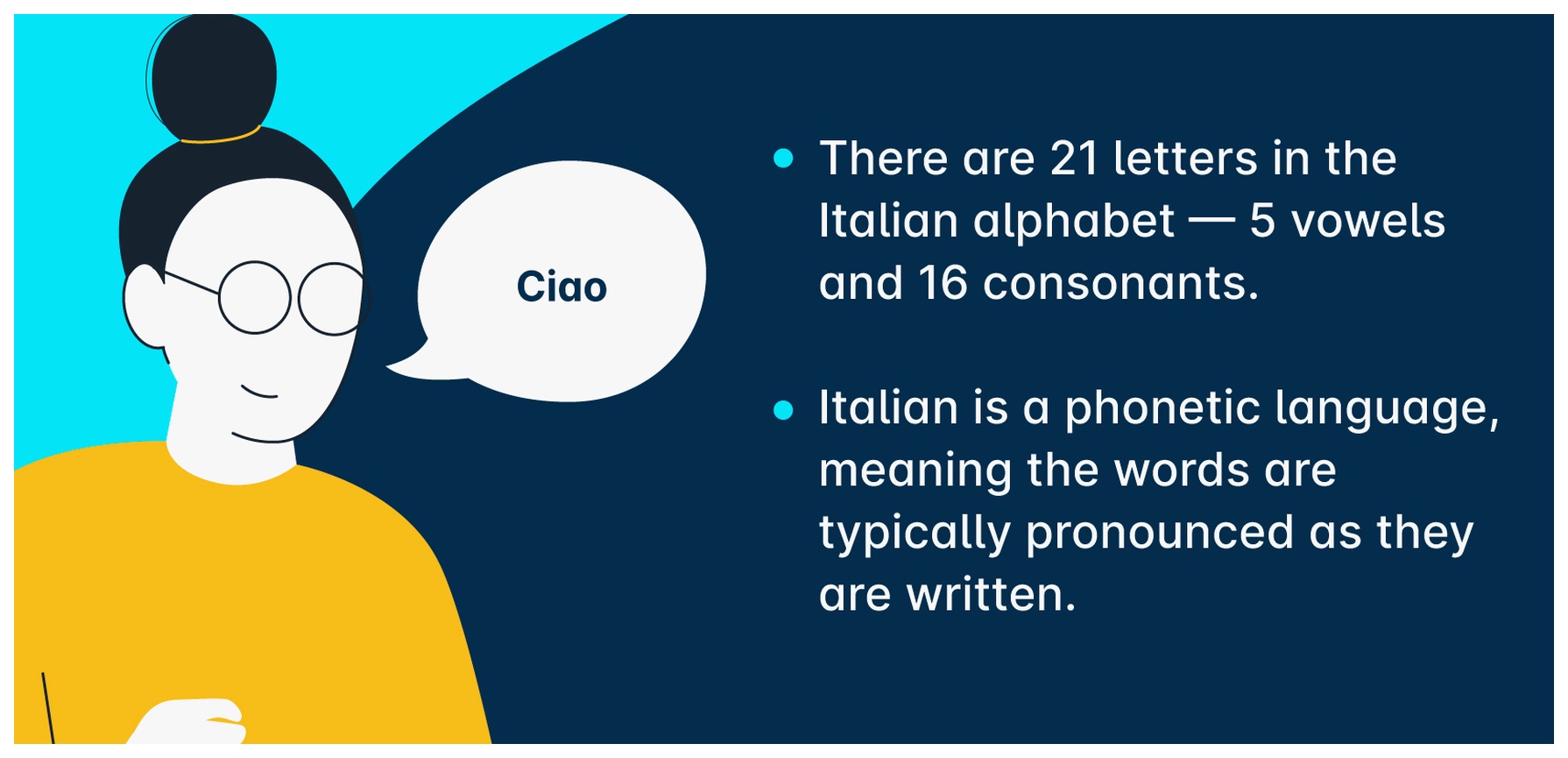
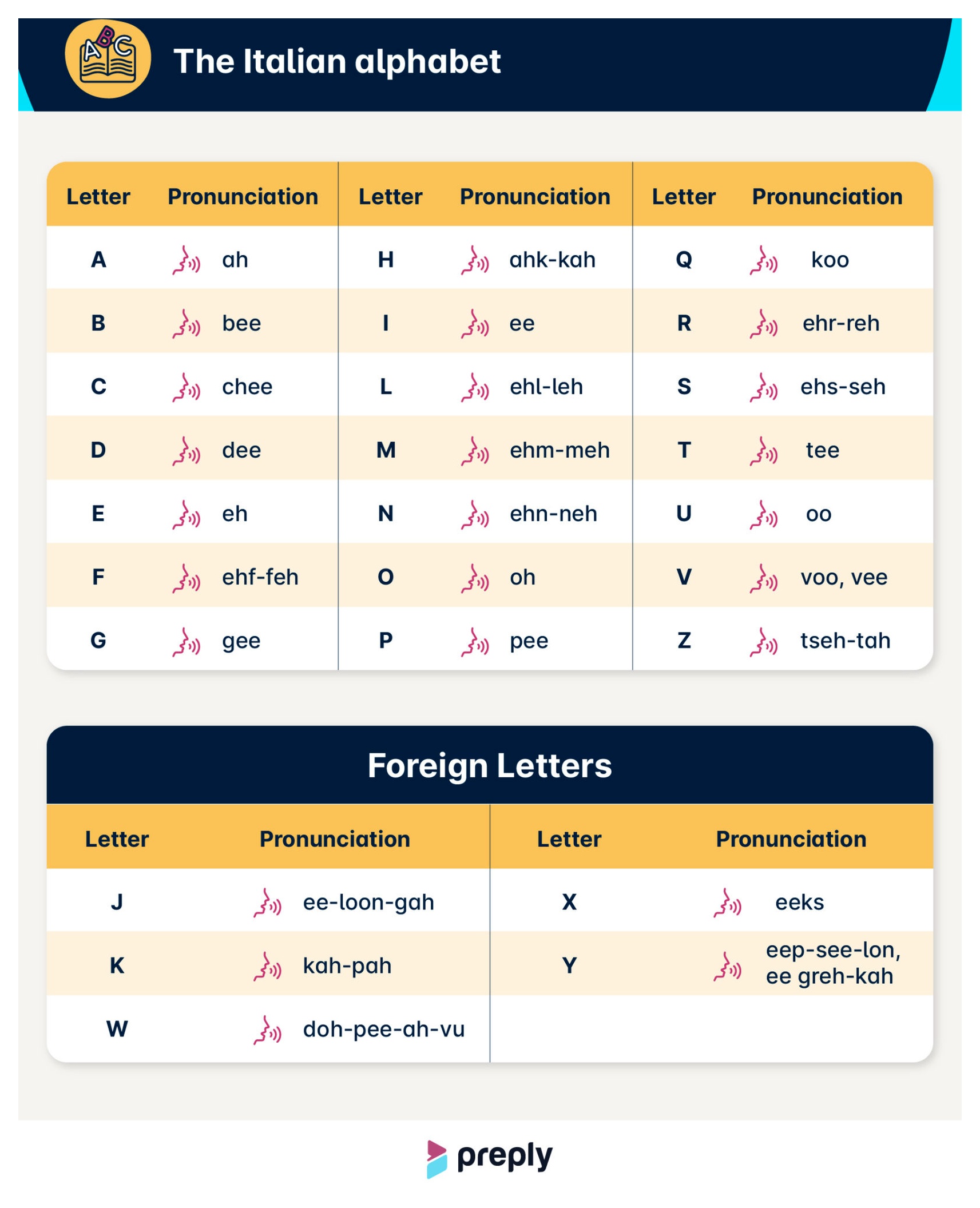
This chart is your gateway to mastering the Italian alphabet and its pronunciations! For your convenience, you can download our printable PDF for quick reference. The Italian alphabet consists of 21 letters—5 vowels and 16 consonants. Notably, the letters j, k, w, x, and y are absent, as they are primarily found in foreign terms.
| Italian alphabet | |||||
| Letter | Pronunciation | Letter | Pronunciation | Letter | Pronunciation |
| A | ah | H | ahk-kah | Q | koo |
| B | bee | I | ee | R | ehr-reh |
| C | chee | L | ehl-leh | S | ehs-seh |
| D | dee | M | ehm-meh | T | tee |
| E | eh | N | ehn-neh | U | oo |
| F | ehf-feh | O | oh | V | vee |
| G | gee | P | pee | Z | tseh-tah |
| Foreign letters | |||||
| Letter | Pronunciation | Letter | Pronunciation | ||
| J | ee-loon-gah | W | doh-pee-ah-vu | ||
| K | kah-pah | X | eeks | ||
| Y | eep-see-lon | ||||
What are the Italian vowels?
The Italian alphabet features five vowels—A, E, I, O, and U—similar to English, excluding “Y,” which is primarily a consonant but can function as a vowel. Italian vowels are pronounced distinctly and frequently appear at the end of words. Notably, there are seven vowel sounds in Italian, with both E and O having two pronunciations that depend on whether they carry acute or grave accents.
| IPA sound | Italian word | Pronunciation | Meaning | English sound equivalent |
| [a] | casa | kah-sah | house, home | father |
| [e] | mela | may-lah | apple | bait |
| [ɛ] | festa | feh-stah | party | bet |
| [i] | dormire | dohr-mee-reh | to sleep | meet |
| [o] | notte | noht-teh | night | boat |
| [ɔ] | mondo | mawn-doh | world | law |
| [u] | gufo | goo-foh | owl | moon |
Italian glides, semivowels and diphthongs
Alongside basic vowels, the Italian language features semivowels (or semi-consonants), diphthongs, and glides. While their pronunciation resembles that of simple vowels, the key distinction lies in how they are structured within syllables.
A semivowel is a sound that resembles a vowel but functions as a consonant. In Italian, semivowels such as [j] and [w] appear before another vowel, transforming into glides. This causes the initial vowel to be shorter and less pronounced than the following one. Here are some examples to illustrate this concept:
| IPA sound | Italian word | Pronunciation | Meaning | English sound equivalent |
| [j] | aiuto | ah-you-toh | help | yet |
| [w] | quello | kweh-lo | that | wet |
Diphthongs are fascinating vowel combinations that create a single syllable sound. When two vowels blend together, one vowel may sound more prominent, while the other can remain unstressed. Diphthongs are categorized into two distinct types, each with its unique features.
A falling diphthong, or “dittongo discendente,” occurs when a vowel appears in the second position. In these instances, the first vowel carries a stronger sound, while the second vowel is less emphasized. It’s important to note that diphthong vowels should be pronounced together as a single syllable.
| Letter combination | Italian word | Pronunciation | Meaning |
| ai | zaino | zah+ee-noh | backpack |
| ei | direi | dee-reh+ee | I’d say |
| oi | poi | poh+ee | then, later |
| ui | lui | loo+ee | he |
| au | aumento | ah+oo-mehn-toh | increase |
| eu | Europa | eh+oo-roh-pah | Europe |
A rising diphthong, or “dittongo ascendente,” occurs when a vowel in the first position is followed by a stronger vowel. In these instances, the sound of the first vowel is less pronounced, while the second vowel takes center stage. Here are a few examples:
| Letter combination | Italian word | Pronunciation | Meaning |
| ia | piano | pee+ah-naw | slow, floor |
| ie | pieno | pee+eh-naw | full |
| io | passione | pahs-see+oh-neh | passion |
| iu | fiume | fee+oo-meh | river |
| ua | guanto | goo+ahn-toh | glove |
| ue | duemila | doo+eh-mee-lah | two-thousands |
| ui | suino | soo+ee-naw | pig |
How do Italian accent marks change pronunciation?
In Italian, accents are exclusively placed on vowels, never on consonants. There are two types of accents: tonic and graphic. Tonic accents are not marked in writing; instead, they indicate which syllable is stressed when spoken. For instance, in the word “thenainnation,” the tonic accent highlights the stressed syllable. On the other hand, graphic accents are explicitly written and come in two forms: acute and grave. These accents alter the pronunciation of the vowels they accompany, adding depth to the language’s rich phonetic structure.
- Acute accent: close sound, accent mark leaning to the right [´]
- Grave accent: open sound, accent mark leaning to the left [`]
Be careful: Pronouncing the same word with different accents might change its meaning!
Acute accent
The acute accent [´] indicates closed vowel sounds, characterized by closely positioned lips. In Italian, this accent appears on letters like “é” and “ó,” enhancing their pronunciation. For example, when you say the English word “state,” the vowel sound closely resembles that of an acute accent on vowels.
The acute accent indicates a long vowel sound, for instance: perché, “because,” or “why” (pehr-keh).
The acute accent can clarify the meaning of words that are spelled identically but have different interpretations. For example, “credé” (kreh-deh) means “he believed,” while “crede” (kreh-deh) translates to “he believes.” This distinction is essential for accurate communication.
Grave accent
The grave accent [`] indicates open vowel sounds, such as è and ò, which are pronounced with spread lips. It also applies to other vowels like à, ì, and ù, where the mouth can be either more open or closed, but this doesn’t change the pronunciation. For example, when you say the English word “hello,” the vowel sound resembles that of a grave accent.
Grave accents are frequently used in Italian to highlight the final syllable of a word. For example, in the words “città” (cheet-tah) meaning “city,” “caffè” (kahf-feh) for “coffee,” and “lunedì” (loo-neh-dee) which translates to “Monday,” the accent signals where the emphasis should be placed when pronouncing these terms.
The grave accent indicates a short vowel sound, for instance: virtù, “virtue” (veer-too), and perciò, “therefore” (pehr-choh).
Similar to the acute accent, the grave accent can differentiate between words that are spelled identically but have distinct meanings. For example, “saltò” (sahl-toh) means “he jumped,” while “salto” (sahl-toh) translates to “I jump.”
What are the Italian consonants?
The Italian alphabet features 16 consonants (b, c, d, f, g, h, l, m, n, p, q, r, s, t, v, and z), yet there are a total of 21 distinct consonant sounds that can be pronounced.
Unlike vowels, which allow the air to flow freely through the mouth, consonants involve varying degrees of obstruction. In Italian, consonants are divided into six distinct categories based on how this airflow is interrupted: plosive, fricative, vibrant, lateral, affricate, and nasal.
Italian plosive consonants
A plosive consonant occurs when airflow is completely blocked during pronunciation, followed by a sudden release, akin to an explosion. There are six key plosive sounds: [b], [d], [g], [k], [p], and [t], produced by specific letters and combinations.
- B + a, e, i, o, u
- D + a, e, i, o, u
- G + a, he, hi, o, u
- C + a, he, hi, o, u
- P + a, e, i, o, u
- T + a, e, i, o, u
Here are some examples to clarify the pronunciation of plosive consonants:
| IPA sound | Italian word | Pronunciation | Meaning | English sound equivalent |
| [b] | balena | bah-leh-nah | whale | boy |
| [d] | dito | dee-taw | finger | dog |
| [g] | gatto | gaht-taw | cat | golf |
| [k] | caro | kah-raw | dear | car |
| [p] | pane | pah-neh | bread | pillow |
| [t] | topo | toh-paw | mouse | tornado |
Italian fricative consonants
Fricative consonants are unique sounds produced by forcing air through a narrow gap as it exits your mouth. Unlike plosive consonants, which involve a complete blockage of airflow, fricatives allow for a continuous stream of air. There are five key fricative sounds: [f], [v], [s], [z], and [ʃ], which correspond to specific letters and letter combinations in our language.
- F + a, e, i, o, u
- S + a, e, i, o, u
- SC + ia, e, i, io, iu
- V + a, e, i, o, u
- Z + a, e, i, o, u
It’s important to understand that the fricative sound /sc/ becomes softer when followed by specific letters, similar to the /sh/ sound in the English word “sharp.” Here are a few examples to illustrate this point:
| IPA sound | Italian word | Pronunciation | Meaning | English sound equivalent |
| [f] | fame | fah-meh | hungry | family |
| [s] | sole | saw-leh | sun | safe |
| [ʃ] | scivolo | shee-vaw-law | slide | shampoo |
| [v] | volare | vaw-lah-reh | to fly | volatile |
| [z] | marzo | mahr-tsaw | March | sits |
Italian vibrant consonants
Vibrant consonants, commonly known as trills, play a unique role in language, particularly in Italian. One standout example is the trilled “r,” a sound that doesn’t have an equivalent in English. Take the word “sera” (pronounced seh-rah), meaning “evening,” which beautifully illustrates this distinctive phonetic feature.
Italian lateral consonants
Lateral consonants are unique sounds produced when airflow is blocked by a single obstruction in the center of the mouth, allowing it to flow freely around the sides. In Italian, there are two distinct lateral consonant sounds: [l] and [ʎ].
| IPA sound | Italian word | Pronunciation | Meaning | English sound equivalent |
| [l] | vela | veh-lah | sail | love |
| [ʎ] | foglia | foh-ljah | leaf | Italian |
The lateral sound [ʎ] is unique and isn’t found in English. When it appears before the vowel ‘i’ (with some exceptions), [ʎ] is pronounced softly. To articulate this sound, the tip of your tongue should press against the roof of your mouth, allowing air to flow around the sides of your tongue. It’s somewhat similar to the English sound [l] as it occurs before the letter ‘y’ in the word “you.”
Italian affricate consonants
Affricate consonants are unique sounds that blend the characteristics of plosives and fricatives. They begin with a complete blockage of airflow, followed by a smooth release that creates a continuous stream of air. In total, there are four distinct affricate sounds to explore:
| IPA sound | Italian word | Pronunciation | Meaning | English sound equivalent |
| [dʒ] | giurare | djoo-rah-reh | to swear | judge |
| [tʃ] | cielo | cheh-law | sky | church |
| [dz] | azzurro | ahdz-zoor-roh | light blue | adds |
| [ts] | pazzo | pat-tsoh | crazy | pizza |
Italian nasal consonants
Nasal consonants occur when the velum is lowered, allowing air to flow through the nose rather than the mouth. In Italian, these nasal sounds include “n,” “m,” and “ng,” each producing distinct auditory effects.
| IPA sound | Italian word | Pronunciation | Meaning | English sound equivalent |
| [m] | mano | mah-naw | hand | mum |
| [n] | naso | nah-saw | nose | name |
| [ɳ] | sogno | saw-njee-aw | dream | onion |
In English, we lack a direct equivalent for the Italian soft sound /gn/. However, you can think of it as being similar to the “ny” in “onion” or the Spanish /ñ/ found in “mañana.”
What are the special Italian pronunciation rules?
Alongside the consonant classification mentioned earlier, there are several key pronunciation rules that frequently appear in Italian. Understanding these rules is essential for mastering the language effectively.
Double consonants
Double consonants are formed by repeating the same consonant, and they create a distinct sound that sets them apart from single consonants. The difference lies in their pronunciation: double consonants are pronounced longer and with greater emphasis.
Enhance your pronunciation skills with this helpful tip: to elongate a double consonant sound, try shortening the vowel that precedes it. While most consonants can be doubled, silent consonants like ‘h’ and ‘q’ are exceptions, with ‘q’ being particularly rare. The only instance of a double ‘q’ can be found in the word “soqquadro,” which means “mess” (pronounced sohk-koo-ah-droh). For further practice, consider the words “tetto” (teht-toh), meaning “roof,” and “sasso” (sahs-saw), meaning “stone.”
Hard and soft pronunciation of c and g
C pronunciations
The letter “c” is pronounced hard when it comes before the vowels “a,” “o,” or “u,” as well as before the letter “h” when followed by the vowels “e” and “i” (as in “che” and “chi”). For instance, “amiche” (ah-mee-keh) translates to “female friends,” while “cuore” (koo-oh-reh) means “heart.”
The letter ‘c’ has a soft pronunciation when it appears before the vowels ‘e’ or ‘i’ (as in ‘ce’ or ‘ci’). For instance, the Italian word “dolce” (pronounced dohl-cheh) translates to “sweet” or “cake,” while “cibo” (pronounced chee-boh) means “food.”
G pronunciations
The hard pronunciation of the letter “g” happens when it precedes the vowels “a,” “o,” “u,” or any consonants. It also occurs when “g” is followed by “h” and the vowels “e” or “i,” as seen in the word “ghiro” (pronounced “ghee-raw”), which means dormouse.
The letter “g” has a soft pronunciation when it appears before the vowels “e” or “i,” as in the combinations “ge” and “gi.” This soft sound is comparable to the English /j/ sound. For instance, in Italian, “gelato” (pronounced jeh-lah-toh) means ice cream, while “magico” (pronounced mah-jee-koh) translates to magic.
The silent h
As previously explained, the letter “h” alters the pronunciation of “c” and “g” when they follow it. However, when “h” appears at the beginning of a word, it remains completely silent, as seen in the word “hanno” (pronounced ahn-noh), which means “they have.”
The Italian r
Italian features two distinct pronunciations for the letter “r.” The first is a trilled, emphasized sound, which occurs at the beginning of a word, when it comes before or after a consonant, or when it appears doubled. A great example of this is “Roma” (pronounced roh-mah), which is the Italian name for Rome.
The other variation is a bit softer and gentler, occurring when it’s surrounded by vowels. A prime example is “mare” (pronounced mah-reh), which means “sea.”
S and z sounds
Consonants can produce two distinct sounds: voiced and unvoiced. You can easily identify them by placing your hand on your throat. If you feel a vibration, the sound is voiced; if not, it’s unvoiced. For instance, the word “thesis” is pronounced like “thez” when it appears between two vowels or before a voiced consonant.
What are the 5 letters missing in the Italian alphabet?
Unlike the English alphabet, which consists of 26 letters, the Italian alphabet is missing five: j, k, w, x, and y. These letters are not officially part of the Italian alphabet, and their sounds are typically represented by other letters. For instance, the Italian “ch” produces a sound similar to the English “k.”
These five absent letters play a crucial role in how Italians incorporate foreign words into everyday conversation. For example:
| Letter | Word | Pronunciation |
| j | déja vu | deh-jah voo |
| k | karaoke | kah-rah-oh-keh |
| w | bowling | boh-ling |
| x | taxi | tah-ksee |
| y | yogurt | yo-goort |
Turn theory into practice with LingualNeeds
Learning a new language often starts with the fundamentals, and Italian is no exception. Mastering the pronunciation of the Italian alphabet is your first step; once you grasp this, you’ll be equipped to pronounce most Italian words confidently on your own.
Putting theoretical knowledge into practice is essential, and one of the most effective ways to do this is by engaging with a native Italian tutor on LingualNeeds.
A skilled tutor can guide you through essential fundamentals such as pronunciation and the alphabet, while also boosting your confidence to start speaking Italian right from the start of your learning journey.
At LingualNeeds, you can kick off your language journey with lessons starting at just $10 per hour. Plus, if your first lesson doesn’t meet your expectations, you have the option to switch to a new tutor at no cost or request a full refund. Explore our selection of Italian tutors and begin your path to fluency today!
end HubSpot Call-to-Action Code
Frequently Asked Questions
What is the Italian alphabet composed of?
The Italian alphabet consists of 21 letters: 5 vowels and 16 consonants.
How do Italian vowels differ from English vowels?
Italian vowels are pronounced distinctly and there are seven vowel sounds, with E and O having two pronunciations depending on their accents.
What are diphthongs in Italian?
Diphthongs are combinations of two vowels that create a single syllable sound, with one vowel often sounding more prominent than the other.
How do accent marks change pronunciation in Italian?
Accents in Italian are placed on vowels and can be tonic or graphic, altering the pronunciation of the vowels they accompany.
Which letters are missing from the Italian alphabet?
The Italian alphabet is missing the letters j, k, w, x, and y.