- Key takeaways
- Querying for crypto terms
- Crypto lingo
- Evaluating crypto literacy
- Curiosity beyond crypto
- Research before investing
- Methodology
- Frequently Asked Questions
- What are the most commonly searched crypto slang terms?
- Which states and cities lead in cryptocurrency searches?
- How confident are Americans in their knowledge of cryptocurrency?
- What percentage of people are interested in learning more about cryptocurrency?
- What is the relationship between cryptocurrency investments and interest in NFTs and the metaverse?
As digital currencies and assets gain popularity, it’s crucial to grasp how Americans perceive and utilize cryptocurrency terminology and slang. At LingualNeeds, we focus on effective communication and mutual understanding, whether through our private English lessons or diverse online language courses. Our latest study delves into the familiarity and confidence levels of various demographics regarding cryptocurrency topics, shedding light on this evolving landscape.
We’re diving into the levels of curiosity and knowledge surrounding cryptocurrency, NFTs, and the metaverse. Through a survey of over 1,000 individuals and an analysis of online search trends, we’ve identified distinct variations in crypto understanding, investment interests, and educational aspirations across different generations and genders. This article sheds light on the state of crypto knowledge in the U.S., highlighting both the excitement and apprehensions within the realm of digital finance.
Key takeaways
- Florida, Washington, and California lead in cryptocurrency searches, with Orlando and Miami, FL, and Atlanta, GA, being the top cities driving this interest.
- DAO, DEX, and ICO are the most commonly searched crypto slang terms.
- 35% of cryptocurrency investors lack confidence in their knowledge, while 60% are unfamiliar with blockchain technology.
- 40% of Gen Z crypto investors don’t feel confident in their knowledge of cryptocurrency.
- 53% of non-crypto investors are interested in learning more – Gen X is the most interested.
- 11% of people are interested in investing in NFTs, and 32% are interested in joining the metaverse.

Learn a language with personalised 1-on-1 classes with our expert tutors from all over the world
French lessons online
Spanish lessons online
Querying for crypto terms
Our investigation into the rising fascination with cryptocurrency in the U.S. uncovers the states and cities that are leading the way in crypto enthusiasm.

Florida, Washington, and California lead the nation in cryptocurrency searches, showcasing the growing interest in digital currencies. Among cities, Orlando and Miami in Florida, along with Atlanta in Georgia, are particularly notable for their enthusiasm towards all things crypto.
Residents of coastal states and cities have been actively exploring the intriguing world of fintech terminology, with a notable interest in cryptocurrency. However, this curiosity is spreading, and more people everywhere are seeking to enhance their understanding of financial technology. If you’re looking to broaden your own vocabulary, consider using LingualNeeds for an engaging language learning experience.
Next, we’ll uncover the cities in each state with the most searches for crypto terms.

Across the United States, from Birmingham, Alabama, to Laramie, Wyoming, interest in cryptocurrency is on the rise. Each of these cities leads their respective states in search volume for crypto-related terms. Birmingham, the largest city in Alabama, serves as a vibrant economic center and is one of the fastest-growing startup hubs in the nation. Meanwhile, Laramie, despite its smaller size, illustrates that curiosity about digital currency transcends geographic boundaries. People in all types of communities are eager to understand how cryptocurrency operates.
Crypto lingo
Here’s a look at the popular slang and acronyms defining the crypto conversation. See how your knowledge stacks up!

The most frequently searched terms in the crypto space included DAO (Decentralized Autonomous Organization), DEX (Decentralized Exchange), and ICO (Initial Coin Offering). Interestingly, there was a notable interest in crypto-related acronyms and abbreviations, suggesting that many users prefer these shorthand terms over longer phrases.
Here’s a glossary of the most commonly searched crypto terms and their meanings:
- ATH: “All-Time High,” the highest price point a cryptocurrency has ever reached.
- Bag: Refers to holding a large quantity of a specific cryptocurrency.
- Bagholder: Someone holding onto crypto through market lows, hoping for a value increase.
- BTD: An acronym for “Buy The Dip,” a strategy for buying crypto when its price drops.
- CeFi: “Centralized Finance,” traditional financial services with a central governing body.
- CEX: “Centralized Exchange,” a traditional cryptocurrency exchange platform.
- DAO: Stands for “Decentralized Autonomous Organization,” a governance model run by programming instead of centralized human control.
- dApps: “Decentralized Applications” that operate on a blockchain network.
- DeFi: “Decentralized Finance,” which uses smart contracts on blockchains to offer financial services without central authority.
- DEX: “Decentralized Exchange,” a platform that allows direct peer-to-peer cryptocurrency transactions.
- Double-Spend: The risk of a cryptocurrency being spent more than once.
- Drop: Refers to the release of new tokens, NFTs, or significant updates in a project.
- DYOR: “Do Your Own Research,” advice encouraging thorough investigation before investing.
- EVM: “Ethereum Virtual Machine,” the part of Ethereum where smart contracts run.
- Exchange: Platforms for buying, selling, or trading cryptocurrencies, either centralized (CEX) or decentralized (DEX).
- Exit Scam: When project creators abscond with investors’ money, often seen in ICOs.
- Fiat: Government-issued currency, in contrast to cryptocurrencies.
- Flippening: A theoretical scenario where Ethereum’s market cap overtakes Bitcoin’s.
- Fren: A friendly term for fellow crypto enthusiasts or investors.
- FUD: “Fear, Uncertainty, Doubt,” a strategy to influence market perception negatively.
- Gas: The fee for conducting transactions and executing smart contracts on Ethereum.
- HODL: A play on the word “hold,” advising investors to keep their crypto assets despite market swings.
- ICO: “Initial Coin Offering,” a fundraising tool for new projects.
- Maximalists (maxis): Individuals very bullish on a specific cryptocurrency, often to the exclusion of others.
- Pump and dump: Artificially inflating the price of a cryptocurrency before selling it off at the peak.
- Rekt: Suffering significant investment losses.
- Rug pull: A scam where developers abandon a project and flee with investors’ funds.
- To the moon: The hope or belief that a cryptocurrency’s price will soar to great heights.
- WAGMI: “We’re All Gonna Make It,” an expression of optimism in the crypto community.
- Whale: A big player who owns large amounts of cryptocurrency and is capable of influencing market movements.
Learn a language online with our free learning materials.
Learn English online
Learn French online
Evaluating crypto literacy
Our research on cryptocurrency comprehension revealed intriguing differences in confidence and curiosity across various age groups and genders. This segment of the study explored who felt truly knowledgeable about the language and concepts of the crypto landscape, as well as those eager to deepen their understanding.
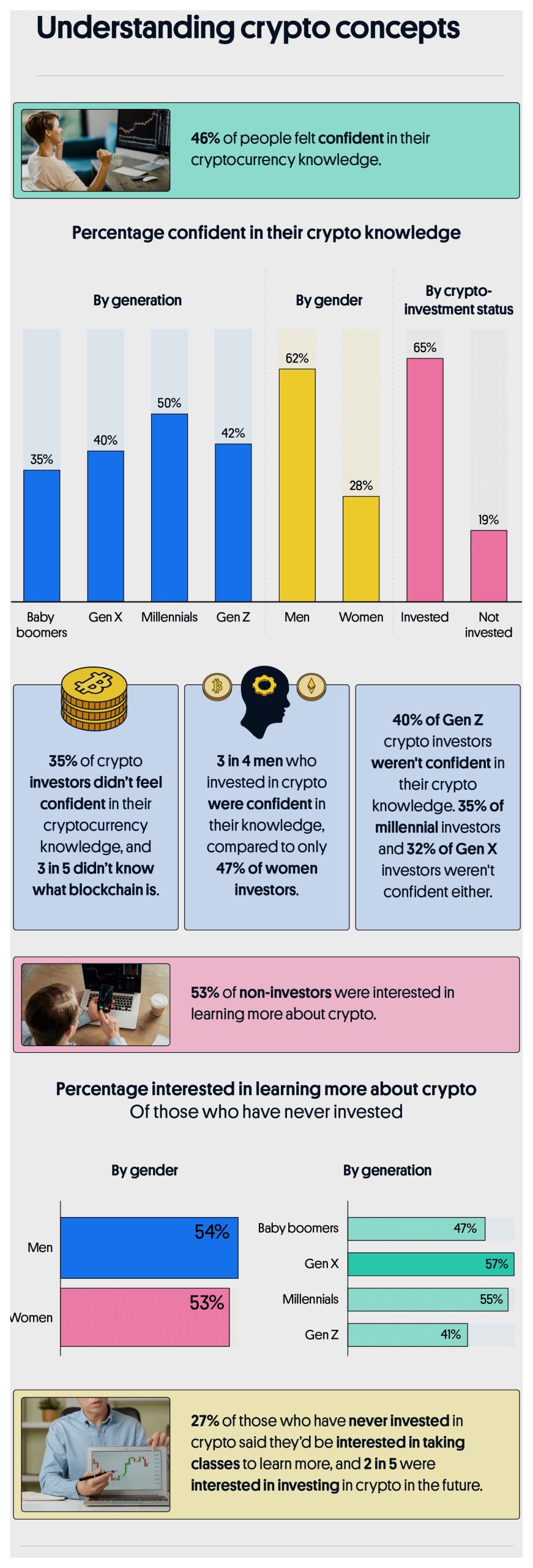
Millennials showed the highest confidence in their understanding of cryptocurrency, with men typically feeling more knowledgeable than women. Yet, despite 46% of individuals expressing overall confidence, a notable 35% of crypto investors were uncertain about their comprehension, particularly among Gen Z, where that figure rose to 40%. Even more astonishing, a significant 60% of investors confessed they lack a solid grasp of blockchain technology.
As we look ahead, it’s clear that Generation X, particularly those who haven’t yet ventured into cryptocurrency, is increasingly curious about investing. In fact, 40% of individuals across all ages who haven’t invested are considering it, with 27% expressing a desire to take classes to deepen their understanding of crypto. This growing interest highlights the vital need for accessible educational resources to help potential investors navigate the world of cryptocurrency.
Effective communication is essential, whether you’re talking about technology, finance, or even the weather. An online tutoring service can be a valuable tool for enhancing your language skills and boosting your confidence in any discussion. For example, consider exploring LingualNeeds for engaging Spanish or French lessons online!
Curiosity beyond crypto
This final section highlights individuals’ confidence in their grasp of NFTs and the metaverse, while also examining their enthusiasm for exploring these digital realms.
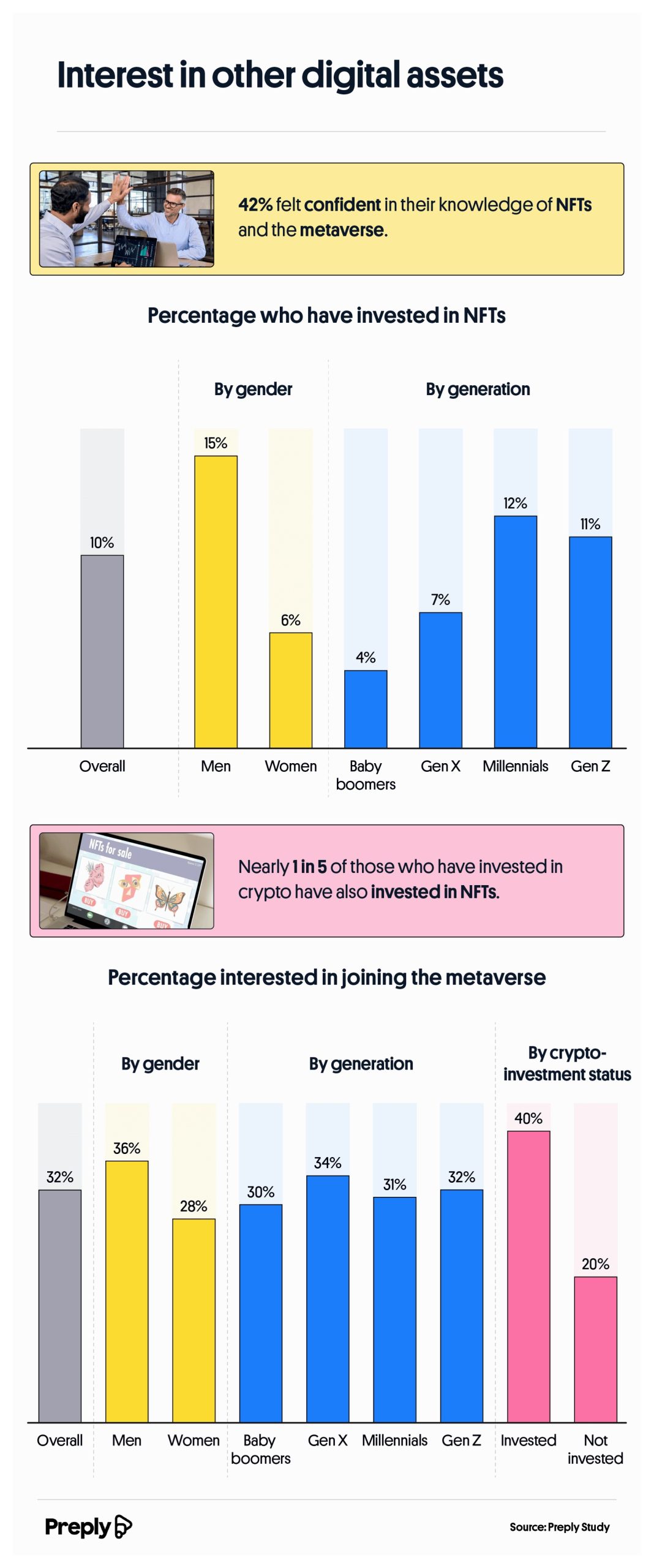
Our survey revealed that only 42% of respondents feel confident in their understanding of NFTs and the metaverse, highlighting a significant opportunity for education in these areas. This lack of confidence may also account for the low enthusiasm for investing in NFTs, with only 11% expressing interest. In contrast, a more promising 32% of participants showed curiosity about exploring the metaverse, indicating a potential avenue for engagement and learning.
Our observations revealed an intriguing connection between cryptocurrency investments and NFTs. It appears that those who ventured into cryptocurrencies were also the sole investors in NFTs. This trend suggests that diving into the world of crypto could serve as a gateway for exploring other digital assets.
Research before investing
Our deep dive into cryptocurrency and digital assets reveals varying levels of understanding, confidence, and curiosity among U.S. consumers. Millennials, in particular, exhibit the highest confidence in their crypto knowledge, suggesting that cryptocurrency could serve as a stepping stone to broader digital investments. These findings underscore a significant interest in and demand for crypto education. As digital currencies, NFTs, and the metaverse gain traction, bridging the knowledge gap is crucial for empowering individuals to engage confidently in these emerging digital economies.
A fantastic way to close knowledge gaps is through online tutoring. If you’re looking to enhance your English vocabulary or dive into learning Spanish, you’ve come to the right place! At LingualNeeds, we offer tailored, accessible language classes designed for enthusiastic learners like you.
Methodology
To uncover the most popular crypto slang terms, we analyzed Google search data for 29 crypto-related phrases over the past year, focusing on all 50 states and 181 major cities across the U.S. Additionally, we conducted a survey with 1,001 U.S. residents to gauge their knowledge, interest, and experiences with cryptocurrency. Our diverse respondents included 5% baby boomers, 24% Gen X, 56% millennials, and 15% Gen Z. In terms of gender representation, 52% identified as men, 47% as women, and 1% as nonbinary or nonconforming. When it comes to investment involvement, 43% had never invested in crypto, 24% had done so in the past, and 33% were currently active investors.
Frequently Asked Questions
What are the most commonly searched crypto slang terms?
The most commonly searched crypto slang terms are DAO (Decentralized Autonomous Organization), DEX (Decentralized Exchange), and ICO (Initial Coin Offering).
Which states and cities lead in cryptocurrency searches?
Florida, Washington, and California lead in cryptocurrency searches, with Orlando and Miami, FL, and Atlanta, GA, being the top cities driving this interest.
How confident are Americans in their knowledge of cryptocurrency?
35% of cryptocurrency investors lack confidence in their knowledge, and 60% are unfamiliar with blockchain technology.
What percentage of people are interested in learning more about cryptocurrency?
53% of non-crypto investors are interested in learning more about cryptocurrency, with Gen X being the most interested group.
What is the relationship between cryptocurrency investments and interest in NFTs and the metaverse?
Individuals who invest in cryptocurrencies are also more likely to be interested in NFTs, with only 11% expressing interest in investing in NFTs, while 32% showed curiosity about exploring the metaverse.