- Key takeaways
- Balancing optimism and concern
- The workers using AI
- The best ways to use AI at work
- The receiving end
- Improving AI skills
- Adding AI to the workload
- Methodology
- Frequently Asked Questions
- What percentage of U.S. workers believe AI skills will be essential in the future?
- How do U.S. workers feel about job security concerning AI?
- Which generation is the most likely to use AI at work?
- What are some common applications of AI in the workplace?
- How are U.S. workers primarily learning new AI skills?
Artificial intelligence (AI) is revolutionizing the way we work and learn. From chatbots assisting customers to predictive tools suggesting potential purchases, AI is everywhere. At LingualNeeds, we see immense potential in the synergy between humans and AI to elevate learning experiences. We’re harnessing AI to enhance our language courses, including Spanish and English, among others. To further understand this evolution, we’re exploring how individuals are integrating AI into their workplaces and the impact it has on communication.
We surveyed more than 1,000 U.S. workers to explore their interactions with AI in the workplace. They shared their experiences with various AI tools, discussed the impact of AI on their jobs, and expressed their opinions about its role in the professional environment. The responses provided valuable insights into the current use of AI in American workplaces and its potential implications for the future of work.
Key takeaways
- 85% of people in the U.S. believe using AI will be an essential skill in the future.
- 1 in 4 workers are afraid they’ll lose their jobs if they don’t improve their AI skills.
- Baby boomers are the most likely generation to use AI at work.
- 1 in 10 remote workers have seen coworkers get replaced by AI.
- 40% of U.S. employees have received AI-generated messages at work, with more than 25% receiving them from their managers.

Learn a language with personalised 1-on-1 classes with our expert tutors from all over the world
French lessons online
Spanish lessons online
Balancing optimism and concern
Artificial intelligence is increasingly shaping our work environment, prompting U.S. employees to recognize the importance of acquiring AI skills to stay competitive. Let’s explore workers’ perspectives on AI in the workplace and the potential consequences of falling behind in technological advancements.
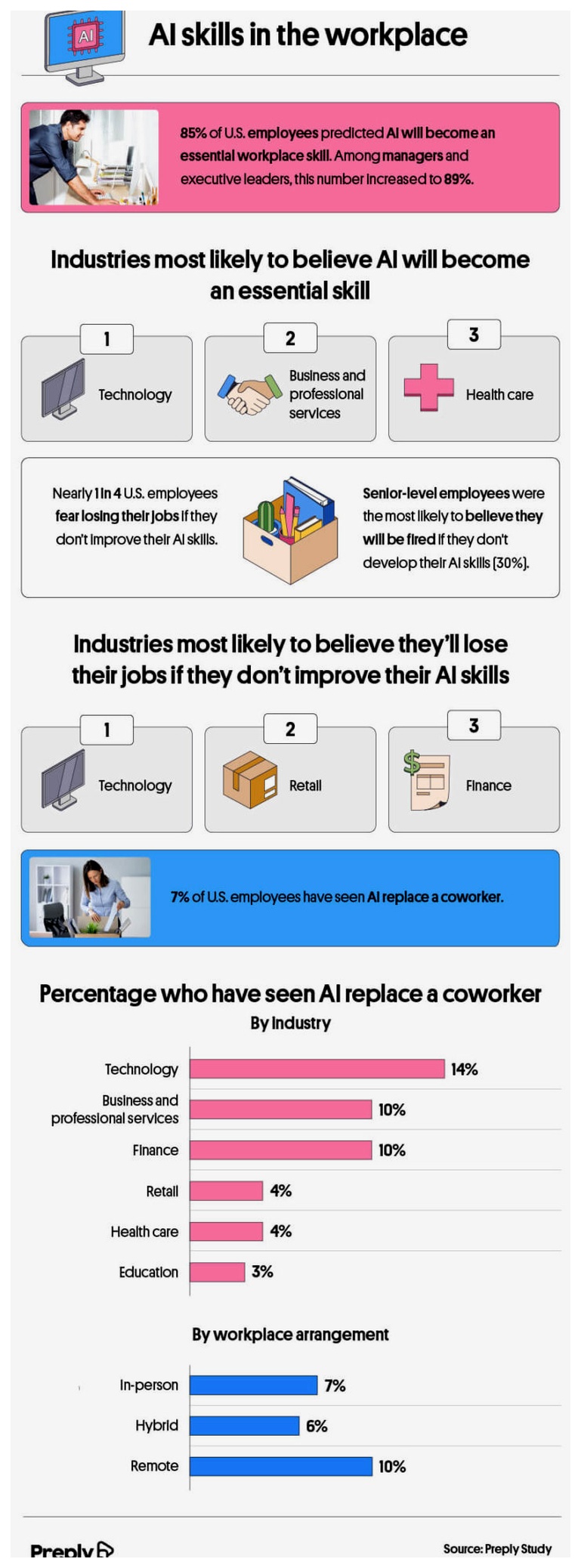
A significant majority of U.S. workers recognize the growing importance of AI, with 85% agreeing that it will be a vital skill in the workplace of the future. This awareness, however, is accompanied by some apprehension among employees. The rapid integration of AI into our daily work routines highlights the necessity for workers to educate themselves about this technology and its implications for their careers.
As the demand for AI skills continues to grow, many workers are feeling anxious about their job security. In fact, a recent survey revealed that 25% of U.S. employees fear they could lose their jobs if they don’t improve their AI proficiency. This concern is not unfounded; 7% of workers reported witnessing a colleague being replaced by AI, with the issue being particularly pronounced among remote workers, where the figure rises to 10%. It’s clear that adapting to AI is becoming increasingly crucial in today’s workforce.
Many remote jobs include tasks that AI can efficiently handle, such as data entry or customer support. However, certain roles still rely heavily on the human element. Take online teaching, for instance—AI serves best as an assistant to enhance educators’ effectiveness, not as a substitute. This is why learning a language with LingualNeeds prioritizes direct interaction, whether you’re enrolling in Spanish classes or French lessons online.
The workers using AI
How frequently are U.S. workers incorporating AI into their daily tasks, and which groups are utilizing it the most? AI is increasingly becoming an integral part of the workplace for many individuals. However, our findings reveal notable differences among various demographics, as well as insights into employers’ perspectives on this technology.
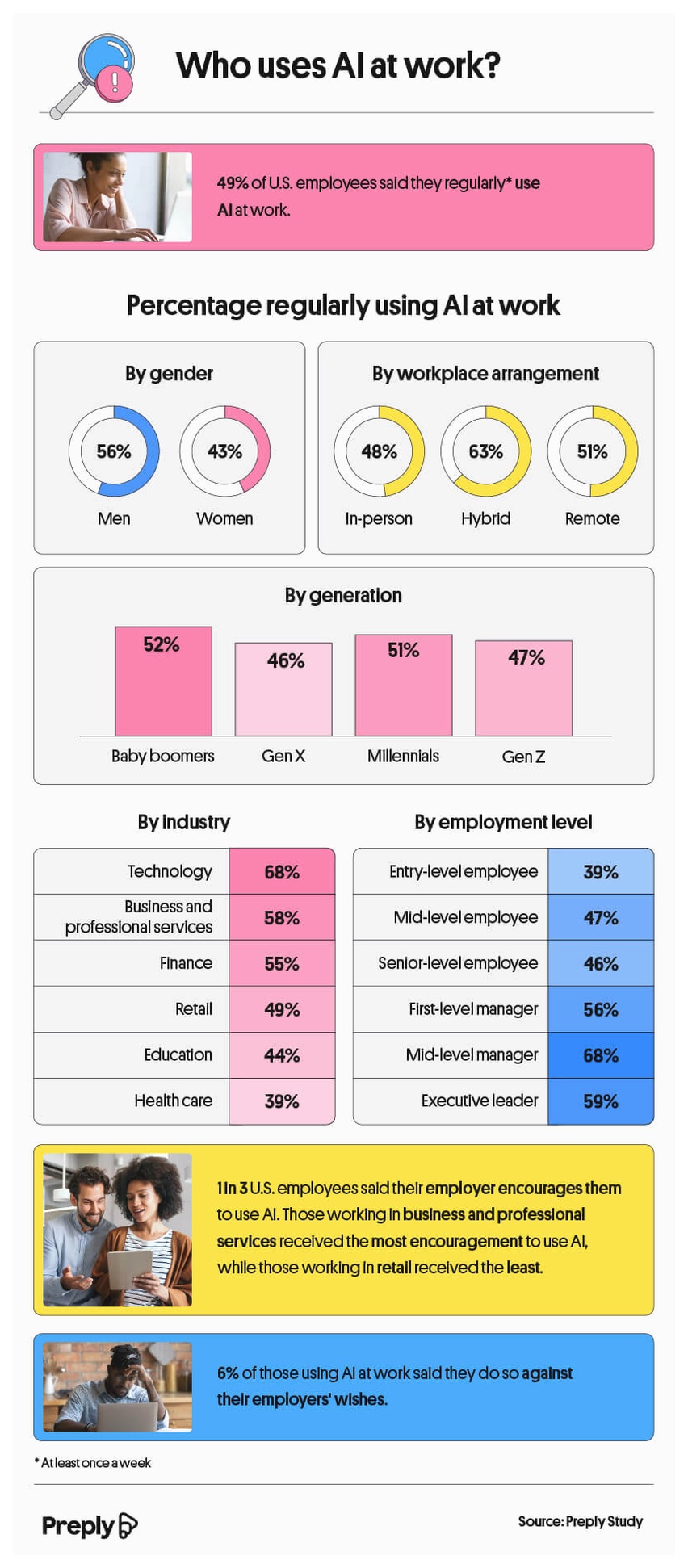
Almost half of U.S. employees (49%) report using AI at work on a regular basis, at least once a week. However, a closer look reveals intriguing trends: men are more inclined to integrate AI into their work routines compared to women, while baby boomers stand out as the most enthusiastic adopters of AI among the various generations. This shows that AI is accessible to all, not just those born in the digital age.
The acceptance of AI in the workplace varies among employers. In the U.S., about one-third of employees reported that their bosses actively encouraged the use of AI tools. However, 6% of those utilizing AI admitted to doing so without their employer’s approval. Despite the fact that many AI tools come with a price tag, only a small fraction—6%—of employees said they receive financial support or reimbursement for these tools from their companies.
Learn a language online with our free learning materials.
Learn English online
Learn French online
The best ways to use AI at work
Many workers are increasingly turning to AI in their daily tasks, but what specific applications are they utilizing? This section delves into the diverse ways AI is being employed across different industries, providing a clearer picture of its impact and benefits.
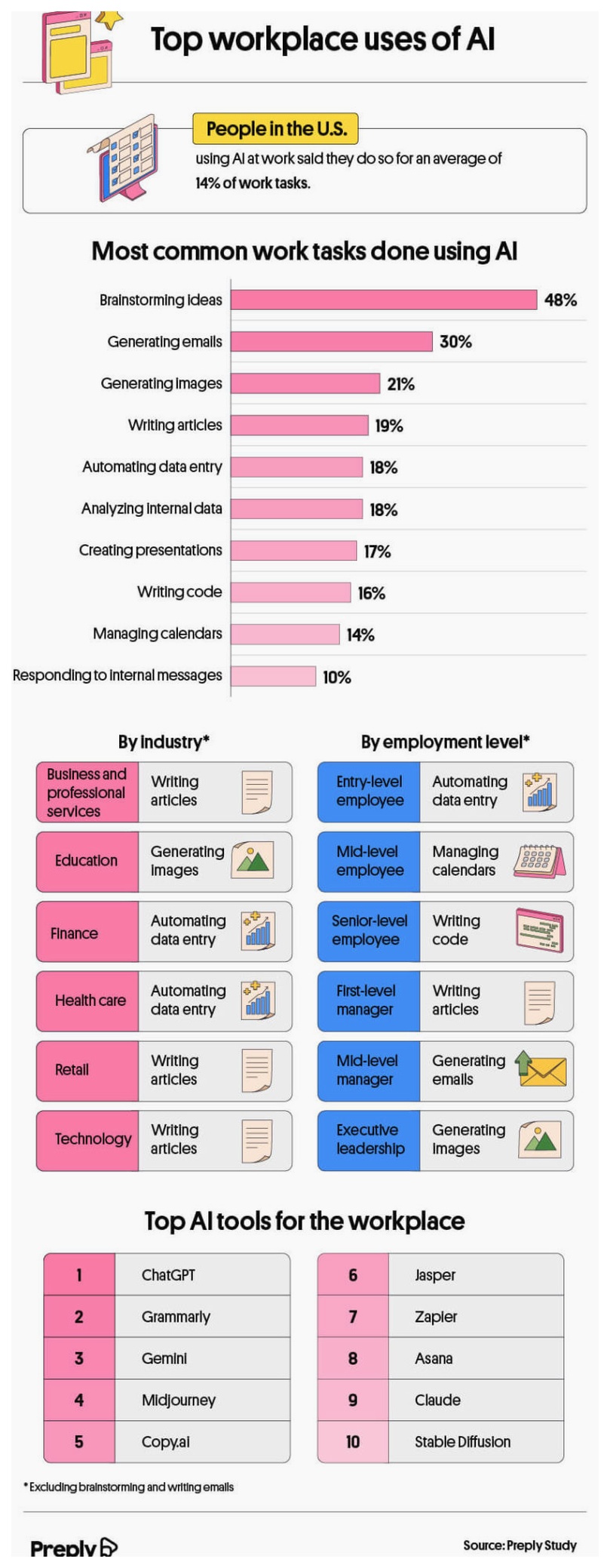
In the U.S., individuals using AI at work incorporate it into 14% of their tasks, with its most popular applications being brainstorming, email generation, and image creation. Among the various AI tools, ChatGPT stands out as a favorite, capturing widespread attention for its versatility. Interestingly, a recent study revealed that when used as a search engine, ChatGPT can even surpass Google in performance at times.
Curious about how AI is transforming various industries? Take a look at these average percentages showing the extent to which AI is utilized for task completion across different sectors:
- Technology: 20%
- Retail: 19%
- Finance: 16%
- Business and professional services: 14%
- Education: 12%
- Health care: 11%
While tech and retail employees have harnessed AI for a broader range of tasks compared to those in education and healthcare, it’s important to explore how AI adoption varies across different job levels. Here’s what our research uncovered:
- Entry-level employees: 14%
- Mid-level employees: 15%
- Senior-level employees: 14%
- First-level managers: 12%
- Mid-level managers: 17%
- Executive leaders: 16%
Mid-level managers are leading the charge in adopting AI, integrating it into 17% of their daily tasks on average. However, it’s not just them; entry-level employees and senior leaders are also leveraging AI, which now plays a significant role in their work routines.
The receiving end
With the rapid advancement and accessibility of AI tools, they are increasingly infiltrating our workplace communications. Let’s explore the frequency with which U.S. workers encounter AI-generated messages and identify the industries experiencing the most significant effects.
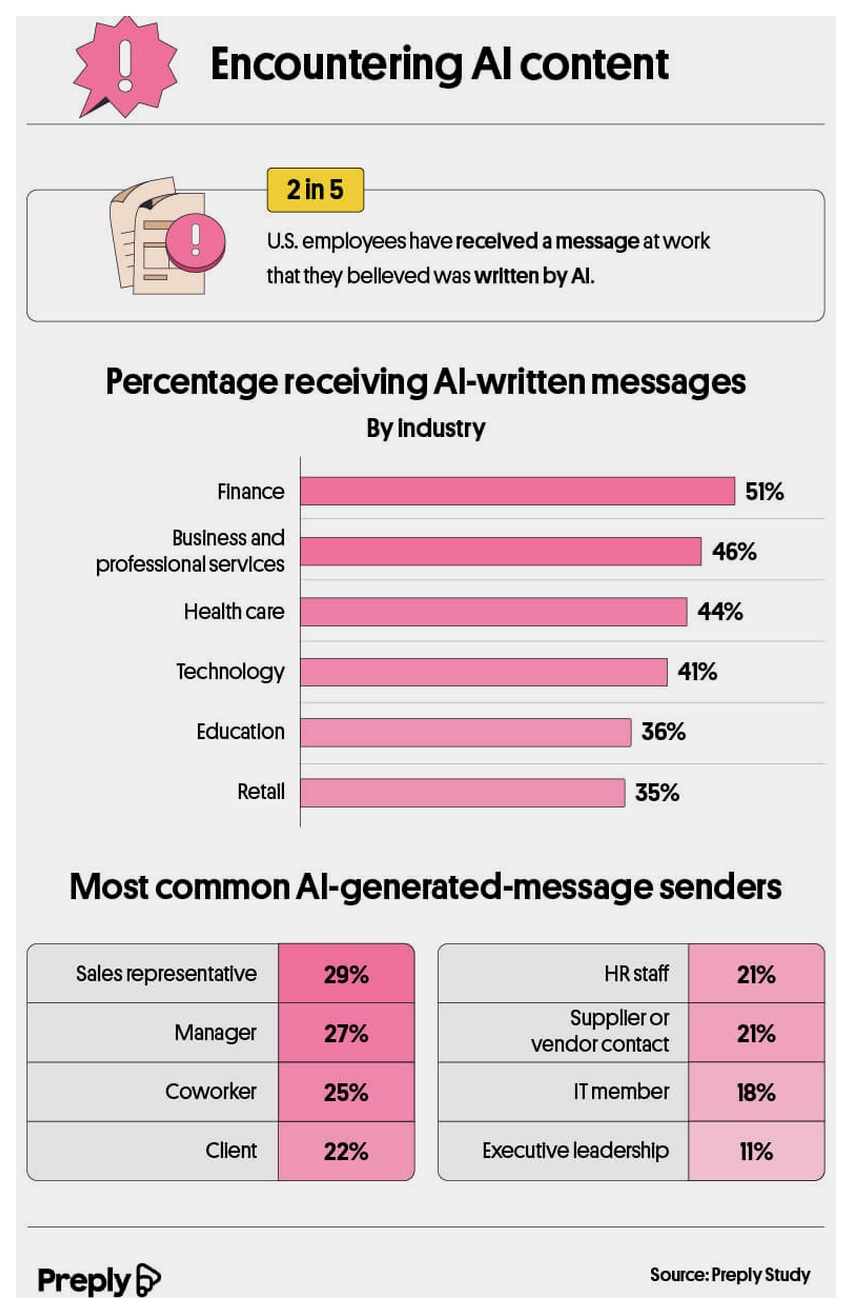
It’s becoming increasingly clear when a message lacks a human touch—recently, 2 out of 5 workers reported receiving workplace communications they suspected were generated by AI. But which industries are experiencing the highest prevalence of these automated messages?
Finance professionals are leading the way in receiving AI-generated messages. Given their heavy reliance on data and numerical analysis—areas where AI excels—it’s no surprise that they also leverage this technology for crafting workplace communications.
It’s not just colleagues who are utilizing AI for communication; more than 25% of individuals have received messages from their managers that were evidently crafted by AI. The impact of this absence of a personal touch in AI-generated communications from leadership on employee engagement is yet to be determined.
Improving AI skills
As AI increasingly integrates into the workplace, a growing number of U.S. workers are keen to enhance their AI skills. We reached out to them to discover which specific areas they find most intriguing.
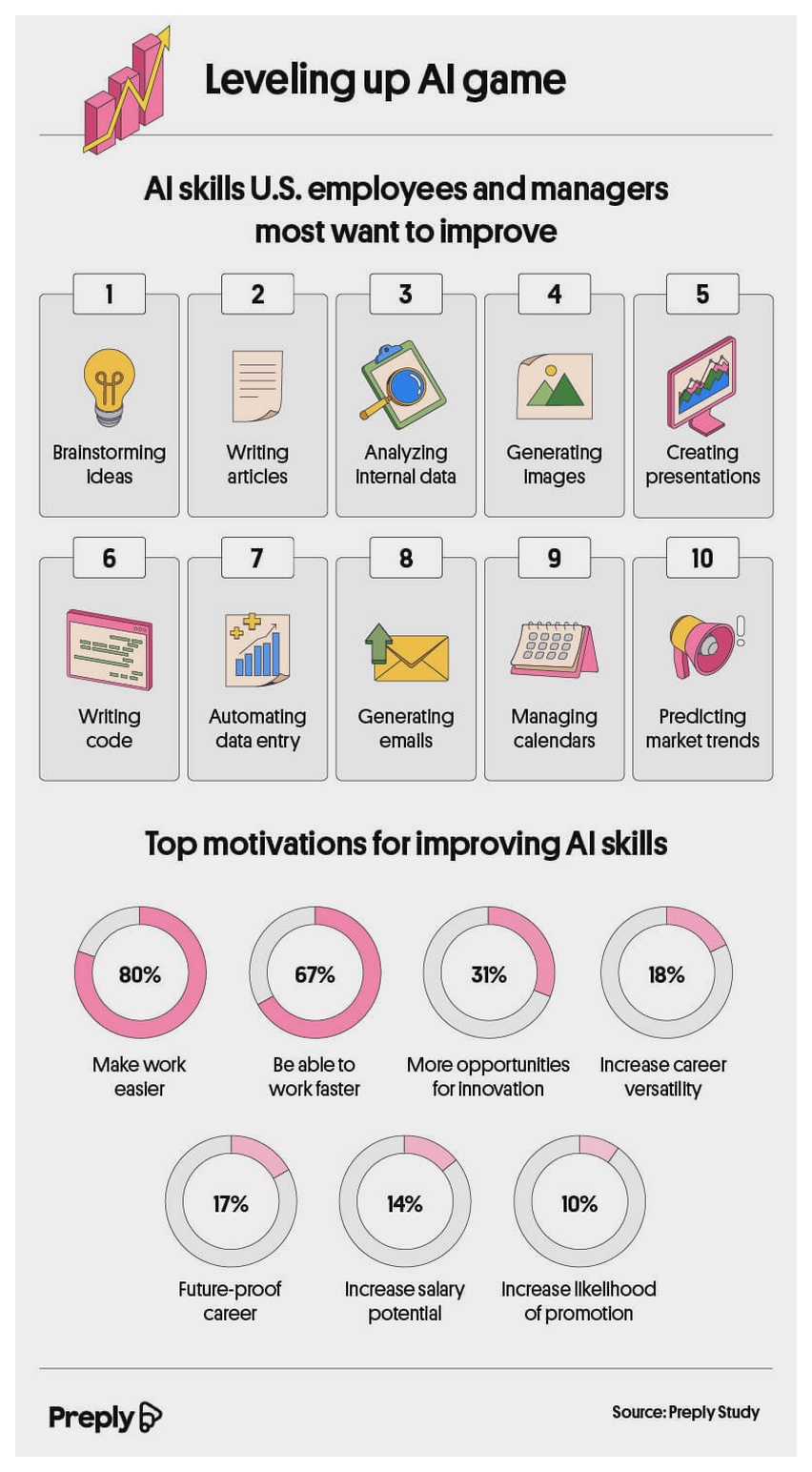
Workers expressed a strong desire to enhance their skills in brainstorming ideas, crafting articles, and analyzing internal data. But what’s driving this interest?
In our survey about the motivations behind AI usage in the workplace, the responses revealed a surprising trend: individuals were less focused on promotions or salary boosts and more concerned with simplifying their tasks. It turns out that U.S. workers are primarily driven by the goal of enhancing their efficiency and making their jobs easier, rather than solely aiming for career advancement.
Let’s explore how AI upskilling objectives differ across various industries. Here’s a breakdown of the top improvement areas sought by each sector:
- Business and professional services: writing articles
- Education: creating presentations
- Finance: generating emails
- Health care: creating presentations
- Retail: writing articles
- Technology: writing code
We also found differences in AI skill preferences across employment levels:
- Entry-level employees: writing articles
- Mid-level employees: analyzing internal data
- Senior-level employees: writing code
- First-level managers: creating presentations
- Mid-level managers: generating images
- Executive leaders: generating images
So, how are U.S. workers going about learning these new AI skills? The top methods they reported were:
- YouTube
- Online courses
- Blogs
- Webinars
- Workshops
- X (formerly Twitter)
- University courses
This highlights the blend of self-directed learning alongside organized options such as workshops and university courses. As AI increasingly influences the workplace, it’s evident that U.S. workers are taking proactive steps to stay ahead of the game.
Adding AI to the workload
U.S. workers are embracing AI more than ever in their everyday tasks. Whether it’s brainstorming ideas, crafting articles, analyzing data, or creating images, AI is enhancing productivity across various industries and job roles. As employees increasingly interact with AI-generated messages from colleagues and managers, this technology is evolving into a key component of workplace communication.
As AI advances and becomes increasingly woven into our professional lives, it’s crucial to consider its impact on our workplace interactions. While AI has the potential to enhance our efficiency and productivity, we must also prioritize preserving the essential human connection that fosters collaboration and teamwork.
If you’re eager to enhance your communication skills in English or any other language, explore LingualNeeds’s online tutoring services. With a team of experienced tutors and a diverse selection of language classes, LingualNeeds is dedicated to elevating your language proficiency to new heights.
Methodology
LingualNeeds conducted a survey of 1,004 employed individuals in the U.S. to explore their views and experiences with AI in the workplace. The respondents included 51% men, 48% women, and 1% identifying as nonbinary or nonconforming. In terms of generational representation, 5% were baby boomers, 24% were Gen X, 59% were millennials, and 12% were Gen Z. When it comes to work arrangements, 42% worked in-person, 28% worked remotely, and 30% had a hybrid setup.
In terms of industry distribution, 14% of workers were employed in technology, 11% in business and professional services, 10% in finance, and another 10% in health care. Education accounted for 8%, while retail comprised 7%, with the remaining 40% spread across various other sectors. When examining employment levels, 34% held entry-level positions, 22% were mid-level employees, and 10% occupied senior roles. Additionally, 10% served as first-level managers, 16% were mid-level managers, and 8% reached the executive leadership tier.
Frequently Asked Questions
What percentage of U.S. workers believe AI skills will be essential in the future?
85% of U.S. workers believe using AI will be an essential skill in the future.
How do U.S. workers feel about job security concerning AI?
1 in 4 workers are afraid they’ll lose their jobs if they don’t improve their AI skills.
Which generation is the most likely to use AI at work?
Baby boomers are the most likely generation to use AI at work.
What are some common applications of AI in the workplace?
Common applications of AI include brainstorming, email generation, and image creation.
How are U.S. workers primarily learning new AI skills?
U.S. workers report learning new AI skills primarily through YouTube, online courses, and blogs.