
- Key takeaways
- Americans’ 9-to-5: Top buzzwords revealed
- Does a higher salary make work more enjoyable?
- How Americans characterize their bosses
- Communication in the workplace
- Frequently Asked Questions
- What percentage of time do Americans typically dedicate to work each year?
- What is the most common word Americans use to describe bad bosses?
- How do Americans earning between $100,000 and $149,999 typically describe their workday?
- Which industry do Americans report feeling the most stress in?
- How does job satisfaction vary between men and women according to the article?
The typical American dedicates over 2,000 hours to work each year, amounting to roughly a quarter of their time. Given this significant investment in your career, finding a job that brings you joy is essential for overall satisfaction and well-being.
Driven by curiosity, our team embarked on a journey to uncover how Americans perceive their jobs. We explored various aspects, including daily routines, job satisfaction, and interactions with their supervisors. Continue reading to discover insights into how Americans truly feel about their careers today.
Key takeaways
- The number one word Americans use to describe bad bosses is “incompetent.”
- Americans making $100,000 to $149,999 annually are most likely to describe their typical workday as “annoying.”
- Nearly 1 in 5 millennials feel their current career is a dead-end.
- When it comes to their boss, 1 in 5 Americans describe them negatively.
- Americans making less than $25,000 annually are most likely to find their typical workday exhausting.
- Americans working in the healthcare industry are the most likely to feel stressed at work.
- Americans working in the computer and technology industry are most likely to find their job enjoyable.
- Americans working in the education field are most likely to feel the busiest.

Learn a language with personalised 1-on-1 classes with our expert tutors from all over the world
French lessons online
Spanish lessons online
Americans’ 9-to-5: Top buzzwords revealed
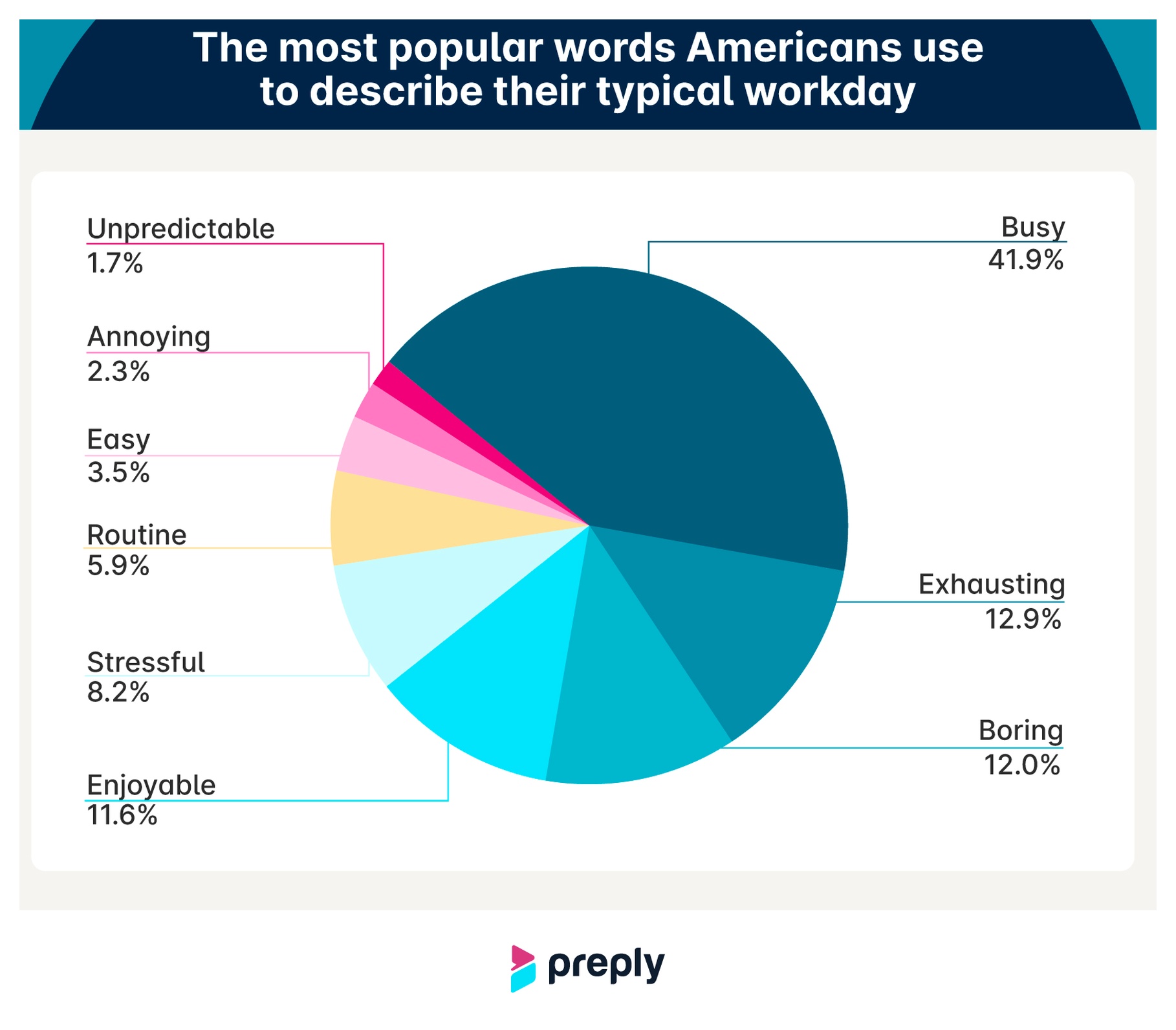
While hard work is often celebrated as a quintessential American value, our research reveals that the average workday is anything but ideal for many professionals in the U.S. Employees frequently describe their daily experiences with words like “busy,” “exhausting,” and “boring,” highlighting a disconnect between the ideal and the reality of modern work life.
The way employees perceive their work experience varies significantly by industry. For instance, those in transportation, manufacturing, and sales often report feelings of boredom. In contrast, workers in education, construction, and healthcare generally describe themselves as feeling the busiest, which aligns with common expectations.
When it comes to stress, there’s a noticeable overlap between feeling bored and being overwhelmed with work. Professionals in healthcare, manufacturing, and the technology sectors often report higher levels of workplace stress.
Certain word choices resonate clearly, even for those not directly involved. Picture a healthcare worker on the front lines during a national crisis, such as the COVID-19 pandemic. They must suddenly put their own safety on the line to protect and save lives.
In high-stakes environments where decisions can mean the difference between life and death, it’s common to feel overwhelmed. This is especially true in fields like education, where professionals often face intense pressure and experience burnout due to insufficient support systems.
Conversely, jobs that involve routine tasks—such as driving a bus on a fixed route or selling paper products—tend to lack excitement. It seems there’s a kernel of truth in the playful antics depicted on *The Office*.
While initial findings may suggest otherwise, many Americans actually find joy in their jobs. Interestingly, those working in finance are most likely to characterize their roles as easy, challenging the intense, cutthroat image portrayed in films like *The Wolf of Wall Street*.
Surprisingly, using seemingly negative language doesn’t necessarily indicate a lack of passion for one’s job. Take professionals in the computer and technology fields, for instance. They often report high levels of job satisfaction, despite also experiencing significant stress.
The key factor lies in the sense of fulfillment from the work. Americans are more inclined to handle stress when engaged in tasks that they find enjoyable, meaningful, or truly care about.
Career satisfaction can often depend on individual perspectives and the specific industries we choose. Research shows that women are generally more inclined than men to describe their jobs as “fulfilling.” This trend is linked to the fact that women often gravitate toward professions that emphasize relationship-building rather than manual labor.
Finding meaning in the workplace can be a challenge. In fact, nearly 20% of millennials view their careers as dead ends. This sentiment is echoed by the recent “Great Resignation,” which highlights that many American professionals are seeking more fulfilling opportunities.
Does a higher salary make work more enjoyable?
While a higher salary might seem like the key to a more enjoyable workday, the truth is that, as the saying goes, money can’t buy happiness. True job satisfaction often stems from factors beyond financial compensation.
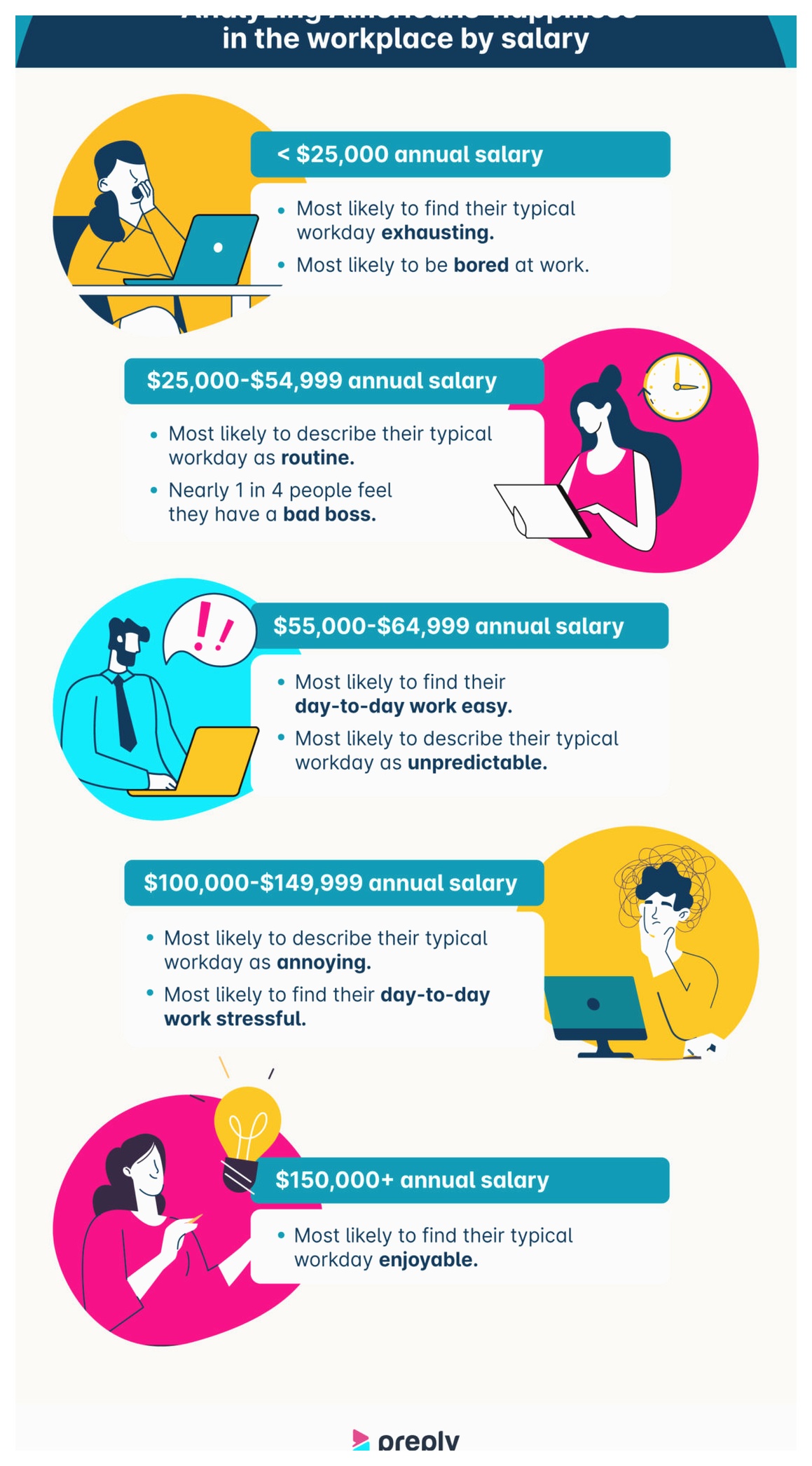
Our research reveals an interesting trend: employees earning $150,000 or more tend to have a more satisfying workday. However, for those in lower salary brackets—even those still considered high earners—job satisfaction can vary significantly.
Research indicates that employees earning between $100,000 and $149,999 are particularly prone to experiencing daily stress at work, often labeling their jobs as “annoying.”
Individuals earning between $75,000 and $84,999 often describe their workdays as “busy.” In contrast, those with annual salaries of $55,000 to $64,999 are more likely to perceive their jobs as both easy and unpredictable. Meanwhile, people making between $25,000 and $54,999 typically view their work as routine.
The findings reveal a clear pattern at both extremes of the income spectrum. Individuals earning over $150,000 report the highest job satisfaction, while those making under $25,000 experience the lowest, often feeling bored and drained by their work.
Learn a language online with our free learning materials.
Learn English online
Learn French online
How Americans characterize their bosses
A significant factor in job satisfaction is the people you work alongside. While the level of personal interaction during your 9 to 5 can differ based on your role or industry, strong relationships remain fundamental to any workplace environment.
One of the most crucial relationships in the workplace is undoubtedly the one between you and your boss. Sadly, not everyone is fortunate enough to enjoy a positive dynamic in this area.
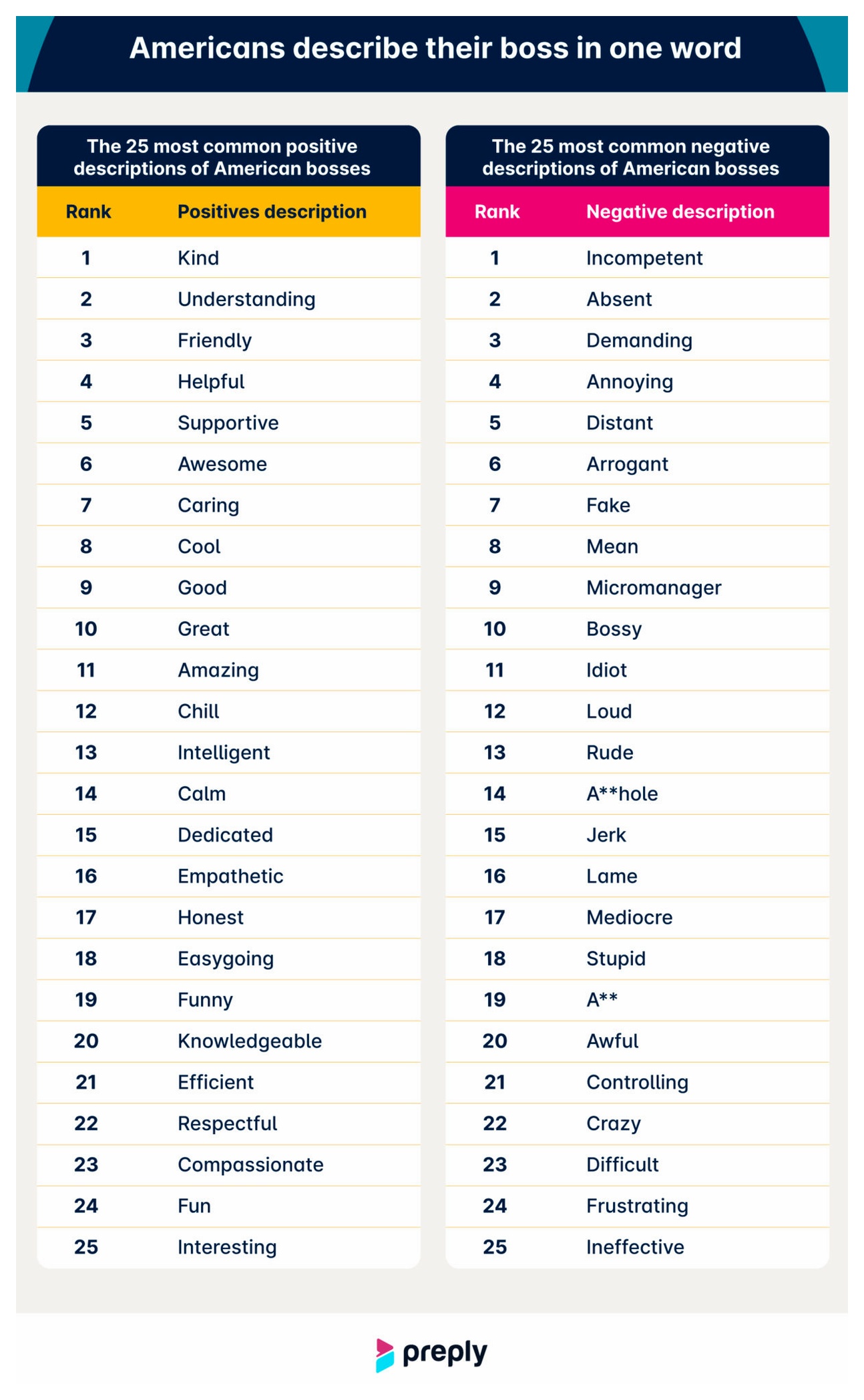
One in five Americans express dissatisfaction with their bosses, frequently describing them as “incompetent,” “absent,” and “demanding.” Notably, “incompetent” tops the list as the most common term used to characterize a poor leader.
A great boss embodies qualities like kindness, understanding, and friendliness. They genuinely care about their employees, ensuring that each team member feels valued and respected in the workplace.
Language expert Sylvia Johnson emphasizes that effective communication is crucial for fostering a positive workplace. She notes that managers who adopt a respectful and open demeanor demonstrate a unique ability to recognize and honor the values, thoughts, and ideas of their team members.
Johnson emphasizes the importance of staying calm and making eye contact, as these actions help establish a connection that strengthens working relationships with employees. This approach not only promotes a culture of trust but also enhances overall employee well-being in the workplace.
In every industry, bosses can vary widely in their effectiveness, but our research reveals an intriguing trend: employees in education and healthcare generally hold a more favorable view of their supervisors, while those in transportation and manufacturing report the most negative experiences.
Spending up to a quarter of your year at work can be disheartening, especially when it feels like those countless hours are reduced to nothing more than a paycheck. It’s essential to find meaning and fulfillment in your daily tasks, so they resonate beyond just financial compensation.
A toxic boss can leave you feeling as if your efforts are never sufficient, while a great boss ensures you feel valued for your hard work. This vital distinction can transform your daily tasks from mundane chores into meaningful opportunities, enhancing your overall job satisfaction.
Communication in the workplace
Americans are employed in a diverse range of industries, and while daily responsibilities can differ widely, many individuals share common experiences in their workdays. Whether their jobs are fast-paced and stressful or enjoyable and fulfilling, effective communication often plays a crucial role in shaping their overall work experience.
Effective communication is vital in any workplace, as poor communication can result in apathy and misunderstandings. To foster strong working relationships and cultivate a positive workplace culture, prioritizing clear and open communication is essential.
To enhance employee engagement, explore LingualNeeds’s Business English courses and corporate language training. These programs are designed to build confidence in workplace communication, fostering a more connected and productive team.
Don’t confine your language learning to the workplace! Explore private or group language classes to enhance your communication abilities. Alternatively, consider booking a trial lesson with our online tutors to discover if embarking on a new language journey is the right move for you.
Methodology
In this research, we conducted a nationwide survey of Americans employed in full-time positions to gain insights into their daily experiences. Participants were asked to capture different facets of their jobs using a single word. We then categorized these responses into thematic groups, allowing us to identify emerging trends and patterns in the data.
We asked Americans to share their thoughts about their bosses, categorizing their responses as positive, negative, or neutral. Words like “friendly” and “helpful” were marked as positive, reflecting a favorable view, while terms such as “incompetent” and “mean” were deemed negative, indicating dissatisfaction with their managers. This approach helped us gauge the overall sentiment toward workplace leadership.
Frequently Asked Questions
What percentage of time do Americans typically dedicate to work each year?
Americans typically dedicate over 2,000 hours to work each year, amounting to roughly a quarter of their time.
What is the most common word Americans use to describe bad bosses?
The number one word Americans use to describe bad bosses is ‘incompetent.’
How do Americans earning between $100,000 and $149,999 typically describe their workday?
Americans making $100,000 to $149,999 annually are most likely to describe their typical workday as ‘annoying.’
Which industry do Americans report feeling the most stress in?
Americans working in the healthcare industry are the most likely to feel stressed at work.
How does job satisfaction vary between men and women according to the article?
Research shows that women are generally more inclined than men to describe their jobs as ‘fulfilling,’ often gravitating towards professions that emphasize relationship-building.