- Key Takeaways
- Where Americans complain the most and least
- The most common topics people complain about
- What Americans worry they complain about too much
- Focus on positive solutions with LingualNeeds
- Methodology
- Frequently Asked Questions
- Which state has the highest complaint score in the U.S.?
- What are the most common topics Americans complain about?
- How do Americans generally feel about complaining?
- What percentage of Americans wish to stop hearing complaints about politics?
- Who do Americans typically share their complaints with?
Complaints often find their way into everyday conversations, whether it’s about the frustrating traffic on your commute or the rain spoiling your weekend plans. It’s natural to vent about these common annoyances. However, while some subjects resonate universally, others can spark strong reactions when people voice their grievances.
Mastering the art of conversation and knowing the right moments and settings to express your concerns is a vital life skill. Recognizing the subtleties of when to voice your complaints can make all the difference in effective communication.
To truly grasp the landscape of complaints across the United States, the dedicated team at LingualNeeds embarked on an ambitious survey, reaching out to individuals in every state. Our goal was to uncover the topics that resonate with people, those they’ve grown weary of, the frequency of their complaints, and much more.
Based on the collected responses, we developed a “complaints score” ranging from 0 to 100 to identify which regions are more likely to express dissatisfaction. Continue reading to discover how your home state measures up against others!
Key Takeaways
- Residents in Mississippi, Alabama, and Nevada were found to be the biggest complainers in the country.
- Residents in Georgia, Oregon, and Connecticut were the least likely to complain about things.
- In 2024, Americans complain most about the cost of things, how people drive, and the quality of things.
- One in three Americans have ended relationships with chronic complainers.
- Overall, 64% of Americans think complaining harms their mental health.
- Nearly 25% of Americans wish to never hear complaints about politics again.

Learn a language with personalised 1-on-1 classes with our expert tutors from all over the world
French lessons online
Spanish lessons online
Where Americans complain the most and least
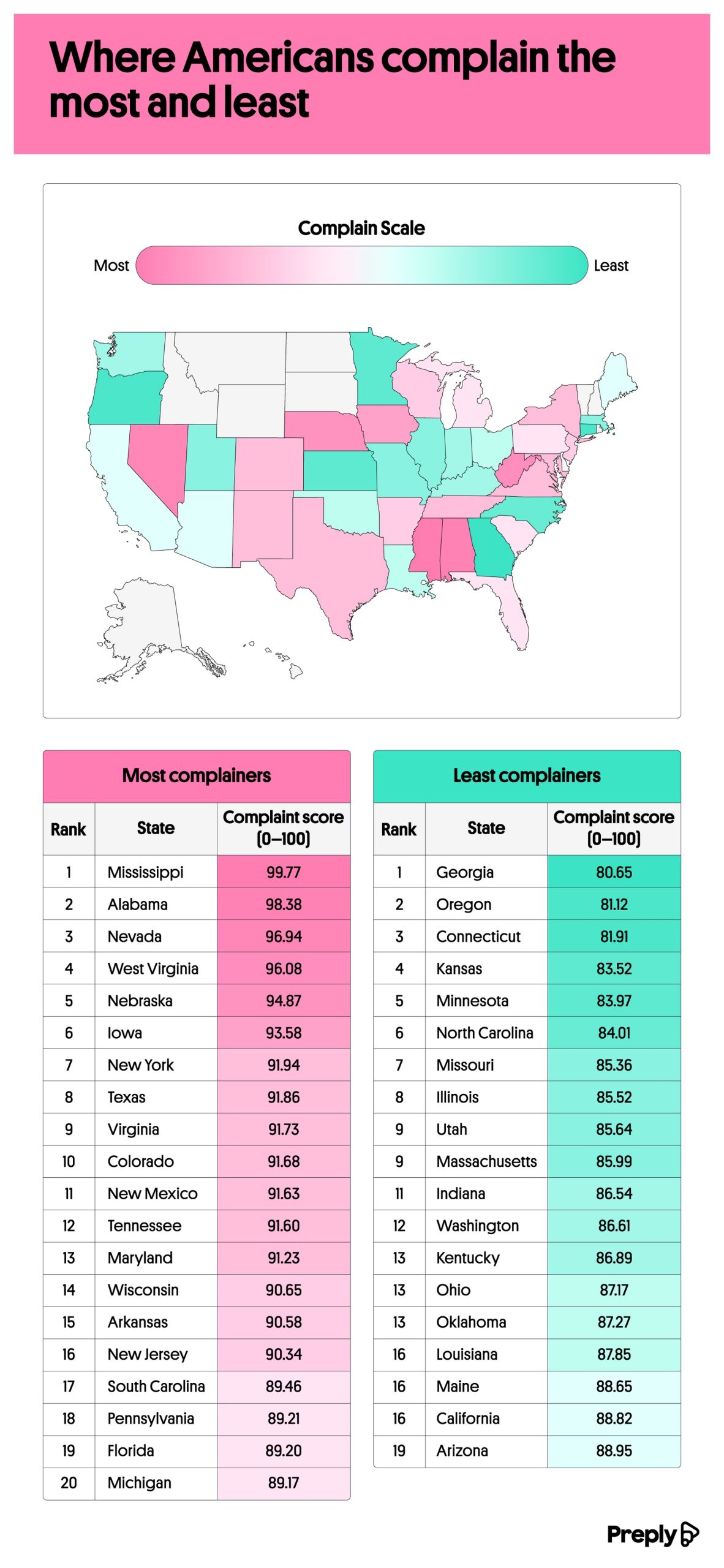
It’s common for people to voice their frustrations from time to time, but some individuals express their grievances more frequently than others. Notably, Mississippi has emerged as the state with the highest number of complainers in the nation.
Mississippi tops the charts with an impressive complaint score of 99.77 out of 100, making its residents the most vocal in the nation. They frequently express concerns about key issues such as physical health, financial debt, and the frustrations surrounding passwords and verifications.
Furthermore, Mississippi shares the spotlight in an eight-way tie for the highest number of complaints regarding living costs. This group includes Alabama, Georgia, Kentucky, Michigan, Nevada, Oregon, and Texas, highlighting a widespread concern about affordability across these states.
Alabama ranked second in the number of complaints, scoring 93.38 out of 100. Interestingly, 68% of residents report having a trusted person to confide in, with friends and siblings being the most popular choices for sharing their frustrations.
Nevada secured third place with a score of 96.94, reflecting a strong tendency among its residents to voice concerns over rising costs, driving behaviors, and the overall quality of goods and services.
It’s tempting to dive into those frustrating subjects during conversations, but keep in mind that if they dampen your spirits, they can do the same for others. If you find it challenging to steer clear of these tricky topics, know that you’re not alone in this struggle.
At LingualNeeds, we provide engaging conversational English classes designed to enhance your speaking skills and build your confidence in communication. Language expert Sylvia Johnson emphasizes, “Confidence in communication is essential; it shapes how others view us and how we see ourselves.” Join us to transform your conversational abilities and self-assurance!
She emphasizes that confidence plays a crucial role in shaping first impressions, influencing relationship dynamics, and advancing careers. When we express our ideas with conviction, others are more inclined to take us seriously. Confident communicators often earn trust and respect for their insights, which helps minimize misunderstandings and ensures that our intentions are clearly communicated.
In Georgia, residents are notably less prone to engaging in uncomfortable, complaint-filled conversations, earning the state the top spot for the fewest complaints in the U.S. When they do feel frustrated, they tend to share their feelings with friends rather than dwell on their grievances.
Oregon ranks second for the fewest complaints, with 65% of residents believing that excessive complaining can negatively impact mental well-being. Connecticut follows closely in third place, where 53% of residents admit to judging those who voice complaints too often.
The most common topics people complain about
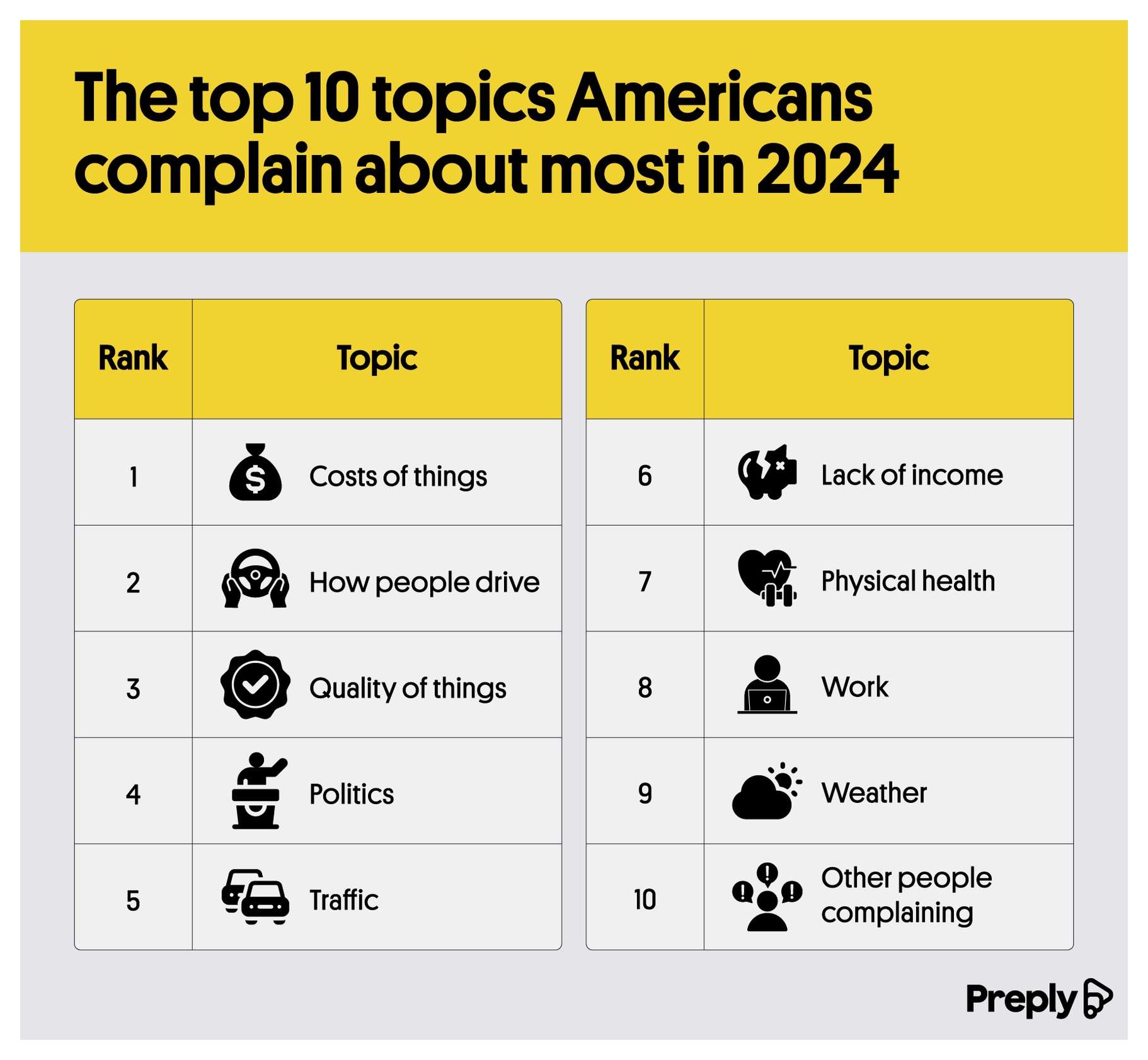
After pinpointing the areas where Americans express their frustrations most frequently, we shifted our focus to the specific issues behind these complaints. Topping the list of irritations in 2024 is the rising cost of living, which has become a significant source of discontent.
Across the United States, people from all income levels share a common frustration: managing bills, purchasing essentials, and dealing with those unexpected expenses that can arise at any moment. Interestingly, a close second on the list of grievances is driving behavior. Many find that being stuck behind a slow or reckless driver is more aggravating than sitting in traffic, which ranks fifth in overall complaints.
Following closely behind, the quality of products and services ranks as the second most common complaint, while political issues take the third spot. As the presidential election approaches, Americans have likely encountered more political discussions recently, contributing to the rise in complaints about this topic.
Surprisingly, about 35% of Americans admit to voicing a complaint at least once a day, and half of the population complains at least once a week. Interestingly, our research reveals that 64% of individuals believe that complaining can negatively impact their mental well-being.
Learn a language online with our free learning materials.
Learn English online
Learn French online
What Americans worry they complain about too much
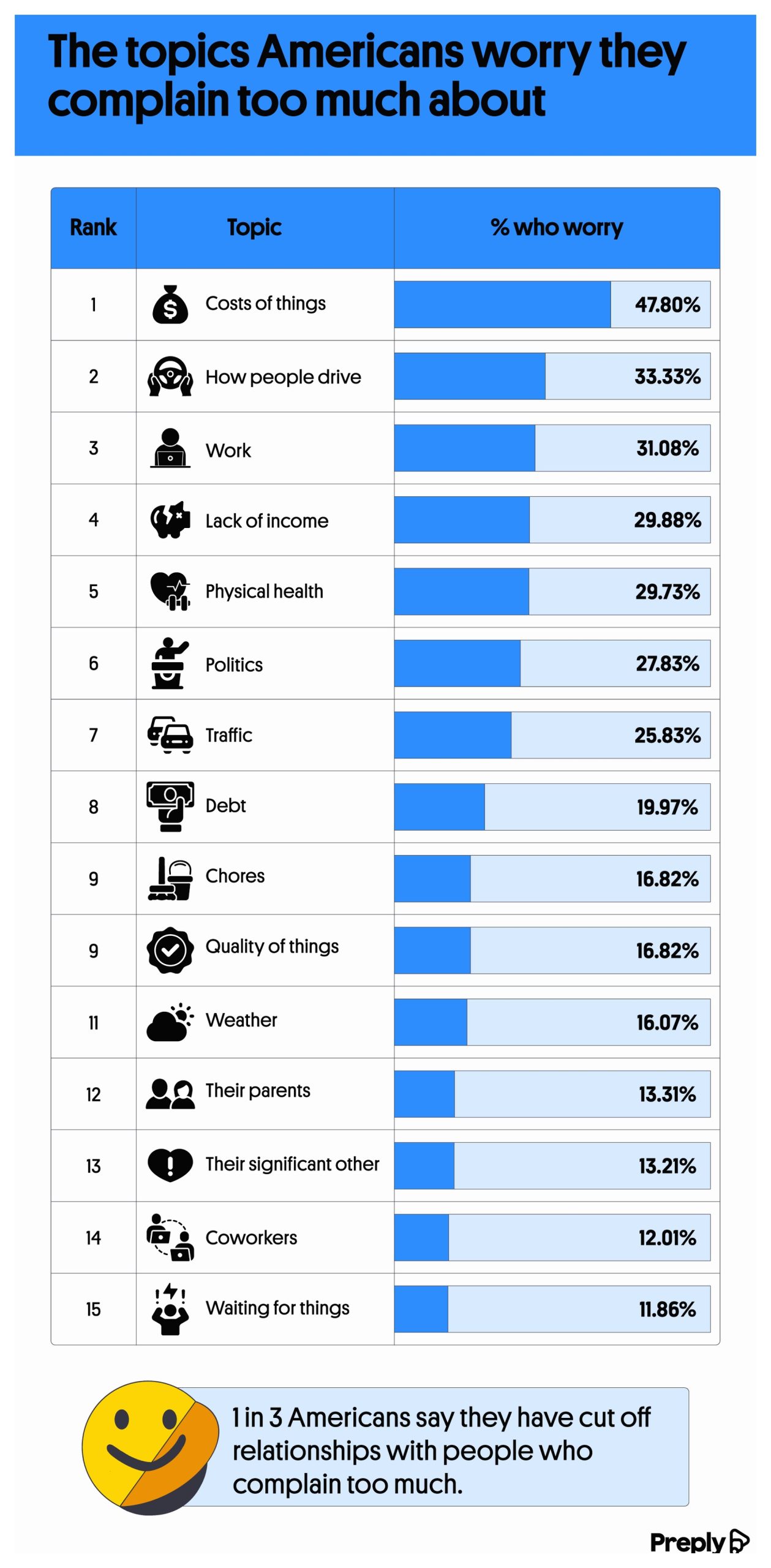
It’s natural to share your frustrations with those closest to you, yet you might find yourself questioning if you’re overdoing it. What feels like a necessary release for you could come across as burdensome to others. To explore this dynamic, we reached out to Americans to discover the topics they believe they complain about too frequently.
Our findings revealed a striking correlation between this ranking and common complaints. The cost of living and driving behavior topped the list, taking the first and second positions, respectively. Interestingly, the third spot was occupied by general work-related issues, highlighting a shift in concerns.
Almost 60% of Americans admit to sharing their workplace grievances with colleagues, and 42% confide in their bosses. However, those outside your professional environment often don’t grasp the everyday challenges you face. This can lead to the feeling that discussing work frustrations might be bothersome to others.
In fourth place was the issue of insufficient income, closely followed by concerns about physical health and politics, which ranked fifth and sixth, respectively. Interestingly, when Americans were asked which topic they would prefer never to hear complaints about again, nearly 25% chose politics. This indicates that for many, political discussions are a source of significant frustration.
In general, Americans tend to share their grievances with friends, parents, and siblings, and interestingly, women are more inclined than men to have a trusted confidant for venting. Additionally, our research reveals that one in three individuals has ended relationships with those they deemed excessively negative.
If you worry about making a fuss too frequently, it’s important to watch for signals that indicate when to dial it back. According to Johnson, “Observe how people respond while you’re talking. Are they showing signs of disinterest, discomfort, or impatience? These reactions can suggest that your complaints are overshadowing or isolating the conversation.”
She emphasizes, “Reflect on your everyday conversations. Do they lean more towards negativity? Are you more inclined to talk about issues and complaints rather than sharing positive experiences or solutions? If you notice that you frequently voice grievances or default to negative comments in discussions, it may indicate that you’re complaining too much.”
Focus on positive solutions with LingualNeeds
Everyone has a tendency to complain from time to time. Life can be challenging, and expressing our frustrations can be a welcome release. Sharing what bothers us not only helps to lighten our emotional load but also fosters connection with others who may feel the same way.
Sharing your struggles with friends and family can be a healthy way to cope, but be mindful of how negativity can affect both you and those around you. Constantly focusing on the negative can lead to a pessimistic mindset and may inadvertently drive others away. Strive for a balance; express your feelings, but also make room for positivity in your conversations.
At LingualNeeds, we recognize that language learning is a lifelong journey. Our dedicated team of tutors is here to guide you every step of the way, helping you master any language you wish to learn.
If self-guided language learning has felt challenging for you, worry no more! The LingualNeeds team is here to help with personalized English lessons that will jumpstart your journey to fluency.
If you’re seeking a fresh challenge, why not embark on the exciting journey of learning Spanish with online classes? No matter what your goals are, the dedicated team at LingualNeeds is here to support you every step of the way. Start your language adventure today!
Methodology
In our comprehensive study, we reached out to Americans across all 50 states to identify the regions most prone to complaining. We posed a range of questions, exploring how frequently individuals express dissatisfaction, the specific topics that trigger their complaints, and their opinions on the complaints of others. This research sheds light on the complaining habits of different areas and the underlying sentiments driving them.
We assigned points based on how often and how many different topics people raised complaints about in each state. By averaging these scores, we determined an overall average for every state. To make the results easier to understand, we then scaled the scores from 0 to 100, where 100 indicates the highest level of complaints.
Frequently Asked Questions
Which state has the highest complaint score in the U.S.?
Mississippi has the highest complaint score of 99.77 out of 100.
What are the most common topics Americans complain about?
The most common topics include the rising cost of living, driving behavior, and the quality of products and services.
How do Americans generally feel about complaining?
64% of Americans believe that complaining can negatively impact their mental well-being.
What percentage of Americans wish to stop hearing complaints about politics?
Nearly 25% of Americans wish to never hear complaints about politics again.
Who do Americans typically share their complaints with?
Americans often share their complaints with friends, parents, and siblings, with women being more likely than men to have a trusted confidant for venting.